Choosing a cosmetic surgery clinic is more consequential than most people initially appreciate. The decision sets the safety, quality, and durability of your result for years afterwards — and the clinic options in London range from CQC-regulated consultant practices like ours through to high-volume operators offering deep discounts on the same procedures with very different risk profiles. Cost differences usually reflect real underlying differences in how the clinic operates, who performs the surgery, and what happens when something needs follow-up.
This page sets out the ten substantive reasons patients choose Centre for Surgery over the alternatives. None of it is marketing language; all of it is verifiable.
1. GMC specialist-registered consultant plastic surgeons
Every surgeon who operates at Centre for Surgery is on the GMC’s specialist register in plastic surgery. This is not the same as being a doctor who performs cosmetic procedures. The specialist register is a separate qualification verifying that a surgeon has completed the formal UK higher surgical training pathway in plastic surgery (typically 6+ years of specialist training following medical school and core surgical training), passed the relevant Fellowship of the Royal College of Surgeons (FRCS Plast) examination, and met the GMC’s standards for independent consultant practice.
This matters because the title “cosmetic surgeon” is unregulated in the UK. Any doctor with a basic medical degree can call themselves a cosmetic surgeon and perform aesthetic procedures, regardless of whether they have completed plastic surgical training. The patients harmed by botched cosmetic surgery in the UK have, in the majority of cases, been operated on by doctors without specialist plastic surgery training.
You can verify any of our surgeons directly at gmc-uk.org — type their name into the public register and check that their entry shows specialist registration in plastic surgery. We encourage this check, not just for our surgeons but for any UK surgeon you are considering.
2. CQC-regulated, with a published inspection report
Centre for Surgery is registered with the Care Quality Commission, which is the independent regulator for health and social care in England. Our Baker Street clinic holds a “Good” rating from the CQC across all five inspection categories (Safe, Effective, Caring, Responsive, Well-led), and the full inspection report is publicly accessible on the CQC website.
CQC registration is a legal requirement for any UK clinic performing regulated activities including surgery, anaesthesia, and diagnostic procedures. It is not an optional accreditation. If a UK clinic cannot demonstrate current CQC registration, it is operating outside the law. Read our detailed explanation of what a CQC Good rating means at what does a CQC Good rating mean for cosmetic surgery patients.
3. We own and operate our own clinical facility
Many cosmetic surgery providers in the UK do not own their own surgical facility. They book theatre space at independent hospitals or third-party day surgery units, often working across multiple sites. The surgeon flies in, performs the procedure, and leaves; the patient is cared for by staff who are not part of the surgeon’s regular team.
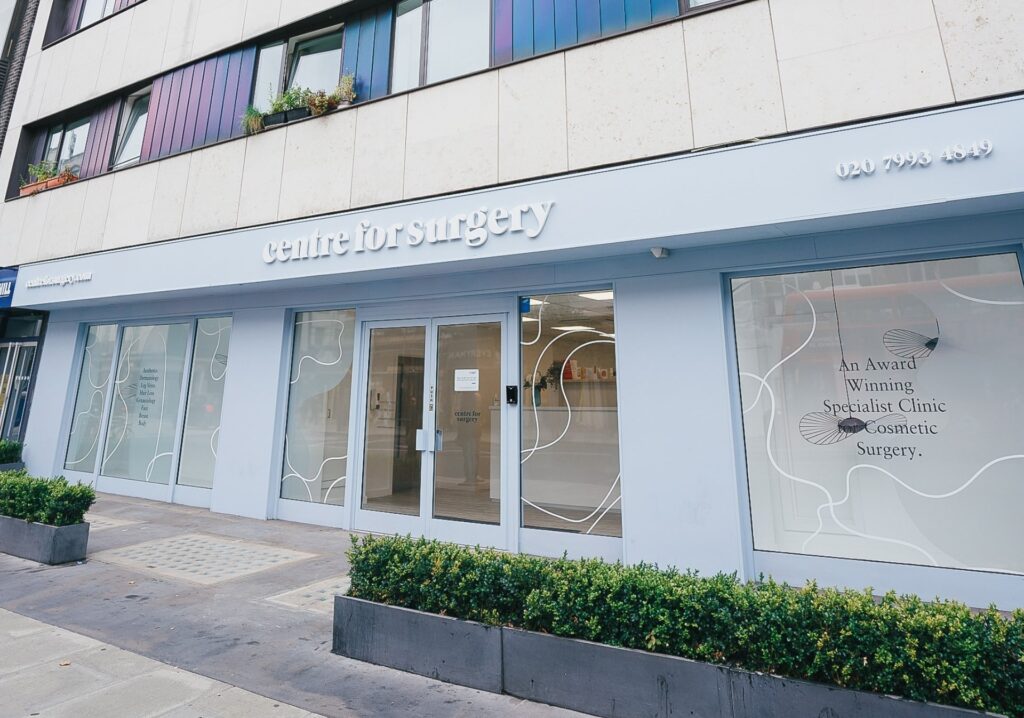
Centre for Surgery operates differently. Our purpose-built day surgery facility at 95-97 Baker Street, Marylebone is owned and run by us. Every member of staff — patient coordinators, pre-operative assessment nurses, theatre nurses, recovery nurses, healthcare assistants, surgeons — works under the same clinical governance framework, follows the same protocols, and is accountable through the same management structure. The advantages this produces:
- Consistent care across the pathway. The team that takes your consultation is part of the same team that performs your surgery and the same team that handles your follow-up.
- 24/7 nurse-led aftercare support. A direct phone line to our clinical team is available outside working hours. Calls are answered by senior nurses who know the surgical pathway, not by a generic call centre.
- Same-day assessment when complications arise. If you call with a concern, you can usually be seen the same day rather than redirected to A&E or asked to wait for a routine appointment.
- Transparent costing. We don’t pay surcharges to third-party hospitals or pass theatre booking fees to patients. The price quoted at consultation is the price you pay.
4. Sub-specialist surgical practice
Our surgeons do not operate as generalists who perform any aesthetic procedure on request. Each surgeon has a defined area of focus — facial work, breast surgery, body contouring, intimate surgery, gender affirmation — and performs procedures in that area at high volume. The surgeon who performs your rhinoplasty consultation and operation is a surgeon who performs rhinoplasties as a major component of their weekly practice, not occasionally as an add-on.
For complex procedures that benefit from multiple specialist skills — for example, a mummy makeover combining abdominoplasty, breast lift, and liposuction — two surgeons may operate together on the same patient under the same anaesthetic, each contributing their specialist expertise. This is unusual in private cosmetic surgery and unusually good for patient outcomes.
Our surgeons meet regularly as a clinical group to discuss complex cases, share learning from recent procedures, and review outcomes. This is the same multidisciplinary governance model used in NHS specialist practice, applied to private cosmetic work.
5. The consultation is the consultation — no salespeople
In many UK cosmetic clinics, the first appointment is not with a surgeon. It is with a “patient advisor” or “treatment coordinator” — a non-medical salesperson, often commissioned, whose role is to convert enquiries into bookings. The surgeon, if you meet one at all, may join briefly toward the end.
At Centre for Surgery, every consultation is with the consultant surgeon who will perform your operation. There are no patient advisors with sales targets, no commissioned coordinators, no “limited-time offers” presented to encourage a same-day deposit. The surgeon listens to your concerns, examines you, discusses what is realistic and what is not, and gives you written quotes and information to take away.
The two-week cooling-off period (a UK requirement we follow strictly) means no procedure can be booked at the consultation itself. You go home, think about it, ask any further questions, and decide on your own timeframe.
We turn away a significant proportion of consultation patients — for some procedures, between 25% and 40% — because they are not suitable candidates, their expectations are unrealistic, or surgery is not the right intervention for what they are actually trying to address. A clinic that operates on everyone who asks is not the clinic you want.
6. Established trust signals
The substantive credentials that matter when evaluating any UK cosmetic surgery provider:
- CQC Good rating across all five inspection categories — verifiable at cqc.org.uk.
- GMC specialist register for every operating surgeon — verifiable at gmc-uk.org.
- BAAPS membership for our consultant plastic surgeons. BAAPS — the British Association of Aesthetic Plastic Surgeons — is the UK’s specialist body for aesthetic plastic surgery and has the most rigorous membership criteria of any cosmetic surgery body in the country.
- £10 million indemnity insurance — the standard required for UK consultant practice.
- WhatClinic 2026 Patient Service Award — based on verified patient feedback.
- Genuine patient reviews on independent platforms (Trustpilot, Google, RealSelf), not curated testimonials on our own website.
7. Honest pricing and FCA-regulated finance
Cosmetic surgery is a significant financial commitment. Our consultation quotes are written, itemised, and include everything — surgeon’s fee, anaesthetist’s fee, theatre fee, implants where applicable, follow-up appointments, garments. There are no surprises at the deposit stage or on the day.
For patients who want to spread the cost, we partner with Chrysalis Finance — an FCA-regulated lender specifically working with the UK medical and aesthetic sector. Finance options include 0% APR over up to 12 months for eligible patients, and longer-term plans at competitive interest rates. We do not pressure patients to take finance, and we never present finance as an incentive to book sooner. Details at our finance options page.
Patients sometimes ask why we don’t price-match cheaper alternatives, particularly Turkish clinics or UK operators with aggressive discount marketing. The answer is straightforward: our costs reflect surgeon expertise, owned facility, full UK clinical governance, and proper aftercare. A clinic offering the same procedure at half the price has reduced one or more of these inputs. The savings often appear later as complications, revision surgery, or both. See the dangers of cosmetic surgery tourism for what the published outcome data shows.
8. Equipment and consumables held to surgical standards
The equipment used during your procedure has a measurable effect on outcomes. Our operating theatres are equipped to the same standards as a modern NHS surgical unit, with single-use instruments where appropriate, modern anaesthetic monitoring, and full resuscitation capacity. Our infection prevention protocols are reviewed continually against current best practice.
For energy-based devices and lasers — used in skin tightening, scar revision, pigmentation treatment, and laser fat reduction — we use current-generation equipment from established medical device manufacturers. We do not buy refurbished lasers or low-cost imports, and we do not invest in new device categories until the clinical evidence supports them. No surgeon at Centre for Surgery has a financial interest in any specific device or product line, so recommendations are based on clinical fit, not commercial relationship.
9. Revision surgery expertise
An increasing portion of our caseload is revision work — patients who had a previous procedure elsewhere (often abroad, often in Turkey or Eastern Europe) and now require correction. The procedures we are most often asked to revise include rhinoplasty (poor functional or aesthetic outcomes from primary surgery), breast augmentation (capsular contracture, malposition, rupture, asymmetric results), abdominoplasty (poor scar placement, residual contour issues), and BBL (residual fat needing correction, contour irregularities, asymmetry).
Revision surgery is significantly more technically demanding than primary surgery, and many surgeons decline to undertake it. Our surgeons take on these cases routinely because the skill base exists in our team. If you have had previous surgery elsewhere and are unhappy with the result, an honest consultation can establish what is achievable through revision and what is not. Some results cannot be improved; the consultation will tell you that as well, if it is the case.
10. Safety culture and the willingness to say no
The single strongest predictor of cosmetic surgery complications is the willingness of the clinic to operate on patients who should not have surgery. Smoking patients, patients with BMI above the procedure-specific threshold, patients with poorly controlled medical conditions, patients with signs of body dysmorphic disorder, patients with unrealistic expectations, patients on the wrong medications — these are the patients with the worst outcomes, and the clinics with the highest complication rates are usually the clinics most willing to operate on them.
We say no a lot. Sometimes to entire procedures (we decline to perform some operations that are offered commonly elsewhere because we are not satisfied with the evidence base). More often to specific patients at specific times — patients who need to stop smoking first, lose weight first, address mental health concerns first, or wait until a developing situation has stabilised. The conversation can be disappointing in the moment. It is the conversation that protects your long-term outcome.
Our safety culture extends beyond patient selection to operational practice: scheduled procedures get the full time they need, surgeons never operate when not at their best, all critical decisions involve more than one clinician, and complications are reviewed systematically as learning opportunities rather than concealed. The CQC rated us as Outstanding for the quality of our post-operative care — the highest rating available, achieved by a small minority of UK providers.
Booking a consultation
If you are considering cosmetic surgery and want to discuss your options with a consultant plastic surgeon, the next step is an in-person consultation at our Baker Street clinic. We will discuss what you want to achieve, examine you, give you honest advice about what is realistic, and provide a written quote you can take away. There is no obligation to proceed, and no pressure to book on the day.
Call 0207 993 4849 or use the contact form to arrange a consultation.
Related reading
- What does a CQC Good rating mean for cosmetic surgery patients?
- Choosing your plastic surgeon
- 10 questions to ask your surgeon
Centre for Surgery · CQC-regulated · GMC specialist-registered surgeons · 95–97 Baker Street, Marylebone, London W1U 6RN · 0207 993 4849 · Book a consultation · Finance from 0% APR