One of the most reassuring things about lipoma removal is how quickly most patients recover. It is not major surgery — for the vast majority of patients it is a straightforward day-case procedure under local anaesthetic, and the disruption to daily life is minimal. That said, understanding what the healing process actually looks like, week by week, helps patients prepare realistically and take the right steps to achieve the best possible outcome.
At Centre for Surgery in London, lipoma removal is performed by GMC-registered consultant plastic surgeons at our Baker Street clinic. Every excised specimen is sent for histological analysis as standard. In this guide, we walk through the lipoma removal recovery timeline in detail — from the day of surgery through to full healing.
How Is a Lipoma Removed?
Before discussing recovery, it is worth briefly clarifying how lipoma removal is performed — because the technique used directly influences how long recovery takes and what the healing process looks like.
Surgical Excision
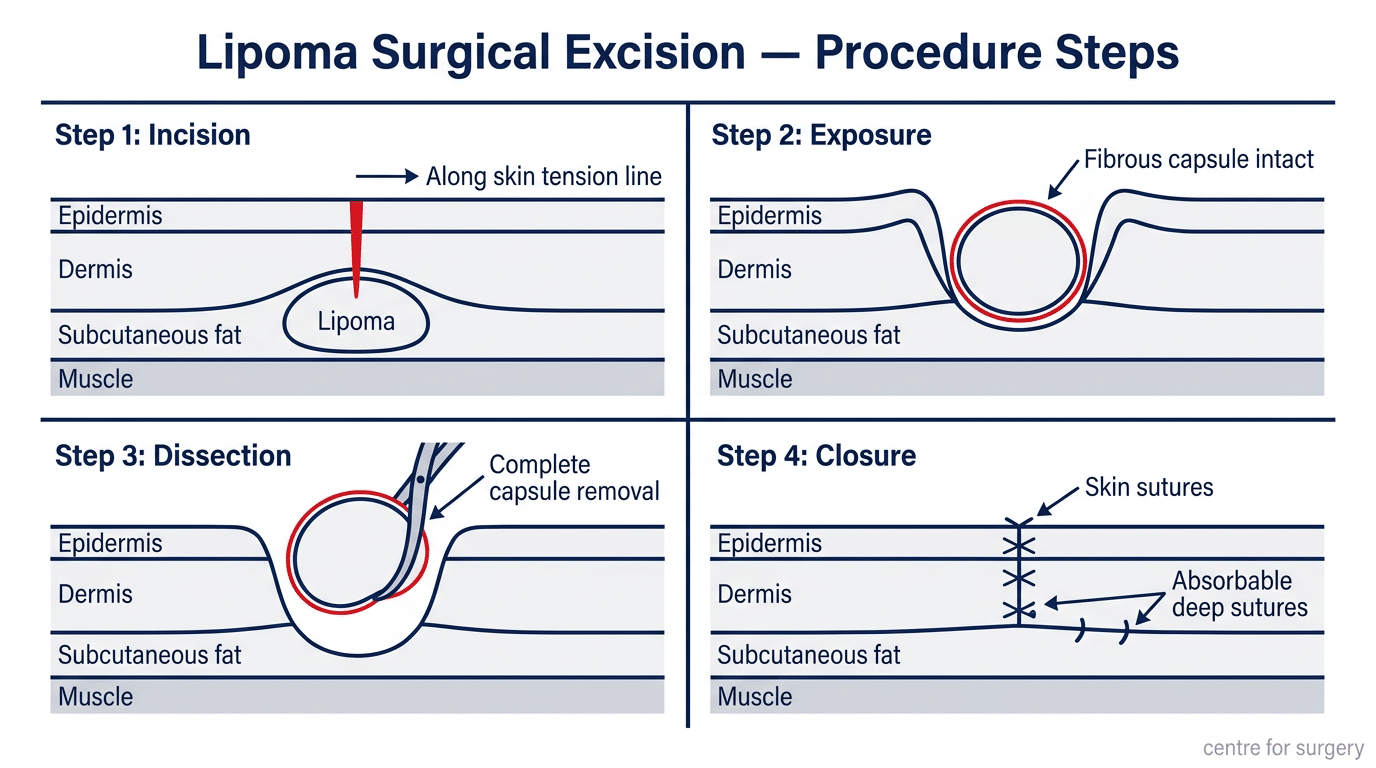
The most common approach is surgical excision under local anaesthetic. A small incision is made over the lipoma, the fatty lump is dissected free from the surrounding tissue in its entirety including the fibrous capsule, and the wound is closed in layers with sutures. Complete capsule removal is important — leaving any capsule behind is the primary reason lipomas recur. The incision length is typically planned along natural skin tension lines to minimise the final scar. For more detail on this technique, see our post on whether lipoma removal leaves a scar.
Liposuction-Assisted Removal
For softer or larger lipomas, liposuction through a small puncture wound can reduce the volume of the lump with a smaller incision. This approach leaves a less visible scar but carries a higher recurrence rate than formal excision because capsule remnants may be left behind. The choice between these techniques is discussed at consultation and depends on the size, consistency, and location of the lipoma. As covered in our post on whether lipomas come back after removal, complete excision remains the gold standard for preventing recurrence.
The Lipoma Removal Recovery Timeline
Day of Surgery
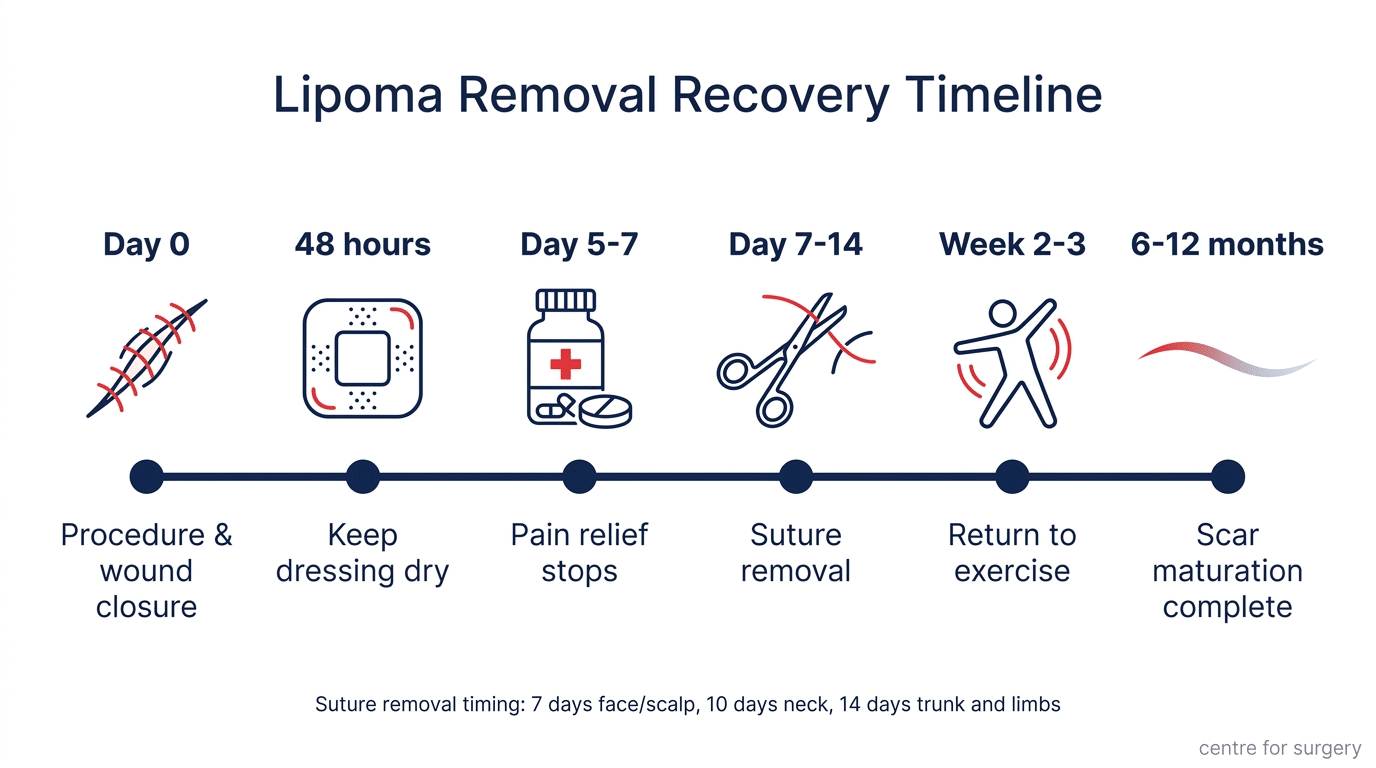
Lipoma removal is performed as a day case. You will be seen, have your procedure under local anaesthetic, and go home the same day — typically within one to two hours of arrival at the clinic. The local anaesthetic injection is the most uncomfortable part of the entire procedure; the removal itself is painless. The wound will be dressed before you leave, and you will be given written aftercare instructions to follow at home. You can drive yourself home if the procedure was under local anaesthetic alone, though having someone with you is always sensible.
The area will feel numb for several hours after the procedure as the local anaesthetic wears off. This is normal. Mild to moderate soreness typically begins two to four hours post-procedure as sensation returns. Over-the-counter paracetamol is usually sufficient to manage this.
Days 1–3
The first few days are the most tender. Expect mild to moderate soreness, some swelling, and potentially some bruising around the wound site, particularly if the lipoma was large or deeply situated. This is entirely normal and part of the inflammatory phase of wound healing. The wound should be kept clean and dry during this period — avoid submerging it in water.
Most patients feel well enough to return to a desk-based job or light activities within one to two days. Physical work, exercise, or anything that places strain on the wound should be avoided. If the lipoma was on the upper back or shoulder, be mindful that arm movements can put tension on the healing incision.
Days 4–7
Swelling and bruising typically begin to resolve by the end of the first week. The wound itself will have sealed at the surface, though internal healing is still in its early stages. Sutures, where placed, are typically removed at seven to ten days for body locations — facial wounds are reviewed earlier, often at five to seven days, as the thinner facial skin heals faster.
At this stage most patients are back to normal daily activities including light work. The wound may feel firm, slightly raised, and itchy — this is a normal sign of active healing and collagen production rather than a sign of problems. Avoid picking at any crusting around the wound edges.
Weeks 2–3
By two to three weeks most patients feel essentially normal. The wound is healed at the surface, sutures have been removed, and daily life is fully resumed. Exercise can typically be reintroduced from around two to three weeks, beginning with low-impact activity and building up gradually. The wound site may still feel mildly firm or tender to deep pressure — this is normal and reflects the ongoing process of deeper tissue healing.
Scar management can begin once the wound surface has fully closed and no crusting remains — typically from around two to three weeks post-procedure. Silicone gel applied daily and gentle massage of the healed scar helps soften the collagen and improve the final scar appearance. Sun protection of the scar site is important from this point onwards.
Weeks 4–6
By four to six weeks the vast majority of patients have no meaningful symptoms. Strenuous exercise, contact sports, and heavy lifting are usually cleared at this stage. The scar will still be in its active remodelling phase — it may appear slightly pink, firm, or raised — but should be progressing in the right direction. Continuing daily silicone gel and SPF protection throughout this period supports the best possible scar outcome.
Months 2–6
The scar continues to mature and fade progressively during this period. Most lipoma removal scars on the body are significantly less noticeable by three to four months and continue to improve for up to six to twelve months. Facial and neck scars, where the skin heals with excellent blood supply, often fade faster. Body scars — particularly on the back, shoulders, and upper arms — may take longer, as these areas are subject to more movement and skin tension during healing.
By six months, the scar is typically well settled and the surgical result is fully visible. Any residual firmness or discomfort at this stage should be reviewed at your follow-up appointment.
Does Recovery Differ Between Excision and Liposuction?
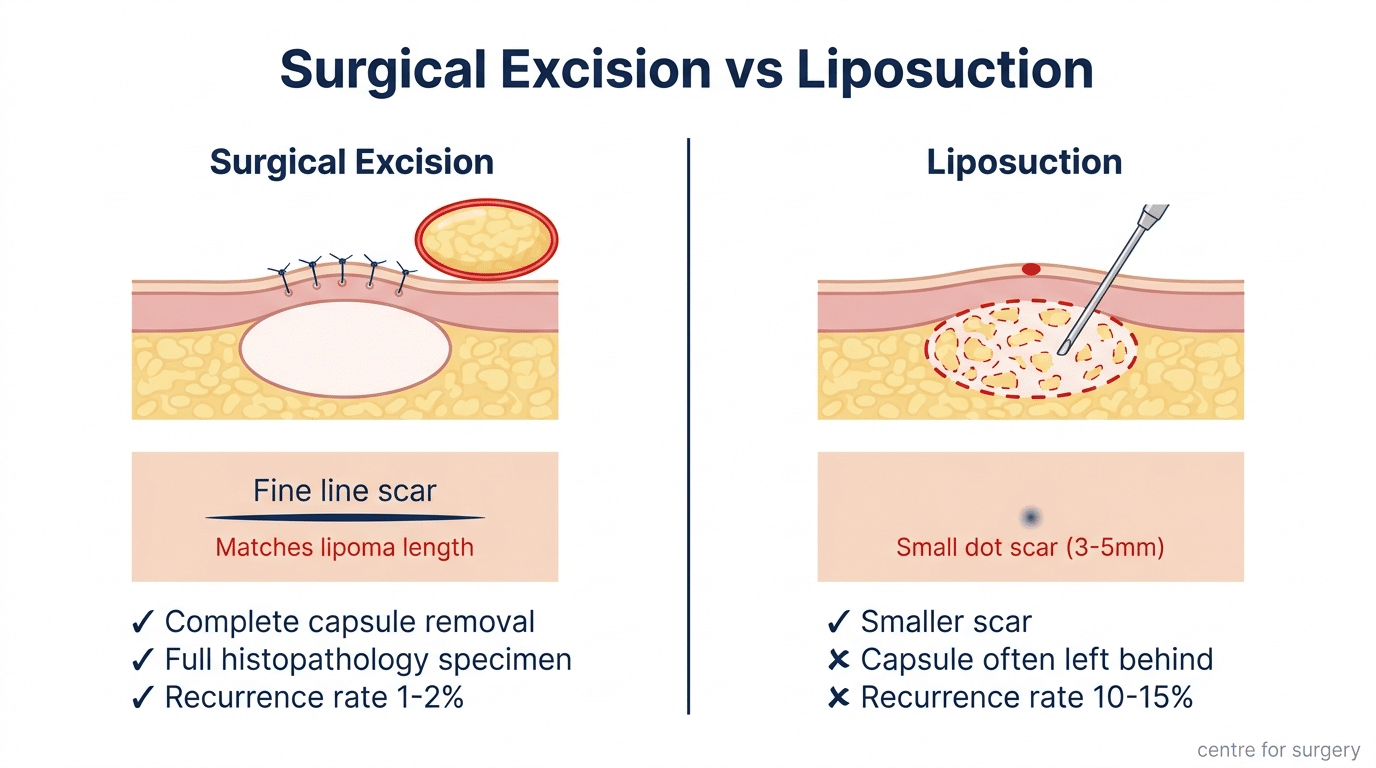
Yes — the liposuction approach generally involves a quicker, less tender recovery. Because the incision is only a small puncture wound of three to five millimetres, there is less wound to heal, less initial soreness, and a smaller scar. Patients who undergo liposuction-assisted lipoma removal typically return to normal activities within 1 to 2 days and experience minimal discomfort.
Surgical excision involves a longer incision — typically approximately half the diameter of the lipoma — and a correspondingly slightly more involved initial recovery. However the difference is modest, and most patients managed with excision are still back to daily activities within two to three days. The trade-off is a more complete removal and a significantly lower recurrence rate, which is why excision remains the preferred technique for most lipomas. See our dedicated post comparing the two approaches via our post on lipoma removal scarring for a fuller comparison.
Factors That Affect Recovery Speed
Lipoma Size and Location
Larger lipomas require a longer incision and more dissection, producing proportionally more initial swelling and tenderness. Location also matters — lipomas over areas of movement such as the shoulder, upper arm, or back are subject to more mechanical tension during healing, which can slow the initial recovery slightly and influence the final scar quality.
Number of Lipomas Treated
It is entirely possible to remove several lipomas in a single session, as described in our post on same-day lipoma removal. When multiple lipomas are excised in one procedure, the recovery involves managing several wound sites simultaneously, which can make the first week slightly more demanding. The overall timeline is not significantly extended, however, and removing multiple lipomas in one session avoids the need for multiple separate recoveries.
Wound Care Compliance
Following the aftercare instructions provided by your surgical team has a real impact on both healing speed and final scar quality. Keeping the wound clean and dry in the first days, attending suture removal at the correct time, beginning scar management at the appropriate stage, and protecting the scar from UV exposure all contribute meaningfully to the final outcome.
Skin Type and Individual Healing
Patients with a personal or family history of keloid or hypertrophic scarring should inform their surgeon before lipoma removal so that appropriate steps can be incorporated into the surgical plan. Early silicone therapy and close follow-up are particularly important in these patients. As discussed in our post on lipoma vs cyst differences, the location of the lipoma also influences the healing environment.
When to Contact the Clinic
Most lipoma removal wounds heal without any problems. However, you should contact Centre for Surgery promptly if you notice increasing rather than decreasing redness or swelling after the first three days, any discharge or opening of the wound edges, fever, or increasing rather than resolving pain. These can indicate a wound infection, which is uncommon but should be assessed and treated early if present.
Any new firm lump developing at the site of a previous lipoma removal should also be reviewed — though as covered in our dedicated post on whether lipomas come back after removal, true recurrence following complete excision is uncommon.
Frequently Asked Questions
How long does lipoma removal recovery take?
Most patients are back to normal daily activities within one to three days. Strenuous exercise is typically resumed at two to three weeks. The wound heals fully at the surface within one to two weeks, and the scar continues to mature for up to six to twelve months.
When are sutures removed after lipoma removal?
Facial and neck sutures are typically removed at five to seven days. Body sutures are usually removed at seven to ten days depending on the location and wound tension. Your surgeon will advise on the specific timing for your wound at the time of surgery.
Can I go to work the next day after lipoma removal?
For desk-based or sedentary work, most patients return the day after surgery or within two days. Physical work that involves lifting, manual activity, or pressure on the wound site should be avoided for two to three weeks.
When can I exercise after lipoma removal?
Light activity such as walking can be resumed within a few days. More demanding exercise including gym work, running, and upper body training is typically cleared at two to three weeks, once the wound has healed sufficiently that movement is not placing tension on the incision.
Is lipoma removal painful to recover from?
Recovery is generally very well tolerated. Most patients describe the first two to three days as mildly uncomfortable rather than painful, and manage well with paracetamol alone. The procedure itself is painless under local anaesthetic.
How long will the scar take to fade?
Most lipoma removal scars show significant improvement by three to four months and reach their final appearance at six to twelve months. Consistent use of silicone gel and daily SPF throughout the maturation period produces the best outcome. Our detailed guide on how long removal scars take to fade covers the broader scar maturation process in full.
Lipoma Removal at Centre for Surgery
Centre for Surgery performs lipoma removal at our CQC-regulated Baker Street clinic in central London. All procedures are performed by GMC-registered consultant plastic surgeons under local anaesthetic as day-case procedures. Every excised specimen is sent for histological analysis as standard, providing patients with a confirmed benign diagnosis following their procedure.
For patients with multiple lipomas, same-day removal of several lipomas in a single session is available — see our post on same-day lipoma removal for details. Finance options including 0% APR are available through our partner Chrysalis Finance — visit our Finance Options page for details.
Phone: 0207 993 4849 | Email: contact@centreforsurgery.com | Address: 95-97 Baker Street, London W1U 6RN
[contact-form-7 id=”256″ title=”Treatments form”]