

Patients researching buttock enhancement surgery quickly encounter two distinct procedures: the Brazilian Butt Lift (BBL) and the Buttock Lift. Both improve the appearance of the buttocks, but they work in fundamentally different ways, address different concerns, and suit different patients. Understanding the distinction between them — and knowing which one applies to your situation — is the most important step in planning effective buttock surgery.
At Centre for Surgery in London, we perform both procedures at our CQC-regulated Baker Street clinic. In this guide, we explain exactly what each operation involves, what problems each one solves, how they differ in terms of technique, recovery, and results, and — most importantly — which one is right for you.
What Is a Brazilian Butt Lift?
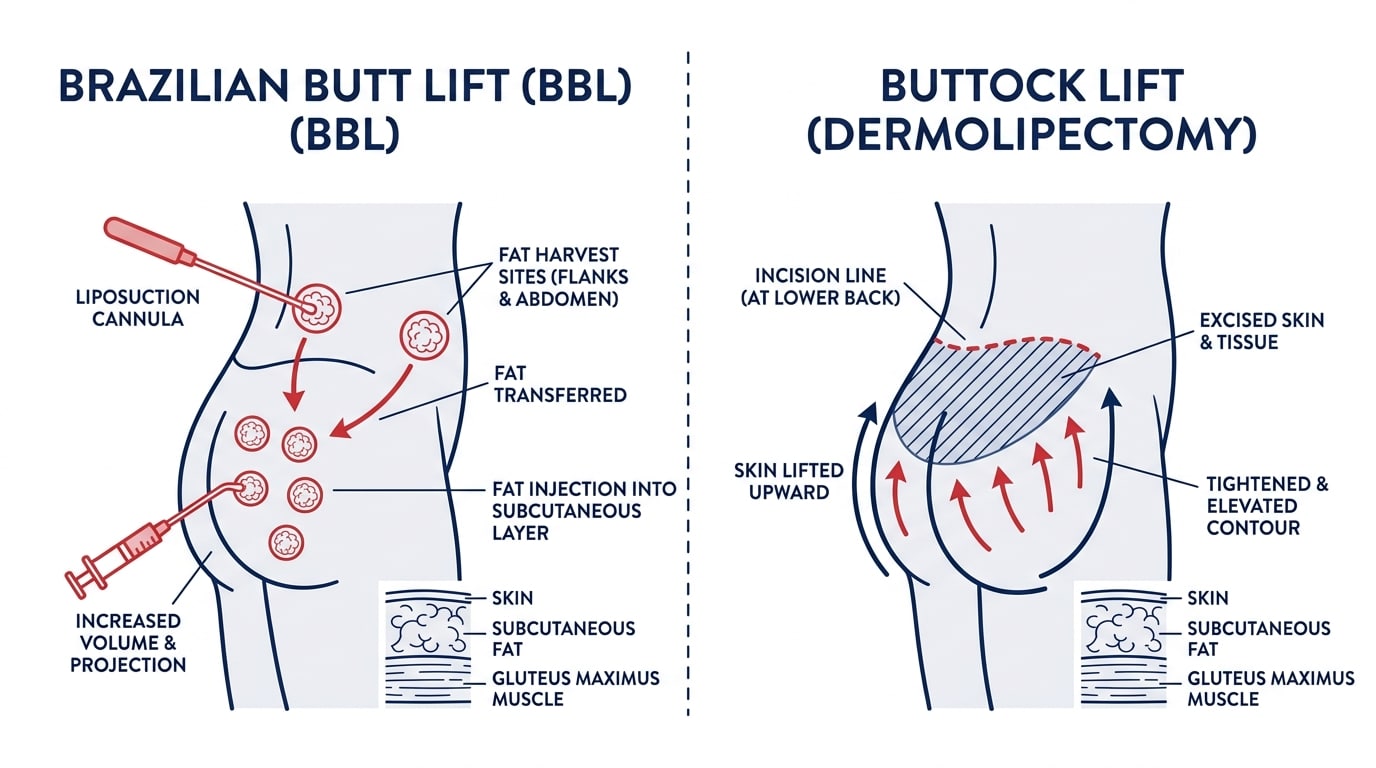
A Brazilian Butt Lift is a fat transfer procedure. It does not involve any incisions in the buttock itself. Instead, fat is harvested by liposuction from donor areas — typically the abdomen, flanks, lower back, and thighs — purified, and injected into the buttocks in carefully planned layers to increase volume, improve projection, and reshape the contour.
The BBL achieves two goals simultaneously: it slims the donor areas through liposuction and adds volume and shape to the buttocks through fat grafting. The result, when well executed, is a more defined waist, fuller buttocks, and an enhanced hourglass silhouette. Because the transferred fat is your own tissue, it integrates naturally and, once established, behaves like any other fat in your body.
At Centre for Surgery, all BBL procedures are performed using the ultrasound-guided technique — the safest approach currently available, ensuring fat is placed exclusively in the subcutaneous plane and significantly reducing procedural risk. This technique was adopted following updated BAAPS guidelines on gluteal fat grafting and represents the current gold standard for safe BBL surgery.
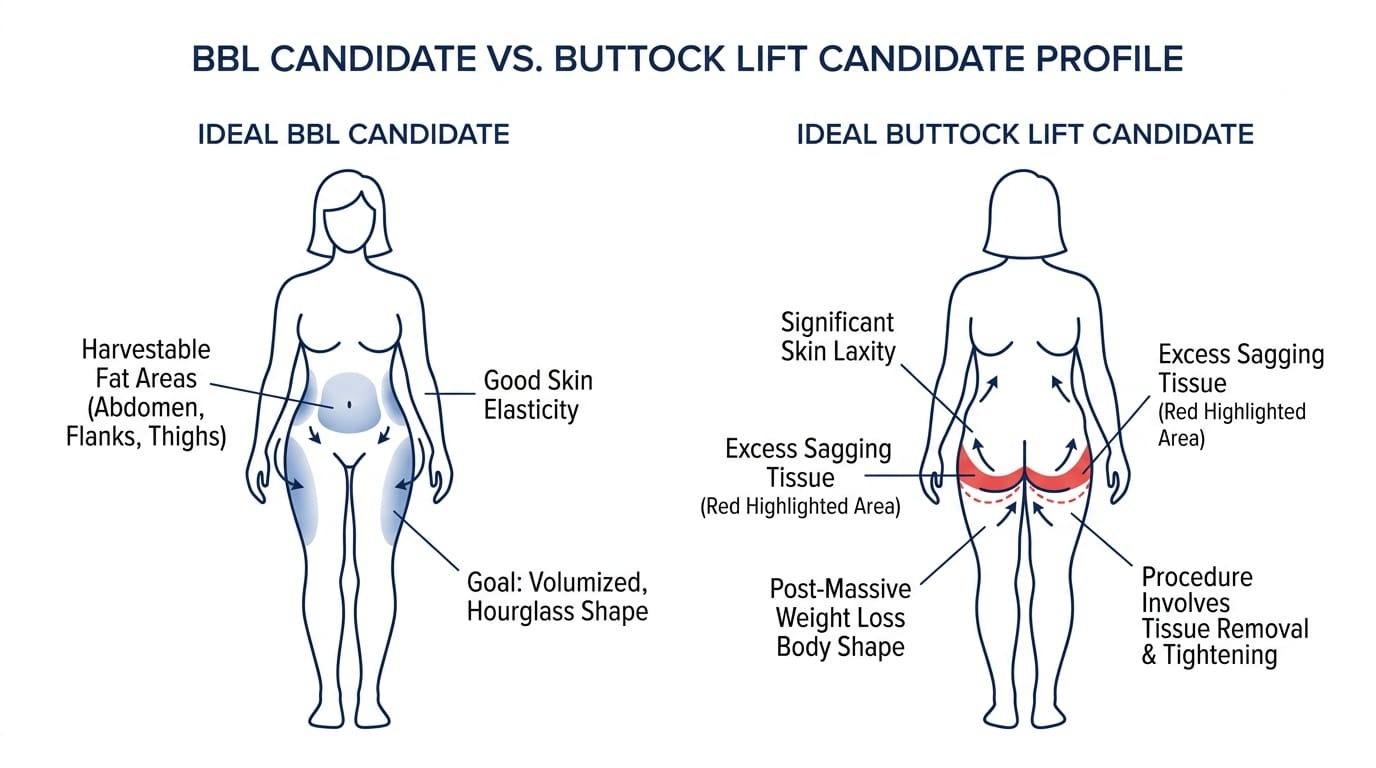
The BBL is best suited to patients who have sufficient donor fat available, good skin tone and elasticity in the buttock area, and whose primary concern is adding volume and reshaping the buttock contour rather than correcting skin laxity or ptosis. As explored in our post on the pros and cons of BBL surgery, results are long-lasting provided weight remains stable — and our detailed post on how long BBL results last explains what influences their durability.
What Is a Buttock Lift?
A Buttock Lift — also called a gluteal lift — is a surgical procedure that removes excess, sagging skin from the lower back and upper buttock area, tightening and lifting the tissues to create a firmer, more elevated appearance. Unlike a BBL, a buttock lift does not add volume — it corrects drooping and skin laxity.
The procedure involves an incision placed strategically along the lower back, typically concealed within the natural bikini line. Excess skin and underlying tissue are excised, and the remaining skin is lifted and secured to create a higher, tighter buttock profile. The incision length and position depend on the degree of ptosis and the specific areas being addressed.
A buttock lift is most appropriate for patients who have experienced significant skin laxity — most commonly following major weight loss, whether through bariatric surgery, lifestyle changes, or other means. It is also used to address age-related ptosis where gravity has caused the buttock tissue to descend and lose its youthful contour. The causes of a sagging buttock — and the range of solutions available — are discussed in detail in our post on sagging butt causes and solutions.
The Key Differences — Side by Side
What Each Procedure Addresses
This is the most fundamental distinction. A BBL addresses volume deficiency — buttocks that are flat, small, or lacking projection. A buttock lift addresses skin laxity and ptosis — buttocks that sag, droop, or have excess hanging skin. These are different problems requiring different solutions, and confusing the two is one of the most common mistakes patients make when researching buttock surgery.
A BBL will not lift a genuinely ptotic buttock. Adding volume to a sagging buttock without removing the excess skin can make the droop more pronounced rather than correcting it. Conversely, a buttock lift will not add volume or reshape a flat buttock — it tightens what is there but cannot create fullness where none exists.
Incisions and Scarring
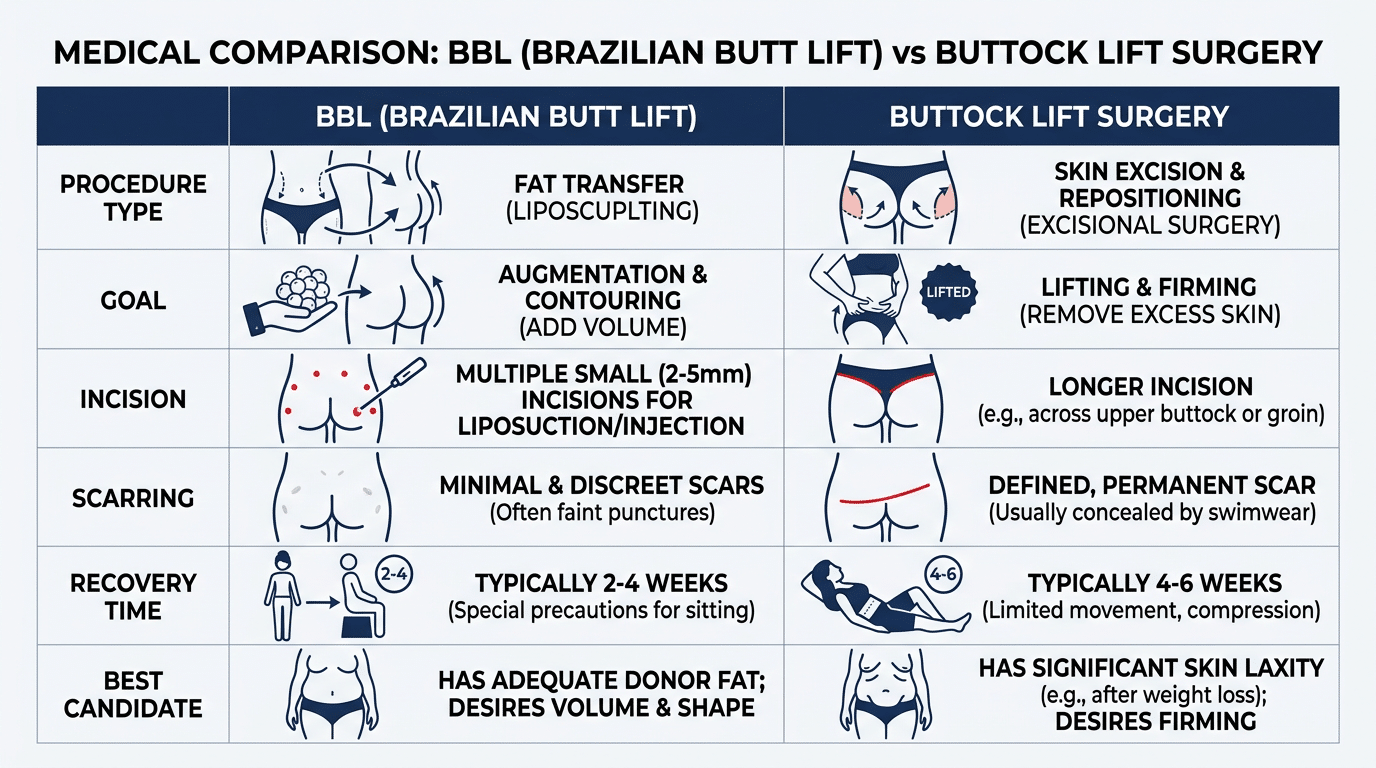
A BBL requires only small puncture incisions for the liposuction cannulas and fat injection cannulas — typically three to five millimetres in size, placed in inconspicuous locations. These heal to barely visible marks in most patients, making the BBL essentially a low-scar procedure. As detailed in our post on whether a BBL leaves scars, the scarring profile is minimal compared to most other body contouring procedures.
A buttock lift, by contrast, requires a longer incision — the length depends on how much skin is being removed, but it commonly spans the width of the lower back. This incision is placed carefully to fall within the bikini line and is usually well-concealed, but it does result in a scar that requires proper management to optimise its final appearance.
The Role of Body Fat
A BBL requires donor fat. Patients who are very slim — with a low body fat percentage — may not have sufficient fat available for transfer, which limits the achievable volume increase. In some cases, patients are advised to gain a small amount of weight before surgery to increase the available donor supply. Our post on what happens if you don’t have enough fat for a BBL covers this in detail.
A buttock lift has no such requirement. It removes tissue — it does not require donor fat. It is therefore available to patients across the full range of body compositions, including those who are slim and would not be suitable for a BBL.
Recovery Differences
BBL recovery has one distinctive feature that sets it apart from most other procedures: patients must avoid sitting directly on the buttocks for a minimum of two weeks following surgery to protect the transferred fat cells while they establish their blood supply. This means sleeping on the front, standing to eat, and using a BBL pillow for any unavoidable sitting during the recovery period. Full recovery and return to strenuous activity typically takes six to eight weeks.
Buttock lift recovery does not carry the same sitting restriction, but involves a longer initial healing period due to the nature of the incision and tissue work. Most patients require two to four weeks before returning to daily activities, with full recovery over three months. Both procedures involve the use of a compression garment during recovery.
Combining BBL and Buttock Lift
For some patients — particularly those who have lost a significant amount of weight — the ideal solution is actually a combination of both procedures. This is because major weight loss can leave buttocks that are simultaneously deflated and ptotic: they have lost volume and they sag. A buttock lift alone would address the sagging but leave the buttocks flat; a BBL alone would add volume but not correct the droop. Combining both in a single operation — or staging them — allows surgeons to address both problems and produce a genuinely comprehensive result.
This combined approach is discussed in the context of post-weight-loss body contouring in our guide to getting rid of saggy buttocks. Whether to combine in a single session or stage the procedures depends on the patient’s health, the complexity of the planned surgery, and the surgeon’s assessment of what can safely be achieved at one time.
Which Procedure Is Right for You?
Choose a BBL If:
Your primary concern is volume — you want larger, fuller, more projected buttocks. Your skin tone is good and there is no significant ptosis. You have sufficient donor fat available for transfer. You want to simultaneously slim your waist and flanks through the liposuction component. You are prepared to follow the specific post-operative sitting restrictions. You understand that results depend on fat survival rates and weight stability — as covered in our post on why some BBLs fail or lose volume.
Choose a Buttock Lift If:
Your primary concern is sagging, drooping, or excess skin — you want the buttocks lifted and tightened rather than enlarged. You have experienced significant weight loss that has left loose, hanging skin. You have age-related ptosis that exercise cannot correct. You are slim and lack sufficient donor fat for a BBL. You are prepared to accept a scar along the lower back in exchange for the lifting effect.
Consider Both If:
You have lost a large amount of weight and your buttocks are simultaneously flat and sagging. You want both lift and volume. Your surgeon confirms you are a suitable candidate for a combined approach. Our post on what happens to BBL results after pregnancy touches on related considerations for patients whose body shape has changed significantly due to major life events.
At a Glance — BBL vs Buttock Lift
Non-Surgical Alternatives
For patients who are not ready for surgery or who have mild concerns, non-surgical options are available. The non-surgical butt lift using HYAcorp dermal fillers can provide modest volume enhancement and contour improvement without surgery, anaesthetic, or downtime. Results are temporary — typically lasting twelve to eighteen months — making this approach best suited to patients with mild concerns or those who want to assess the effect of volume enhancement before committing to surgery. Our post on non-surgical buttock lift vs BBL surgery compares these options in detail.
Safety Considerations
Both procedures carry risks that should be discussed openly at consultation. The BBL historically carried a higher mortality risk than other cosmetic procedures due to the risk of fat embolism when fat was inadvertently injected into the gluteal vasculature. The adoption of the ultrasound-guided technique — which ensures subcutaneous placement only — has significantly reduced this risk. Our dedicated posts on whether a BBL is dangerous and whether the Brazilian Butt Lift is safe cover this in detail. Patients should always ensure their surgeon uses ultrasound guidance and can demonstrate training and experience with this technique.
Buttock lift surgery carries risks common to all body contouring procedures including wound healing complications, infection, and scarring. Choosing an experienced GMC-registered consultant plastic surgeon operating in a CQC-regulated facility significantly reduces these risks.
Frequently Asked Questions
Can I have both a BBL and a buttock lift?
Yes — for patients with both volume loss and skin ptosis, combining or staging both procedures is often the most comprehensive solution. Your surgeon will assess whether a combined single-session approach is appropriate for your specific situation and anatomy.
Does a BBL lift the buttocks?
A BBL can create the appearance of lift by adding volume to the upper pole of the buttock, which pushes the tissue upward and improves projection. However, it does not physically remove or tighten skin. Where genuine ptosis exists — sagging caused by excess skin — a BBL alone will not correct it.
Does a buttock lift add volume?
No. A buttock lift removes and tightens skin and underlying tissue but does not add volume. Patients who want both lift and enhanced size typically need a combined procedure.
What is the recovery difference between BBL and buttock lift?
The BBL requires strict avoidance of sitting for two weeks but generally has a lighter tissue recovery than a buttock lift. The buttock lift involves a more significant incision and typically a longer initial recovery of two to four weeks, without the sitting restriction.
Can a skinny person have a BBL?
It depends on the amount of donor fat available. Very slim patients may not have sufficient fat for transfer, limiting what can be achieved. Our dedicated post on what happens if you don’t have enough fat for a BBL covers the options for slim patients in detail.
What is the difference between a BBL and implants?
A BBL uses your own fat; implants use silicone prostheses inserted into the buttock. Our post on BBL vs butt implants compares these two approaches in full.
BBL and Buttock Lift at Centre for Surgery
Centre for Surgery performs both BBL surgery and buttock lift surgery at our CQC-regulated Baker Street clinic in central London. All BBL procedures use the ultrasound-guided technique as standard. Our GMC-registered consultant plastic surgeons take an anatomy-first approach to procedure selection — recommending the right operation for your specific concerns rather than defaulting to the most popular option.
Finance options including 0% APR are available through our partner Chrysalis Finance — visit our Finance Options page for details.
Phone: 0207 993 4849 | Email: contact@centreforsurgery.com | Address: 95-97 Baker Street, London W1U 6RN
[contact-form-7 id=”256″ title=”Treatments form”]