What is the definition of HD Liposuction, and what’s the difference between this and standard liposuction?
Liposuction is a technique plastic surgeons use to remove excess fat from the body. To understand the difference between traditional and high-definition liposuction, it is essential to know the distribution of fat in the human body.
Fat tissue, also called the adipose tissue, is located in 2 main places:
- Visceral fat: this is stored around the internal organs of the body, such as the intestine, liver, stomach and others.
- The external fat is found outside of the body between the muscle linings and the skin.
Only the external fat, not the visceral fat, can be removed by liposuction.
The external fat spreads in 2 levels separated by a thin layer called fascia:
- The superficial fat, subcutaneous fat, is a thin layer of fat immediately under the skin and above the fascia. This has a uniform thickness of about 1-2cm and provides padding to the skin.
- The deep external fat sits deeper under the fascia and directly over the muscle. This forms distinctive lumps and bumps, known as fat pads, all over the body, which make a major contribution to body shape and figure. They vary widely in thickness and volume among individuals and anatomical areas, giving rise to different body shapes and figures. These fat pads include love handles and lower flanks (also known as Muffin Tops), gluteal fat, and abdominal fat.
The standard definition of liposuction is that it removes the deep fat beneath the fascia while preserving all subcutaneous fat. This technique is the most commonly used and achieves basic general body contouring or reshaping.
High-definition liposuction is a modern, advanced procedure that removes deep fat and targeted subcutaneous areas to achieve sharper definition and enhance the contour of the underlying muscle.
What areas are most commonly treated?
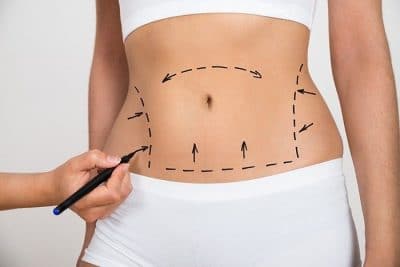
- Lower abdomen (lower abs and V)
- Whole abdomen (six packs, full abs, serratus anterior)
- 360 abdomen and back (flanks, latissimus dorsi, gluteal, full abs, six packs, serratus anterior)
- Chest (pecs)
- Arms, deltoids
- Calfs
What are the advantages and disadvantages of HD-LS?
The main advantage of high-definition liposuction is achieving enhanced muscle shape and significantly sharper definition compared to standard liposuction.
However, there are several limitations to this technique, such as:
- It is more invasive (traumatic), therefore needs a deeper anaesthetic, is more painful to recover from, and has longer downtime
- It can be more expensive than standard liposuction because it is more complex, requires a longer operation, and requires a plastic surgeon with specific training and experience in this technique.
- It can not be combined with skin tightening procedures such as a tummy tuck
Am I suitable for this procedure?
- Body weight: you shouldn’t be too slim or too heavy. The best outcome is achieved with those individuals with a body mass index (BMI) between 20 and 28
- You should be medically fit to undergo the anaesthetic and recover from the surgery, and should not be smoking.
How can I explore this further?
- Find a plastic surgeon with the specific skills and experience in performing this type of procedure and book a consultation.
- A trained, experienced plastic surgeon should be able to assess your aims and expectations and provide tailored, individualised advice on suitability and outcomes.