The erbium YAG laser sits at the heart of modern skin resurfacing — a single wavelength of light that can vaporise photo-aged surface cells, smooth acne scarring, lift superficial pigmentation and trigger collagen renewal in the dermis below. At Centre for Surgery, we use the Fotona SP Dynamis Pro Er:YAG platform for all laser skin resurfacing at our Baker Street private hospital. Compared with older CO₂ resurfacing, Er:YAG delivers comparable cosmetic results with substantially less thermal injury, faster healing and a markedly lower risk of pigmentary side effects.
This guide explains how the erbium laser works at a tissue level, where it sits relative to CO₂ and non-ablative alternatives, which conditions respond best, what recovery looks like, and how to decide whether you’re a good candidate.
What is the erbium YAG laser?
Erbium YAG (Er:YAG) is an ablative laser emitting light at a wavelength of 2,940 nanometres. Its defining property is extraordinarily high absorption by water — roughly 10–15 times stronger than the 10,600 nm CO₂ laser. Because human skin is mostly water, Er:YAG energy is absorbed almost instantly in the most superficial cell layers, vaporising them precisely without spreading heat into surrounding tissue.
That precision is the entire clinical advantage. CO₂ resurfacing achieves its results partly by bulk heating; the surrounding zone of thermal injury is what drives long recovery, persistent redness and a higher rate of post-inflammatory hyperpigmentation. Er:YAG removes the same damaged layers, stimulates the same collagen response, but does so with a thin rim of thermal effect that the skin tolerates and heals far better.
For a side-by-side patient-facing comparison of the two systems, see our guide on Erbium Laser vs CO₂ Laser resurfacing.
How erbium laser resurfacing works on the skin
Resurfacing relies on a controlled wound-healing response. The Er:YAG laser passes over the skin in pulses, each pulse vaporising a uniform depth of tissue — typically 10 to 50 microns at a time. The clinician chooses pulse energy, pulse duration and number of passes based on the depth and severity of what’s being treated.
Once the damaged surface is removed, two healing processes happen in parallel. Within days, fresh epidermis migrates in from sweat glands and hair follicles to re-cover the surface. Over the following weeks and months, the dermis below lays down new collagen — a process called neocollagenesis — which thickens and tightens the skin from underneath. The visible result is smoother texture, finer lines and tighter, more even skin.
Er:YAG can be used in two distinct modes:
- Fully ablative resurfacing — deeper passes across the whole face, used for significant photo-ageing, advanced lines and confluent acne scarring. Recovery is around 10 to 14 days.
- Fractional resurfacing — laser energy delivered in microscopic columns that leave bridges of intact skin between treated zones, accelerating healing. Recovery is typically 5 to 7 days. Used for scarring, moderate texture concerns and as a refresh between deeper treatments.
A third mode — Fotona’s proprietary SMOOTH® pulse — delivers thermal energy in a fully non-ablative manner, heating the dermis without disturbing the epidermal surface. This is the basis of SmoothEye eyelid tightening, Fotona 4D facial rejuvenation, and several intra-oral and intra-vaginal treatments.
What erbium laser treats well
Er:YAG is one of the most versatile lasers in dermatological aesthetics. The conditions it treats best fall into three groups: surface texture and ageing, pigmentary concerns, and superficial skin lesions.
Fine lines, wrinkles and skin texture
Static lines around the eyes, mouth and cheeks — those visible at rest, caused by accumulated UV damage and collagen depletion — respond well to fractional or fully ablative Er:YAG. Dynamic lines caused by muscle movement (frown lines, forehead lines, crow’s feet during smiling) are better treated with anti-wrinkle injections or dermal fillers, sometimes alongside resurfacing.
Sun damage and pigmentation
Solar lentigines (age spots), uneven skin tone and the rough surface of chronic photo-damage all clear well with erbium resurfacing. For diffuse pigmentation or melasma, our dedicated laser pigmentation treatment page covers tailored protocols. For the role of sun exposure in skin ageing more broadly, see our overview of the five signs of sun damage and how each can be addressed.
Acne scarring
Atrophic acne scars — ice pick, boxcar and rolling — are a flagship indication for fractional Er:YAG. The microcolumns of energy reach into the deep dermis where scar tissue sits, triggering collagen remodelling that gradually fills in pitted scars. Our acne scar removal service combines fractional Er:YAG with adjunctive techniques where appropriate.
Superficial skin lesions
Erbium laser is ideal for benign lesions sitting in the epidermis or upper dermis — seborrhoeic keratoses, actinic keratoses, skin tags, milia, syringomas, xanthelasma and warts. Each is vaporised layer by layer under local anaesthetic, typically in a single short appointment.
The five clinical advantages over CO₂
1. Optimal wavelength for skin ablation
The water absorption coefficient of skin peaks sharply between 2,500 and 3,500 nm. Er:YAG at 2,940 nm sits inside that peak; CO₂ at 10,600 nm does not. The result is that Er:YAG vaporises water-rich tissue rapidly and cleanly, with minimal energy left over to heat the surroundings.
2. Tunable treatment depth
By shortening pulse duration (down to around 100 microseconds), the clinician can deliver “cold” ablation with essentially no thermal damage — suitable for the gentlest skin refreshes, sometimes marketed as light peels. Lengthening pulse duration (up to 1,000 microseconds) builds in controlled thermal effect for deeper collagen tightening. CO₂’s wavelength gives no equivalent flexibility.
3. Less discomfort during treatment
Lower thermal effect translates directly into lower pain. Many small Er:YAG lesion treatments are tolerated under topical anaesthetic alone; CO₂ at equivalent depths typically requires more substantial local infiltration or oral sedation.
4. Lower risk of pigmentary side effects
Post-inflammatory hyperpigmentation (PIH) and hypopigmentation are driven primarily by thermal injury depth. Less heat means less PIH risk — particularly important for darker Fitzpatrick skin types (IV–VI), where CO₂ carries a clinically significant risk of long-lasting pigment change. Er:YAG is far safer in pigmented skin.
5. Faster recovery
Because the wound is shallower and the surrounding tissue less heat-damaged, re-epithelialisation happens faster. A full-face Er:YAG resurfacing typically heals in 7 to 14 days; an equivalent CO₂ treatment often takes 14 to 21 days, with redness persisting for months in some cases.
Erbium laser skin tightening with SMOOTH® mode
Beyond ablative resurfacing, the Fotona Er:YAG laser has a dedicated SMOOTH® pulse profile designed to deliver thermal energy without removing tissue. This non-ablative mode underpins several of our most popular treatments:
- Fotona 4D — four-step facial rejuvenation combining intraoral and external passes for non-surgical lifting
- SmoothEye — non-ablative eyelid tightening as an alternative to surgical blepharoplasty for mild to moderate skin laxity
- LipLase — non-surgical lip enhancement and definition
- TightSculpting — body skin tightening and fat reduction
- NightLase — laser snoring treatment
SMOOTH® treatments have essentially no downtime, are well tolerated without anaesthesia, and work best as a course of three to four sessions spaced several weeks apart. Results emerge gradually as new collagen forms over two to three months.
What happens during a treatment
Your visit begins with a consultation in which a clinician examines your skin, takes a medical history and explains which Er:YAG protocol fits your concerns. For full-face resurfacing, we’ll discuss preparation, recovery, realistic timelines and outcomes; for a localised lesion we may proceed the same day.
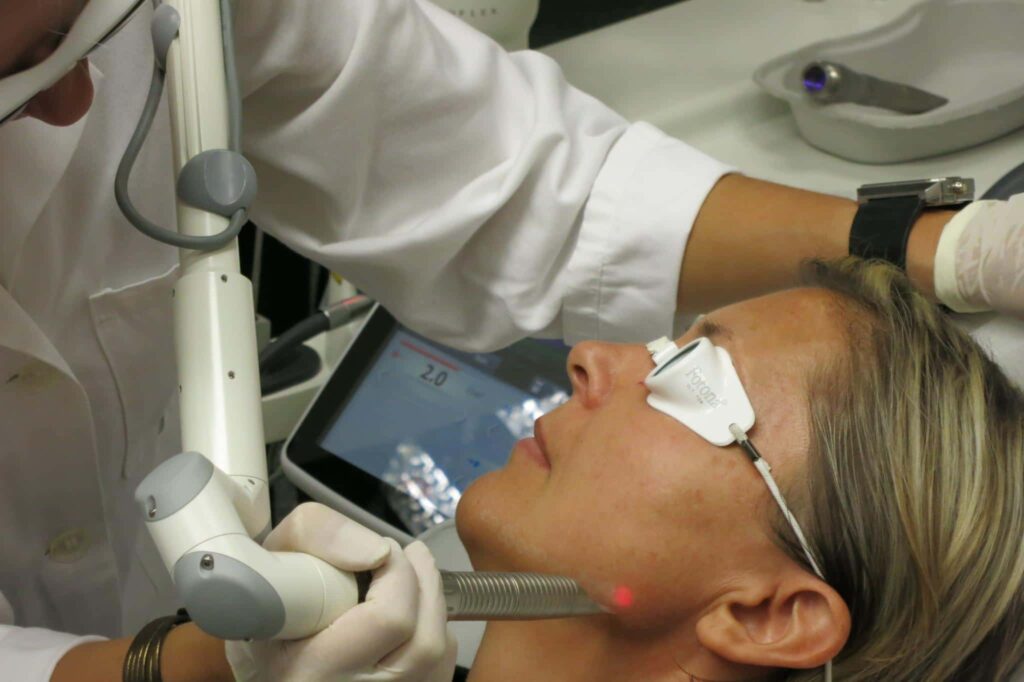
For resurfacing, topical anaesthetic is applied for around 30 to 45 minutes to numb the skin. Deeper protocols may add infiltrative local anaesthetic or oral sedation. Protective eye shields are worn throughout. The clinician passes the laser handpiece systematically over the treatment area, with each pass removing a defined layer of tissue. Total treatment time ranges from 30 minutes for a focal area to 90 minutes for full-face deeper resurfacing.
Immediately afterwards the skin feels warm and looks pink — comparable to a moderate sunburn. Cooling and an occlusive ointment are applied. You’ll go home the same day with detailed written aftercare instructions.
Recovery, aftercare and pain
Recovery depends on the depth of treatment. A typical timeline for fractional Er:YAG resurfacing:
- Days 1–3 — swelling and redness peak; the skin weeps slightly and crusts. Cool compresses and frequent occlusive ointment are essential.
- Days 4–7 — peeling and flaking as the old surface sheds. Resist the urge to pick.
- Days 7–10 — fresh pink skin emerges. Mineral SPF 50 becomes essential and continues for at least three months.
- Weeks 2–12 — residual pinkness fades. Collagen remodelling continues, with results refining over several months.
Pain during the healing window is mild and usually controlled with paracetamol. For more detail on the full healing arc, including weekly milestones and what to avoid, see how long it takes to heal after laser skin resurfacing. If you’re wondering about the procedure itself, our guide to whether laser skin resurfacing is painful covers what to expect during and after. Patients often ask when normal cosmetics can resume — typically around day 10 — and our dedicated guide on applying makeup after laser skin resurfacing covers this.
Who is a good candidate
The ideal candidate for ablative Er:YAG resurfacing:
- Has moderate to advanced photo-ageing, fine to moderate lines, acne scarring or sun-induced pigmentation
- Has Fitzpatrick skin types I–III for fully ablative protocols (Er:YAG remains safer than CO₂ for types IV–VI, but fractional protocols and careful patch testing are preferred)
- Can tolerate one to two weeks of social downtime
- Doesn’t smoke (smoking impairs healing and increases scarring risk)
- Has no active skin infection, recent isotretinoin use within six months, or history of keloid scarring
- Has realistic expectations and is prepared to follow aftercare and sun protection diligently
Patients with significant skin laxity or volume loss may benefit more from surgical options — facelift, blepharoplasty or Morpheus8 RF microneedling — sometimes combined with Er:YAG to address surface quality.
Combining erbium laser with other treatments
Er:YAG resurfacing is often paired with complementary modalities to deliver a more comprehensive result. Common combinations:
- Er:YAG + Morpheus8 — surface resurfacing plus deep RF skin tightening, typically staged a few weeks apart
- Er:YAG + anti-wrinkle injections — surface smoothing combined with dynamic line treatment
- Er:YAG + Profhilo or polynucleotide bio-stimulation — resurfacing plus deep hydration and collagen support
- Er:YAG + facelift — many patients have Er:YAG resurfacing once their facelift has fully settled to address skin quality that surgery alone doesn’t change
For a comparison with our other flagship non-surgical platform, see Fotona 4D vs Morpheus8.
What we don’t recommend
A few points where we differ from what’s often marketed:
- One-shot CO₂ resurfacing for darker skin — the pigmentation risk is real and often understated. We use Er:YAG instead, with patch testing, conservative settings and a longer course where needed.
- Chemical peels in place of laser for deeper concerns — peels can be unpredictable in penetration depth, with a higher rate of patchy pigmentation. For texture, scarring or fine lines, fractional Er:YAG is the more controllable tool.
- Resurfacing while on isotretinoin or within six months of finishing — the impaired healing response increases scarring risk significantly. We routinely defer treatment.
- “Hollywood Peel” marketing for clinical resurfacing — at very low settings Er:YAG can be used as a superficial refresh, but this is cosmetic polish, not a substitute for true resurfacing on lined or scarred skin. Expectations should match the protocol.
Frequently asked questions
How long do erbium laser results last?
Surface improvements from a single fully ablative treatment can last five years or more, with continued benefit from the underlying collagen renewal. The natural ageing process continues, so maintenance with non-ablative SMOOTH® treatments or repeat fractional sessions can extend results indefinitely.
Is erbium laser safe?
In experienced hands, on appropriate candidates, with proper preparation and aftercare, Er:YAG has an excellent safety profile. The main risks — pigmentation change, prolonged redness, infection, scarring — are uncommon and largely preventable.
How much does erbium laser resurfacing cost?
Pricing depends on the area treated, the depth of resurfacing required and whether single or multiple sessions are needed. Lesion removal starts at around £450 per session; full-face resurfacing ranges from £1,500 to £6,000 depending on protocol. A consultation gives you an exact quote. We offer finance from 0% APR through Chrysalis Finance.
Can erbium laser be used on the neck and chest?
Yes, but with caution. The neck and chest have fewer accessory skin structures than the face, which slows healing. We use conservative settings, often fractional rather than fully ablative, and may stage treatments over a longer course.
How does erbium compare to non-ablative lasers like the Erbium glass?
Non-ablative lasers (such as 1,550 nm Erbium glass) heat the dermis without removing the surface, giving minimal downtime but more gradual results — typically requiring three to four sessions. Ablative Er:YAG produces more dramatic change in a single treatment but requires real recovery. The choice depends on your tolerance for downtime versus desire for one-step transformation.
Why choose Centre for Surgery
We operate the Fotona SP Dynamis Pro at our purpose-built Baker Street private hospital — one of the most sophisticated Er:YAG platforms available. Our clinicians have extensive experience tailoring protocols to skin type, concern and downtime tolerance. Treatments are delivered in a CQC-regulated environment with the full safety infrastructure of a private hospital behind every session.
Centre for Surgery · CQC-regulated · GMC specialist-registered surgeons · 95–97 Baker Street, Marylebone, London W1U 6RN · 0207 993 4849 · Book a consultation · Finance from 0% APR