

Back pain after breast augmentation is one of the most commonly reported physical complaints among women with implants — yet it is also one of the most frequently dismissed or underexplored concerns in pre-operative consultations. The relationship between breast implants and back pain is real, it is clinically recognised, and it deserves a direct and honest answer rather than a vague reassurance that everything will be fine.
The short answer is yes — breast implants can cause back pain. But the fuller answer is more nuanced. Whether they will cause back pain in any individual patient depends on the size and weight of the implants chosen, the placement technique used, the patient’s pre-existing posture and musculoskeletal health, and a range of other factors that are entirely addressable at the consultation stage. At Centre for Surgery, implant selection is always guided by a thorough assessment of the patient’s individual anatomy, body frame, and lifestyle — because choosing the right implant size is as much about long-term physical comfort as it is about aesthetic outcome.
How Can Breast Implants Cause Back Pain?
To understand why breast implants can cause back pain, it helps to understand the mechanical effect of adding weight to the front of the chest. The spine is exquisitely sensitive to changes in load distribution. When significant weight is added to the anterior chest — whether from naturally large breasts, implants, or both — the body’s centre of gravity shifts forward. The muscles of the upper and lower back must work harder to compensate for this shift, and over time this increased muscular demand can translate into chronic discomfort in the upper back, lower back, shoulders, and neck.
This is precisely the mechanism that drives women with naturally large, heavy breasts to seek breast reduction surgery. The physical symptoms these women experience — back ache, neck strain, shoulder grooving from bra straps, skin irritation beneath the breast crease, and difficulty exercising — are well documented and widely recognised as legitimate medical indications for reduction. As detailed in our post on large heavy breasts and back pain, the weight of breast tissue has a direct and measurable impact on the musculoskeletal system.
Breast implants introduce exactly the same mechanical variable, scaled to the size and weight of the chosen implant. A pair of 300cc silicone implants adds approximately 600–700 grams to the anterior chest — the equivalent of carrying a standard bag of flour strapped to your chest for every waking hour. For many women this is entirely well-tolerated, and no back pain ever develops. For others — particularly those with a smaller frame, narrower shoulders, weaker core musculature, or a pre-existing tendency to postural imbalance — it is the tipping point into persistent back and shoulder discomfort.
The Role of Implant Size and Weight
Not all implants are equal in their impact on the back. The relationship is broadly proportional — larger, heavier implants place greater demand on the posterior musculature and are more likely to cause or exacerbate back pain. As explored in our guide to how much breast implants weigh, a 300cc silicone implant weighs approximately 310–330 grams, while a 500cc implant weighs approximately 510–530 grams. The additional weight of larger implants is not trivial, particularly when it is positioned on the anterior chest and sustained throughout the day.
This is one of the strongest clinical arguments for choosing an implant size that is proportionate to the patient’s body frame rather than simply maximising volume. At Centre for Surgery, our surgeons discuss implant weight and its musculoskeletal implications with every breast augmentation patient as part of the consultation. Our guide to choosing the right breast implant size covers this in detail, and our post on reasons for choosing smaller breast implants addresses the physical as well as aesthetic case for a more conservative approach.
How Implants Affect Posture
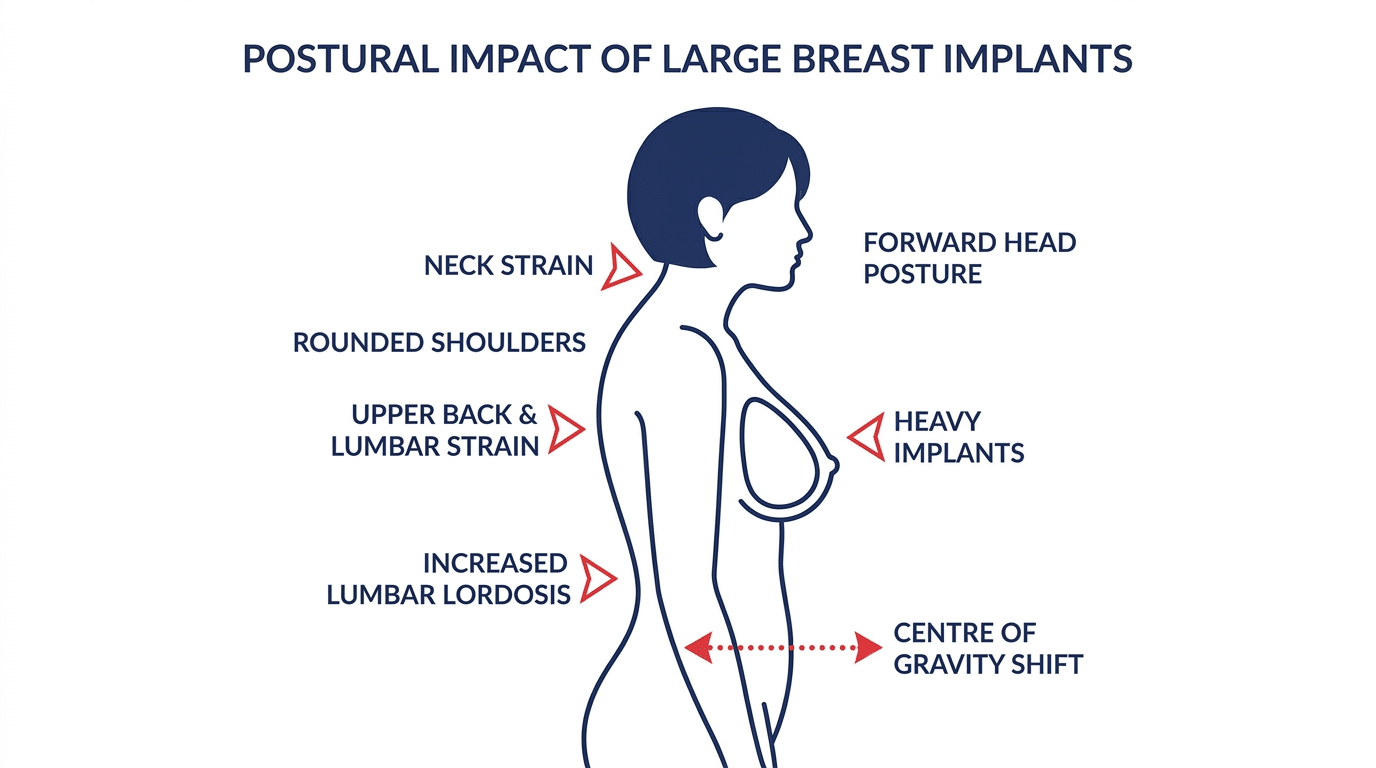
Beyond the simple question of weight, breast implants can affect posture in ways that contribute to back pain. The addition of anterior chest weight creates a tendency towards rounded shoulders and forward head posture — the upper body tilts subtly forward to compensate for the changed centre of gravity, the thoracic spine curves more than before, and the muscles of the posterior neck and upper back are placed under sustained, low-level tension. Over months and years this postural adaptation can become habitual, producing chronic upper back and neck discomfort.
The implant placement technique also plays a role. Sub-muscular placement — in which the implant is positioned beneath the pectoralis major muscle — involves dissection and stretching of this muscle during the healing period. In the initial recovery weeks, the tightness and guarding of the pectoralis can contribute to postural changes as patients instinctively protect the operated area. For most patients this settles fully as the muscle heals and relaxes. In a smaller number of cases, particularly where implants are very large or where the patient had significant baseline muscle tension, this tightness can become more persistent.
Pre-Existing Conditions That Increase Risk
Not every woman who develops back pain after breast augmentation does so purely because of the weight of the implants. Several pre-existing factors increase the likelihood that augmentation will be followed by musculoskeletal symptoms.
Small Frame and Narrow Chest
Patients with a smaller frame and narrower chest width have less structural surface area over which to distribute the load of implants. The same implant that sits comfortably on a broad-shouldered woman may produce disproportionate strain in a petite patient. This is one reason why implant selection must be referenced to the patient’s actual chest measurements — specifically the base width of the breast — rather than to abstract volume numbers. Our guide to breast anatomy basics explains why base width is the most important starting point for implant selection.
Weak Core and Posterior Musculature
The muscles of the core provide the postural support that allows the spine to absorb and distribute load from the anterior chest. In patients with weak core musculature, the spine has less dynamic support, and the posterior back muscles must work harder to maintain upright posture against the forward pull of the added chest weight. Strengthening the core before and after surgery is one of the most effective strategies for reducing the risk of back pain following augmentation.
Pre-Existing Postural Issues
Patients who already have kyphosis, scoliosis, forward head posture, or chronic upper back tension before surgery are at higher baseline risk of developing or worsening these symptoms after augmentation. The discussion about implant size needs to be informed by the patient’s musculoskeletal history, and post-operative physiotherapy should be proactively considered.
Very Large Natural Breast Size
Patients who already have large natural breast tissue and who add implants on top of that existing volume are at greater risk of developing back pain than those who start from a smaller baseline. The combined weight of natural breast tissue plus implant can be considerable.
Implant Placement and Its Effect on Back Comfort
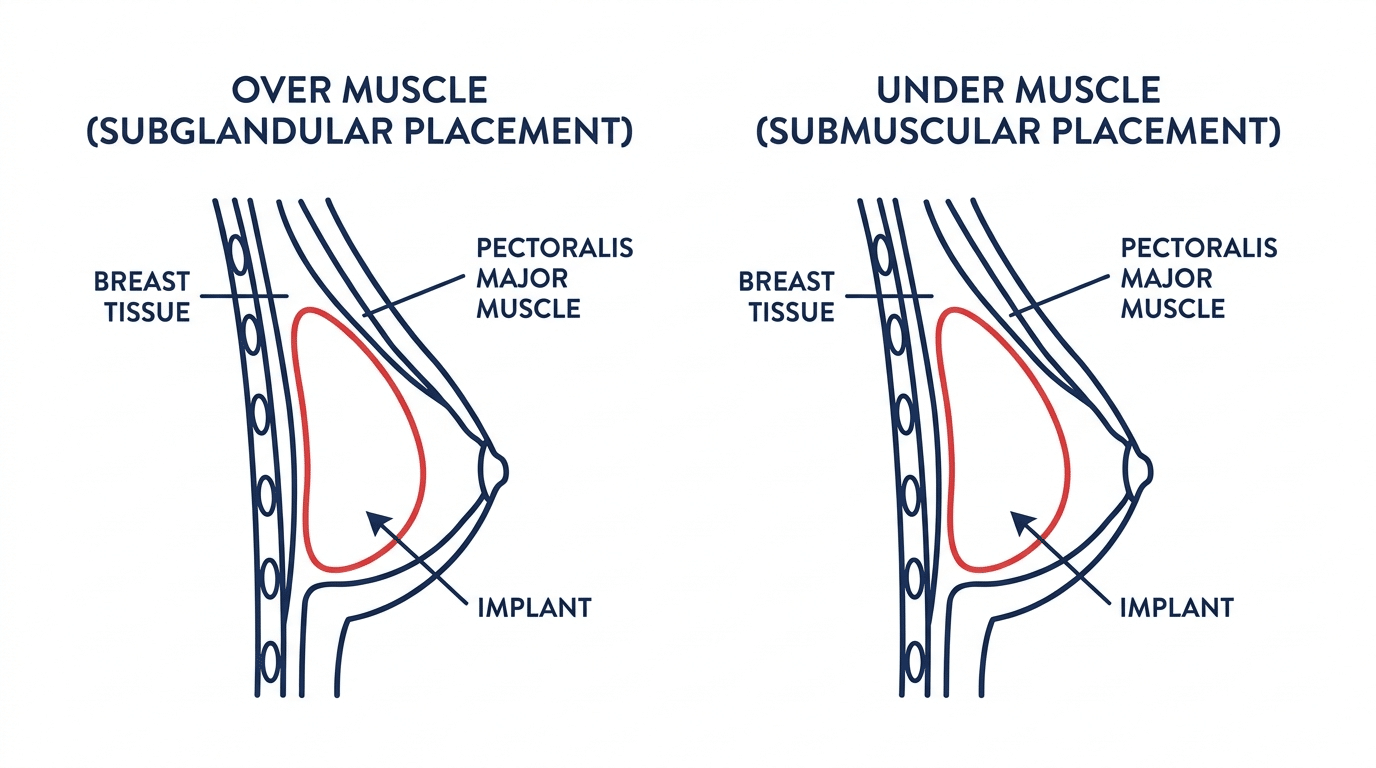
The plane in which implants are placed — sub-glandular (over the muscle), sub-fascial, or sub-muscular (under the muscle) — has implications beyond aesthetics. A detailed explanation of the different placement options is available in our guide to over muscle vs under muscle placement.
Sub-muscular placement, which remains the most commonly used technique at Centre for Surgery, positions the implant beneath the pectoralis major. This placement distributes the implant weight across the chest wall muscle rather than allowing it to rest solely on the breast tissue and skin envelope. Sub-glandular placement positions the implant above the muscle, where the weight rests more directly on the anterior chest without the muscular support of the sub-muscular pocket. In patients with higher risk factors for back pain, this placement consideration is worth discussing with the surgeon.
Breast Implant Illness and Systemic Symptoms
It is worth distinguishing between the mechanical back pain discussed above and the broader constellation of symptoms sometimes reported under the term breast implant illness. Some women with implants report fatigue, joint pain, diffuse musculoskeletal aching, and other systemic symptoms that they attribute to their implants. As covered in our detailed post on breast implant illness, this remains an evolving area of clinical discussion. Patients who develop new or worsening symptoms following augmentation should have these assessed by their surgical team. Reviewing our guide to common side effects after breast augmentation is also a useful resource.
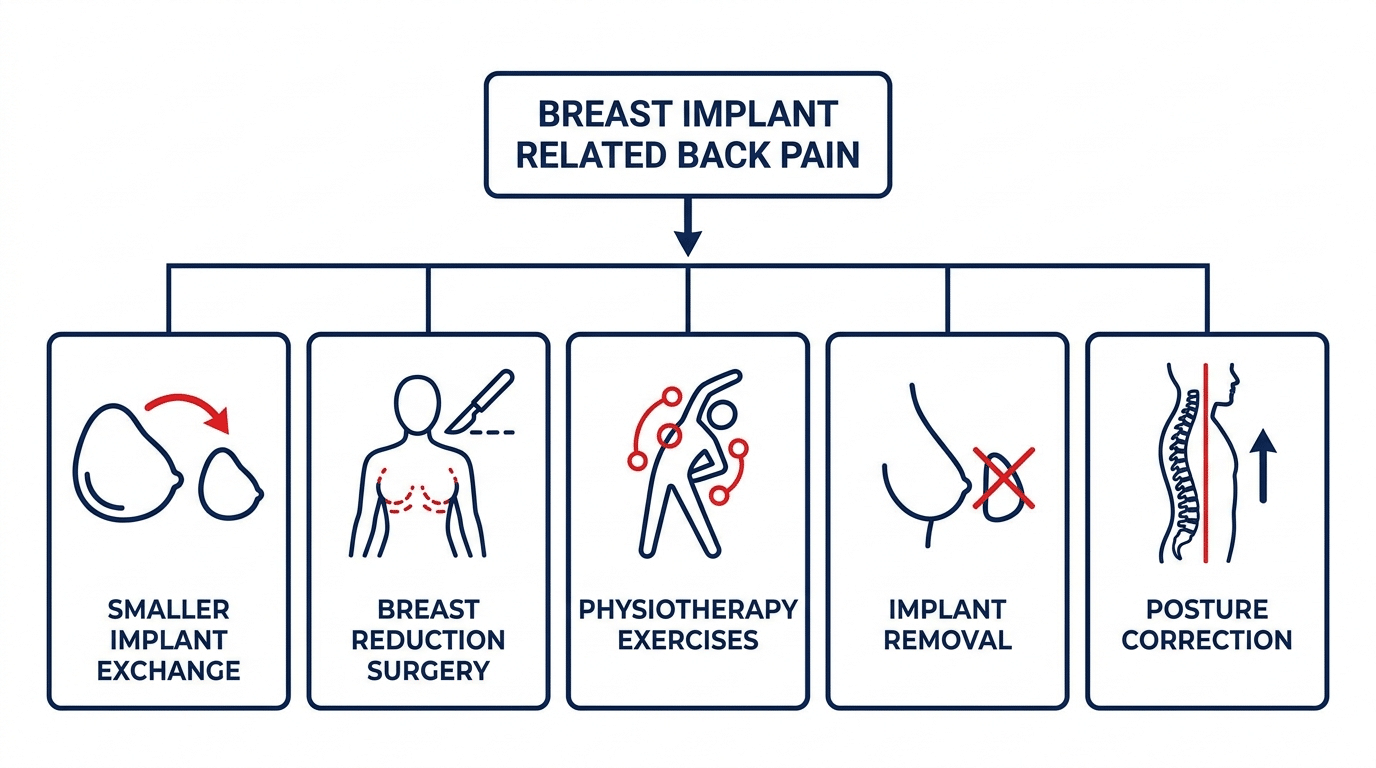
What Can Be Done If Implants Are Causing Back Pain?
Physiotherapy and Core Strengthening
For mild to moderate discomfort, a structured physiotherapy programme focused on postural correction and core strengthening is the first-line approach. This is non-invasive, does not require any change to the implants, and produces measurable improvement in most patients with mild symptoms.
Implant Exchange to a Smaller Size
For patients whose symptoms are clearly related to the size and weight of their implants, exchanging to a smaller implant can produce significant improvement. Reducing from 400cc to 250cc, for example, removes approximately 300 grams of weight from the anterior chest — a meaningful reduction that many patients notice immediately in terms of comfort. Our post on options following implant removal or exchange explains the surgical approach.
Breast Reduction
For patients with implants who also have significant natural breast tissue — and where the combined volume is producing substantial back symptoms — breast reduction surgery may be the most appropriate solution. Our post on whether breast reduction is right for you and our dedicated post on breast reduction for dense breasts are useful starting points.
Implant Removal
Some patients with significant back pain choose to have their implants removed entirely. Many patients report immediate and significant improvement in back and shoulder discomfort following explantation. Our guide to options following implant removal covers what patients can expect.
Frequently Asked Questions
Do breast implants always cause back pain?
No. Many women with breast implants — including large implants — never develop back pain. Whether back pain develops depends on implant size relative to body frame, placement, pre-existing musculoskeletal health, core strength, and posture. The risk is meaningful but not universal.
How much weight do breast implants add?
A 300cc silicone implant weighs approximately 310–330 grams. A pair of 300cc implants therefore adds approximately 620–660 grams to the anterior chest. Full detail is covered in our guide to how much breast implants weigh.
Will smaller implants cause less back pain?
Yes, generally. The relationship between implant weight and musculoskeletal demand is proportional. Smaller, lighter implants place less load on the posterior musculature and are associated with a lower incidence of back pain.
Can I have my implants exchanged for smaller ones?
Yes. Implant exchange is a well-established procedure and is one of the most common reasons women return for revision surgery. Exchanging to a smaller size reduces the weight on the anterior chest and can produce significant improvement in back and shoulder symptoms.
Should I avoid breast augmentation if I already have back pain?
Not necessarily — but pre-existing back pain should be discussed openly at your consultation. If back symptoms could be compounded by the addition of anterior chest weight, this needs to be factored into implant selection. In some patients, choosing a modest implant size and investing in pre and post-operative physiotherapy allows augmentation to proceed without worsening back symptoms.
How long after breast augmentation can back pain develop?
Back pain related to implant weight can develop at any point after surgery. Some patients notice it within the first few months as the implants settle and postural changes become established. Others develop symptoms gradually over years. In either case, the symptoms should be assessed and managed actively.
Breast Augmentation at Centre for Surgery
Centre for Surgery performs breast augmentation at our CQC-regulated Baker Street clinic in central London. Our GMC-registered consultant plastic surgeons take a thorough, anatomy-first approach to implant selection — incorporating chest measurements, frame size, lifestyle, and physical health alongside aesthetic goals. Every consultation includes an honest discussion of the physical implications of different implant sizes.
Finance options including 0% APR are available through our partner Chrysalis Finance — visit our Finance Options page for details.
Phone: 0207 993 4849 | Email: contact@centreforsurgery.com | Address: 95-97 Baker Street, London W1U 6RN
[contact-form-7 id=”256″ title=”Treatments form”]