The promise of a non-surgical alternative to a facelift is one of the most over-marketed claims in aesthetics. So when patients ask whether Fotona 4D can really tighten skin without surgery, they deserve a careful answer: yes, it genuinely tightens — but it’s not a facelift, and it works best when patients understand exactly what to expect.
This guide explains how the four-step Fotona 4D protocol works, who it suits, what realistic results look like, and where it fits relative to surgical lifting and other non-surgical alternatives at our Baker Street clinic.
What Fotona 4D actually is
Fotona 4D is a four-stage laser facial that uses two complementary wavelengths — Nd:YAG (1,064 nm) and erbium YAG (2,940 nm) — to deliver heat to different depths of the face. The “4D” refers to the four sequential modes, each targeting a different layer of tissue:
- SmoothLiftin™ — laser energy delivered inside the mouth, heating the dermis from beneath. Lifts the mid-face, softens nasolabial folds, supports the perioral area. The intraoral approach is what distinguishes Fotona 4D from most non-surgical tightening platforms.
- FRAC3® — a non-ablative fractional Nd:YAG pulse that addresses pigmentation, fine lines and deeper texture in scattered micro-zones.
- PIANO® — a super-long Nd:YAG pulse that delivers uniform deep bulk heating to stimulate collagen contraction in the deeper dermis. This is the principal “tightening” step.
- SupErficial™ — a light Er:YAG peel that refines the surface, evens tone and gives the skin its post-treatment glow.
Each step takes a few minutes. The full sequence runs 45 to 60 minutes. There’s no anaesthesia, no needles, and no real downtime — most patients walk out and resume normal activities the same day. For an alternative perspective comparing Fotona 4D against RF microneedling, see Fotona 4D vs Morpheus8.
How the tightening actually works
The PIANO® step is the engine of the result. By delivering uniform deep heating without surface ablation, it creates a controlled thermal environment in the dermis. This triggers two responses:
- Immediate collagen contraction — existing collagen fibres shorten and tighten in response to heat, producing a visible firming effect within the first few weeks
- Neocollagenesis — new collagen is laid down over the following two to three months as the dermis remodels in response to the thermal stimulus
The intraoral SmoothLiftin™ step contributes the lift component. Heating the dermis from inside the mouth tightens the perioral area, supports the mid-face, and adds definition to the smile lines from beneath rather than from above.
For patients with mild to moderate skin laxity, the combined effect is genuinely visible — firmer jawline, less prominent nasolabial folds, a freshness around the lower face. For patients with significant laxity, it softens without dramatically lifting.
What results look like — and what they don’t look like
Honest expectations make the difference between satisfied and disappointed patients. Realistic Fotona 4D outcomes:
- Firmer, smoother skin texture
- Mildly tightened jawline and lower face
- Softening of nasolabial folds and perioral lines
- More even tone and brighter complexion
- Gradual improvement that builds over two to three months
- Results lasting around 12 to 18 months before maintenance is needed
What Fotona 4D doesn’t do:
- Re-suspend significantly sagging tissue (that’s a surgical facelift)
- Remove excess skin (also surgical)
- Address volume loss in cheeks or temples (that’s dermal fillers or facial fat transfer)
- Treat dynamic wrinkles caused by muscle movement (that’s anti-wrinkle injections)
- Match the dramatic single-session change of ablative erbium laser resurfacing
For visual reference of typical patient outcomes, see our service page at Fotona 4D Laser.
Who Fotona 4D suits
The ideal candidate is someone with mild to moderate signs of ageing who isn’t ready for, or doesn’t want, surgery. Typical patient profiles:
- Late 30s to early 50s, noticing early laxity and texture change
- Patients in their 50s and 60s wanting to refine results between or before considering surgery
- Anyone seeking firmer skin and a refreshed look without downtime
- Post-facelift patients using Fotona 4D as part of long-term maintenance
- Patients with concerns about facial volume preservation — Fotona 4D is collagen-stimulating, not volume-depleting
Patients with significant skin laxity, jowls or excess skin will get better results from surgical options. We’re honest about this at consultation — Fotona 4D is the wrong tool for advanced ageing changes, and we’d rather direct a patient to facelift, neck lift or blepharoplasty than over-promise non-surgical results.
For safety across skin types, see our companion guide on whether Fotona 4D is safe for all skin types.
How many sessions you need
For first-time patients, a course of three to four sessions spaced three to four weeks apart delivers the best results. Each session contributes to the collagen-stimulating effect, and the gradual rebuilding from the PIANO® step is what creates the visible tightening over months.
For patients on maintenance — those who’ve already had a full course, or post-facelift patients — one to two sessions a year typically sustain the result.
During and after a Fotona 4D session
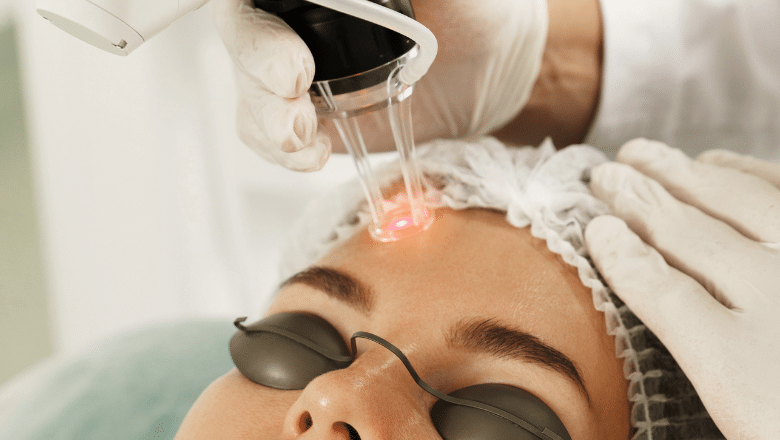
You arrive without makeup, having avoided retinoids and acids for several days beforehand. The clinician cleanses the skin and applies protective eyewear. The intraoral SmoothLiftin™ step comes first — a small mouth retractor holds the lip open while the laser handpiece works inside the mouth. Most patients describe a warm, slightly snapping sensation; not painful but a novel feeling.
The FRAC3® and PIANO® steps follow on the external surface, with the laser passed systematically across the face. PIANO® feels warmer than the other steps as the dermis is heated. The session closes with the SupErficial™ peel, which leaves the skin pink and glowing.
Immediately after, you may have mild redness for a few hours and a warm flush similar to a light sunburn. Mineral makeup can typically go on the next day. Strict SPF 50 daily for the following two weeks — fresh post-treatment skin is photosensitive even when no surface ablation has occurred.
How Fotona 4D fits with other treatments
Fotona 4D pairs well with most other aesthetic treatments. Common combinations:
- Fotona 4D + anti-wrinkle injections — addresses static skin quality plus dynamic lines
- Fotona 4D + dermal fillers — tightening plus volume restoration where needed
- Fotona 4D + Profhilo or polynucleotide treatment — surface tightening plus deep hydration and bio-stimulation
- Fotona 4D + Morpheus8 — staged programme combining surface and deep RF microneedling tightening
- Fotona 4D + SmoothEye — face tightening plus dedicated periocular treatment
For body-area equivalents using the same Fotona platform, see TightSculpting.
What we don’t recommend
- Fotona 4D marketed as a “non-surgical facelift” for advanced ageing — for jowls and significant laxity, only surgery delivers comparable results. Our preference is to be honest about this rather than oversell.
- A single Fotona 4D session in place of a course — one session gives a modest glow; the collagen-driven tightening only emerges over a full course.
- Skipping sun protection because there’s no ablation — even without surface peeling, the skin is more vulnerable to UV during the treatment window. SPF 50 daily, no exceptions.
- Combining with strong active skincare immediately before treatment — retinoids and acids should pause for at least one week pre-treatment to minimise irritation.
Frequently asked questions
How long do Fotona 4D results last?
After a full course, results typically last 12 to 18 months before noticeable softening. One to two maintenance sessions per year sustain the effect indefinitely.
Is Fotona 4D painful?
No anaesthesia is needed. Most patients describe the sensation as warmth or tingling. The PIANO® step is the warmest of the four. The intraoral step feels novel rather than painful.
When will I see results?
Some immediate freshness and glow within days. The tightening builds gradually over the course and continues to improve for two to three months after the final session.
Is there any downtime?
Essentially none. Mild redness for a few hours post-treatment, sometimes a light flush. Most patients return to work the same day.
How much does Fotona 4D cost?
Single sessions and course pricing vary; a consultation gives an exact quote. We offer finance from 0% APR through Chrysalis Finance.
Can men have Fotona 4D?
Yes — many male patients have Fotona 4D for jawline definition and skin quality. The treatment is identical regardless of gender.
Why choose Centre for Surgery
We operate the full Fotona SP Dynamis Pro platform at our purpose-built Baker Street private hospital. Our clinicians are experienced in calibrating the 4D protocol to each patient’s skin type, age and goals — the four-step sequence isn’t a fixed recipe but a flexible framework adjusted to what each face needs. Treatments are delivered in a CQC-regulated environment with the full safety infrastructure of a private hospital.
Centre for Surgery · CQC-regulated · GMC specialist-registered surgeons · 95–97 Baker Street, Marylebone, London W1U 6RN · 0207 993 4849 · Book a consultation · Finance from 0% APR