
When you’re researching laser skin resurfacing, two names dominate the conversation: the erbium YAG laser and the CO₂ laser. Both ablate damaged surface skin to trigger collagen renewal. Both deliver dramatic improvements in fine lines, scarring, sun damage and texture. But they’re engineered around different wavelengths, and that single technical difference cascades into very different recovery profiles, comfort levels and safety margins.
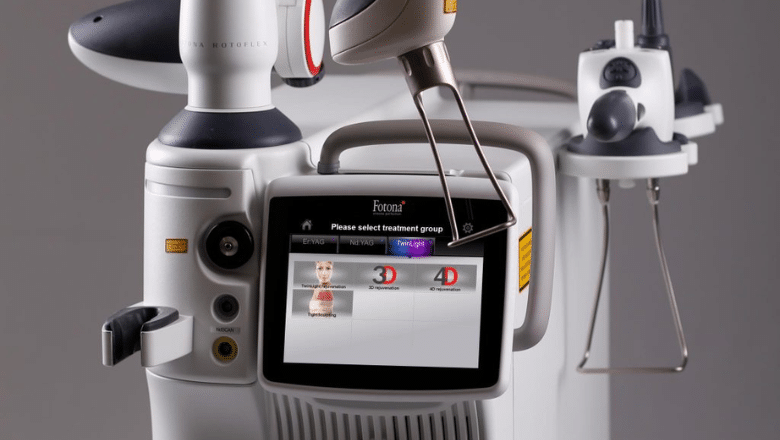
At Centre for Surgery, our laser specialists use the Fotona SP Dynamis Pro erbium platform for all laser skin resurfacing at our Baker Street private hospital. This guide explains how the two systems compare, when each is appropriate, and why Er:YAG is the right default choice for most patients in 2026.
The technical difference in one sentence
The CO₂ laser emits light at 10,600 nm; the Er:YAG laser at 2,940 nm. Water — the dominant component of skin — absorbs Er:YAG energy roughly 10 to 15 times more efficiently. That means Er:YAG vaporises water-rich tissue almost instantly with very little spillover heat, while CO₂ deposits more thermal energy into surrounding skin as it ablates the surface.
Both lasers achieve resurfacing; the trade-off is between depth of effect and severity of recovery. For the underlying tissue science in more detail, see our deeper guide to the benefits of the erbium laser.
CO₂ laser resurfacing: deep, dramatic, demanding
The CO₂ laser has been the benchmark for ablative resurfacing since the 1990s. Its longer wavelength penetrates further into the dermis, and the additional thermal effect stimulates substantial collagen contraction and remodelling. For patients with deep static wrinkles, severely sun-damaged skin or advanced atrophic acne scarring, a single fully ablative CO₂ session can produce results that look genuinely transformative.
That power comes at a cost. CO₂ recovery typically runs 14 to 21 days of social downtime, with persistent erythema that can linger for weeks or months. The risk of post-inflammatory hyperpigmentation is meaningful — particularly in skin types IV to VI, where it can be both more prevalent and longer-lasting. Hypopigmentation, where treated skin loses pigment permanently, is a rare but documented complication. Because the thermal margin is wider, the technique demands an experienced operator: parameters that work beautifully on light, sun-tolerant skin can cause real harm on darker complexions or thinner areas like the neck.
For patients who tolerate the recovery and fall in the right candidacy window, CO₂ remains powerful. For most patients, the calculation now favours erbium.
Erbium laser resurfacing: precise, safe, faster healing
The Er:YAG laser approaches the same skin concerns from the opposite direction: vaporise tissue cleanly with minimal heat, and rely on a series of precisely controlled passes to reach the desired depth. With the Fotona SP Dynamis Pro, our clinicians can dial pulse duration anywhere from 100 microseconds (essentially cold ablation, almost no thermal effect) up to 1,000 microseconds (added thermal effect for collagen tightening). That tunability is the platform’s defining advantage — one device can deliver everything from a light texture refresh to deep collagen-stimulating resurfacing, with the clinician adjusting energy in real time to suit the area and the skin type.
The clinical consequences are tangible. Recovery typically runs five to ten days for fractional protocols and 10 to 14 days for fully ablative full-face. Redness fades faster. The pigmentation risk is markedly lower, making Er:YAG far safer in olive and darker skin tones. Discomfort is reduced, and many smaller treatments are tolerated under topical anaesthetic alone.
Er:YAG is also exceptional on delicate areas — around the eyes, on the neck, on the décolletage — where the higher thermal load of CO₂ creates a real risk of scarring or pigment loss.
Side-by-side: which laser for which problem
The honest answer is that the conditions overlap substantially. Both lasers can treat the same indications. What changes is the recovery curve and the safety margin.
- Deep static wrinkles and severe photodamage — CO₂ in a single session, or a staged course of fractional Er:YAG. We typically opt for the latter, which reaches comparable end-results across two or three sessions with less aggregate downtime than one CO₂ recovery.
- Atrophic acne scarring — fractional Er:YAG is the workhorse. The microcolumns of energy reach scar tissue deep in the dermis and trigger remodelling. See our acne scar removal service for the full protocol.
- Fine lines, uneven tone and texture refresh — Er:YAG, lower settings, shorter recovery. Often paired with anti-wrinkle injections for dynamic lines.
- Pigmentation and sun damage — Er:YAG with conservative fluence. For diffuse pigmentation or melasma, the dedicated laser pigmentation treatment protocol is more appropriate than full resurfacing.
- Periocular and neck rejuvenation — Er:YAG only. CO₂’s thermal margin is too aggressive for these areas.
- Darker skin types (Fitzpatrick IV–VI) — Er:YAG with patch testing, fractional protocols and careful aftercare. CO₂ is generally avoided in this group.
Recovery side-by-side
For patients deciding between the two approaches, the recovery comparison usually settles it.
- Days 1–3: both lasers cause swelling, redness and weeping. CO₂ is more pronounced; Er:YAG more like a deep sunburn.
- Days 4–7: Er:YAG begins to peel and re-epithelialise. CO₂ continues to crust.
- Days 7–14: most Er:YAG patients are presentable with mineral makeup by day 10. CO₂ patients are often still visibly red.
- Weeks 2–8: Er:YAG redness fades steadily. CO₂ erythema can persist for two months or more.
- Months 3–6: collagen remodelling continues for both, with results refining over the half year that follows treatment.
For the full week-by-week recovery arc and detailed aftercare guidance, see our companion guide on how long it takes to heal after laser skin resurfacing. For makeup and skincare timing during the healing window, see our guide to when you can apply make-up after laser skin resurfacing. Many patients also ask whether laser skin resurfacing is painful — the short answer is that anaesthetic technique makes the procedure itself comfortable, but the first 48 hours of healing involves real but manageable soreness.
What happens during your treatment
Your first appointment is a consultation. We examine your skin, discuss what you want to change, take a thorough medical history, and recommend the laser protocol that best fits your concerns, skin type and downtime tolerance. If you’ve been using retinoids, are on or recently finished isotretinoin, or have a history of cold sores, we’ll adjust the plan accordingly.
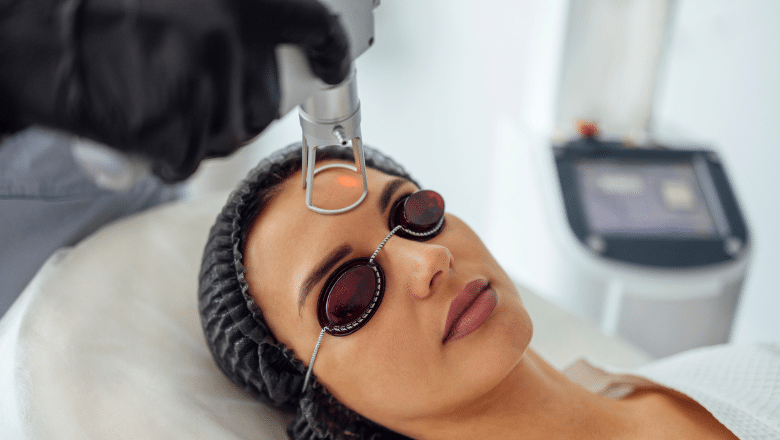
On treatment day, the skin is cleansed and a topical anaesthetic cream is applied for around 30 to 45 minutes. Deeper protocols may add infiltrative local anaesthetic. Protective eye shields are placed. Treatment itself takes 30 to 90 minutes depending on the area and protocol. The sensation during is a warm tingling or mild stinging; immediately after, the skin feels like a moderate sunburn. A cooling mask and ointment are applied before you leave.
You go home with detailed written aftercare instructions: how to cleanse, what ointment to apply and how often, sun protection requirements, and warning signs to watch for. Strict daily SPF 50 use is essential for at least three months — the new skin is highly photosensitive and unprotected sun exposure during this window can cause hyperpigmentation that’s hard to reverse.
Combining laser with other treatments
One of the reasons we lean towards Er:YAG is that it pairs well with other modalities for patients wanting comprehensive rejuvenation:
- Er:YAG + Morpheus8 — surface laser resurfacing combined with RF microneedling for deeper tissue tightening. Typically staged a few weeks apart.
- Er:YAG + Fotona 4D — ablative resurfacing for surface concerns plus non-ablative tightening for facial laxity
- Er:YAG + Profhilo or polynucleotide treatment — resurfacing followed by bio-stimulation to support collagen remodelling
- Er:YAG + anti-wrinkle injections or dermal fillers — static line treatment alongside dynamic and volume correction
- Er:YAG + blepharoplasty or facelift — surgical lifting plus surface quality work, with Er:YAG typically staged after the surgical recovery is complete
For an overview of how Fotona’s range of treatments fits together, see our guide on Fotona 4D vs Morpheus8.
Who is a good candidate
The ideal candidate for Er:YAG laser resurfacing:
- Has fine to moderate lines, sun damage, atrophic acne scars, uneven tone or textured skin
- Wants meaningful improvement without committing to surgical recovery
- Can take five to fourteen days of social downtime depending on protocol depth
- Has skin types I to VI (with appropriate protocol adjustment for darker tones)
- Doesn’t smoke and isn’t on isotretinoin within the past six months
- Has no active skin infection, recent sunburn or history of keloid scarring
- Will commit to strict sun protection for at least three months after treatment
Patients with significant skin laxity or volume loss may benefit more from surgical lifting — facelift, blepharoplasty, FaceTite — sometimes followed by Er:YAG to address skin quality.
What we don’t recommend
A few honest editorial positions:
- CO₂ resurfacing as the default choice — in 2026, with a mature Er:YAG platform like the Fotona SP Dynamis Pro, the additional intensity of CO₂ rarely justifies the longer recovery and higher complication risk. We reserve CO₂ approaches for very specific indications and rarely as a first-line option.
- CO₂ on darker skin tones — the pigmentation risk is real and often under-disclosed. We use Er:YAG with adjusted protocols instead.
- Chemical peels as a substitute for laser — peels are unpredictable in depth and harder to control on textured skin or scarring. For real resurfacing work, lasers are the more controllable tool.
- Single-session promises for deep concerns — for advanced scarring or photodamage, a staged course of Er:YAG sessions usually beats one heroic CO₂ treatment on both safety and aggregate downtime.
Frequently asked questions
Which is better, erbium or CO₂ laser?
Neither is universally better — they answer different questions. For most patients in 2026, Er:YAG offers a better balance of results, safety and recovery. CO₂ remains an option for very specific indications, but is rarely our first recommendation.
How many erbium sessions will I need?
For most concerns, one to three fractional sessions spaced four to six weeks apart deliver excellent results. Fully ablative full-face treatment is typically a one-off, with maintenance via non-ablative SMOOTH® treatments thereafter.
How long do results last?
Surface improvements can last five years or more. The natural ageing process continues, so maintenance treatments — typically non-ablative — extend benefit indefinitely.
What does Er:YAG resurfacing cost?
Pricing depends on protocol depth and area. Focal resurfacing starts around £600; full-face fractional ranges £1,500 to £3,000; fully ablative full-face £3,000 to £6,000. We offer finance from 0% APR.
Can the two lasers be combined?
It’s possible but rarely necessary. The dynamic range of the Fotona SP Dynamis Pro is wide enough that we can deliver everything from gentle refresh to deep ablation on one platform without bringing in a CO₂ system.
Why choose Centre for Surgery
Our Baker Street private hospital is built around the Fotona SP Dynamis Pro — one of the most advanced Er:YAG platforms in clinical use. Treatments are delivered by experienced laser specialists in a CQC-regulated environment, with the full safety infrastructure of a private hospital. Every protocol is calibrated to your skin type, downtime tolerance and goals — there is no one-size-fits-all laser at our clinic.
Centre for Surgery · CQC-regulated · GMC specialist-registered surgeons · 95–97 Baker Street, Marylebone, London W1U 6RN · 0207 993 4849 · Book a consultation · Finance from 0% APR