Cystic acne is the most severe form of acne and the most prone to leaving permanent scarring. Unlike papular or pustular acne, the cysts develop deep beneath the skin surface — large, painful, inflamed nodules filled with pus that can persist for weeks and are notoriously slow to settle. The combination of deep inflammation and slow healing is exactly what drives the characteristic atrophic scarring that follows untreated cystic acne.
Conventional acne treatments often underperform on cystic disease. Topical actives can’t reach the depth where the cysts sit. Oral antibiotics help with inflammation but don’t fully address the underlying mechanism. Isotretinoin works powerfully but carries significant side effects and contraindications. For many patients, Fotona Nd:YAG laser acne treatment represents the most effective in-clinic intervention for cystic acne — addressing the disease at the depth where it lives without the systemic exposure of medication.
This guide explains how cystic acne develops, why Fotona laser is particularly suited to treating it, what a treatment course looks like, and how the approach compares with the other options at our Baker Street private hospital.
What cystic acne is
Cystic acne is characterised by large, painful, inflamed lesions sitting deep in the dermis. The cysts are pus-filled, often 5 mm or more in diameter, and frequently last several weeks before resolving. Most commonly the face is affected — particularly the jawline, chin and cheeks — but cystic acne also appears on the chest, back, upper arms and shoulders.
Several features distinguish cystic acne from other forms:
- Depth — lesions sit much deeper than the surface pustules of typical inflammatory acne
- Size — individual lesions can be substantially larger than papules or pustules
- Pain — cystic lesions are often acutely tender, particularly when inflamed
- Persistence — weeks to months rather than days
- Scarring risk — significantly higher than other acne types, with atrophic (depressed) scarring particularly common
The pattern is often confused with severe nodular acne or with severe folliculitis, and the distinction matters because management differs. A thorough clinical examination at consultation establishes which pattern you have and what’s driving it.
What drives cystic acne
The mechanism shares the four core processes of all acne — excess sebum production, abnormal follicular shedding blocking pores, colonisation by Cutibacterium acnes bacteria, and inflammatory response — but with several aggravating factors that push it into the cystic pattern.
Hormonal influence
Hormonal cycling drives cystic acne more reliably than other forms. Premenstrual flares, perimenopausal onset, postpartum changes and PCOS-related androgen excess all commonly present as cystic disease. The jawline-and-chin distribution typical of hormonal acne is also the most common location for cysts.
Genetic predisposition
Family history of cystic acne is a strong predictor. The inherited tendency affects sebaceous gland sensitivity to hormones, follicular shedding patterns and inflammatory response intensity.
Severe inflammation
The cystic pattern develops when the inflammatory response is intense enough to rupture the follicular wall, releasing follicular contents into the surrounding dermis and triggering a much larger inflammatory cascade. Once this rupture-and-cascade pattern is established, it tends to repeat.
Picking and squeezing
Manual manipulation of inflamed lesions drives the deep tissue damage that converts a surface pustule into a true cyst. This is the single most preventable cause of cystic conversion and of the scarring that follows. Don’t squeeze acne lesions, particularly inflamed ones.
External factors
Pressure (helmets, masks, leaning on the face), occlusion (heavy comedogenic products), heat and humidity, stress, certain medications (corticosteroids, lithium, some hormonal therapies), and high-glycaemic-index diet can all contribute to flares.
Why Fotona Nd:YAG laser suits cystic acne
The Fotona SP Dynamis Pro at our clinic uses Nd:YAG laser at 1,064 nm — a wavelength specifically suited to addressing the depth at which cystic acne lives. Four mechanisms work in parallel:
1. Depth of penetration
1,064 nm penetrates through the epidermis without ablating the surface, reaching directly to the sebaceous glands and deep follicular structures where cysts originate. Topical treatments simply cannot reach this depth. Oral medications work systemically but distribute throughout the body. The Nd:YAG laser delivers concentrated thermal effect exactly where it’s needed.
2. Sebaceous gland reduction
Sebum overproduction is the foundational driver of cystic acne — without excess sebum, follicles don’t block, bacteria don’t colonise, and the inflammatory cascade doesn’t begin. The photothermal effect on sebaceous glands reduces their size and activity, addressing the disease at the source. This mechanism is similar to isotretinoin’s action but achieved locally rather than systemically.
3. Direct bactericidal effect
The heat generated by the laser directly kills Cutibacterium acnes bacteria in the follicle. Unlike long-term oral antibiotics, which drive antimicrobial resistance, the laser mechanism doesn’t select for resistant strains. This is both a clinical advantage for the patient and a public-health advantage.
4. Anti-inflammatory and collagen-stimulating effects
Laser energy modulates inflammatory mediators in the skin, reducing the size and pain of active cysts. The same thermal effect stimulates fibroblast activity in the deeper dermis, producing new collagen that begins addressing early scarring while active disease is still being treated. This dual effect is unique to laser among acne treatments.
The treatment course for cystic acne
Cystic acne typically needs a more intensive initial course than milder presentations:
- Phase 1 (month 1) — two sessions per week to bring active disease under control rapidly
- Phase 2 (months 2 to 3) — one session per week to consolidate the response
- Phase 3 (months 4 to 6) — sessions every two weeks tapering to monthly as control is established
- Phase 4 (maintenance) — single sessions every 4 to 6 months indefinitely to prevent recurrence
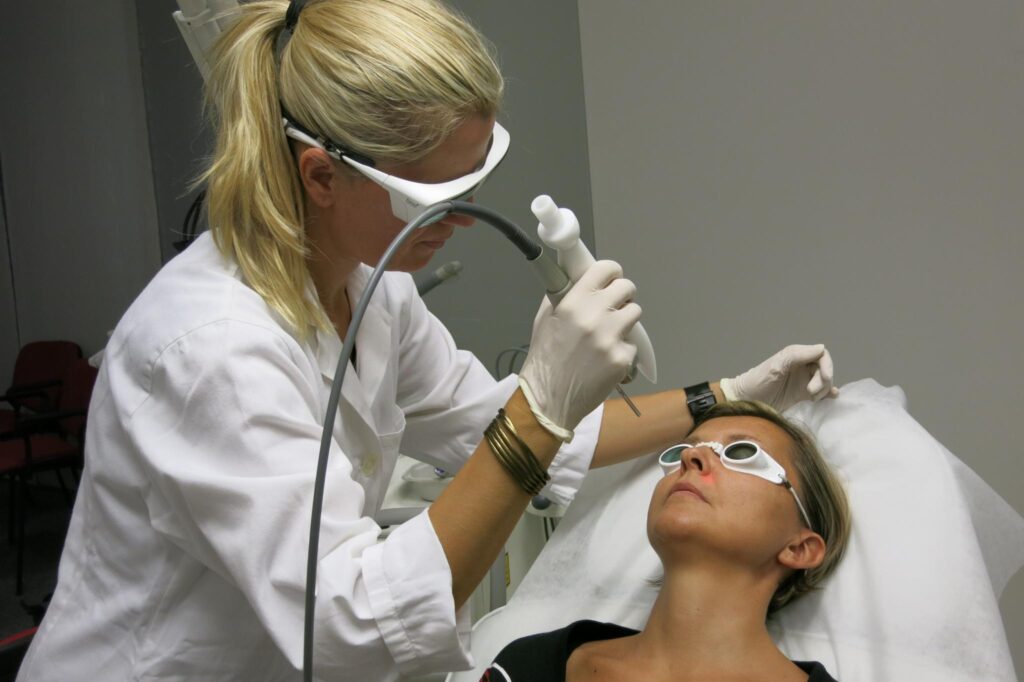
Each session takes 30 to 40 minutes for typical facial cystic acne. The skin is cleansed and protective eyewear placed. The laser handpiece is passed in six measured passes over the affected areas, with cold-air cooling through the device for comfort. The sensation is warm tingling rather than pain — most patients tolerate the treatment without topical anaesthetic.
For deep, particularly large cystic lesions, we sometimes combine the Nd:YAG protocol with focal Er:YAG ablation on the surface of the cyst, accelerating drainage and resolution. This combined approach is reserved for specific situations.
There’s no significant downtime. Mild redness and warmth for a few hours after each session is the typical extent. Strict daily SPF 50 for at least two weeks post-session is essential, as with all laser treatments.
What to expect from results
Most patients see meaningful improvement within the first four to six sessions, with continued progress over the full three- to six-month course. The pattern typically follows this progression:
- Weeks 1 to 2 — existing cysts feel less inflamed, less painful; some active lesions begin resolving
- Weeks 3 to 6 — frequency of new lesion formation begins to drop; smaller papules and pustules clear noticeably
- Weeks 6 to 12 — major reduction in active lesion count; ongoing improvement in skin texture as collagen remodelling begins
- Months 3 to 6 — sustained remission with maintenance sessions; visible improvement in early scarring
- Beyond 6 months — long-term stability with maintenance, refinement of remaining textural changes
Established scarring from past cystic acne won’t fully resolve with the laser acne treatment alone. For patients with significant atrophic scarring, we typically add fractional Er:YAG resurfacing or Morpheus8 RF microneedling sessions once the active disease is under control. The combined programme addresses both active acne and the scarring legacy of past disease — something no single modality can match. See our dedicated acne scar removal service for the scarring treatment side.
How laser compares with other cystic acne treatments
Vs isotretinoin (Roaccutane)
Isotretinoin remains the most powerful single treatment for severe cystic acne and can produce long-lasting clearance after a six-month course. The downsides — strict contraceptive requirements during and after treatment, mandatory blood monitoring, mood effects, prohibition of cosmetic procedures during and for six months after treatment, and a significant list of other side effects — make it the wrong choice for many patients.
Laser is the highest-impact alternative when isotretinoin is contraindicated or declined. For some patients, laser then isotretinoin (or vice versa) in sequence is the right plan; we discuss this individually at consultation.
Vs oral antibiotics
Oral tetracyclines help with the inflammatory component of cystic acne but underperform laser on the depth of effect and on the antibiotic resistance concerns. Antibiotic courses also have an inevitable exit point — laser provides a more sustainable long-term mechanism.
Vs hormonal modulation
For women whose cystic acne has a clear hormonal pattern (jawline distribution, premenstrual flare, response to historical hormonal contraception change), hormonal modulation can be very effective on its own. We often combine hormonal modulation with laser to address both the underlying driver and the surface mechanism.
Vs topical therapy
Topicals alone are inadequate for cystic acne — they can’t reach the depth where cysts sit. Topicals retain a role in maintenance and in addressing surface comedonal lesions alongside laser.
Vs steroid injections
Intralesional triamcinolone (corticosteroid injection directly into a cyst) can rapidly settle individual large lesions and is sometimes used for specific cysts ahead of important events. It’s a focal intervention rather than a treatment for the disease, and we use it adjunctively rather than as primary management.
For the broader comparison of treatment options, see our hub guide on the most effective treatment for acne and our specific comparison of laser versus medication for acne.
Pre-treatment preparation
To get the best results from your cystic acne laser programme:
- Stop strong actives one to two weeks before treatment — retinoids, glycolic and salicylic acids, vitamin C serums. Continue gentle cleansing and moisturising.
- Avoid tanning for three weeks before — tanned skin has more epidermal melanin which competes for laser energy
- Daily SPF 50 from at least two weeks before — stabilises baseline pigmentation
- Avoid alcohol for 48 hours before — reduces vasodilation and inflammation
- Tell us about all medications — particularly isotretinoin (current or recent), photosensitising drugs, and immunosuppressants
- Mention any history of cold sores — antiviral prophylaxis can be arranged if periocular treatment is planned
- Arrive without makeup on treatment day
Combining laser with the broader treatment plan
For cystic acne specifically, the most effective approach often combines several modalities:
- Fotona Nd:YAG laser as the central in-clinic mechanism
- Prescription topical regimen — we use the Obagi CLENZIderm M.D.™ System for its prescription-strength benzoyl peroxide and complementary actives
- Hormonal modulation for women with hormonal-pattern cystic acne (combined OCP with anti-androgenic progestogen, or spironolactone)
- Short-course oral anti-inflammatories — sub-antimicrobial-dose doxycycline if needed to settle severe inflammation rapidly
- In-clinic chemical peels for comedonal lesions and post-inflammatory pigmentation
- Scar treatment programme — fractional Er:YAG or Morpheus8 once active disease is controlled
The combination is calibrated to your specific presentation — there’s no fixed package. Patients with predominantly hormonal-pattern cystic acne often need different combinations from those with stress-driven flares or genetic-pattern persistent disease.
What we don’t recommend
- Squeezing or picking cystic lesions — the single most preventable cause of scarring. Even the inflamed-and-ready lesions should be left alone or addressed by us with sterile technique.
- Aggressive home exfoliation — drives inflammation and barrier damage in already-compromised skin. Gentle cleansing only.
- “Detox” diets and supplements — no evidence of meaningful benefit. Time spent on these is time not spent on treatments that work.
- Heavy occlusive cosmetics marketed for “acne-prone skin” — read ingredient lists rather than marketing copy. Many “acne-friendly” products contain comedogenic ingredients.
- Microdermabrasion for active cystic acne — surface abrasion drives inflammation in deep lesions. Not appropriate, not part of our offering.
- Long-term oral antibiotic monotherapy — drives resistance, doesn’t address mechanism. If you’ve been on oral antibiotics for more than six months without sustained benefit, the approach needs to change.
Frequently asked questions
How quickly will my cysts stop forming?
Most patients see a meaningful reduction in new lesion formation by week six to eight of treatment. Resolution of existing cysts varies — smaller lesions often clear within the first month, larger established lesions may take longer.
Will the scars from my old cystic acne improve?
The collagen-stimulating effect of laser begins addressing early scarring while treating active disease. For more established atrophic scarring, we typically add dedicated scar treatment — fractional Er:YAG resurfacing or Morpheus8 — once active acne is under control. See acne scar removal for that side of the programme.
Is the treatment painful?
No — most patients describe warmth or mild tingling rather than pain. Cold-air cooling through the laser handpiece reduces discomfort further. Topical anaesthetic is rarely needed.
Can I have laser if I’m on isotretinoin?
No — we don’t combine concurrent laser with isotretinoin treatment. Skin is too fragile during isotretinoin courses. We typically recommend a six-month wait after isotretinoin completion before starting laser.
Is laser safe for darker skin types?
Yes — Nd:YAG at 1,064 nm is one of the safest laser wavelengths for Fitzpatrick types IV to VI because less of its energy is absorbed by epidermal melanin. We adjust settings and conduct patch testing where appropriate.
How long does the result last?
With maintenance sessions every 4 to 6 months, results sustain indefinitely. Without maintenance, gradual recurrence is common — but typically less severe than pre-treatment.
How much does the treatment cost?
Course pricing depends on length of programme and area treated. We offer discounted packages for full course bookings. A consultation gives an exact quote. Finance from 0% APR is available through Chrysalis Finance.
Why choose Centre for Surgery
Our cystic acne programmes combine Fotona SP Dynamis Pro Nd:YAG laser, prescription topical regimens (including the Obagi CLENZIderm M.D.™ System), hormonal management where appropriate, and dedicated scar treatment under one clinical team at our CQC-regulated Baker Street private hospital. Treatment is delivered by clinicians experienced in calibrating protocols across skin types and acne severities. The goal is not just to clear active cysts but to prevent the scarring that defines the long-term cost of untreated cystic acne.
Centre for Surgery · CQC-regulated · GMC specialist-registered surgeons · 95–97 Baker Street, Marylebone, London W1U 6RN · 0207 993 4849 · Book a consultation · Finance from 0% APR