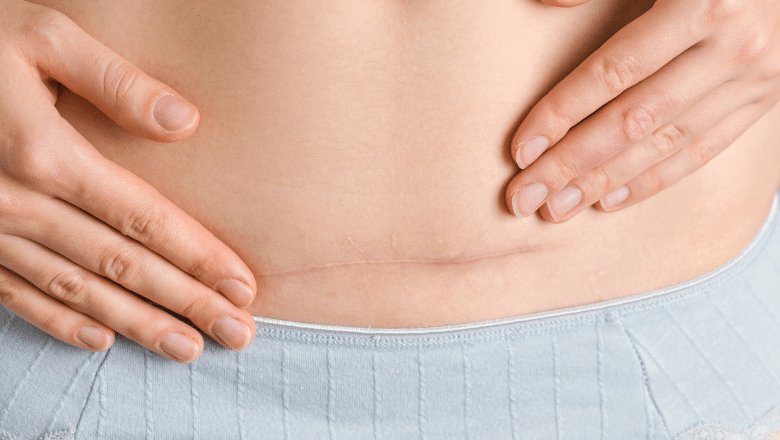
A caesarean leaves a scar — that part is unavoidable. What can be controlled is how that scar matures over the following 12 to 18 months, and there are evidence-based things that genuinely make a difference. There are also a lot of things commonly recommended that don’t.
This article covers what actually helps, what doesn’t, and what to do if a C-section scar has healed badly and needs revision.
Things that genuinely improve scar outcome
Silicone — gel or sheet
Silicone is the only topical treatment with strong randomised-trial evidence for scar improvement. It works by occlusion: hydrating the scar and signalling fibroblasts to slow collagen production. Used continuously for 12 weeks (silicone gel applied twice daily, or silicone sheets worn 12+ hours a day), it reduces redness, thickness, and itchiness, and lowers the risk of hypertrophic scarring.
It can be started once the wound is fully closed — usually around two to three weeks post-op — and continued for at least three months.
RELATED: Do Silicone Strips Help Scars Heal Better?
Sun protection
A new scar contains immature melanocytes that overreact to UV. A few unprotected sun exposures in the first six months can leave the scar permanently darker than the surrounding skin — particularly in skin types III–VI.
SPF 50 over the scar daily for the first 12 months is more important than any cream or oil.
Tension reduction
A scar widens when the skin pulls on it. The first three months are when this matters most, as the collagen is still soft. Avoiding heavy lifting, twisting, and abdominal exercise during this window helps keep the scar narrow. Some surgeons recommend paper tape across the scar for the first 6–12 weeks for the same reason.
Scar massage
Once the wound is fully closed and any scabs have come off — usually around four weeks — daily massage with firm circular pressure for five minutes helps soften the scar by breaking down the dense early collagen and improving circulation.
Things commonly recommended that don’t help much
Vitamin E oil has no evidence of benefit and can cause contact dermatitis in around a third of users. Bio-Oil and similar branded products are essentially mineral oil with fragrance — they moisturise but don’t change scar biology. Aloe vera, cocoa butter, and coconut oil are pleasant but don’t outperform plain moisturiser.
The active ingredient that actually matters in topical scar treatment is silicone. If a product contains silicone, it works. If it doesn’t, it’s effectively just an emollient.
When a scar heals badly
Some C-section scars never settle properly. The four common problems:
Hypertrophic scar — raised, red, itchy, but stays within the original incision line. Treated with silicone, intralesional steroid injection, or fractional laser.
Keloid scar — extends beyond the original incision, often pruritic or painful. More common in skin types IV–VI. Treated with steroid injection, sometimes combined with surgical excision and post-operative radiotherapy in severe cases.
Wide stretched scar — flat but disfiguringly broad. Cannot be improved with topicals; requires surgical revision.
Adherent scar with overhang — scar pulled inward by adhesion to the abdominal wall, with overhanging skin above. Common after multiple C-sections. Surgical revision combined with abdominoplasty usually gives the best result.
RELATED: Caesarean Scar Revision
C-section scar revision options
Surgical revision
The original scar is excised and the incision re-closed using more meticulous suturing technique than is typical at the time of delivery. Best for wide, stretched, or adherent scars. Usually performed under local anaesthesia as a 60-minute procedure with full recovery in three to four weeks.
Fractional laser
Fractional CO2 or Erbium laser remodels the scar by creating microscopic columns of controlled injury, which trigger collagen turnover. Best for raised, red, or textured scars where the underlying shape is acceptable but the surface needs refinement. A course of three to four sessions, spaced six to eight weeks apart.
Morpheus8
Morpheus8 combines microneedling with radiofrequency to remodel scar tissue at depth. Particularly useful for thick, fibrotic scars where surface laser alone is insufficient.
Tummy tuck combined with scar revision
For women who also have abdominal skin laxity, diastasis recti, or a fat pad sitting above the scar, a tummy tuck after C-section excises the old scar entirely as part of the procedure and produces a single, clean, low scar instead.

Booking a consultation
For a C-section scar assessment at our Baker Street clinic, call 0207 993 4849 or email contact@centreforsurgery.com. Finance options including 0% APR are available through Chrysalis Finance.
[contact-form-7 id=”256″ title=”Treatments form”]