The short answer is no — properly managed, laser skin resurfacing is not a painful procedure. The longer answer matters because comfort depends on which laser, what depth, what anaesthesia and what aftercare you have. This guide breaks down what to expect during the procedure itself, what the recovery window feels like, and how each laser protocol differs.
At Centre for Surgery, we use the Fotona SP Dynamis Pro Er:YAG laser for all laser skin resurfacing at our Baker Street private hospital. The platform’s flexibility means we can deliver everything from a comfortable cosmetic refresh to deeper resurfacing with appropriate pain management for each.
Pain during the procedure
What the procedure feels like depends entirely on protocol depth.
Non-ablative SMOOTH® treatments
For Fotona 4D, SmoothEye, LipLase and other SMOOTH® protocols — where the laser delivers heat without removing the skin surface — most patients describe the sensation as warm tingling rather than pain. No anaesthesia is typically required. The PIANO® step in Fotona 4D is the warmest sensation, lasting a few minutes per pass; some patients describe it as a gentle “hot stone” feeling.
Fractional ablative resurfacing
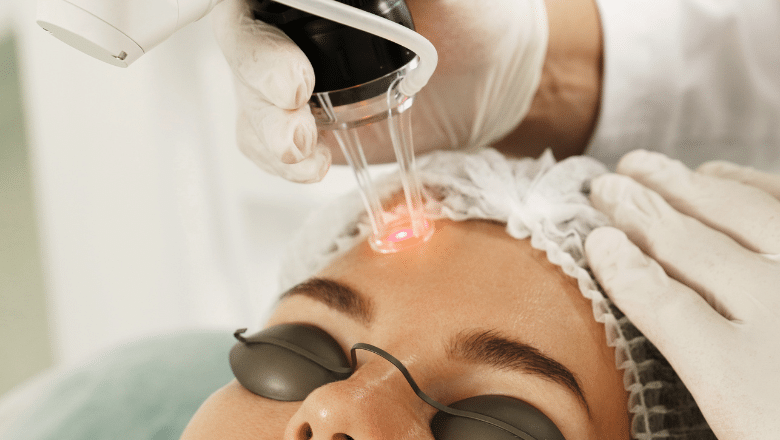
For fractional erbium YAG resurfacing — where laser energy is delivered in microscopic columns — the sensation during treatment is brief stinging in the moment of each pass, comparable to flicks of a rubber band on warmed skin. A topical anaesthetic cream applied for 30 to 45 minutes before treatment significantly reduces this. Most patients find the procedure entirely tolerable. Treatment time runs 30 to 60 minutes depending on area.
Fully ablative resurfacing
For full-thickness ablative treatments — where the entire epidermis is vaporised over the treatment area — the procedure is more intense and requires infiltrative local anaesthetic, sometimes combined with oral sedation. With appropriate anaesthesia, patients feel pressure and warmth but not pain. Without it, the sensation would be significant. We never run fully ablative protocols without proper anaesthesia.
Lesion removal
For individual skin lesion removal — moles, seborrhoeic keratoses, milia, skin tags — a small infiltration of local anaesthetic around the lesion eliminates discomfort entirely. The lesion is then vaporised over a few minutes. Patients feel nothing during the procedure itself.
What the recovery window feels like
Pain in the recovery window depends on the protocol depth.
Hours 0–48
The treated skin feels warm and tight — most patients describe it as like a moderate to severe sunburn. For fractional protocols this is mild and manageable with paracetamol. For fully ablative work it’s more pronounced but still controlled with standard pain relief. Cool compresses for short intervals and frequent application of the prescribed occlusive ointment help significantly.
Days 3–5
The burning sensation fades. The skin starts to feel itchy and tight as healing accelerates. This is psychologically challenging — the itch can be distracting — but isn’t painful. Keeping the area thoroughly moisturised reduces the urge to scratch.
Days 5–14
Peeling and re-epithelialisation. The skin feels tender to touch but isn’t actively painful unless directly pressed. By the end of this window most patients describe the area as merely “sensitive” rather than uncomfortable.
Weeks 2–6
Residual pinkness without significant discomfort. Skin may feel tight or dry for several weeks as collagen remodelling proceeds. Standard moisturiser keeps this comfortable.
For the full week-by-week recovery breakdown including what to expect at each stage, see our companion guide on how long it takes to heal after laser skin resurfacing.
How pain is managed
Several layers of pain management combine to make laser resurfacing comfortable.
Before treatment: Topical anaesthetic creams applied for 30 to 45 minutes numb the skin surface effectively. For deeper protocols, infiltrative local anaesthetic injected into the skin produces complete numbness in the treatment area. For fully ablative full-face protocols, oral sedation can be added to reduce anxiety and discomfort during the longer procedure.
During treatment: For Fotona protocols, the laser’s adjustable pulse profile lets the clinician deliver each pass at the most comfortable setting for that patient and area. Cooling air through the handpiece reduces the sensation further on settings where that’s helpful.
Immediately after: A cooling mask or aloe-based gel calms the post-treatment warmth. The prescribed ointment provides ongoing comfort during early healing.
During recovery: Paracetamol is sufficient for most patients. For fully ablative protocols, a few days of stronger pain relief may be prescribed. Cool compresses, head elevation overnight and avoiding heat exposure all help.
Comparing Er:YAG to CO₂ for comfort
One of the reasons we use erbium YAG rather than CO₂ for resurfacing at our clinic is the comfort difference. The Er:YAG wavelength produces less thermal spread, which translates directly into less discomfort during and after treatment.
Patients who have had both lasers consistently describe Er:YAG as more comfortable across the whole arc — gentler stinging during the procedure, milder post-treatment warmth, less prolonged tenderness during healing. The clinical evidence supports this experience: CO₂’s longer thermal effect drives more inflammation and a more uncomfortable recovery.
For a full comparison covering safety and outcomes as well as comfort, see our guide on erbium laser vs CO₂ laser resurfacing. For the technical reasons Er:YAG is more comfortable, see benefits of the erbium laser.
Factors that affect your pain experience
Within typical protocols, individual experience varies. Pain tends to be milder in patients who:
- Have prepared their skin appropriately — stopped retinoids and acids before treatment, applied SPF in the preceding weeks, kept skin well moisturised
- Follow aftercare protocols precisely
- Are well-rested and adequately hydrated on the day of treatment
- Aren’t taking medications that increase skin sensitivity (some antibiotics, NSAIDs in the 48 hours before treatment)
- Are non-smokers (smoking impairs wound healing and prolongs discomfort)
Pain tends to be more pronounced in patients with previous reactions to skin treatments, very thin or sensitive skin, or specific medical conditions affecting nerve sensitivity. Mention any of these at consultation — anaesthesia and protocol can be adjusted accordingly.
Comparing pain across treatment modalities
If you’re choosing between laser and other rejuvenation options, the comfort comparison:
- Non-ablative Fotona SMOOTH® treatments: warmth only; no anaesthesia needed
- Fractional Er:YAG: brief stinging with topical anaesthetic; well tolerated
- Fully ablative Er:YAG: comfortable with infiltrative anaesthetic; recovery moderately uncomfortable for 48 hours
- Morpheus8 RF microneedling: described as “spicy” — significantly more uncomfortable than fractional Er:YAG in the moment, but recovery is faster
- Chemical peels (medium-depth): stinging that builds during application; recovery can be uncomfortable for several days
- Surgical blepharoplasty or facelift: pain-free under general or twilight anaesthesia; tighter recovery comfort for the first week
What we don’t recommend
- Skipping topical anaesthetic to save time — the 30 to 45 minutes of preparation make the procedure substantially more comfortable. Use it.
- Fully ablative resurfacing without infiltrative anaesthetic — we don’t do this. Any clinic offering full ablative work with topical only is undertreating the discomfort.
- Aspirin or ibuprofen in the 48 hours before treatment — both increase bleeding and bruising. Stop these unless they’re medically necessary.
- Treating pain with alcohol — affects healing and increases bruising risk.
- Pushing through severe post-treatment discomfort — most pain after laser resurfacing should respond to paracetamol. If it doesn’t, contact us — occasionally signals an infection or other issue worth assessing.
Frequently asked questions
Is the laser more painful than I’m expecting?
For most patients, the procedure is more comfortable than they anticipated. The discomfort is short and managed.
What painkillers can I take after treatment?
Paracetamol is the first-line choice — it doesn’t affect bleeding or healing. Avoid aspirin and ibuprofen in the first 48 hours. For more demanding protocols, stronger pain relief may be prescribed.
Can I have anaesthesia if I’m anxious?
Yes — for longer or deeper procedures, oral sedation can be added to topical and infiltrative anaesthesia. Discuss this at consultation.
Will it hurt more in sensitive areas like around the eyes?
The periocular skin is more sensitive, but it’s also where we use the most controlled settings. For SmoothEye non-ablative protocols specifically, even patients with sensitive periorbital skin generally tolerate the treatment without anaesthesia.
How long does the post-treatment discomfort last?
The “sunburn” feeling fades within 24 to 48 hours for fractional protocols and 2 to 4 days for fully ablative. Mild tenderness on touch may persist for a week to ten days.
What if I have a low pain tolerance?
Tell us at consultation. We adjust protocols, build in more thorough anaesthesia, and can stage treatment over more shorter sessions rather than fewer intense ones. There’s no need to suffer through laser resurfacing.
Why choose Centre for Surgery
Our laser specialists deliver Fotona SP Dynamis Pro treatments with thorough anaesthesia, careful protocol selection and comprehensive post-treatment support. Pain management is part of the protocol, not an afterthought — and the result is treatments most patients describe as much more comfortable than they expected.
Centre for Surgery · CQC-regulated · GMC specialist-registered surgeons · 95–97 Baker Street, Marylebone, London W1U 6RN · 0207 993 4849 · Book a consultation · Finance from 0% APR