The skin around the eyes is the thinnest on the face and the first to show ageing. For many patients, the first noticeable sign that “something has changed” is loose, crepey skin on the upper or lower eyelid — a tired look that no amount of sleep seems to fix. Traditionally, surgical blepharoplasty was the only meaningful answer. Today, for mild to moderate laxity, SmoothEye laser eyelid tightening offers a genuinely effective non-surgical alternative.
This guide explains how SmoothEye works, where it sits relative to blepharoplasty, who it suits, and what realistic results look like at Centre for Surgery’s Baker Street private hospital.
What SmoothEye is
SmoothEye is a non-ablative laser treatment delivered on the Fotona SP Dynamis Pro using a proprietary Er:YAG SMOOTH® pulse profile. The “non-ablative” part is key: unlike laser resurfacing, SmoothEye doesn’t remove the skin surface. Instead, controlled pulses of laser energy pass through the epidermis and deposit heat in the deeper layers of the skin, triggering a collagen response without disturbing the surface.
The result is a treatment that delivers genuine eyelid tightening with essentially no downtime. There’s no incision, no needle, no recovery to plan around. Most patients walk out of the clinic and resume normal activity the same day.
How the tightening happens
The mechanism is collagen renewal. When the dermal layer is heated to a precise therapeutic range, two responses occur:
- Immediate collagen contraction — existing collagen fibres shorten in response to heat, producing visible firming within weeks
- Neocollagenesis — new collagen is laid down over the following two to three months, gradually thickening and tightening the skin from underneath
The skin around the eyes responds particularly well to this approach because of its thinness — heat reaches the appropriate dermal depth easily, and the collagen renewal makes a visible difference where every micron counts.
The treatment targets the skin around the eyelid rather than the eyelid surface directly. This protects the delicate eyelid margin while addressing the laxity, fine lines and crepey texture that affect the surrounding skin.
SmoothEye vs surgical blepharoplasty
The honest comparison is that these are different tools for different problems. SmoothEye and blepharoplasty aren’t competitors — they sit at different points on the same spectrum of eyelid rejuvenation, and the right choice depends on what your eyelids actually need.
SmoothEye is the right choice when:
- You have mild to moderate eyelid skin laxity
- You want to address fine lines, crepey texture or dullness around the eyes
- You’re not ready for surgery, or want to delay it
- You can commit to a course of treatments rather than a single intervention
- You want minimal disruption to work or social life
- You’re treating early ageing changes preventively
- You’ve had previous blepharoplasty and want to maintain the result long-term
Surgical blepharoplasty is the right choice when:
- You have significant excess upper eyelid skin (sometimes resting on the lash line)
- You have noticeable under-eye bags from herniated orbital fat
- The excess skin is heavy enough to impair peripheral vision
- You want a single-intervention result rather than a treatment course
- The structural changes are beyond what skin tightening can address
For a more detailed comparison of when each is appropriate, see our companion piece on non-surgical alternatives to blepharoplasty.
What SmoothEye treats well
The clinical indications fall into a few clear groups:
- Loose, crepey skin on the upper eyelid — mild to moderate; significant excess needs surgery
- Loose skin and fine lines on the lower eyelid — particularly the smooth-skinned area below the lash line where dynamic and static lines accumulate
- Periorbital fine lines and crow’s feet — see also our guide on getting rid of crow’s feet without injections
- Dull or tired-looking eyes from photodamage and reduced skin quality
- Under-eye wrinkles and skin texture — see our guide on how to get rid of under eye wrinkles
- Early preventive treatment for patients in their 30s and 40s
What SmoothEye doesn’t treat: significant herniated lower eyelid fat (the surgical “eye bag”), substantial excess upper eyelid skin, true ptosis (drooping upper lid from muscle weakness), or dark under-eye circles caused by hyperpigmentation rather than shadow.
What to expect during treatment
Your visit begins with a consultation in which a clinician examines the periocular skin, reviews your medical history and determines whether SmoothEye is the right approach. If there are factors that suggest you’d benefit more from blepharoplasty, we’ll say so honestly — the right answer for some patients is surgery, and we’d rather direct you appropriately than push a non-surgical option that won’t meet your expectations.
For the SmoothEye procedure itself:
- Preparation: skin is cleansed; protective eye shields are placed (essential — laser energy must not reach the eye itself)
- Optional topical anaesthetic: many patients tolerate the treatment without numbing cream, but it’s available if preferred
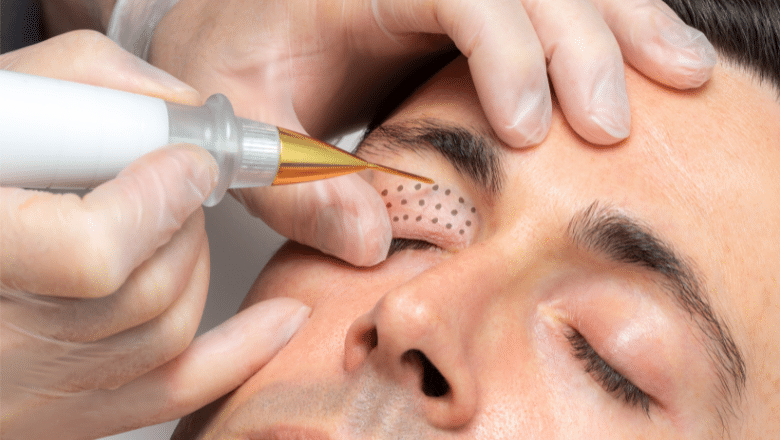
- Treatment: the Fotona handpiece is passed gently across the periorbital skin in sub-second pulses. The sensation is described as warm tingling — comfortable for most patients
- Duration: 15 to 20 minutes total
- Immediately after: skin may look mildly pink for a few hours. No dressings, no ointment, no restrictions
You can apply mineral makeup the next morning. Strict daily SPF 50 is essential for at least two weeks post-treatment, as with all laser work.
How many sessions you need
For most patients, a course of four to six sessions spaced two to three weeks apart delivers optimal results. Each session contributes to the collagen-stimulating effect, and the tightening builds gradually as new collagen forms.
After the initial course, results refine for another two to three months as collagen remodelling continues. Most patients then need one to two maintenance sessions per year to sustain the result.
Pricing
SmoothEye is priced per session, with discounted course packages available. A consultation gives you an exact quote based on your treatment plan. We offer finance from 0% APR through Chrysalis Finance.
How to prepare for SmoothEye
To get the best results and minimise the risk of side effects:
- Avoid sun exposure and tanning for three weeks before treatment — tanned skin contains more melanin, which competes for laser energy
- Stop tretinoin, glycolic acid and other strong actives one to two weeks before — these can increase skin sensitivity
- Apply daily SPF 50 for at least two weeks pre-treatment — protects the skin and stabilises baseline pigmentation
- Avoid ibuprofen and alcohol for 48 hours beforehand — both can increase bruising risk and slow healing
- Mention any history of cold sores at consultation — antiviral prophylaxis is available if relevant
- Arrive without eye makeup on the day of treatment
Combining SmoothEye with other treatments
SmoothEye works well as part of a broader rejuvenation plan:
- SmoothEye + anti-wrinkle injections — laser tightening for skin laxity plus muscle-relaxing injections for dynamic lines around the eyes
- SmoothEye + tear trough filler — under-eye hollow correction alongside skin quality work
- SmoothEye + Fotona 4D — comprehensive facial tightening with focused periocular treatment
- SmoothEye + post-blepharoplasty — long-term maintenance of surgical results
- SmoothEye + Profhilo — surface tightening plus deep hydration and bio-stimulation
For the underlying laser technology, see our deeper guide on the benefits of the erbium laser.
Side effects and safety
SmoothEye has an excellent safety profile when performed by experienced clinicians on appropriate candidates. Mild redness and warmth for a few hours after treatment is universal; some patients notice a slight pink flush in the periocular area for up to 24 hours. Bruising is rare. Significant complications — pigmentation change, prolonged redness — are uncommon and largely related to inadequate sun protection or treatment of unsuitable candidates.
Patients who should not have SmoothEye include those with active periocular skin infection, recent sunburn, active isotretinoin treatment, pregnancy, history of keloid scarring, or recent significant eye surgery. A consultation identifies any specific considerations.
What we don’t recommend
- SmoothEye in place of blepharoplasty for advanced laxity — no laser delivers the result of a properly indicated surgical lid lift. We’re honest about this at consultation.
- Single SmoothEye sessions for established eyelid changes — one session gives modest improvement at best. The result depends on completing a course.
- Skipping sun protection because the treatment is non-ablative — even without surface ablation, post-treatment skin is photosensitive. SPF 50 isn’t optional.
- Combining strong active skincare with SmoothEye too close to treatment — wait the recommended one to two weeks before and after.
Frequently asked questions
Does SmoothEye work on the upper or lower eyelid?
Both. The treatment targets skin around the eye on both sides — the same protocol addresses upper eyelid laxity, lower eyelid crepiness, and crow’s feet at the outer corners.
How long do SmoothEye results last?
After a full course, initial results are visible by week eight to twelve and continue to improve for up to a year. With one to two maintenance sessions per year, results can be sustained indefinitely.
Is SmoothEye painful?
Most patients describe the sensation as warm tingling — uncomfortable in a mild way rather than painful. Numbing cream is available if needed but most patients don’t ask for it after the first session.
How does SmoothEye compare to RF microneedling around the eyes?
Both can address mild eyelid laxity. SmoothEye has zero downtime and treats the most delicate periocular area; Morpheus8 is generally used away from the immediate eyelid for deeper tissue work. They can be combined.
Can SmoothEye treat dark circles?
Partial improvement is possible if dark circles are caused by thin skin showing underlying vessels — the collagen-thickening effect can help. If they’re caused by hyperpigmentation or tear-trough hollows, other treatments are more appropriate.
What about results compared to a facelift?
SmoothEye treats the eye area specifically. For the whole face, see facelift surgery or Fotona 4D as broader options.
Why choose Centre for Surgery
We deliver SmoothEye on the Fotona SP Dynamis Pro at our Baker Street private hospital — the same platform used internationally for clinical research into eyelid laser tightening. Treatments are performed by clinicians experienced in tailoring protocols to skin type, age and degree of laxity. We’re a CQC-regulated provider operating in a full private hospital environment.
Centre for Surgery · CQC-regulated · GMC specialist-registered surgeons · 95–97 Baker Street, Marylebone, London W1U 6RN · 0207 993 4849 · Book a consultation · Finance from 0% APR