A “non-surgical neck lift” isn’t a single procedure — it’s a planned combination of non-surgical treatments designed to address the visible signs of neck ageing without surgery. The right combination depends entirely on which aspect of neck ageing is dominant in your particular case: skin laxity, platysmal banding, submental fat, or skin quality deterioration.
For mild to moderate neck ageing, the right combination of treatments produces meaningful improvement. For significant skin laxity or pronounced platysmal banding, the honest answer is that no non-surgical approach matches what a surgical neck lift delivers — but understanding what each non-surgical option can and can’t do helps make the right decision.
What changes in the ageing neck
The neck ages on four distinct axes, and most patients are seeing some combination of all of them:
Skin quality. The dermis thins, loses elastin, and develops fine horizontal lines (often called “necklace lines”). The skin becomes crepey to the touch — a texture change that’s particularly pronounced on the neck because the skin there is thinner than facial skin.
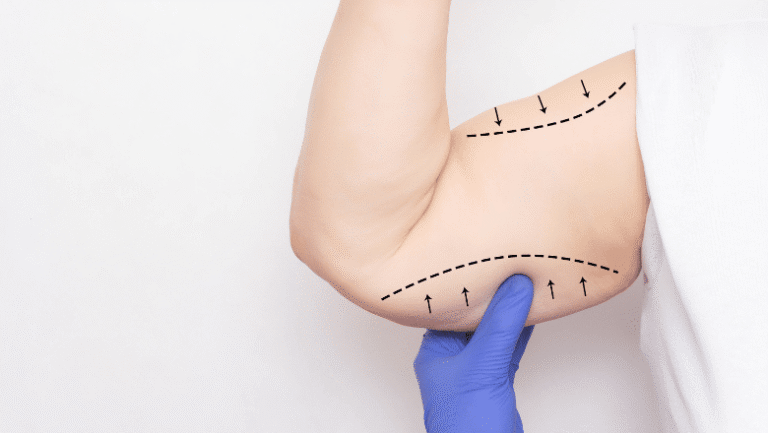
Skin laxity. As collagen breaks down, the skin loses its retractive ability. Mild laxity is what gives a soft, slightly loose appearance under the jaw. Severe laxity is hanging skin that has separated from the underlying tissue plane.
Submental fat. The fat pad beneath the chin can be genetic (present from a young age) or accumulated (developing with weight gain or age). It blunts the cervicomental angle — the sharp 90-degree corner between chin and neck that defines a youthful jawline. Persistent submental fat that doesn’t respond to weight loss can be treated with submental liposuction.
Platysmal banding. The platysma is a thin sheet of muscle covering the front of the neck. With age, its two inner edges separate and become visible as vertical cords running from the jaw to the collarbone.
Non-surgical treatment addresses the first two effectively, the third partially, and the fourth not at all. Knowing which problem you actually have determines which treatment makes sense.
For the related question of how to manage these changes specifically with energy-based treatments, see our comprehensive guide on how to tighten neck skin without surgery.
Anti-wrinkle injections for platysmal banding
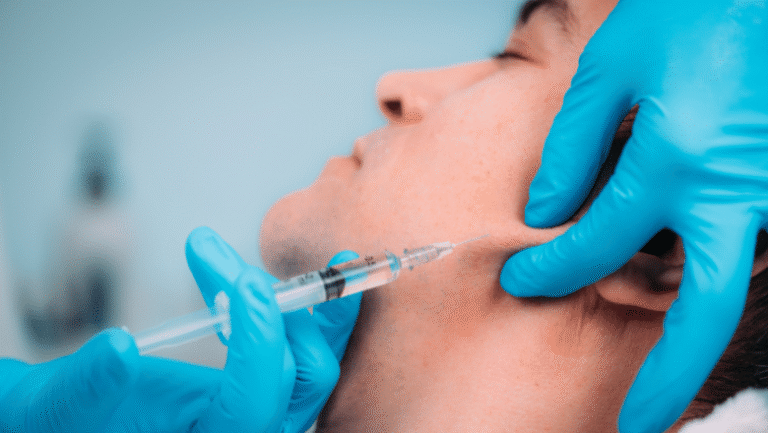
Anti-wrinkle injections placed into the platysma muscle relax the muscular cords that produce visible banding. The effect is best for mild to moderate banding — patients with very pronounced platysmal cords typically need surgical platysmaplasty for definitive correction.
What to expect:
- Small doses placed at multiple points along each platysmal band
- Treatment takes 10-15 minutes
- Effect develops over 2 weeks
- Result lasts 3-4 months
- Maintenance every 3-4 months
Cost: from £350 per session.
This treatment is sometimes called a “Nefertiti lift” — placing AWI along the lower jaw and upper neck to soften the platysmal pull on the jawline. The Nefertiti reference comes from the elegant neckline of the Egyptian queen — though the historical accuracy of that comparison is more marketing than substance.
Morpheus8 radiofrequency microneedling
Morpheus8 combines microneedling with deep radiofrequency energy. For the neck, it’s particularly effective because:
- The under-chin and upper-neck region has thicker skin that responds well to deep RF
- It can reduce small pockets of submental fat at deeper settings
- It tightens skin from below through collagen contraction and stimulation
- Effect develops over 8-12 weeks following each session
What to expect:
- Topical anaesthetic for about 45 minutes before treatment
- Procedure takes 30-45 minutes
- Heat-and-pressure sensation during the passes
- 4-7 days of pinkness with tiny scabs that flake away
- Course of 2-3 sessions spaced 4-6 weeks apart
How long it lasts: 12-24 months from a completed course.
Cost: from £650 per session.
Fotona4D laser facelift
Fotona4D uses dual laser wavelengths in four sequential treatment modes including an intra-oral pass. For the neck, it produces:
- Immediate collagen contraction during treatment
- Stimulated collagen production over 8-12 weeks
- Improvement in skin quality and texture alongside tightening
- No significant downtime — patients return to normal activities immediately
What to expect:
- Sessions take 45-60 minutes
- Warm sensation during treatment, no significant pain
- Mild redness for a few hours
- Course of 3-4 sessions spaced 4 weeks apart
How long it lasts: 12-24 months from a completed course.
Cost: from £600 per session.
Profhilo and polynucleotides for skin quality
For patients whose primary neck concern is crepey, thin, or poor-quality skin rather than significant laxity, bioremodelling treatments improve dermal quality.
Profhilo uses high-concentration HA injected at specific points across the neck to improve overall skin hydration, elasticity, and quality. Two sessions four weeks apart, with maintenance every 6-9 months. See our comprehensive Profhilo guide for detailed coverage.
Polynucleotide treatment uses DNA-derived molecules to stimulate fibroblast activity. Works on similar principles to Profhilo through different biological mechanisms. Often combined with Profhilo or used in patients who want more aggressive texture improvement.
Cost: Profhilo for face/neck/décolletage from £700 per session; polynucleotides from £550 per session for the neck.
FaceTite for substantial tightening
For patients with more substantial neck laxity than non-invasive treatment can address, FaceTite delivers radiofrequency energy below the skin via a small probe inserted through tiny incisions. Single-session treatment produces meaningful skin tightening with about a week of recovery.
This sits between fully non-invasive treatment (Fotona4D, Morpheus8) and surgical neck lift — minimally invasive, performed under local anaesthesia, with results developing over 3-6 months.
Cost: from £2,500 for the neck.
Combination treatment plans
A typical non-surgical neck lift plan combines several treatments to address different aspects of the ageing neck:
Early signs of ageing (late 30s, early 40s): Profhilo or polynucleotides for skin quality, with anti-wrinkle injections for any platysmal banding. Annual maintenance.
Moderate ageing (40s to early 50s): Morpheus8 or Fotona4D for skin tightening, combined with Profhilo for ongoing skin quality. AWI for platysmal banding if present.
More advanced ageing without significant laxity (50s+): FaceTite + Morpheus8 + Profhilo, with AWI maintenance for platysmal cords. By this stage, the conversation often shifts toward whether surgery would deliver substantially better results.
Post-surgical maintenance: patients who’ve had neck lift or facelift surgery use a non-surgical neck lift package as ongoing maintenance — annual Morpheus8 plus AWI plus occasional Profhilo. The combination keeps the surgical result fresh.
The combinations aren’t fixed. A consultation tailors the plan to your specific anatomy, concerns, and lifestyle.
When surgery is the right answer
The honest threshold: a simple test — pinch the loose neck skin gently and let go. If it springs back immediately, non-surgical treatment is likely to help. If it tents momentarily before settling, the skin volume exceeds what collagen stimulation can correct.
Other indicators that surgery is more appropriate than continued non-surgical treatment:
- Pronounced platysmal banding visible at rest
- Significant submental fullness not responding to weight loss
- Diminishing returns from previous non-surgical treatment
- Increasing total cost of non-surgical treatment approaching or exceeding surgical cost
- Significant loose skin requiring excision rather than tightening
Surgical options for neck rejuvenation include:
- Mini neck lift — for moderate skin laxity and some platysmal banding without requiring full facelift
- Full neck lift — comprehensive correction including platysmaplasty
- Submental liposuction — addressing submental fat (often combined with skin tightening)
- Combined facelift + neck lift for patients with significant lower-face descent alongside neck changes
For the broader comparison, see our guide on neck lift surgery vs non-surgical neck rejuvenation.
For the broader non-surgical context across the face, see the non-surgical facelift hub and anti-ageing treatments hub.
Who is a good candidate?
The ideal candidate for non-surgical neck treatment has:
- Mild to moderate skin laxity with reasonable elasticity
- Skin quality concerns — crepiness, fine lines, texture deterioration
- Mild platysmal banding responsive to AWI
- Minimal submental fullness or fullness that can be addressed alongside skin tightening
- Realistic expectations about subtle improvement rather than transformation
- Willingness to maintain with periodic treatment
Less suitable candidates:
- Patients with significant loose skin requiring excision
- Patients with pronounced platysmal banding
- Patients with substantial submental fat
- Patients wanting dramatic, definitive change
Cost summary
- Anti-wrinkle injections for platysmal bands: from £350
- Fotona4D: from £600 per session (course of 3-4)
- Morpheus8: from £650 per session (course of 2-3)
- Profhilo: from £700 per session for face/neck/décolletage
- Polynucleotides: from £550 per session for neck
- FaceTite: from £2,500 for the neck
A typical combined non-surgical neck treatment plan costs £2,500-£5,000 over an initial 3-6 month course, with maintenance approximately annually.
Finance options through Chrysalis Finance, including 0% APR, are available across all treatments.
A useful comparison: combined non-surgical treatment over 5-10 years often approaches or exceeds the cost of surgical neck lift. For patients who would ultimately need surgery anyway, choosing surgery earlier is sometimes more cost-effective.
Procedure timeline
Day of treatment: session takes 30-90 minutes depending on the treatment. Mild redness or swelling immediately afterward. Most patients return to normal activities immediately or the next day.
First week: any initial swelling or redness resolves. AWI effects begin to develop.
Weeks 2-4: AWI fully effective. Initial skin tightening from energy-based treatments visible. Profhilo’s bioremodelling effect begins.
Weeks 4-12: meaningful improvement develops as collagen production responds to energy-based treatment.
Months 3-6: full effect of treatment course visible. Stable result.
Months 6-12: maintenance treatment scheduled to sustain the result.
Common questions
Can non-surgical treatment really replace a neck lift?
For mild to moderate neck ageing, yes — meaningfully. For significant skin laxity or pronounced platysmal banding, the honest answer is no.
How long until I see results?
AWI — 2 weeks. Profhilo and polynucleotides — gradual over 4-8 weeks. Fotona4D and Morpheus8 — gradual over 8-12 weeks. FaceTite — gradual over 3-6 months.
Will I need maintenance?
Yes for all non-surgical treatments. AWI every 3-4 months. Profhilo every 6-9 months. Energy-based treatments annually.
What about thread lifts for the neck?
PDO thread lifts are sometimes marketed for neck rejuvenation. The evidence base is mixed — results are typically modest and short-lived, and complications (thread migration, lumping, asymmetry) can be difficult to correct. We don’t offer PDO threads at Centre for Surgery; for patients needing lift beyond what filler and energy-based treatments can provide, surgical options are the appropriate intervention.
Can I combine treatments?
Yes — most combinations are appropriate, with appropriate sequencing (energy-based and injectables typically 2 weeks apart). A combined plan addresses multiple aspects of neck ageing.
Is there pain or discomfort?
AWI and Profhilo — minimal discomfort. Energy-based treatments — heat-and-pressure sensation with topical anaesthesia. FaceTite — performed under local anaesthesia.
What if my neck has lots of loose skin?
Loose skin that tents when pinched is unlikely to be adequately addressed by non-surgical treatment. Surgery is more likely to deliver the result you want.
How do these treatments compare with neck creams or topical products?
Topical products work on the outer layers of skin only. Energy-based treatments and injectables work on the dermis and deeper tissues where ageing changes actually occur. The depth of effect is substantially different.
Centre for Surgery · CQC-regulated · GMC specialist-registered surgeons · 95–97 Baker Street, Marylebone, London W1U 6RN · 0207 993 4849 · Book a consultation · Finance from 0% APR