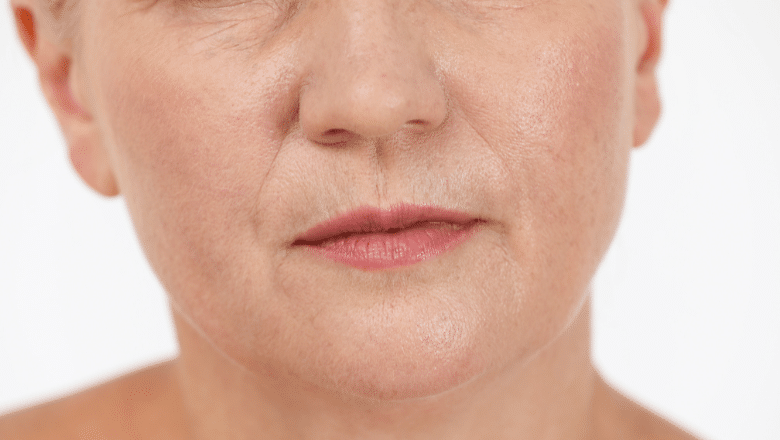

Smoker’s lines — also called perioral lines, lipstick lines, or barcode lines — are the fine vertical wrinkles that develop above the upper lip. They’re called smoker’s lines because smoking accelerates their formation, but they appear in non-smokers too, and they’re one of the more challenging areas of the face to treat well.
This guide covers the anatomy that produces them, why they’re harder to treat than wrinkles elsewhere, and the realistic options at each stage — from skincare through to lip lift surgery.
The anatomy
The muscle responsible is the orbicularis oris — the circular muscle that surrounds the mouth and controls every lip movement: speaking, kissing, eating, drinking through a straw, whistling. Unlike most other facial muscles, it doesn’t attach to bone — it sits in a sphincter pattern around the mouth, with its fibres inserting into the skin directly.
This anatomy explains two things about smoker’s lines:
Why they form so consistently. The orbicularis oris contracts many thousands of times a day in normal use. Every contraction folds the overlying skin radially toward the lip. Combined with the very thin skin in this area, the lines etch in quickly.
Why anti-wrinkle injections are tricky here. The orbicularis oris controls essential functions — speech, eating, drinking, kissing. Over-relaxation produces difficulty with these activities. Doses used in this area must therefore be very small, and the technique is more demanding than for upper-face treatment.
What causes them
Repetitive lip movement is the underlying mechanism. Anyone whose lips are active — speakers, singers, wind instrument players — develops perioral lines over time.
Smoking accelerates the process in two ways: the pursing action of inhalation adds mechanical wear above the baseline, and the chemical effect of smoke directly degrades dermal collagen and impairs blood supply to the skin. Long-term smokers consistently develop deeper, more etched perioral lines than non-smokers.
UV exposure is the second largest modifiable factor. The upper lip area takes significant UV without much natural protection.
Sleep position. Patients who consistently sleep face-down or with one side of the mouth pressed into the pillow develop asymmetric perioral lines.
Volume loss. As the lips and surrounding area lose volume with age, the skin above the lip slackens and the lines deepen. Volume loss in the lip itself shortens the lip vertically, exaggerating the lines above it.
Loss of the white roll and Cupid’s bow definition with age contributes to the area looking less crisp overall.
For an overview of how skin ageing progresses, see our guide on fine lines versus wrinkles.
Treatment options
Skincare and lifestyle
The baseline interventions are the same as for facial ageing in general but matter particularly here:
Stop smoking — this is the single highest-impact intervention if you’re a current or former smoker. Existing lines won’t disappear, but progression slows substantially.
Daily broad-spectrum SPF applied to the upper lip area, including reapplication after eating or drinking.
Topical retinoids build dermal collagen and thicken the skin over time. Start low and build tolerance.
Vitamin C serum provides antioxidant protection and supports collagen synthesis.
A good lip balm with SPF in daytime reduces the constant mechanical wear from lip-licking.
These steps slow the progression of new lines but don’t reverse established ones.
Dermal fillers
For mild to moderate established lines, hyaluronic acid filler placed precisely into the lines themselves and into the upper lip border (the white roll) softens the lines and restores definition.
The technique varies based on what the patient needs:
Direct line filling uses very small amounts of soft, low-viscosity HA placed within each visible line. This requires a delicate hand and the right product choice — a soft, finely-tuned filler designed for superficial placement, not the more robust cheek fillers.
Lip border restoration places a small amount of filler along the vermilion border (where the lip meets the skin) to restore the natural ridge that fades with age. Improving the border indirectly improves how the lines above it read.
Lip volume restoration with lip filler can address the underlying lip thinning that exaggerates perioral lines. Modest volume restoration often improves the visual impact of the lines above without needing to fill them directly.
What to expect. Topical anaesthetic is applied for 15-20 minutes before treatment. The filler product contains lidocaine. The session itself takes 20-30 minutes. Mild swelling and possible bruising for 2-3 days afterwards.
Results last 6 to 12 months depending on the product and individual metabolism. The treatment can be reversed with hyalase if needed.
Anti-wrinkle injections — small role, small doses
Very small doses of botulinum toxin into the orbicularis oris (1 to 2 units total, distributed across 4 points along the upper lip border) can soften the dynamic component of perioral lines — what’s sometimes called a “lip flip.” This relaxes the muscle just enough to reduce the mechanical wrinkle-forming action without compromising essential lip function.
The doses must be very conservative because the orbicularis oris controls essential daily activities. Over-treatment produces difficulty pronouncing certain consonants (P, B, M), difficulty drinking from a straw, asymmetric smile, or temporary numbness of feel. These effects resolve when the toxin wears off but are unwelcome in the meantime.
For this reason, AWI for the perioral area should only be performed by experienced injectors who know exactly how much is safe in this anatomically demanding location.
Energy-based treatments
For static lines that haven’t responded fully to filler, energy-based skin treatments stimulate collagen and improve skin quality:
Morpheus8 — radiofrequency microneedling reaches the deeper dermis and produces stronger remodelling. Recovery is 4 to 7 days. Particularly useful for the upper lip where skin texture has become crepey.
Laser resurfacing — including erbium and CO2 ablative laser — removes the top layer of damaged skin and stimulates significant collagen remodelling. Recovery is longer (10-14 days for ablative treatments), but the results for established perioral lines can be substantial. Often the right answer for patients with significant established lines who want a single treatment with a meaningful improvement.
Fotona 4D — combines four laser modes with no significant downtime. Useful for milder lines and as maintenance.
Multiple sessions are typically needed for non-ablative treatments; ablative resurfacing usually produces results in a single session.
Surgery — when the underlying issue is structural
For patients whose perioral concerns include lip thinning, lengthening of the upper lip with age, or descent of the lip corners, surgical treatment is sometimes more effective than continuing non-surgical maintenance.
Lip lift — a small surgical procedure that shortens the space between the nose and the upper lip and restores the upward curve of the lip. The procedure itself takes about an hour under local anaesthetic. Recovery is around 2 weeks, with sutures hidden at the base of the nose. The lift naturally reduces the area on which perioral lines etch and produces a more youthful lip position.
Facial fat transfer — the patient’s own fat is harvested, processed, and re-injected into the lips and perioral area. Unlike filler, the result is permanent for the fraction that survives transfer. Often combined with other facial work.
Mini facelift or full facelift — for patients with significant lower-face descent contributing to perioral and marionette line concerns. The lift repositions descended tissue and addresses the broader context of which perioral lines are one feature.
A consultation with our specialist team — including Dr Spyridon Vlachos — establishes which approach matches your anatomy and goals.
How to decide which treatment fits
Mild dynamic lines, visible during expression only: conservative AWI with a small dose into the orbicularis oris, plus daily SPF and good skincare.
Mild to moderate static lines: filler into the lines and along the lip border, plus lip filler if there’s volume loss contributing. Energy-based treatment as a complement if skin quality is a concern.
Established static lines with skin texture changes: energy-based treatment becomes the primary intervention. Laser resurfacing (erbium or CO2) is the strongest non-surgical option. Filler provides ongoing maintenance.
Significant perioral ageing with lip thinning, lengthening, or corner descent: surgical assessment. Lip lift addresses the structural changes that filler and laser can’t.
For most patients, combination treatment over time produces the best result — never relying entirely on one approach, and progressing through the stages as needed.
What we don’t recommend
Branded fillers as marketing tools. We use HA fillers chosen for their suitability for the specific area, not for brand recognition. Patients should be skeptical of clinics promoting specific filler brands as a selling point.
Microdermabrasion as primary treatment. The mechanical exfoliation it provides doesn’t reach the dermal level where perioral lines actually live. For superficial concerns, a topical retinoid produces more meaningful long-term benefit.
Aggressive chemical peels for established lines. These can produce significant downtime and pigmentation issues, particularly in patients with skin tones outside the lightest range. Energy-based laser treatment is generally a more predictable and controllable option.
Cost
Filler for the perioral area is priced per syringe, with most patients needing 1 syringe for line and border work. Lip filler is usually a separate syringe if volume restoration is part of the plan. Laser resurfacing varies by depth and area. Surgical options (lip lift, fat transfer, facelift) vary substantially. Finance options through Chrysalis Finance, including 0% APR, are available.
Common questions
I’ve never smoked — why do I have these lines?
Smoker’s lines is a misleading name. The vast majority of patients with perioral lines aren’t smokers — they have lines because the orbicularis oris muscle works the same way in everyone. Smoking accelerates the process but isn’t required for it.
Why can’t anti-wrinkle injections solve this completely?
The dose required to fully relax the orbicularis oris would compromise speech, eating, and other essential functions. Conservative AWI helps with the dynamic component of perioral lines but doesn’t reverse static lines that have already etched into the skin. Combined treatment is almost always needed.
Can filler in my lip lines look obvious?
Yes — if too much is used, or the wrong filler is chosen, or if it’s placed too superficially, the result can look bumpy or unnatural. This is why the choice of filler product matters and why an experienced injector matters. Subtle results in this area require very small amounts of soft, low-G’ (softer) HA filler placed precisely.
How long after laser resurfacing will I see results?
Initial improvement is visible as soon as the surface heals (around 10-14 days for ablative treatments). The deeper collagen remodelling continues for 3 to 6 months — patients see the full result at that point.
If I’m planning a lip lift later, should I keep getting filler now?
Worth a specific discussion with your surgeon. Recent filler can complicate surgical planning, so most surgeons prefer at least 6 months between any HA filler treatment and surgery (or have the filler dissolved with hyalase a few weeks before).
Centre for Surgery · CQC-regulated · GMC specialist-registered surgeons · 95–97 Baker Street, Marylebone, London W1U 6RN · 0207 993 4849 · Book a consultation · Finance from 0% APR
Medically reviewed by Dr Spyridon Vlachos, GMC 7522950.