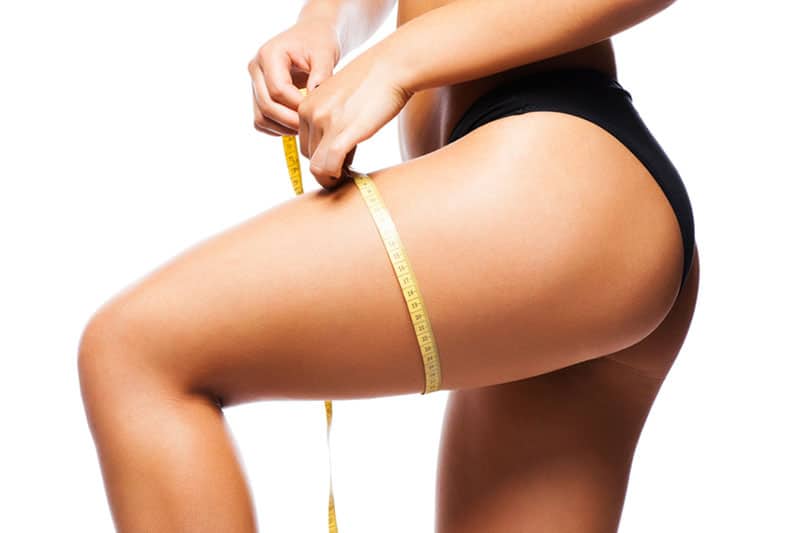
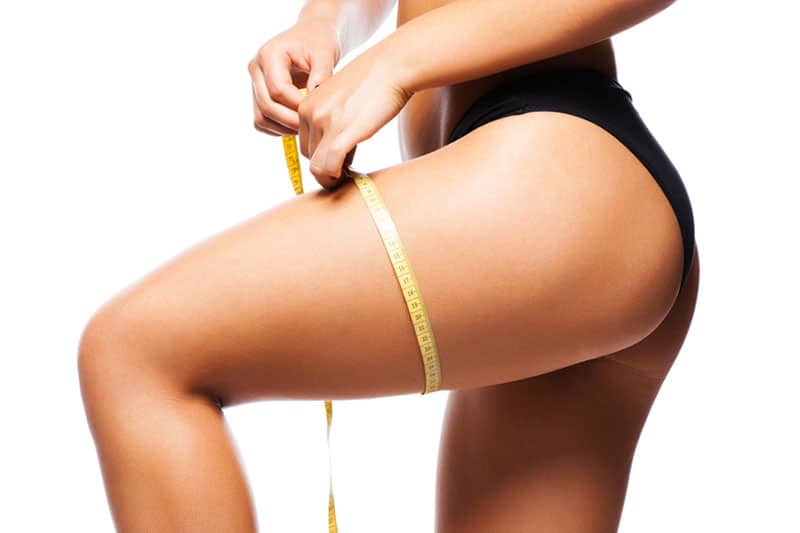
Thigh liposuction is one of our most popular procedures for removing excess fat from the thighs. Many patients consult with us to reduce inner thigh fat to improve cosmetic appearance and eliminate chafing between the thighs. Thigh liposuction may also be combined with liposuction of the hips to remove unsightly bulges of prominent fat referred to as ‘saddlebags’.
Thigh liposuction involves mechanically detaching fat cells from surrounding connective tissue using specialised vibrating cannulas, which are then gently extracted with vacuum suction. Patients can look forward to slimmer, more sculpted thighs that often appear more toned. Some patients may be able to achieve an inner thigh gap with inner thigh liposuction.
Stretch marks and cellulite often coexist with excess thigh fat. Liposuction is not a recognised treatment for either of these conditions. However, at Centre for Surgery, we have two highly effective treatments: CelluTite for cellulite removal and Morpheus8 for stretch marks.
What does liposuction of the thighs involve?
Thigh liposuction is most commonly used to get rid of inner thigh fat and can also be performed on the outer thighs to get rid of saddle bags, which are the localised prominences of fat located over the hip bones. There is also the option of 360 liposuction of the thighs, which involves circumferential liposuction of both the inner and outer, front and back of the thighs and is commonly combined with liposuction of the knees.
Once you have decided to learn more about thigh liposuction, we recommend a face-to-face consultation with one of our expert body-contouring surgeons to assess your suitability for the procedure. As with all procedures at the Centre for Surgery, liposuction is performed as a day-case procedure, which means you can recover in the comfort of your own home later the same day.
Although thigh liposuction can be performed under both general and local anaesthesia, local anaesthesia is ideally suited only to small, localised areas. In all other cases, we would recommend a general anaesthetic for your complete comfort both during and after the procedure. Unlike traditional general anaesthetics used in hospitals, our anaesthetists are experts in total intravenous anaesthesia (TIVA), using short-acting medicines to ensure your recovery is rapid and free of dizziness or sickness.
Once your anaesthetist has put you to sleep, the areas of excess thigh fat will be accessed via tiny incisions, which permit access to specialised liposuction cannulas to efficiently break up fat cells and detach them from their surrounding connective tissue. Tiny incisions mean any potential scars are barely visible six weeks later. We most commonly use power-assisted liposuction to gently remove fat cells. This gentle removal process also means fat cells can easily be used for fat transfer. Many patients commonly choose to combine thigh liposuction with fat transfer. The most common areas for fat transfer include the buttocks (also known as a Brazilian butt lift, or BBL) and the breasts. Fat transfer to the breasts is known as a natural method of breast augmentation, as it uses your own body fat and does not involve silicone implants.
Once the thigh lipo procedure is complete, your surgeon will remove any residual anaesthetic fluid before applying sterile dressings to the treatment areas. You will recover in our specially designated recovery area, where a highly trained recovery nurse will closely monitor you. Once you are fit for discharge, you can go home with a responsible adult who will need to look after you for the first 24 hours after your thigh liposuction procedure.
One of the most common questions is, “Do fat cells grow back once they are removed?”. In all liposuction cases, and as long as you maintain a healthy lifestyle by eating sensibly and exercising regularly, your thighs will keep their new sculpted look. Fat does not grow back after liposuction.
Once the thigh liposuction procedure is complete, our theatre nurses will apply a specialised lipo compression garment that must be worn for at least 4 to 6 weeks. The surgical garment is designed to speed up the resolution of post-surgical swelling and help the thighs optimise their contour by keeping the skin firmly pressed down. Patients with a healthy body mass index below 25 are more likely to achieve aesthetically pleasing results than those with a BMI over 30. We recommend losing weight if your body mass index is over 30, as you may not see significant results.
Achieving the best thigh liposuction results depends on following all of your surgeon’s post-operative instructions to optimise healing and recovery. In most cases, patients can expect to fully recover from thigh liposuction between 6 and 8 weeks after the procedure. Your surgeon will review you at 6 weeks, and initial results will become evident by then, but final results are expected between 3 and 6 months after surgery. Thigh liposuction is a body-contouring procedure and should not be viewed as a specific treatment for weight loss. Patients seeking obesity treatment would be better advised to consider weight loss surgery if dieting and exercise have failed.
What are the benefits of thigh lipo?
Thigh lipo is a minimally invasive procedure with a short recovery period and can transform a patient’s self-confidence. The many benefits of thigh lipo include:
- More sculpted thighs
- Thinner thighs
- Ability to create a thigh gap
- Eliminate chafing of inner thigh skin
- Clothes fit better
- Patients can wear fitted clothing without feeling self-conscious.
- An improvement in emotional well-being
- Reduced anxiety and stress
- Ability to combine the procedure with fat transfer
Who are the most appropriate candidates?
Your surgeon will assess you at a one-on-one consultation to determine your suitability and will take the following factors into account:
- You have a body mass index below 30
- You are in good physical health with no chronic medical conditions like heart disease.
- You are concerned about the appearance of fat thighs
- You suffer from skin irritation from inner thighs rubbing together, and are keen to get rid of inner thigh fat
- You have realistic expectations of what thigh liposuction can achieve and are aware of the risks and complications of the procedure.
Can thigh liposuction be combined with other types of body contouring surgery?
Thigh liposuction is commonly carried out on its own, whether to treat the inner or outer thighs. Inner thigh liposuction is often combined with knee liposuction to remove fat from the knees. Thigh lipo can also be combined with liposuction in other body areas, such as the stomach or back. 360 liposuction is one of our most popular liposuction treatments at Centre for Surgery, delivering dramatic results.
What are the common liposuction areas?
Many patients develop loose skin on their thighs and are understandably concerned about the appearance of sagging. Many patients choose to combine thigh liposuction with a thigh lift to remove both excess fat and loose skin from the inner thighs.
Due to highly sophisticated fat-removal techniques, the fat cells are well preserved after removal. They can be used in a fat transfer procedure to enhance volume in another part of the body. Fat transfer involves liposuction as the first step to remove the fat, which is then injected into another area. The most common body fat transfer procedures are gluteal and breast fat transfer. Facial fat transfer may also involve thigh liposuction to remove thigh fat.
Fat transfer to the buttocks can also improve their firmness. In moderate to severe cases of saggy buttocks, patients may wish to consider having a surgical buttock lift procedure, which involves the removal of skin and fat from the area joining the lower back with the upper part of the buttocks. This procedure results in the buttocks appearing more lifted and can be combined with a Brazilian butt lift (BBL) to increase projection and volume in the buttocks.
Mummy makeover surgery is an all-in-one procedure and most commonly involves a combination of methods, including breast augmentation and breast lift combined with liposuction of the abdomen or thighs. Abdominoplasty or tummy tuck surgery may be combined with stomach liposuction for women with loose skin after pregnancy. The purpose of a mummy makeover is to restore a woman’s body to its pre-pregnancy shape.
Cellulite most commonly affects the outer thighs and buttocks and is easily treatable with an innovative procedure we offer at Centre for Surgery called CelluTite. CelluTite is a radiofrequency treatment combined with cellulite subcision to effectively break up the vertical bands, which pull the skin inwards, giving rise to a dimpled or pitted skin appearance. CelluTite can be combined with thigh liposuction to remove fat thighs and cellulite.
Please get in touch with us to arrange a consultation with an expert surgeon who can advise you on the optimal combination of treatments to achieve slimmer, toned thighs.
Why choose Centre for Surgery?
Patients choose Centre for Surgery for their thigh liposuction procedure for several reasons, including:
- Centre for Surgery is one of the top cosmetic clinics in London and has an excellent reputation, as shown by hundreds of verified five-star Google and Trustpilot reviews
- We only work with fully GMC-registered liposuction specialists with experience performing all types of thigh liposuction.
- Our patient satisfaction rate after liposuction exceeds 95%, and many patients recommend us to friends and family.
- We pride ourselves on using only the most effective, medically proven liposuction techniques to achieve the best possible results.
- We are a specialised case facility, with our state-of-the-art Baker Street clinic in Marylebone among London’s leading cosmetic surgery clinics.
- Our preoperative and postoperative nursing team keeps in regular contact with you to ensure you are fully prepared for your procedure and that your healing after the procedure proceeds as smoothly as possible.
- Our surgeons are experts in all types of liposuction, including SmartLipo, VASER liposuction, Tickle Lipo, Body-Jet, MicroAire, and PAL Lipo.
- We are one of the few cosmetic surgery providers specialising in total intravenous anaesthesia to enable rapid recovery after your procedure, allowing you to go home later the same day.
How much does thigh liposuction cost?
Thigh liposuction starts from £3500 at the Centre for Surgery. The cost of the procedure will increase if you plan to include additional liposuction areas. Many patients choose to have 360 liposuction of the thighs, which costs approximately £6000. The cost of inner liposuction in the UK depends on whether the inner and outer thighs are treated together and whether liposuction is performed elsewhere, such as the stomach or chest.
Thigh lipo cost includes all preoperative and post-operative care, unlimited surgeon follow-ups after your procedure, anaesthetist fees, facility fees and your allocated patient coordinator to answer your questions and concerns during your patient journey with Centre for Surgery. The Care Quality Commission has described our post-operative nursing care as ‘outstanding’.
Online prices should be viewed as a rough guide only, and accurate thigh liposuction costs will be given once you have consulted the surgeon. Our patient coordinator will provide you with the cost of your treatment after the consultation.
Thigh liposuction is not available on the NHS, and the treatment is only available at private clinics, where you will have to fund the cost of the procedure yourself or in conjunction with a finance plan. Centre for Surgery has partnered with Chrysalis Finance to offer our patients affordable financing for liposuction.
What are the causes of fat thighs?
The development of fat thighs is linked to several potential lifestyle factors. Many people increasingly lead sedentary lifestyles, with little or no exercise on a typical day, and this is combined with a highly calorific diet. People who consume high amounts of sugary and fatty foods, with little or no vegetables and fruit, are more likely to develop increased overall body fat and the risk of fat thighs. Many people who drink alcohol are often unaware that certain alcoholic beverages contain a significant amount of sugar, which results in a high-calorie count.
The size and shape of the thighs can also be determined by hereditary factors, with certain people more likely to have fat thighs if they run in the family, even if they eat a healthy diet and exercise regularly. One’s gender can also affect the appearance of inner and outer thigh fat. Women are more likely to have prominent fat deposits on the outer hips, known as ‘saddlebags’. These prominent areas of fat appear most apparent when viewed face-on and typically develop during puberty when circulating oestrogen levels rise. Saddlebags rarely occur in isolation and are often accompanied by fatty prominence elsewhere, such as large buttocks and fat knees.
In women, excessive fat tends to accumulate in certain areas of the body, such as the inner thighs, and this is more likely with the natural ageing process. Significant weight gain and ageing are the main factors in the development of fat thighs; however, some women may be genetically predisposed to large thighs. Many patients come to see us when they are bothered by thigh chafing caused by the inner thighs rubbing together while walking or running.
As many women approach menopause, the levels of oestrogen in the body begin to decline significantly. Although many women may be looking forward to losing thigh fat, sadly, this does not occur. This is because your basal metabolism begins to decrease during menopause, making it easier to gain weight despite a normal diet and regular exercise.
Pregnancy is often when women may begin to develop larger thighs due to weight gain. Many women have significant difficulty getting rid of their pregnancy-related weight gain, and so come to the Centre for Surgery to consider thigh liposuction. Our surgeons commonly combine thigh lipo with other procedures as part of a mummy makeover to restore a woman’s body contours to their pre-pregnancy shape.
How can I reduce thigh fat without surgery?
Most people with excess thigh fat struggle to achieve slim-looking thighs. The best way to get rid of fat thighs is to adopt healthy lifestyle habits, including eating a healthy diet and undertaking regular physical exercise.
There are many self-help guides detailing various healthy diets you could follow. The key similarities include many fruits and vegetables, plenty of whole-grain foods, and lean protein sources. You should avoid certain refined sugar foods, such as cakes and biscuits. It would help to minimise your intake of sweetened fizzy drinks, as they are a recognised cause of fat thighs. Excessive alcohol consumption can result in people developing large thighs, and you should try to adhere to drinking no more than 14 units a week as the NHS recommends.
Regular physical exercise is a good idea. We recommend 30-minute sessions approximately 5 times per week to reduce thigh fat and achieve slimmer, more contoured thighs. This means you will meet the recommended weekly exercise duration of 150 minutes.
Several specific exercises, including squats, target the thighs to tone and contour them. Several exercises focus on specific areas of the thighs, such as lateral thigh raises, which involve lying on your side while lifting your hips and engaging your core. These exercises should be continued for 10 to 15 repetitions, then repeated on the other side. Other types of exercise target generalised body fat, such as cardiovascular activities like running, cycling, and swimming. Patients unable to commit to 150 minutes a week due to a busy job may consider high-intensity interval training, which involves short, intense bouts of exercise separated by brief rest periods. Overall workout durations range from 15 to 20 minutes. Regular walking can benefit the thighs, improving thigh tone.
It is easy to find various weight-loss supplements online or over the counter at many High Street health food stores. We generally advise against weight-loss supplements, as many are expensive and have no proven effectiveness. In some cases, they may even be dangerous, and you should always consult with your GP before considering taking weight loss supplements. Your GP can recommend appropriate supplements to take alongside a healthy diet and regular physical exercise. Any weight loss supplement should not be viewed as a replacement for maintaining a healthy lifestyle.
In many cases, thigh fat development is genetic, and there is not much that can be done to get rid of it. Although diet and exercise are excellent ways to keep overall body fat low, they may not reduce thigh fat. In these cases, we would recommend considering thigh liposuction. Liposuction of the inner or outer thighs can effectively eliminate stubborn thigh fat in one treatment.
Patients seeking the best results should set realistic expectations for what thigh liposuction can achieve. This means conducting thorough research and asking your surgeon as many questions as you need to build a clear picture of the procedure. Many patients would like to achieve a thigh gap after inner thigh liposuction. In many cases, whether this is achievable depends on the structure of your thigh bone and muscles, not on excessive thigh fat.
[contact-form-7 id=”256″ title=”Treatments form”]