The lips are one of the most defining features of the face. Their shape, volume, and proportions play a significant role in overall facial balance — influencing how youthful, feminine, masculine, or expressive the face appears. Yet despite their prominence, very few people can accurately describe what type of lips they have, or understand how the natural variation in lip shape affects which treatments are most appropriate for achieving their aesthetic goals.
Understanding lip shapes is useful for anyone considering lip fillers, lip lift surgery, lip reduction, or any other treatment designed to alter or enhance the lips. Different lip shapes respond differently to different treatments — what works beautifully on one shape may look disproportionate on another. At Centre for Surgery in London, every lip treatment consultation begins with a careful assessment of the patient’s individual lip anatomy, so that the treatment plan is tailored specifically to their starting point and goals.
This guide covers the full spectrum of lip shapes, explains the anatomical features that define each one, and explains how different treatment approaches can be used to enhance, balance, or alter the lips depending on the patient’s specific anatomy and objectives.
The Anatomy of the Lips — Key Structures
Before exploring lip shapes, it is helpful to understand the key anatomical features that define lip appearance. These are the landmarks that surgeons and aesthetic practitioners assess when planning any lip procedure.
The Vermillion Border
The vermillion border is the clearly defined edge that separates the red or pink tissue of the lip from the surrounding skin. A sharp, well-defined vermillion border creates the impression of fuller, more defined lips. A less defined border makes the lips appear softer, flatter, or less prominent. The definition of the vermillion border changes with age — it tends to become less distinct as collagen in the lip margin degrades — and restoring it is one of the most impactful aspects of lip filler treatment.
The Cupid’s Bow
The Cupid’s bow is the double-curved shape at the centre of the upper lip, named for its resemblance to the bow of the Roman god of love. It is formed by two peaks where the vermillion border curves upward, separated by a central dip called the philtral dip, and flanked by two lateral peaks. The prominence, sharpness, and symmetry of the Cupid’s bow are highly variable between individuals and have a significant effect on overall lip aesthetics. Defining and enhancing the Cupid’s bow is one of the most sought-after outcomes of lip filler treatment, and our dedicated guide to enhancing the Cupid’s bow with fillers covers this in detail.
The Philtrum
The philtrum is the vertical groove that runs from the base of the nose to the centre of the upper lip, ending at the philtral dip of the Cupid’s bow. The length of the philtrum is one of the most important determinants of lip appearance. A short philtrum positions the upper lip closer to the nose, giving the upper lip a more prominent, curled appearance. A long philtrum causes the upper lip to appear thin, elongated, and recessive, as the lip rolls inward and downward. Reducing a long philtrum is the primary goal of lip lift surgery.
The Tubercles
The upper lip has three distinct tubercles — small raised prominences of tissue. The central tubercle sits directly beneath the Cupid’s bow and creates the characteristic pout of the upper lip. Two lateral tubercles flank it on either side. The lower lip has two tubercles, one on each side of the central axis. The prominence of these tubercles determines how full and three-dimensional the lips appear, and targeted filler placement can selectively enhance specific tubercles to improve lip shape and projection.
The White Roll
The white roll is a subtle pale ridge that runs along the outer edge of the vermillion border, just beneath the skin. It is a key aesthetic landmark — when present and well-defined, it contributes significantly to the visual impression of lip volume and definition. The white roll is often enhanced or defined during lip filler treatment to create a more polished, defined result without adding excessive bulk.
Upper to Lower Lip Ratio
In terms of classical facial proportion, the lower lip is typically slightly fuller than the upper, with an ideal ratio of approximately 1:1.6 (upper to lower). However, this ratio varies considerably between individuals and across different ethnic backgrounds, and there is no single universally correct proportion. Personal preference and facial harmony are ultimately more important than adherence to any fixed ratio.

The Different Lip Shapes
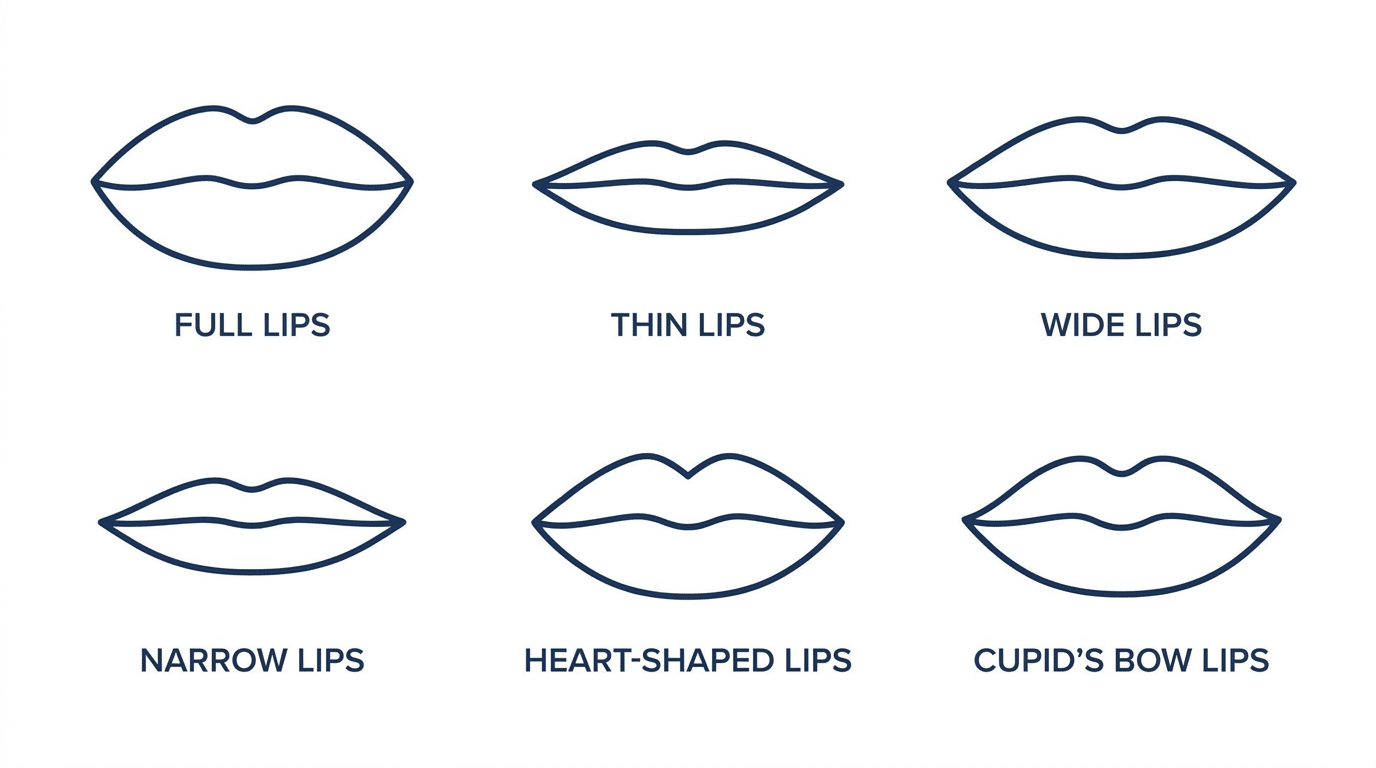
1. Full Lips
Full lips are characterised by generous volume in both the upper and lower lip, a well-defined vermillion border, and prominent tubercles that give the lips a rounded, three-dimensional appearance. The Cupid’s bow is visible but not exaggerated, and the overall effect is one of natural plumpness and youthfulness. Full lips are often considered the aesthetic ideal in Western culture and are the most frequently requested outcome by patients seeking lip augmentation.
For patients with naturally full lips who want to maintain or slightly enhance their shape, conservative lip filler treatment with hyaluronic acid can add hydration, definition, and subtle additional volume without creating an artificial result. For patients who feel their lips are disproportionately full relative to their other facial features, lip reduction surgery can achieve a more balanced, proportionate appearance.
2. Thin Lips
Thin lips are characterised by a reduced volume in one or both lips, with a less prominent vermillion border and flatter tubercles. The Cupid’s bow may be present but subtle, and the overall appearance can give the impression of a more reserved, serious, or aged expression. Thin lips are more common in individuals of Northern European heritage and become increasingly common with age as lip tissue loses volume and the vermillion border becomes less distinct.
Thin lips respond very well to lip filler treatment. Careful placement of hyaluronic acid filler along the vermillion border and within the body of the lip can add definition, restore volume, and create a more youthful, pronounced appearance. The approach must be tailored — adding too much volume too quickly can produce an unnatural result, and building the result gradually over multiple sessions tends to produce the most natural outcome.
3. Wide Lips
Wide lips extend laterally across a broad portion of the face, with the corners of the mouth sitting far apart from each other. Wide lips are a natural facial characteristic that can give the face an expressive, open quality, but some patients feel that their lip width is disproportionate to their other features. Lip filler treatment can be used to selectively enhance the central portion of the lips and create the visual impression of a more defined, less laterally spread appearance. In cases where the corners of the mouth turn downward, a corner lip lift using filler can elevate the lateral commissures and create a more positive, rested expression.
4. Narrow or Small Lips
Narrow lips are characterised by a limited lateral width, with the corners of the mouth positioned relatively close together. This gives the face a more concentrated, delicate appearance. Lip fillers can increase the apparent width of the lips by adding volume to the lateral portions of the lip body, extending the visible lip slightly towards the corners. This is a technically nuanced approach that requires careful assessment of the patient’s facial proportions.
5. Cupid’s Bow Lips
Cupid’s bow lips are defined by a particularly prominent, well-defined double curve at the centre of the upper lip. The two peaks of the Cupid’s bow are sharply defined and clearly visible, creating a characteristic heart-shaped profile to the upper lip. This lip shape is widely considered aesthetically desirable and is frequently associated with classic, timeless beauty. For patients with a naturally prominent Cupid’s bow, treatment should be focused on preserving and enhancing this feature rather than obscuring it — our guide to enhancing the Cupid’s bow with fillers explains the correct approach.
6. Flat or Undefined Upper Lip
A flat or undefined upper lip lacks the characteristic Cupid’s bow definition and tubercle prominence that give the upper lip its three-dimensional character. The upper lip lies flat against the teeth rather than curling forward, and the vermillion border may be indistinct. This lip shape is often associated with a long philtrum — the upper lip is pulled downward and appears thin, with very little of the vermillion surface visible when the face is in repose.
This is one of the most commonly treated lip concerns at Centre for Surgery. For patients in whom the flat upper lip is primarily caused by a long philtrum, lip lift surgery is the most effective and lasting solution. By surgically shortening the philtrum, the upper lip is rolled upward and outward, revealing more of the vermillion surface and creating the natural pout that was previously absent. The results of a lip lift are permanent, unlike filler which requires ongoing maintenance. For patients who prefer a non-surgical approach, the lip flip — a technique using muscle relaxant injections to subtly evert the upper lip — can add the appearance of volume without adding physical bulk.
7. Asymmetric Lips
Asymmetric lips are characterised by a visible difference between the two sides of the lips — in volume, height, shape, or position of the Cupid’s bow peaks. A degree of facial asymmetry is entirely normal and present in virtually everyone, but more pronounced asymmetry can be a source of self-consciousness. Asymmetry can arise from natural anatomical variation, from the effects of muscle activity over time, from previous trauma or scarring, or from previous lip filler treatment that has not been placed symmetrically. Lip filler can be used to correct mild to moderate asymmetry by selectively adding volume to the less prominent side.
8. Downturned Lips
Downturned lips have corners of the mouth that angle downward rather than sitting horizontally or curving slightly upward. This gives the resting face a saddened, disapproving, or stern expression regardless of the person’s actual emotional state, and it is one of the most common complaints that brings patients to the cosmetic clinic. Downturning of the mouth corners is often a feature that becomes more pronounced with age as the depressor anguli oris muscle continues to contract while surrounding support tissues lose tone and volume.
Treatment options include lip filler at the corners of the mouth to physically support and lift the lateral commissures, muscle relaxant injections into the depressor anguli oris muscle to reduce its downward pull, or a corner lip lift for a permanent structural correction. Our guide to the difference between bullhorn and corner lip lifts explains the surgical options in detail.
9. Heart-Shaped Lips
Heart-shaped lips combine a very pronounced Cupid’s bow with a rounded, full lower lip, creating a distinctive heart-like overall profile. The Cupid’s bow peaks are high and sharply defined, the philtral dip is deep, and the lower lip is full and rounded. This lip shape is closely associated with a youthful, feminine aesthetic. For patients who naturally have heart-shaped lips but feel that the Cupid’s bow definition has softened with age or that the lower lip has lost volume, lip filler can restore the original shape effectively.
10. Thin Upper Lip with Full Lower Lip
Some patients have a naturally fuller lower lip paired with a relatively thin or undefined upper lip. This mismatch can create an unbalanced appearance — the lower lip may appear disproportionately prominent and the upper lip may appear to disappear when smiling or speaking. Adding selective volume to the upper lip via filler, defining the upper vermillion border, or using a lip lift to increase the visible height of the upper lip are all options depending on the degree of disproportion.
11. Naturally Ageing Lips
Ageing has a profound effect on the lips. Volume is lost from both the upper and lower lip as the underlying fat compartments deflate. The vermillion border becomes less distinct and develops fine vertical lines. The Cupid’s bow softens and flattens. The philtrum lengthens as the skin relaxes, causing the upper lip to roll inward and downward. The corners of the mouth descend. The overall effect is a progressive thinning, flattening, and elongation of the lip complex that is one of the most recognisable signs of facial ageing.
For patients in whom age-related lip changes are the primary concern, a combination approach is typically most effective — lip fillers to restore volume and define the vermillion border, muscle relaxant injections to soften perioral lines and reduce depressor anguli oris activity, and possibly a lip lift where philtrum elongation is the dominant feature. The LipLase laser treatment is a non-surgical option that stimulates collagen production in the lip tissue and surrounding skin, improving fine lines and overall skin quality around the mouth without the use of injectables.

Which Lip Shape Is Most Attractive?
There is no objectively “best” or “most attractive” lip shape — attractiveness is highly subjective, culturally variable, and ultimately personal. What matters clinically is not whether a patient’s lips conform to any particular ideal, but whether their lips are in harmony with the rest of their face and whether they reflect the way the patient feels about their appearance. Proportionality and balance are more important than absolute shape or size. This is why detailed assessment of the entire face — not just the lips in isolation — is an essential part of any lip treatment consultation at Centre for Surgery.
Which Treatment Is Right for My Lip Shape?
The right treatment depends entirely on your specific lip anatomy, your aesthetic goals, and whether you prefer a surgical or non-surgical approach.
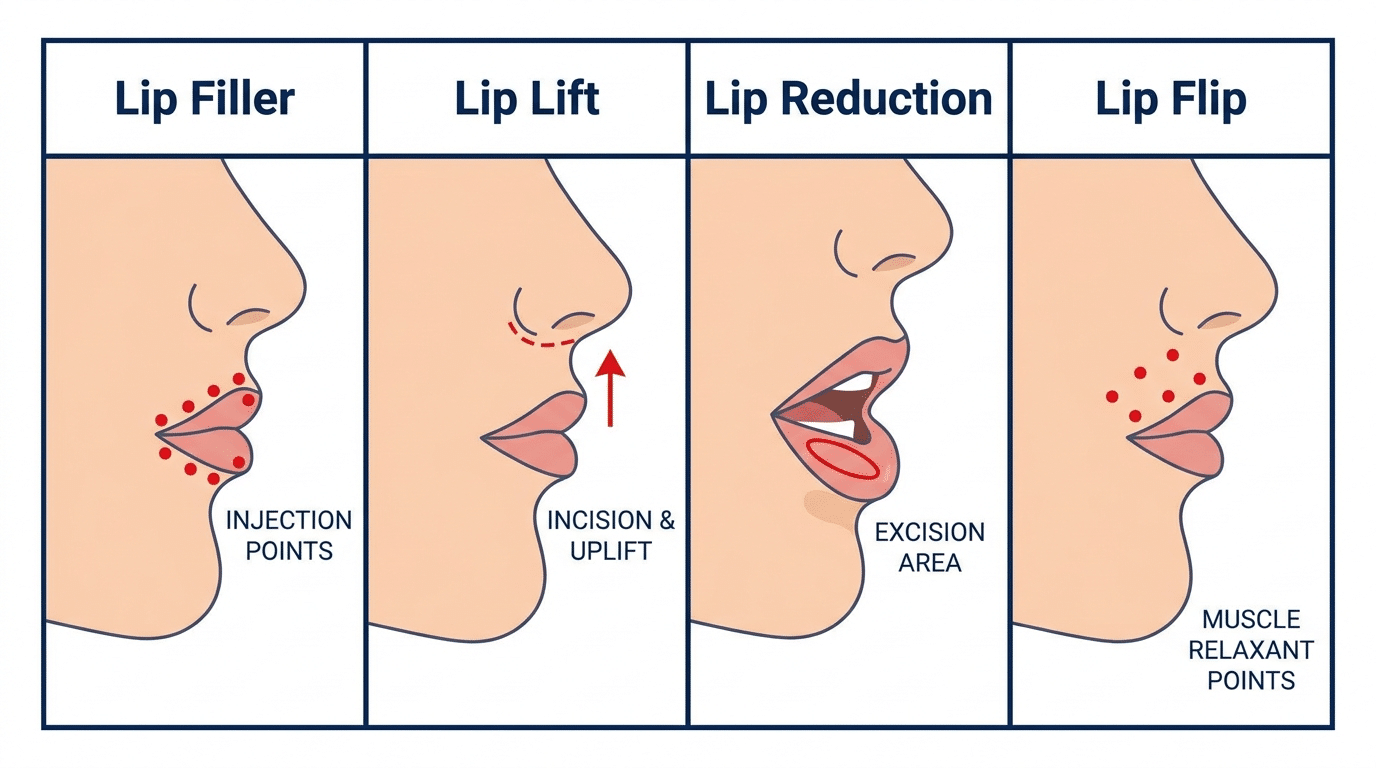
Lip fillers are the most versatile option — they can add volume, define the vermillion border, enhance the Cupid’s bow, correct mild asymmetry, and restore age-related volume loss. Results last between six and twelve months. They are reversible with hyaluronidase if the patient is unhappy with the result.
The lip flip uses muscle relaxant injections to subtly evert the upper lip and add the appearance of volume without physically adding any material. It is suitable for patients who want a natural improvement to the upper lip without committing to filler. Results last approximately eight to twelve weeks.
Lip lift surgery is the most effective permanent solution for patients with a long philtrum, a flat upper lip, or downturned mouth corners. The bullhorn lip lift addresses the central and lateral upper lip; the corner lip lift specifically elevates downturned mouth corners.
Lip reduction surgery is appropriate for patients whose lips are genuinely disproportionately large relative to their facial features. The procedure removes a strip of tissue from the inner surface of the lip and scarring is not visible externally.
The LipLase non-surgical lip enhancement uses Fotona laser technology to stimulate collagen production within the lip tissue, producing a natural plumping and tightening effect. It is particularly suitable for patients concerned about perioral lines and general lip skin quality.
Frequently Asked Questions
What is the most common lip shape?
There is no single most common lip shape — the range of natural variation is enormous. However, a moderately full lower lip paired with a slightly less prominent upper lip is a frequently occurring natural configuration across many ethnicities.
Can lip fillers change my lip shape?
Yes. Lip fillers can add volume, define the vermillion border, enhance the Cupid’s bow, correct asymmetry, and subtly alter the apparent shape of the lips. For more structural changes — such as shortening a long philtrum or permanently elevating downturned corners — surgical options are more appropriate.
How do I know which lip treatment is right for me?
The best way to determine the most appropriate treatment is through a face-to-face consultation at Centre for Surgery. Your practitioner will assess your lip anatomy in detail, discuss your concerns and goals, and provide a clear recommendation about which approach will produce the most natural and satisfying result for your specific starting point.
Is a lip lift better than lip fillers for a thin upper lip?
It depends on the cause. If the upper lip appears thin primarily because of a long philtrum pulling it downward, a lip lift is likely to produce a superior and more lasting result. If the thinness is primarily due to volume loss, lip fillers may be more appropriate — or a combination of both.
Can lip reduction make my lips look more natural?
Yes. For patients whose lips are genuinely disproportionately large, lip reduction surgery can produce a balanced, proportionate result that looks entirely natural. Scarring is internal and not visible from the outside.
Do different ethnicities have different typical lip shapes?
Yes. Lip anatomy varies considerably across different ethnic backgrounds. Treatment at Centre for Surgery is always planned with the patient’s ethnic background and individual anatomy in mind — the goal is always to enhance natural features rather than impose a single cultural standard of lip aesthetics.
Lip Treatments at Centre for Surgery
Centre for Surgery in London offers the full spectrum of lip enhancement and correction procedures, from subtle non-surgical treatments to permanent surgical solutions. Our team of specialist surgeons and aesthetic practitioners take a holistic, anatomy-first approach to lip assessment — ensuring that every treatment plan is genuinely tailored to the individual patient’s lip shape, facial proportions, and aesthetic goals.
All surgical lip procedures are performed at our CQC-regulated Baker Street clinic in central London by GMC-registered consultant surgeons. Finance options including 0% APR are available through our partner Chrysalis Finance — visit our Finance Options page for details.
Phone: 0207 993 4849 | Email: contact@centreforsurgery.com | Address: 95-97 Baker Street, London W1U 6RN
[contact-form-7 id=”256″ title=”Treatments form”]