The Dermamelan peel is a specialist in-clinic treatment developed specifically for melasma and stubborn forms of hyperpigmentation. Unlike standard chemical peels — which work by removing the outer layers of skin to reveal fresher skin beneath — Dermamelan works at a deeper level, directly inhibiting the enzymes that produce excess melanin. For patients with established melasma that hasn’t responded to topical-only treatment, Dermamelan offers a more powerful intervention without the heat-based risks of aggressive laser.
This guide explains what the Dermamelan peel involves, how it works, who it suits, what recovery looks like, and where it fits relative to other laser pigmentation and topical options at Centre for Surgery’s CQC-regulated Baker Street private hospital.
What the Dermamelan peel is
Dermamelan is a two-phase depigmentation system developed by Mesoestetic, a Spanish dermatology company. It combines a powerful in-clinic mask with a structured at-home maintenance regimen. Unlike most chemical peels, which work primarily through controlled skin shedding, Dermamelan works through melanogenesis inhibition — directly blocking the enzymatic pathway that produces excess melanin.
The active ingredients include:
- Phytic acid — chelates the copper needed for tyrosinase activity
- Kojic acid — inhibits tyrosinase, the key enzyme in melanin production
- Ascorbic acid (vitamin C) — reduces existing melanin and provides antioxidant protection
- Arbutin — a natural tyrosinase inhibitor
- Azelaic acid — inhibits abnormal melanocyte activity
- Retinoic acid derivatives — accelerate cell turnover
- Other supporting compounds for skin barrier protection and inflammation control
The combination targets every step of the melanogenesis pathway simultaneously, rather than relying on a single mechanism. This is why Dermamelan often delivers results in stubborn melasma cases that haven’t responded to single-agent topical therapy.
How Dermamelan works
The treatment is delivered in two phases:
Phase 1: The in-clinic mask
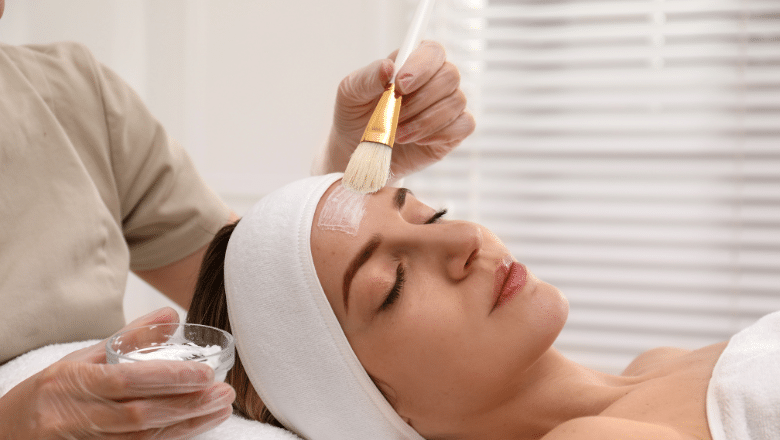
The mask is a thick, opaque cream applied generously to the entire face at our clinic. The application process is straightforward:
- Thorough skin cleansing to remove all makeup, oils and impurities
- Skin degreasing with an alcohol-based prep to maximise mask penetration
- Application of the Dermamelan mask in a thick, even layer across the face
- The mask is left in place for 8 to 12 hours, sometimes longer depending on skin type and severity
You leave the clinic wearing the mask and remove it at home using gentle soap and warm water at the prescribed time. The mask itself is the powerful intervention — it delivers the active ingredients in concentrations and contact times that no take-home product can match.
Phase 2: The at-home maintenance regimen
After the in-clinic mask, you continue with a structured at-home regimen of Dermamelan products for approximately three to four months. The home products work at lower concentrations than the mask but provide the sustained tyrosinase inhibition needed to consolidate results and prevent rebound.
The home regimen typically includes a daily depigmenting cream and a maintenance gel, applied morning and evening, alongside non-negotiable daily broad-spectrum SPF 50 with iron oxide content for visible-light protection.
What Dermamelan treats
Dermamelan is most effective for:
- Melasma — including dermal-component melasma that hasn’t responded to standard topical therapy. For full melasma context, see our guide on melasma hyperpigmentation causes and solutions.
- Post-inflammatory hyperpigmentation (PIH) — particularly from acne, where active acne has been controlled but pigment remains
- Sun-induced hyperpigmentation — diffuse photodamage with mottled discolouration
- Chloasma — pregnancy-related melasma (treated postpartum, not during pregnancy)
- Lentigines — though more focal treatments like laser are usually preferred for discrete sunspots
- Mixed-pattern hyperpigmentation where multiple pigmentation types coexist
It’s particularly valuable for darker Fitzpatrick skin types (IV to VI) where heat-based laser treatments carry higher risk of post-treatment hyperpigmentation. The non-thermal mechanism of Dermamelan avoids that risk.
Dermamelan also addresses several adjacent skin concerns alongside the primary pigmentation target — improved skin clarity and radiance, smoother texture, reduced pore size, and modulation of sebum production that can benefit oily and acne-prone skin.
What to expect — treatment day and recovery
Before treatment
Your clinician takes a full medical history, examines your skin in detail, classifies the pattern and depth of your pigmentation, and confirms Dermamelan is the right approach for your specific case. We also assess your skin type and discuss what realistic outcomes look like.
For 7 to 14 days before the mask, avoid:
- Direct sun exposure and tanning
- Other in-clinic treatments (peels, laser, microneedling)
- Strong actives (high-concentration retinoids, glycolic acid, salicylic acid)
- Waxing or aggressive hair removal on the treatment area
The application appointment
The actual appointment is short and simple. Cleansing, degreasing and mask application typically take 30 minutes. The mask doesn’t feel painful — most patients describe mild warmth or tingling. You leave the clinic wearing the mask, which appears as a pale yellow film across the face.
The first 24 hours
The mask remains in place for 8 to 12 hours (your clinician will specify the exact duration based on your skin assessment). During this period the active ingredients are penetrating and the melanin-inhibition process is underway. You’ll be advised to:
- Avoid touching or rubbing the masked area
- Avoid water contact, including showering on the masked area
- Sleep with care to avoid disturbing the mask
- Remove the mask at the prescribed time using gentle soap and lukewarm water
The first week
After mask removal, the skin will feel tight and may appear mildly red. Over the following 3 to 7 days, peeling and flaking occur as the surface skin sheds. This peeling is normal and is part of the treatment. Use the prescribed medical-grade moisturiser frequently to keep the skin comfortable and speed barrier recovery.
Most patients describe this phase as similar to the recovery from a moderate sunburn — uncomfortable rather than painful, with the skin feeling tight and looking flaky. Concealing makeup can usually go on by day 5 to 7 once the active peeling has settled.
The maintenance period (months 1–4)
The at-home Dermamelan products start a few days after the mask, once active peeling has settled. The regimen runs for approximately 3 to 4 months, with continued depigmenting effect as the active ingredients sustain tyrosinase inhibition. Strict daily SPF 50 is non-negotiable throughout.
Results and timeline
The pattern of improvement typically follows:
- Days 1–7 — initial peeling phase; pigmentation may temporarily look more obvious before improving
- Week 2 — initial brightening visible; pigmentation begins to lighten
- Weeks 3–6 — clear improvement in tone and texture; pigmented patches noticeably lighter
- Months 2–3 — optimal results emerge as ongoing melanin inhibition consolidates
- Beyond 3 months — maintenance phase; results sustained with at-home products and sun protection
For severe or extensive melasma, a second mask application 2 to 4 weeks after the first can be performed to enhance results. Most patients respond well to a single mask treatment combined with the full at-home maintenance regimen.
Long-term results depend heavily on sun protection. Without ongoing UV protection — daily broad-spectrum SPF 50, ideally with iron oxide content for visible-light protection — pigmentation will return.
Dermamelan vs other pigmentation treatments
Vs standard topical regimens
Topical regimens (such as the Obagi Nu-Derm system or modified Kligman formula combinations) work gradually over months. They’re appropriate for mild melasma and as ongoing maintenance. Dermamelan delivers more intensive depigmentation in a shorter timeframe but at higher upfront cost and with more visible recovery. Most patients with established melasma benefit from Dermamelan plus a topical maintenance regimen, rather than topicals alone.
Vs laser treatment
Laser treatments for melasma are restricted to low-fluence non-thermal protocols (typically Q-switched Nd:YAG at low fluence). They’re effective for some melasma patterns but carry risks of paradoxical worsening if the wrong protocol or settings are used. Dermamelan’s non-thermal mechanism avoids these risks entirely, making it safer for many darker-skinned patients where laser risk is higher.
For sunspots, freckles and well-defined lentigines, laser typically outperforms Dermamelan. For diffuse melasma and mixed-depth pigmentation, Dermamelan often outperforms laser. The choice depends on the specific pigmentation pattern.
Vs standard chemical peels
Standard chemical peels (TCA, glycolic, salicylic) work through controlled exfoliation. They can help superficial pigmentation but underperform on dermal pigment. Dermamelan’s depigmenting mechanism reaches deeper than exfoliation-based peels.
Vs oral tranexamic acid
Oral tranexamic acid (250 mg twice daily) has good evidence for moderate-to-severe melasma. Some patients benefit from combining tranexamic acid with Dermamelan; others respond well to either alone. We discuss this individually at consultation.
How many Dermamelan treatments you’ll need
Most patients need a single mask application followed by the full 3–4 month at-home regimen. For extensive or particularly stubborn melasma, a second mask can be performed 2–4 weeks after the first to enhance results.
After the initial treatment, periodic maintenance — either repeat Dermamelan every 12–18 months or sustained topical regimen with strict sun protection — is needed to maintain results. Melasma is chronic, and treatment achieves remission rather than cure.
What areas can be treated
Dermamelan is designed for facial use. The mask is applied across the full face. It’s not suitable for body areas — different formulations exist for those purposes, but Dermamelan specifically is a facial intervention.
The neck and décolletage are sometimes treated alongside the face in patients with extensive pigmentation, though application requires careful technique and the recovery profile differs slightly.
Side effects and what to expect
The most commonly encountered effects:
- Mild redness — normal and resolves within hours of mask removal
- Tight sensation — typical for 48 to 72 hours after mask removal
- Peeling and flaking — expected in the first week, part of the treatment mechanism
- Mild irritation — particularly with the early at-home products as the skin adapts
- Photosensitivity — treated skin is more vulnerable to UV; strict SPF 50 essential
Less common but possible:
- Prolonged redness — uncommon, usually settles within a week
- Paradoxical pigmentation if sun exposure is inadequate
- Skin sensitivity persisting for several weeks
- Cold sore reactivation in susceptible patients (antiviral prophylaxis can be arranged)
Serious complications are very uncommon with experienced operators. We carefully select candidates and adjust application duration based on skin type.
Who shouldn’t have Dermamelan
Specific contraindications:
- Active skin infection or open wound in the treatment area
- Recent significant sun exposure or tanning
- Pregnancy or breastfeeding
- Active isotretinoin treatment or within 6 months of completion
- History of keloid or hypertrophic scarring
- Allergy to any of the active ingredients
- Recent (within 4 weeks) other facial peel or laser treatment
- Significant atopic dermatitis or compromised skin barrier
None of these are necessarily lifetime exclusions. A consultation establishes whether timing or alternative approaches allow safe treatment.
What we don’t recommend
- Dermamelan without committed sun protection — pointless and potentially harmful. Result will regenerate or worsen.
- Stacking Dermamelan with concurrent aggressive treatments — wait 4 weeks before or after other peels, laser or microneedling
- DIY skin lightening protocols after Dermamelan — Dermamelan does the work; aggressive home additions drive irritation that undermines results
- Dermamelan for very mild diffuse pigmentation — topical-only management is usually sufficient and substantially cheaper
- Dermamelan for discrete sunspots — focal laser is usually a better choice for individual well-defined spots
- Unregulated alternatives bought online — products marketed as “Dermamelan equivalents” outside UK regulation often contain unlabelled high-percentage hydroquinone or steroids causing significant skin damage
Frequently asked questions
How quickly will I see results?
Initial brightening is visible within the first 2 weeks. Significant improvement in pigmentation by weeks 3 to 6. Optimal results between 2 and 3 months as the at-home regimen completes its course.
Is the Dermamelan mask painful?
No — most patients describe mild warmth or tingling during the mask wear. There’s no significant discomfort during application or removal.
How much downtime do I need?
Plan 5 to 7 days of social downtime to navigate the peeling phase comfortably. Most patients can return to work within 2 to 3 days but may want to avoid major social events during active peeling.
Can I have Dermamelan if I’m pregnant?
No — we don’t treat during pregnancy or breastfeeding. Most patients with pregnancy-related melasma (chloasma) wait until postpartum to treat. Topical sun protection and gentle skincare are the safe pregnancy approach.
Can men have Dermamelan?
Yes — though melasma is much more common in women, men do develop the condition and respond equivalently to treatment. The protocol is identical.
How long do results last?
With strict sun protection and the maintenance regimen, results sustain for 12 to 18 months or longer. Without sun protection, pigmentation returns. Periodic re-treatment (every 12 to 18 months) sustains long-term control.
Can Dermamelan be combined with laser?
Yes, in carefully staged combinations. We typically allow 4 to 6 weeks between Dermamelan and any subsequent laser treatment, and the combination is reserved for specific clinical situations. We design combined plans at consultation.
How much does Dermamelan cost?
The treatment includes the in-clinic mask appointment plus the structured at-home product regimen for 3 to 4 months. A consultation gives an exact quote based on your specific plan. Finance from 0% APR is available through Chrysalis Finance.
Why choose Centre for Surgery
Our laser dermatologists and aesthetic practitioners deliver Dermamelan within the broader framework of our pigmentation programmes — alongside topical prescription regimens, low-fluence laser where appropriate, and oral tranexamic acid for severe cases. The Dermamelan mask is one tool among several, calibrated to your specific pigmentation pattern at our CQC-regulated Baker Street private hospital.
Centre for Surgery · CQC-regulated · GMC specialist-registered surgeons · 95–97 Baker Street, Marylebone, London W1U 6RN · 0207 993 4849 · Book a consultation · Finance from 0% APR