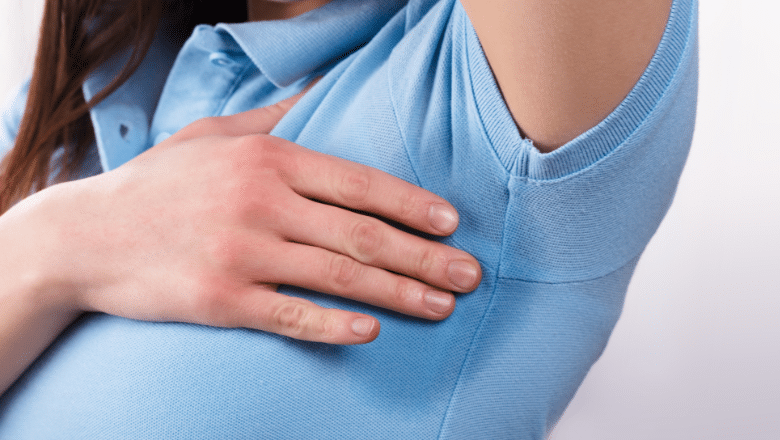
Axillary hyperhidrosis is excessive underarm sweating that goes well beyond what the body needs for temperature regulation. It affects around 5% of the UK population and has nothing to do with hygiene — the underlying cause is overactive sweat glands triggered by overactive sympathetic nerve signals. For most patients, it’s been a lifelong issue that prescription antiperspirants and lifestyle modifications haven’t resolved.
This is the comprehensive hub guide to what hyperhidrosis is, what causes it, and the full range of medical treatments available — from anti-sweat injections through to permanent surgical solutions. Each treatment has a different mechanism, a different duration, and suits a different kind of patient. The right answer depends on how severe the symptoms are, how often you want to repeat treatment, and what level of intervention you’re willing to accept.
What axillary hyperhidrosis is
Sweating is the body’s primary mechanism for cooling. The eccrine sweat glands distributed across the body — and particularly concentrated in the underarms, palms, soles, and forehead — are activated by signals from the sympathetic nervous system. In normal sweating, these glands respond proportionally to heat, exercise, and physiological need.
In hyperhidrosis, the sympathetic nerves over-stimulate the sweat glands beyond what’s required for thermoregulation. The result is sweating that occurs at rest, in cool conditions, during normal social interaction, or in situations where most people wouldn’t sweat at all.
The condition is divided into two types:
Primary hyperhidrosis has no identifiable underlying cause. It’s typically symmetrical, affects specific body regions (commonly underarms, palms, soles, scalp), and often starts in childhood or adolescence. There’s no associated medical condition driving it.
Secondary hyperhidrosis is excessive sweating triggered by another medical condition or medication. Causes include hyperthyroidism, diabetes, menopause, certain infections, some cancers, and medications including antidepressants and certain pain medications. Secondary hyperhidrosis often affects the whole body rather than specific regions, and may occur at night (which primary hyperhidrosis rarely does).
The distinction matters clinically because secondary hyperhidrosis sometimes resolves with treatment of the underlying cause, whereas primary hyperhidrosis requires targeted treatment of the sweat glands or nerves themselves.
For more detail on the condition specifically, see our companion guide on hyperhidrosis and how to treat it.
How common it is, and the impact
Around 5% of the UK adult population has some degree of hyperhidrosis. Of these, axillary (underarm) hyperhidrosis is the most common presentation, followed by palmar (hands) and plantar (feet) hyperhidrosis. The condition affects men and women roughly equally, though men typically sweat more in volume because they have more active sweat glands and larger body mass.
The impact extends well beyond the physical inconvenience. Patients commonly describe:
- Avoiding handshakes and physical contact due to clammy hands
- Visibly stained or wet clothing requiring multiple daily changes
- Avoiding certain fabrics, colours, or styles of clothing
- Difficulty with manual tasks that require dry hands (typing, holding documents, using touchscreens)
- Localised skin irritation and increased risk of bacterial or fungal infections in the constantly moist underarm or foot area
- Significant impact on social, work, and intimate relationships
- Anxiety, embarrassment, and reduced self-confidence
Hyperhidrosis is not dangerous in itself, and there’s no strong evidence linking it to dehydration or other systemic problems. But its psychological and social burden is substantial enough that treatment is justified on quality-of-life grounds alone.
Causes and contributing factors
Genetics. A family history of hyperhidrosis is common, suggesting genetic factors predispose some individuals to overactive sweat glands. Around 30 to 50% of patients have a first-degree relative with similar symptoms.
Hormonal changes. Periods of significant hormonal shift — adolescence, pregnancy, menopause — can trigger or worsen hyperhidrosis. Hormonal conditions like hyperthyroidism are a recognised cause of secondary hyperhidrosis.
Stress and emotional triggers. The sympathetic nervous system that controls sweating also drives the body’s stress response, so anxiety, nervousness, and excitement all activate the same pathway. Many patients with primary hyperhidrosis notice worse symptoms during stressful situations even when ambient temperature is comfortable.
Medications. Several classes of medication can induce sweating as a side effect — antidepressants (particularly SSRIs and SNRIs), pain medications (opioids, NSAIDs), some diabetes medications, and certain steroids. Reviewing medication history is part of the standard hyperhidrosis assessment.
Medical conditions. Hyperthyroidism, diabetes, infection, lymphoma, and certain neurological conditions can all cause secondary hyperhidrosis. Patients presenting with new-onset adult hyperhidrosis — particularly when it’s generalised or night-predominant — should be evaluated for underlying conditions before assuming primary disease.
What antiperspirants can and can’t do
Antiperspirants work by partially blocking sweat ducts using aluminium-based compounds (typically aluminium chloride hexahydrate). Over-the-counter formulations contain modest concentrations and work well enough for mild sweating but are usually insufficient for clinical hyperhidrosis.
Prescription-strength antiperspirants contain higher concentrations of aluminium chloride (typically 12 to 20%) and are the appropriate first-line medical treatment. They’re applied at night to clean, dry skin and washed off in the morning. Used consistently, they reduce sweating measurably in many patients.
Most patients who present to specialist clinics have already tried prescription antiperspirants without sufficient benefit — which is the point at which the conversation moves to the more substantive options below.
Anti-sweat injections (botulinum toxin)
Anti-sweat injections are the most commonly used non-surgical treatment for axillary hyperhidrosis. The same botulinum toxin used in anti-wrinkle injections for the face is used here, but in larger doses delivered into the skin of the underarm.
How it works. Botulinum toxin blocks the chemical signal (acetylcholine) that the sympathetic nerves use to activate sweat glands. When the signal can’t reach the gland, the gland stops producing sweat in that area. Other parts of the body continue to sweat normally.
What the procedure involves. Topical anaesthetic cream is applied to both armpits for about 30 minutes before treatment. The product is then injected in a grid-like pattern across the affected area — typically 15 to 25 small injections per side. The total dose is around 50 to 100 units per armpit, depending on the affected area size and symptom severity. The whole procedure takes 20 to 40 minutes.
When it works. Patients typically notice significantly reduced sweating within 7 to 10 days of treatment. Maximum effect is usually visible at 2 weeks.
How long it lasts. 6 to 12 months per treatment, with most patients needing 2 to 3 sessions per year to maintain results. Some patients find the effect lasts longer with consistent treatment over time, as the underlying nerve activity moderates.
Other areas. The same approach can be used for palmar hyperhidrosis (palms) and plantar hyperhidrosis (soles), though these areas are more painful to inject and may require local anaesthetic block rather than just topical cream.
Side effects. Mild bruising at injection sites, occasionally compensatory sweating elsewhere (uncommon for axillary treatment), very rare allergic reactions. Side effects are mild and self-limiting in almost all cases.
Who it suits. Patients who want a reliable, non-surgical treatment, who are happy with maintenance every 6 to 12 months, and who don’t have contraindications to botulinum toxin (pregnancy, breastfeeding, neuromuscular disorders, known allergy).
For more on AWI in general, see our anti-wrinkle injections FAQ.
Morpheus8 radiofrequency microneedling
Morpheus8 combines microneedling with fractional radiofrequency energy delivered through insulated needles. For hyperhidrosis, the needles are calibrated to reach the depth where eccrine sweat glands sit — and the radiofrequency energy thermally ablates these glands, permanently reducing their function.
What the procedure involves. Topical anaesthetic for about 45 minutes. The Morpheus8 handpiece delivers the microneedles into the skin, releasing radiofrequency energy at the gland-containing depth. Treatment of both armpits takes about 30 to 45 minutes. There’s a heat-and-pressure sensation during treatment; most patients tolerate it well with topical numbing alone.
How long until results. Initial reduction in sweating is noticeable within a few weeks. The full effect develops over 2 to 3 months as the treated glands are progressively destroyed and the local tissue heals.
How many treatments. 2 to 3 sessions spaced 4 to 6 weeks apart. Most patients achieve significant or complete resolution after 2 treatments; some need 3 for the strongest effect.
How long the result lasts. Permanent in the treated tissue — the destroyed glands don’t regenerate. New gland formation in adulthood is minimal, so the effect tends to hold long-term.
Recovery. 3 to 5 days of redness and tiny scabs at the treatment points. Underarm tenderness for a few days. Patients can return to most normal activities immediately, but should avoid heavy exercise and hot showers for 24 to 48 hours.
Side effects. Temporary swelling, redness, and small scabs at treatment points. Pigmentation changes are rare in adult patients and resolve over weeks. Permanent hair reduction in the treated area is possible (the RF energy can affect hair follicles alongside sweat glands) — most patients consider this a bonus rather than a disadvantage.
Who it suits. Patients who want a permanent reduction in sweating without surgery, who can accept 2 to 3 sessions to reach the result, and who are willing to tolerate a few days of redness and scabbing per session.
For more on the device generally, see our Morpheus8 for excessive armpit sweating page.
Suction curettage — the permanent surgical option
Suction curettage is the most definitive treatment for axillary hyperhidrosis. It’s a minimally invasive surgical procedure that physically removes the sweat glands from the underarm tissue — meaning the source of the sweating is gone, not just suppressed.
How it works. A specially designed cannula combines suction with mechanical curettage to disrupt and remove the eccrine sweat glands at their tissue layer (the deep dermis and subcutaneous junction). Because the glands themselves are physically removed, sweating cannot resume from the treated tissue.
The procedure step by step:
- Local anaesthetic is injected throughout the underarm area. The anaesthetic solution contains a vasoconstrictor (typically adrenaline) to minimise bleeding and improve visibility during the procedure.
- One or two very small incisions are made in each underarm — typically 3 to 5mm long.
- A power-assisted suction curettage cannula is introduced through the incision. The cannula has both suction and a curette-shaped tip that mechanically disrupts the sweat glands.
- The glands are progressively detached from surrounding tissue and removed through the suction.
- Importantly, the technique deliberately preserves the connective tissue framework, lymphatics, and blood vessels — only the glands are targeted.
- Once the glands are removed, smaller cannula probes equalise the remaining fat layer to ensure even contour. This avoids the lumpy or rippling appearance that can occur with cruder techniques.
- The small incisions are closed with a single suture each. Compression dressing is applied for 24 hours.
Anaesthesia. The procedure is performed under local anaesthetic as an outpatient — you’re admitted and discharged the same day. Most patients tolerate it well with local alone. For more anxious patients, mild oral sedation or TIVA (total intravenous anaesthesia, a light general anaesthetic) can be added without changing the day-case nature of the procedure.
How long it takes. The procedure itself takes about 45 to 60 minutes per side, with the patient comfortable throughout under local.
Recovery. Mild swelling, numbness, or tenderness for around a week. Most patients return to office work within 2 to 3 days and to most normal activities (including exercise) within 2 weeks. The small incisions heal with minimal scarring, hidden in the underarm crease.
How effective. The procedure typically removes 80 to 90% of underarm sweat glands. While 100% removal isn’t usually possible, the reduction is more than sufficient to permanently eliminate hyperhidrosis symptoms for the vast majority of patients. Result is permanent — the glands don’t regrow.
Risks and complications. The minimally invasive suction curettage technique has a low overall complication rate, but several risks should be understood before proceeding:
- Haematoma or bleeding under the skin (uncommon, usually self-resolving)
- Ecchymosis (visible bruising) — common, resolves over 1-2 weeks
- Seromas (fluid collections under the skin)
- Superficial skin erosions
- Temporary loss of local sensation in the underarm
- Skin necrosis (very rare with proper technique)
- Infection (uncommon with sterile technique and standard prophylaxis)
- Reduction in underarm hair growth
- Subcutaneous fibrosis or adherences
- Scarring (typically minimal, hidden in the crease)
- Recurrence of hyperhidrosis (rare)
Why suction curettage rather than laser-assisted methods. Some clinics offer laser-assisted hyperhidrosis treatment. The laser energy targets sweat glands but carries additional risk of thermal injury, skin burns, and pigmentation changes that aren’t issues with suction curettage. Suction curettage is mechanically gentler and at least as effective.
Who it suits. Patients who want a single permanent solution rather than ongoing maintenance. Patients whose symptoms are severe enough to justify a small surgical procedure. Patients who’ve tried injections or other options and want something definitive.
Other treatments — and why they’re less commonly chosen
Iontophoresis uses low-level electrical current passed through water to reduce sweating, primarily for palmar and plantar hyperhidrosis. It requires multiple treatments per week initially, with maintenance sessions thereafter. The results are variable, the time commitment is significant, and it’s difficult to use for the underarm area. For motivated patients with hand and foot hyperhidrosis specifically, it can be useful, but it’s not a first-line option for axillary hyperhidrosis.
MiraDry is a microwave-based device that delivers thermal energy to sweat glands at depth. It’s a relatively newer technique with the right idea but several practical limitations: the equipment is expensive to acquire (so treatment costs reflect this), there’s documented risk of skin thermal injury and burns, and it only treats the underarm — palms, soles, and other areas can’t be addressed. Long-term outcomes data is more limited than for established alternatives. We don’t routinely offer MiraDry at Centre for Surgery because suction curettage delivers more reliable permanent results.
Endoscopic thoracic sympathectomy (ETS) is a highly invasive surgical procedure performed under general anaesthesia in a hospital setting. A vascular or thoracic surgeon enters the chest cavity endoscopically and cuts or clamps the sympathetic nerve chain that controls upper body sweating. ETS is dramatically effective but carries significant risks — most notably compensatory hyperhidrosis, where sweating shifts to other body areas (typically the trunk, back, or thighs) in 50 to 90% of patients, sometimes severely. Other risks include Horner’s syndrome, persistent chest pain, and rarely more serious chest complications. ETS is reserved for the most severe cases that have failed all other treatment, and the decision to proceed requires careful discussion with a thoracic surgeon. It’s not offered at Centre for Surgery — patients requiring this level of intervention are referred to hospital-based thoracic services.
Choosing between the options
A useful framework for deciding which treatment fits:
Mild to moderate symptoms, willing to maintain treatment: anti-sweat injections every 6 to 12 months. Reliable, predictable, no permanent intervention.
Moderate to severe symptoms, wanting a non-surgical permanent option: Morpheus8 over 2 to 3 sessions. Effective, with a permanent outcome and minimal downtime per session.
Severe symptoms, wanting a single definitive treatment: suction curettage. One procedure, permanent result, minimal scarring, full recovery in 2 weeks.
Multi-region hyperhidrosis (underarms + hands + feet): typically anti-sweat injections, which can address all three areas, sometimes combined with iontophoresis for hands and feet.
Severe symptoms unresponsive to all of the above: referral for ETS assessment, with clear understanding of the compensatory hyperhidrosis risk.
A consultation establishes which approach is right for your specific symptom pattern, severity, lifestyle, and preferences.
Cost
At Centre for Surgery, treatment pricing varies by modality. Anti-sweat injections are priced per session and typically require 2 to 3 per year. Morpheus8 is priced per session with a course of 2 to 3. Suction curettage is a single procedure with a one-time fee. Finance options through Chrysalis Finance, including 0% APR, are available across all treatment types.
The most cost-effective option over a 5-year horizon is usually suction curettage — the single upfront fee usually works out less than 5 years of biannual injections.
Common questions
Will hyperhidrosis go away on its own?
Rarely. Primary hyperhidrosis typically persists or worsens over time without treatment. Secondary hyperhidrosis can sometimes improve if the underlying cause is addressed (treating thyroid disease, changing medications) but primary hyperhidrosis doesn’t self-resolve in most cases.
Is hyperhidrosis hereditary?
30 to 50% of patients have a first-degree relative with the condition, suggesting a genetic component, though no single gene has been definitively identified. The pattern is consistent with a polygenic predisposition rather than simple Mendelian inheritance.
Can I treat hyperhidrosis at home?
Lifestyle measures help but rarely resolve the condition: wear cotton and loose-fitting clothes, use protective sweat shields, change socks 2 to 3 times daily, regularly change footwear and prefer leather shoes, avoid spicy food and excessive alcohol (both increase sweating). Prescription antiperspirants are the strongest at-home option. If these are insufficient, in-clinic treatment is the next step.
Will losing weight or exercising more help?
General fitness improves overall thermoregulation slightly but doesn’t address primary hyperhidrosis specifically. Patients with primary hyperhidrosis usually have normal physiology in every other respect.
What’s the difference between deodorant and antiperspirant?
Deodorant masks odour but doesn’t reduce sweating. Antiperspirant reduces sweating by partially blocking sweat ducts. For hyperhidrosis, deodorant alone is insufficient — you need an antiperspirant or stronger intervention.
Are anti-sweat injections safe for repeat use over years?
Yes — botulinum toxin has a long track record of safety in repeated medical use for hyperhidrosis, far longer than its cosmetic use. There’s no evidence of cumulative harm with consistent treatment over many years.
What’s compensatory sweating, and should I be worried about it?
Compensatory sweating refers to increased sweating in untreated body areas after a treatment that significantly reduces sweating somewhere else. It’s a known risk of ETS surgery (where 50-90% of patients experience it). It’s rare to negligible with anti-sweat injections, Morpheus8, or suction curettage because these treatments address only the local glands rather than disrupting nerve supply to large body regions.
Will suction curettage leave a visible scar?
The incisions are 3 to 5mm and hidden in the underarm skin crease. Most patients have essentially invisible scars after 6 months. The result is consistently cosmetically acceptable.
Can hyperhidrosis treatment affect my body’s ability to regulate temperature?
No — even with treatments that target large areas, the body retains plenty of functional sweat glands elsewhere (chest, back, forehead, etc.) for thermoregulation. Treating the underarms specifically has no impact on the body’s overall cooling capacity.
Centre for Surgery · CQC-regulated · GMC specialist-registered surgeons · 95–97 Baker Street, Marylebone, London W1U 6RN · 0207 993 4849 · Book a consultation · Finance from 0% APR