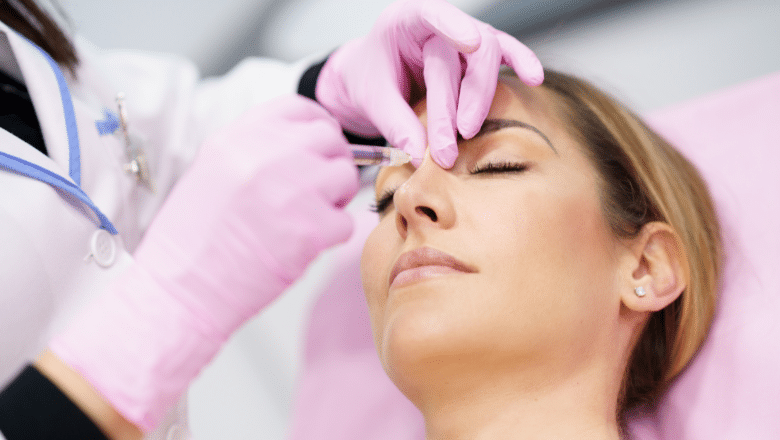
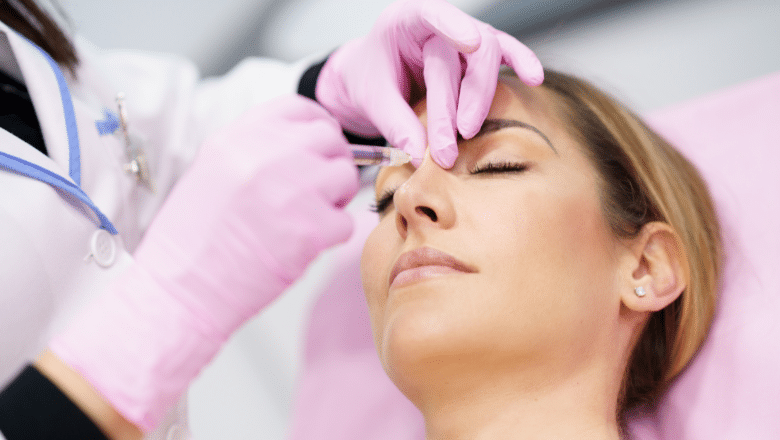
Bunny lines are the diagonal wrinkles that appear on either side of the upper nose when you scrunch, laugh, or make a disapproving face. They’re named for the way a rabbit’s nose twitches, and they’re caused by a single muscle: the nasalis.
This is a brief but well-understood treatment, and it has one clinically important quirk — bunny lines often become more prominent in patients who’ve had anti-wrinkle injection treatment elsewhere in the upper face. Understanding why explains a lot of what good treatment of this area involves.
The anatomy
The nasalis is a small, two-part muscle that wraps over the bridge of the nose. Its transverse portion compresses the nasal bridge when you scrunch your nose; its alar portion flares the nostrils. The diagonal lines that appear on the sides of the upper nose during this movement are produced by the transverse portion of the nasalis pulling the skin into folds.
In youth, the skin smooths fully when the muscle relaxes. With repeated contraction over years, the lines etch into the skin and begin to remain faintly visible at rest. Once that point is reached, treatment becomes meaningfully more effective for prevention than for reversal.
For a broader overview of how facial muscles produce wrinkles, see our guide on fine lines versus wrinkles.
The “compensatory bunny lines” phenomenon
A pattern that surprises many patients: bunny lines often become more obvious after upper-face anti-wrinkle injection treatment, particularly to the forehead and glabella.
The mechanism is straightforward. When the frontalis (forehead muscle) and corrugator (frown muscle) are relaxed, they stop pulling. The nasalis, which previously contributed to expressions like surprise and scrunch in concert with these other muscles, now does more of the work on its own. Patients who weren’t bothered by bunny lines before AWI treatment may notice them clearly afterwards — not because the lines have actually deepened, but because they’re no longer “hidden” by the surrounding muscle activity that’s now been switched off.
The clinical implication: when treating the upper face comprehensively, the nasalis often needs a small dose alongside the forehead, glabella, and crow’s feet. This produces a more balanced result and prevents the new lines patients notice once their forehead and frown lines have been smoothed.
This is one of the reasons why treating the upper face as a unit, rather than addressing single areas in isolation, produces better outcomes. See our guide on frown lines and forehead wrinkles and our anti-wrinkle injections FAQ for more on combined-area treatment.
How bunny lines are treated
Anti-wrinkle injections are the only effective treatment. Filler doesn’t work for bunny lines because they’re caused by muscle activity rather than volume loss, and the skin in this area is too thin to hide filler well.
How the treatment is delivered. A very small dose — typically 2 to 4 units total, split across one or two injection points per side of the nose — is placed into the transverse nasalis muscle. The injections are extremely superficial and use the finest available needles.
Why doses are smaller than elsewhere. The nasalis is a small muscle that doesn’t require much product to relax. Over-treatment in this area can cause issues — particularly affecting the alar portion of the nasalis, which would change how your nostrils move when you smile, or the nearby levator labii superioris alaeque nasi (the muscle that lifts the upper lip), which could affect your smile. A careful, conservative injector working with precise anatomical knowledge avoids these complications easily, but the area is technical enough that it shouldn’t be treated by inexperienced practitioners.
What to expect on the day. The procedure itself takes 2 to 3 minutes. Most patients describe a brief sting at each injection point. We sometimes apply ice to the area first, which makes the injections more comfortable and reduces the small risk of bruising. There may be tiny bumps at the injection sites that settle within 15 minutes.
Results timeline
The effect starts to develop at days three to five, with the full result visible at around 14 days. You’ll notice that scrunching your nose no longer produces the diagonal folds — the muscle still moves slightly but doesn’t generate enough contraction to crease the skin.
Results typically last 2 to 3 months — slightly shorter than for larger areas like the forehead, because the smaller dose used here wears off faster.
Maintenance treatment every 3 months is the typical schedule for patients who want to keep the result.
Aftercare
The same 24-hour aftercare rules apply as for other anti-wrinkle treatments:
- No lying flat for 4 hours
- No strenuous exercise that day
- No facial massage or rubbing the area
- No facials, saunas, or steam rooms
These restrictions exist to prevent the product migrating to nearby muscles before it has settled. For a fuller guide, see our injectables aftercare guide.
Who is a good candidate?
Bunny line treatment suits:
- Patients with prominent diagonal lines on the sides of the upper nose when scrunching, laughing, or making expressive faces
- Patients who’ve already had treatment to the forehead or glabella and have noticed bunny lines becoming more prominent afterwards
- Patients seeking comprehensive upper-face balance rather than treating one area in isolation
- Patients with mild early static lines that are visible faintly at rest
The treatment is less suitable for:
- Patients whose bunny lines are very faint or only visible during extreme expressions — the marginal benefit may not justify the cost
- Patients who use a lot of nose expressivity professionally (singers, wind instrument players, actors who rely on nuanced nasal expressions) — discuss with your injector before proceeding
Risks and side effects
Side effects are uncommon and usually mild:
Bruising at the injection sites — small visible vessels can occasionally be nicked despite careful technique. Bruising typically resolves within a few days.
Mild headache for 24 hours after treatment, occasionally reported.
Asymmetry noticed at the 2-week mark — straightforward to correct with a small top-up if needed.
Spread to nearby muscles — the most concerning complication and the reason careful technique matters. If the product migrates to the levator labii superioris alaeque nasi, the upper lip may lift unevenly when you smile for several weeks. Migration is rare with appropriate technique and post-treatment care.
Allergic reactions to botulinum toxin formulations are extremely rare.
A consultation with one of our experienced injectors — including Dr Spyridon Vlachos — establishes whether this treatment matches your concerns.
Cost
Bunny line treatment is usually priced as an add-on to other upper-face anti-wrinkle treatment, since most patients are treating the area as part of a broader plan rather than in isolation. Standalone treatment starts from around £100. Comprehensive upper-face treatment (forehead, glabella, crow’s feet, bunny lines) usually offers better value than treating each area separately, and produces a more balanced result.
Finance options through Chrysalis Finance, including 0% APR, are available across treatment plans.
Common questions
Will my nose look different when I smile after treatment?
The treatment specifically targets the transverse part of the nasalis that creates the diagonal lines. The smile itself, the nostril movement, and overall facial expression should remain natural. Skilled injection avoids any effect on the muscles that move the upper lip or open the nostrils.
Do I really need to treat bunny lines if I’m having forehead and frown lines done?
Often yes — for the reason explained above. Once the surrounding muscles are relaxed, the nasalis does relatively more of the work and bunny lines become more visible. Treating the nasalis at the same session prevents this and produces a more balanced result. Some patients choose to wait and see if it becomes an issue; others prefer to address it preventatively in the same session. Either approach is reasonable.
Can I have only bunny lines treated, without other areas?
Yes — if bunny lines are your only concern and other parts of your upper face don’t bother you, isolated treatment is fine. The small dose required keeps the cost modest.
How long until the result is fully visible?
Two weeks. The effect starts at days 3 to 5 and continues to develop. Don’t judge the result before the 14-day mark — and if there’s any asymmetry or under-response, the right time to address it is at the 2-week check-in, not earlier.
Can I prevent bunny lines from forming in the future?
The factors are the same as for all facial wrinkles: daily SPF, not smoking, not constantly scrunching the nose in response to bright light (sunglasses help), and considering preventative AWI once dynamic lines start remaining visible at rest. See our guide on how young is too young for anti-wrinkle injections for the honest case on preventative treatment.
Centre for Surgery · CQC-regulated · GMC specialist-registered surgeons · 95–97 Baker Street, Marylebone, London W1U 6RN · 0207 993 4849 · Book a consultation · Finance from 0% APR
Medically reviewed by Dr Spyridon Vlachos, GMC 7522950.