
Breast Implant-Associated Anaplastic Large Cell Lymphoma: Understanding the Risks and Symptoms of this Rare Cancer
For decades, breast implants have been a popular cosmetic procedure among women who wish to enhance the appearance of their breasts. While breast implants are generally regarded as safe, recent research has identified a rare but serious cancer that is associated with textured implants: Breast Implant-Associated Anaplastic Large Cell Lymphoma (BIA-ALCL).
Unlike Breast Implant Illness (BII), which is a collection of symptoms reported by some women with breast implants, BIA-ALCL is a rare type of cancer that affects a small number of women with textured implants.
RELATED: 3 breast implant safety considerations to know about
It is crucial to be aware of the symptoms and signs associated with BIA-ALCL, so that prompt diagnosis and treatment can be sought. Symptoms of BIA-ALCL can include breast swelling, pain, lumps, or asymmetry, as well as fever and night sweats.
The good news is that early diagnosis and swift surgical treatment of BIA-ALCL can result in very positive outcomes. Treatment typically involves the removal of the implants and surrounding capsule en-bloc, which has been shown to provide excellent outcomes, with many patients making a full recovery.
READ THE LATEST UK GOVERNMENT GUIDANCE ON BIA-ALCL HERE
BIA-ALCL: Understanding this Rare Type of Cancer Associated with Breast Implants
Breast Implant-Associated Anaplastic Large Cell Lymphoma (BIA-ALCL) is a rare type of cancer that can develop in women with certain types of breast implants. Unlike breast cancer, which develops in the breast tissue, BIA-ALCL arises from immune cells in the breast, and is therefore classified as a type of T-cell lymphoma.
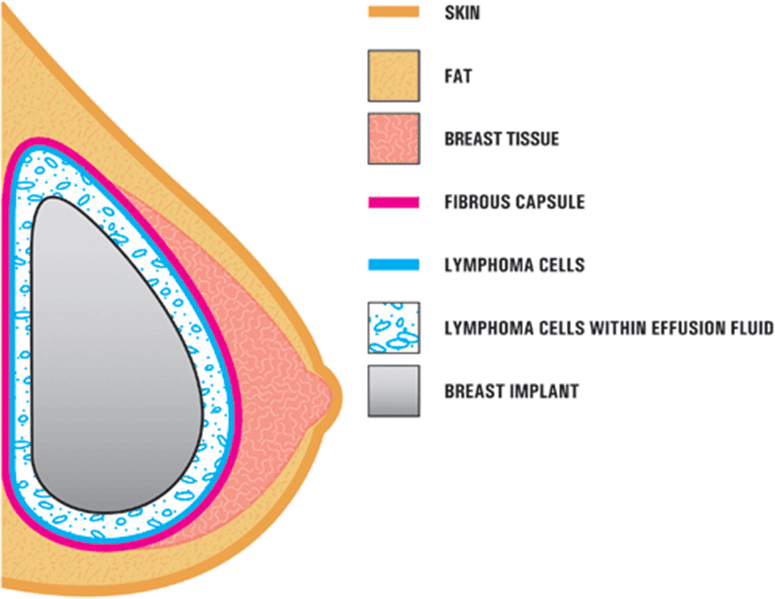
BIA-ALCL is typically detected when cancer cells are found in the fluid (effusion) that accumulates around the implant, or in the surrounding scar tissue (capsule).
Understanding the Risk Factors for BIA-ALCL
BIA-ALCL is a relatively recent medical discovery, and as a result, doctors are still working to understand its underlying causes. The British Association of Aesthetic Plastic Surgeons (BAAPS) has identified several factors that may contribute to an increased risk of developing breast implant-associated cancer:
- The Connection between Textured Implants and BIA-ALCL: Among the known risk factors, textured implants stand out as the most prominent. A majority of reported BIA-ALCL cases involve women with textured breast implants, particularly those manufactured by Allergan.
- The Role of Bacterial Contamination in BIA-ALCL: During surgical procedures, breast implants may occasionally become contaminated with harmful bacteria. This contamination can lead to inflammation, which is believed to elevate the risk of developing BIA-ALCL.
- The Impact of Time Since Surgery on BIA-ALCL Occurrence: BIA-ALCL typically manifests within 7 to 10 years following implantation.
- The Potential Involvement of Genetic Predisposition in BIA-ALCL: Researchers have also identified possible links between genetic predisposition and BIA-ALCL. Specifically, mutations in the JAK1 and STAT3 genes may play a role.
Recognising the Symptoms and Signs of BIA-ALCL: What to Watch For
Awareness of the symptoms associated with BIA-ALCL is crucial for early detection and prompt intervention.
- Asymmetry Between Breasts – If you notice a sudden or significant difference in the appearance of your breasts, this asymmetry could be a warning sign of BIA-ALCL.
- Swelling or Lumps in the Armpit Area – Swollen or enlarged lymph nodes in the armpit area may also signal the presence of BIA-ALCL.
- Swelling in the Breast – One of the primary indicators of BIA-ALCL is breast swelling, which may develop gradually or suddenly.
- Fluid Buildup and Seroma Formation – Fluid accumulation beneath the skin, known as seroma, can be another symptom of BIA-ALCL.
- Changes in Breast Shape or Size – Any alterations in the shape or size of your breast should be discussed with your surgeon.
- Experiencing Breast Pain – A painful breast can be a warning sign of BIA-ALCL and should not be ignored.
- Detecting Breast Lumps – If you feel a lump in your breast, it is essential to consult your plastic surgeon.
- Redness and Inflammation – Unexplained redness or inflammation around the breast area may also indicate the presence of BIA-ALCL.
RELATED: Breast Implant Check
Prioritising Early Detection and Consultation
It is crucial not to delay seeking medical attention if you experience any of these symptoms. An early diagnosis of breast implant-associated lymphoma can greatly improve the chances of successful treatment and recovery.
Methods for Diagnosing BIA-ALCL
Plastic surgeons use various methods to diagnose BIA-ALCL, including:
- Patient Examination – Your plastic surgeon will conduct a physical examination of your breasts and armpits, asking you about any symptoms you may have noticed.
- Ultrasound Imaging – A non-invasive, safe technique that uses sound waves to create an image of the breast tissue. It can detect any fluid, masses, or lymph nodes near your implants.
- Magnetic Resonance Imaging (MRI) – An advanced imaging technique that can detect any tissue abnormalities in your breasts, including BIA-ALCL.
- Needle Biopsy – If ultrasound or MRI scanning reveals something suspicious near your breast implant, your surgeon may perform a needle biopsy.
CD30 Testing – CD30 is a protein receptor found on activated T-cell lymphocytes. A positive CD30 test result is an indication of possible BIA-ALCL, and further testing will be needed to confirm the diagnosis.
Effective Treatment Options for BIA-ALCL
BIA-ALCL is a rare type of cancer that can develop after receiving breast implants. Fortunately, there are several treatment options available that have shown to be effective.
Testing and Staging
Before starting treatment for BIA-ALCL, it is important to undergo proper testing and staging by an oncologist.
Surgical Treatment
Surgery has been the most effective and commonly used treatment for BIA-ALCL. An experienced breast surgeon can perform En-bloc or complete capsulectomy excision to remove the old implant and surrounding fibrous tissue capsule. This surgery has been shown to be highly effective in treating BIA-ALCL.
Additional Treatment Options
In rare cases where surgery alone is not enough, other treatment options may be recommended. Chemotherapy may be used to destroy cancer cells with medication. Radiotherapy is also an option that may be used in addition to surgery.
Reconstruction Options
After the treatment of BIA-ALCL, breast reconstruction using new implants or a breast lift can be done in most cases.
Breast Surgery at Centre for Surgery
Centre for Surgery is a leading cosmetic surgery clinic in London, UK, with a team of highly skilled and experienced surgeons specialising in a wide range of cosmetic and reconstructive surgeries. Among our areas of expertise is breast surgery, including breast augmentation, breast reduction, breast lift, and breast reconstruction.
At Centre for Surgery, we understand that every patient is unique and has different needs and goals. That’s why we take a personalised approach to each case, providing our patients with comprehensive consultations to determine the most suitable surgical plan for them.
Our team of surgeons is highly respected in the field of breast surgery and is committed to ongoing education and training to ensure that they are up-to-date with the latest developments in the field.
If you are considering breast surgery, we encourage you to schedule a consultation with one of our experts at Centre for Surgery to discuss your options and determine the best course of action for you.
[contact-form-7 id=”256″ title=”Treatments form”]