
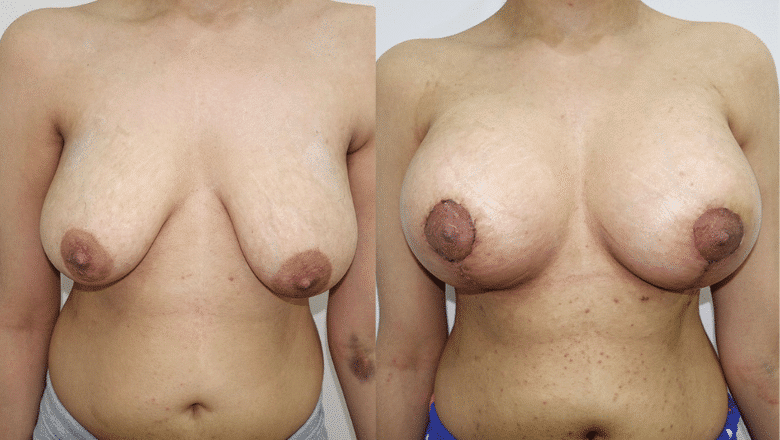
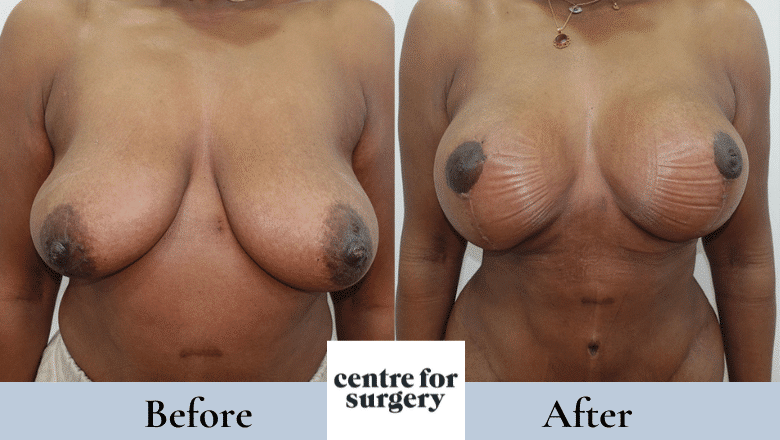
For many people who may be considering having a breast lift in the UK, the appearance of scarring after a breast lift may be enough to put people off having the procedure. By viewing our breast lift before and after photos, patients can develop a clear idea of what scars after a breast lift can look like. It is essential to be aware of several facts about breast lift scars, which may help to dispel certain myths:
- Not all types of breast lift will leave visible scarring.
- Breast lift scars gradually fade over time and will become barely visible.
- There are several things which patients can do to help minimise the appearance of breast lift scars.
- Although breast lift surgery results in scars, many people believe a breast lift is worth it due to its incredible ability to get rid of saggy or droopy breasts effectively.
RELATED: What is a breast lift?

What to expect from scars after breast lift surgery
Breast lift surgery scars vary in appearance depending on the type of breast lift a patient chooses. There are four main types of breast lifts. Although there are other techniques, these are the four most commonly used techniques in the UK.
Each specific breast lift method is characterised by the distinctive incision involved.
Crescent Breast Lift
The least invasive type of breast lift is called a crescent lift. This procedure involves making a crescent-shaped incision in the upper part of the areola to create a subtle uplift. This technique is only suitable for very minor degrees of breast lift and is most commonly used in combination with breast implant surgery.
Doughnut Breast Lift
The second type is called a doughnut breast lift or mini breast lift. This technique involves making a circumferential incision around the areola. A larger circular incision is then made around the initial incision. The skin and a small amount of breast tissue between the two incisions are then removed. When the incisions are closed with stitches, the breasts are lifted to a higher position on the chest. This technique is suitable for patients with minor degrees of breast sagging. The procedure is commonly combined with breast augmentation surgery in women who cannot successfully correct breast drooping with implants alone. When the incisions heal, it can be challenging to see the scars, as the incisions blend into the border of the areola and the surrounding breast skin.
Lollipop Breast Lift
Most types of breast lift surgery involve making a circular incision around the areola. A lollipop breast lift involves making a circumferential incision around the areola with a further incision that runs from the lower part of the areola incision down towards the lower breast crease. The incision is said to resemble a lollipop.
RELATED: Inverted T vs Lollipop Breast Lift
Anchor Breast Lift
An anchor breast lift is similar to a lollipop lift and involves an additional horizontal incision along the inferior breast crease. Both the lollipop lift and the anchor lift, with their vertical scars, are often the most noticeable for scarring. The lower breast crease incisions and the circular incisions around the areola are the least visible because they blend with the surrounding tissue. Although a vertical breast lift scar may be more noticeable initially during the early stages of recovery, breast lift scars will gradually fade over time. Below, we present top tips that every patient can follow to minimise the appearance of breast lift scarring.
How can I improve the appearance of breast lift scars?
Following the steps can improve the appearance of scarring after a breast lift. This will help make your scars look as inconspicuous as possible.
- Smoking should be stopped. If you cannot quit smoking completely, you should stop for a minimum of four weeks before and after your surgery to minimise the detrimental effects of smoking on wound healing.
- Avoid carrying out strenuous exercise or lifting heavy objects within the first six weeks after breast lift surgery, as this could affect wound healing.
- Avoid scratching or irritating the incision lines during the critical first two weeks of healing. Breast lift scars tend to itch after the first week, which is due to the healing process.
- Avoid exposure of breast lift scars to strong sunlight or tanning beds
- We would recommend breast massage to help soften and flatten the scars, as this will help to reduce internal scar tissue. This should only be done once the wounds have fully healed.
- Breast lift scars can be further improved with the application of silicone gel sheets once the incisions are fully healed. Placing them over the wounds will help them heal and flatten more quickly.
Am I a good candidate for a breast lift?
A breast lift is an ideal procedure for patients who have developed sagginess or droopiness of the breasts, most commonly due to pregnancy and breastfeeding. The natural ageing process can also result in breast ptosis as the effects of gravity become more pronounced, with weakening of the breast’s internal connective tissue leading to stretching and eventual sagging. Women who experience significant fluctuations in weight are more at risk of developing droopy breasts with a loss of volume and shape. Significant weight loss may lead to a deflated breast appearance as the breast’s fat tissue is lost. This can exaggerate breast droop caused by loose skin.
Women who have completed one or more pregnancies may develop droopy breasts. Breasts increase substantially in size during pregnancy, and if a mother chooses to breastfeed, milk production stretches the breast tissue further, which then shrinks with each feed. Continual expansion and contraction of the breast tissue and ligamentous framework lead to sagging breasts.
Why you should not be concerned about breast lift scarring
For women who have saggy breasts with nipples that are located in the lower portion of the breast or may be pointing downwards, there are a few options for improving the shape of the breasts. A non-surgical breast lift is relatively ineffective for improving breast perkiness. The best treatment to correct breast sagging is a surgical breast lift performed by an expert consultant plastic surgeon. Although women may be concerned about the appearance of scarring after a breast lift, this is understood by our surgeons. However, breast lift scarring should not deter you from having the procedure.
Scars after a breast lift are barely noticeable once they have fully healed, especially if you comply with your surgeon’s postoperative care instructions in full. The scars are concealed in most types of clothing. Most people who choose to have a breast lift do so to address significant unhappiness with the size and shape of their breasts. Breasts that have lost their shape can sag and droop, leading women to lose self-confidence. In many cases, women may experience pain and discomfort and may experience difficulty in finding the correct bra to wear. Many types of clothing may be unsuitable, which leads women to wear baggy, formless clothing. This can make women feel less desirable because they are increasingly self-conscious about how their breasts look.
The best way to address these problems is to have breast lift surgery. We would recommend reaching out to us to schedule a consultation with a UK-trained plastic surgeon with years of experience in performing breast lift surgery.
Breast lift surgery at Centre for Surgery
Although there are certain things which you can do at home to improve the appearance of restless scarring, nothing can replace choosing an expert breast surgeon to perform your procedure. This expertise will ensure your surgery and recovery proceed as smoothly as possible, helping to optimise the appearance of scars once healing is complete.
Our surgeons have years of experience in all types of breast lift surgery in London and are among a handful of surgeons in the UK with specialised fellowship training in cosmetic breast surgery. We carry out hundreds of cosmetic breast procedures each year at our state-of-the-art Baker Street clinic in central London.
If you have any questions or concerns about scarring after breast lift surgery, get in touch with us today by calling 020 7993 4849 or by completing the contact form below to schedule an in-person consultation.
[contact-form-7 id=”256″ title=”Treatments form”]