
Advances in surgical techniques now mean several different types of facelift and neck lift surgeries can be customised to the individual patient’s needs and desires. Although it can be daunting to understand the pros and cons of each type of facelift and neck lift, here we provide comprehensive information on key things to know about each type of facial rejuvenation procedure. Facelift and neck lift surgery is designed to eliminate signs of ageing, producing a youthful-looking facial appearance that boosts self-confidence.
RELATED: Facial Skin Tightening Treatments: A Comprehensive Guide
Centre for Surgery is home to some of the best facelift surgeons in London and is renowned as an expert UK centre for facelift and neck lift surgery. Our surgeons have years of experience customising facelift surgery to the facial anatomy of each patient they treat. When you have an in-person consultation at our Baker Street clinic in London, you will receive customised recommendations on the most appropriate type of facelift or neck lift that is right for you.
Benefits of facial rejuvenation surgery
The face is one of the most noticeable aspects of a person, and facial appearance is often viewed as a guide to personality and temperament. The ageing process can cause skin sagging, leading to a sad-looking face or an appearance that seems more anxious. This can often influence people’s perceptions of you and make you appear older than you actually are. This explains the rise of facial rejuvenation surgery, which has helped people look and feel better about themselves. This enables individuals to be the best version of themselves and gives them newfound confidence in everyday social interactions.
RELATED: Common Facelift Myths
Facelift surgery was traditionally viewed as something for Hollywood celebrities and those in the public spotlight. Facial rejuvenation surgery has become much more accessible since then. Facelift and neck lift surgery are among the most popular types of cosmetic surgery in London, UK. Tens of thousands of people choose to have a facelift or neck lift each year to reverse the signs of facial ageing to achieve a younger-looking appearance.
Causes of facial ageing
Several reasons can cause premature or early-onset ageing:
- excessive UV sun exposure
- smoking tobacco
- poor lifestyle habits (late nights, heavy drinking)
- genetics
Everybody’s skin is different, and this has a corresponding impact on the degree of facial ageing and at what rate.
We tell all our patients that there are several key criteria for being ‘ready’ for a facelift:
1) Structural evidence of facial ageing that is amenable to reversal with a facelift. This includes areas such as the jowls, neck skin laxity, or neck bands.
2) A realistic expectation of what can be achieved
3) Good overall medical health and a good social support system available after the procedure. A patient who is 44 may satisfy all three of these criteria, and a patient who is 58 may not – treatment is always individualised to the needs of every patient.
A facelift with our surgeons will restore a more youthful appearance, helping to correct many of the visible signs of ageing in the face and neck area. Reasons for having a facelift include:
- Sagging in the mid-face area
- Deep creases below the lower eyelids
- Deep creases along the nose extending down to the corner of the mouth
- Loose skin and excess fatty deposits under the chin area, resulting in a “double chin” or “turkey neck”
- Facial fat that is displaced or drooping, creating exaggerated jowls
Other factors help determine if you are a good candidate for facelift surgery including:
Good health: You should be in good health and be free of any major medical conditions prior to your surgery. This is key for proper healing and recovery after your procedure.
Most importantly, you should have realistic expectations about your surgical goals. Ideally, you want to look like a revitalised, refreshed version of yourself. The best way to determine if you’re a candidate for a facelift is to schedule a consultation with one of our specialist facial surgeons.
If you are a good candidate, you may wish to explore what finance options we have available.
RELATED: What is the best age for a facelift?
How to choose the best type of facelift
The first step in understanding the different types of facelift procedures and determining which one is best for you is to schedule an in-person consultation at our London cosmetic surgery clinic. The naming conventions used for facelift surgery may differ slightly among surgeons and can, therefore, have different meanings. A mini facelift may be referred to as a skin-only facelift by one surgeon or a minimally invasive type of SMAS facelift by another specialist. Here at Centre for Surgery, we consider a mini facelift a type of SMAS facelift.
RELATED: Facelift Recovery – top tips
It is the SMAS layer and the overlying facial skin that begin to lose their natural tightness as part of the ageing process. The SMAS, or superficial muscular aponeurotic system, is the distinct layer of fibromuscular tissue beneath the facial skin. It is the key tissue structure that must be tightened during facelift surgery to achieve significant anti-ageing effects that can last at least five years for a mini facelift or up to 10 years for a full facelift.
Choosing the Right Facelift Option for Your Needs
The different types of facelifts can be differentiated based on the facial structures they are designed to tighten or the specific parts of the face they target. Here we cover the full range of facelift procedures.
Skin-only facelift
A skin-only facelift is designed to address what its name suggests, namely, the facial skin layer only. This procedure does not involve tightening the underlying SMAS layer. The skin-only facelift was previously a popular procedure; however, as scientific knowledge has increased about key aspects of facial ageing, the popularity of this procedure has significantly decreased. In facial ageing, it is not only the skin that loses its elasticity. The underlying SMAS layer also becomes loose over time. Failing to tighten the SMAS layer means that surgery results are often short-term and insufficient to achieve adequate correction of many aspects of facial ageing. Incisions for a skin-only facelift are typically no more than 1 to 2 cm in length and are located in front of the ear. The surgery takes typically no more than 90 minutes to complete, and the recovery period is relatively brief.
Given the minimal results achievable with a skin-only facelift, this type of facelift is not performed at the Centre for Surgery.
Mini facelift
A mini facelift or short scar facelift is one of the most popular procedures at Centre for Surgery due to its ability to produce impressive facial rejuvenation results with a quick recovery period and minimal risk of complications. Mini facelift surgery is ideal for people with mild to moderate signs of ageing affecting the middle or lower part of the face. Facial lines and wrinkles, sagging jowls, loose facial skin and deflated cheeks can be corrected with a mini facelift. People who have the procedure look more youthful and often feel more refreshed.
A mini facelift involves making a short incision located in front of the ear with a small extension around the lower part of the earlobe. Once the facial skin has been separated from the underlying SMAS layer, the SMAS is surgically tightened and lifted in an upward direction. Excess skin is then carefully trimmed, followed by the closure of the incisions with dissolvable stitches. The short incision of a mini facelift means patients recover and heal relatively quickly. Although a mini facelift does not produce results as significant as a complete facelift, many people feel a mini facelift is well worth it. It should be remembered that a mini facelift is unable to target signs of ageing affecting the upper part of the face.
A mini facelift is ideal for people in their early 40s with mild to moderate signs of ageing. A traditional facelift is better suited for people in their 50s and 60s.
SMAS facelift
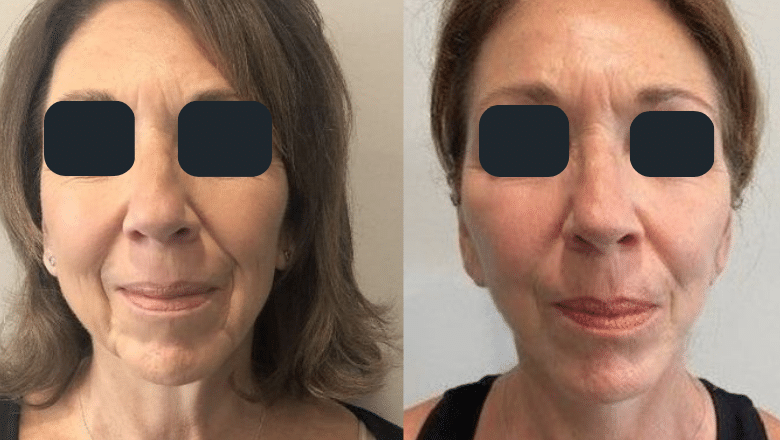
A traditional facelift, also known as an SMAS facelift, is considered the gold standard in facelift procedures. It is ideal for individuals with moderate to extensive signs of ageing and can produce dramatic results, improving both the face and neck. The procedure is designed to eliminate deeper wrinkles, correct deflated cheeks, droopy jowls, marionette lines, and loose skin.
A full facelift is a surgically invasive procedure that usually takes between 3 and 4 hours to complete. The incisions for a full facelift most commonly begin within the temple area and extend both in front of the ear and behind the ear into the posterior hairline.
Deep plane facelift
A deep plane facelift is the most extensive type of facelift, involving meticulous tissue dissection beneath the SMAS layer. Deep plane facelift surgery is the most effective way to lift the cheeks compared to other lifting procedures. Longer-lasting and dramatic results can be achieved with a deep plane facelift.
Upper facelift
An upper facelift or forehead lift is designed to target signs of ageing affecting the brow, upper eyelids, outer eyes and forehead. Forehead wrinkles can be eliminated for a smoother look. A sagging brow can be lifted and can also help to improve the appearance of the upper eyelids. Still, it is most commonly combined with an upper eyelid lift, also known as an upper blepharoplasty.
Brow Lift or Forehead Lift
A brow lift, also known as a forehead lift, is a specialised facelift procedure that focuses specifically on the forehead area. While certain facelifts do not address ageing concerns related to the eyelids and forehead, a brow lift offers an excellent solution for individuals dealing with forehead wrinkles. This surgery eliminates wrinkles and folds, lifts the upper eyelids, and results in a more youthful appearance around the eyes.
Various techniques can be employed to perform a brow lift, with the coronal lift being the most common method. The coronal lift involves a horizontal incision along the hairline of the forehead. Subcutaneous tissue is then lifted and secured in place using sutures. The surgeon will remove any excess skin and close the incisions, resulting in a smoother, more rejuvenated forehead for the patient.
Mid facelift
Mid-facelift, also known as a cheek lift, is commonly requested by patients to target features of ageing affecting the middle third of the face. The middle part of the face is often one of the first areas to show signs of facial ageing. Signs of ageing affecting this area include deflated cheeks, sunken eyes, nasolabial folds and vertical lip lines. A mid-face lift does not treat loose skin or jowls in the lower part of the face or neck. If you want to achieve enhanced cheeks with the appearance of higher cheekbones, a mid-facelift may be the ideal procedure.
The incisions for a mid-facelift are located on either side of the face within the hairline. The SMAS layer will be tightened and anchored at a higher position. Excess skin will be surgically trimmed, followed by the closure of the incisions with dissolvable stitches. Mid-facelift surgery typically takes approximately two hours to perform. It is often combined with facial fat grafting to enhance the volume and contour of the mid-face, including the cheeks.
Lower facelift
A lower facelift, also known as a jowl lift, targets signs of ageing affecting the lower part of the face, including areas located beneath the corner of the mouth, such as marionette lines, facial wrinkles, jowls, and sagging skin. A lower facelift is preferred for people who have minimal features of ageing affecting the mid or upper face and wish to achieve rejuvenation of the lower face and neck only.
RELATED: Difference between Neck Lift & Lower Facelift Surgery
Non-surgical facelift (liquid facelift)
A non-surgical facelift with fillers is also known as a liquid facelift. A non-surgical neck lift involves injecting hyaluronic acid-based dermal fillers to enhance tissue volume and soften the appearance of lines and wrinkles. Expert dermal filler injections can help recontour your face and enhance cheek volume to achieve a tighter-looking appearance without the need for incisions and scars associated with a surgical facelift.
Thread lift
A thread lift is a non-invasive facial rejuvenation technique that uses PDO threads. A thread lift has gained popularity in recent years and is one of several techniques for performing a nonsurgical facelift. Compared to facelift surgery, a PDO thread lift does not require incisions and has a shorter recovery period. The procedure is easily performed with a local anaesthetic, and the patient can go home immediately once the procedure is complete. Several types of PDO threads are available, including barbed threads and cogged threads, to achieve different degrees of tissue lifting.
The procedure involves inserting the PDO threads through the skin at different angles and then withdrawing them to a position that facilitates effective lifting of the underlying facial tissues. Once the threads have engaged with the tissue, it takes 3 to 4 months for them to dissolve. During this period, the threads initiate an inflammatory phase, a normal healing response that stimulates collagen formation and produces anti-ageing effects.
Neck lift options
A neck lift can either be performed independently or as part of a facelift procedure. Most people often have signs of ageing affecting both the face and neck; a neck lift is commonly combined with facelift surgery. The procedure is designed to enhance the jawline and reduce sagging jowls. Excess fat and vertical neckbands can be eliminated with a neck lift.
Full neck lift
A traditional neck lift is the best treatment for individuals who exhibit significant signs of ageing in the neck area. Incisions for a full neck lift are located in front of the ear and extend to the back of the ear into the posterior hairline. The underlying neck muscles will be surgically tightened, followed by the repositioning of sagging tissues to a higher level before being fixed in position with stitches. This helps eliminate vertical neckbands to achieve a tighter, smoother-looking neck. Any loose skin is then surgically removed, and the incisions are closed with dissolvable stitches.
Mini neck lift
A mini neck lift is ideal for younger men and women with milder signs of ageing affecting the neck. A mini neck lift can be combined with chin liposuction to eliminate a double chin. Excess skin can be surgically removed as part of a mini neck lift. If weakened neck muscles are present, a full neck lift may be more appropriate to address significant signs of ageing affecting the neck.
The incision for a mini neck lift is located beneath the chin. The surgeon will trim excess fat through this incision before surgically tightening the platysma muscle with stitches. Excess skin is not typically removed using the incision beneath the chin, but rather involves repositioning the skin to achieve a tighter-looking neck. A mini neck lift is a quick procedure that can be performed and has a relatively short recovery period. The procedure costs less than a full neck lift, although it may not achieve as dramatic results as a traditional neck lift. A mini neck lift does not eliminate jowls. Older people with loose neck skin and excess fat would be better suited to having a full neck lift.
Facelift and neck lift at Centre for Surgery
Centre for Surgery is the leading cosmetic surgery clinic in London and is home to some of the best facelift and neck lift surgeons in the UK. We perform hundreds of facial rejuvenation procedures each year at our state-of-the-art Baker Street clinic in London. We are renowned for providing the highest standards of medical care, both before, during, and after your procedure, to ensure you achieve the best possible results in an accredited and caring environment.
Call us today at 020 7993 4849 to schedule an in-person consultation with an expert plastic surgeon at our Baker Street clinic in Marylebone.
[contact-form-7 id=”256″ title=”Treatments form”]