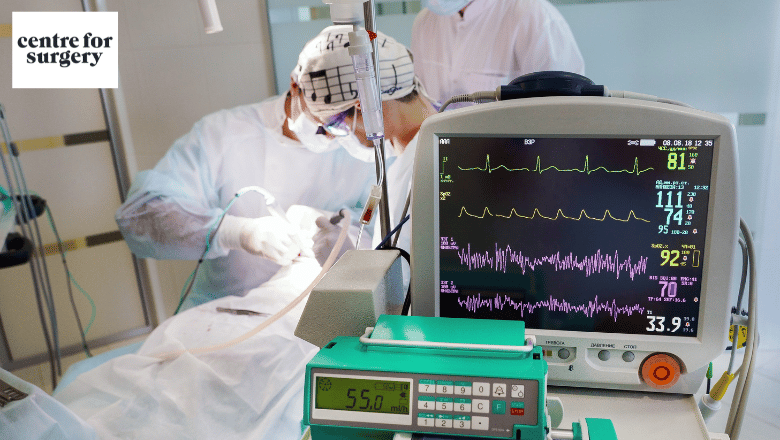
Twilight sedation — also called conscious sedation, moderate sedation, or IV sedation — is an anaesthetic technique that produces a state of deep relaxation and reduced awareness without full unconsciousness. It sits between local anaesthesia and general anaesthesia on the depth spectrum, and is widely used for short, minimally invasive procedures.
For cosmetic surgery specifically, twilight sedation has a narrower role than the marketing of some clinics suggests, and the choice between sedation and general anaesthesia has significant implications for both safety and patient experience. This guide explains what twilight sedation actually involves, where it is appropriate, where it isn’t, and why Centre for Surgery uses total intravenous anaesthesia (TIVA) — a form of general anaesthesia — for most of our procedures rather than twilight sedation.
What twilight sedation is, mechanically
Twilight sedation is produced by intravenous drugs that reduce anxiety, produce drowsiness, and suppress memory of the procedure. The drugs used are typically a benzodiazepine (most commonly midazolam) combined with a short-acting opioid (fentanyl or remifentanil), sometimes with the addition of propofol at low doses.
The defining feature is that the patient retains spontaneous breathing and protective airway reflexes throughout — they are not intubated, and an airway device is not used. The patient can usually be roused with verbal stimulus, will typically respond to commands, and breathes independently. Recovery is rapid, with most patients alert within 30 to 60 minutes of the procedure ending.
This is fundamentally different from general anaesthesia, where consciousness is fully suppressed, airway reflexes are abolished, and breathing is supported or controlled mechanically.
Where twilight sedation works well
Twilight sedation is well established for several specific use cases:
- Short dental procedures, including wisdom tooth extraction.
- Diagnostic endoscopy (gastroscopy, colonoscopy).
- Minor dermatological procedures.
- Cardiac catheterisation and similar interventional radiology.
- Some minor cosmetic procedures that are also feasible under local anaesthetic alone — small skin lesion excisions, simple earlobe repair, single-area mole removal.
For these uses, twilight sedation offers a useful middle ground — more comfort than local anaesthesia alone, less commitment than full general anaesthesia, faster recovery, and lower drug doses.
Why Centre for Surgery uses TIVA instead for most cosmetic surgery
The procedures Centre for Surgery performs — breast augmentation, abdominoplasty, rhinoplasty, facelift, blepharoplasty, gynaecomastia surgery, liposuction, mummy makeover, and so on — share several characteristics that make twilight sedation a poor fit:
- Operating times of 1 to 4 hours. Twilight sedation works well for 30 to 60 minutes. Sustained for longer periods, the drug doses required start to approach those of general anaesthesia, but without the airway control that makes general anaesthesia safer at higher doses.
- Patient immobility is important. Procedures like rhinoplasty, blepharoplasty, and breast augmentation are technically demanding precision work. A patient who shifts position, coughs, or moves in response to stimulus during these procedures compromises surgical accuracy.
- Significant tissue manipulation produces stimulus that breaks through sedation. Liposuction tunnelling, tissue dissection during a facelift, and implant pocket creation all produce intense stimulus. Patients under twilight sedation can experience awareness, discomfort, and movement at these points.
- Airway concerns. Facial and head-neck surgery in particular benefits from a secured airway, both to keep the surgical field clear and to maintain ventilation in a procedure where the surgeon’s hands are working close to the airway.
The technique we use instead — Total Intravenous Anaesthesia, or TIVA — delivers a controlled general anaesthetic using intravenous propofol and short-acting opioids. The patient is fully unconscious, the airway is secured (typically with a laryngeal mask), and the depth of anaesthesia is precisely titrated by the consultant anaesthetist throughout the procedure. Recovery profile is comparable to twilight sedation in most respects, but the safety margins during the procedure itself are significantly wider.
For a fuller comparison of anaesthetic options used in cosmetic surgery, see our forthcoming guide on types of anaesthesia used in plastic surgery.
The specific risks of twilight sedation in cosmetic surgery
Twilight sedation is not an inherently dangerous technique. Used in appropriate settings, by appropriately trained clinicians, with appropriate monitoring, it has an excellent safety record. The risks emerge when one or more of those conditions is not met — and the cosmetic sector is one of the places where they are sometimes not.
The “deep sedation” problem. The line between moderate sedation and general anaesthesia is not bright. As drug doses rise, patients pass through a continuum from light sedation to deep sedation to general anaesthesia without obvious external signal. A patient who was breathing comfortably at minute 20 may, at minute 45, have transitioned into a state where their airway is partially obstructed and their oxygen saturation is dropping. Without a secured airway and without an anaesthetist whose sole job is the airway, this can be missed.
Inadequate monitoring. Twilight sedation requires, at minimum, continuous pulse oximetry, blood pressure monitoring, ECG, and end-tidal CO2 monitoring (capnography) where available. Some non-CQC-regulated cosmetic settings provide less than this, with no continuous oxygen saturation monitoring or no capnography.
Operator versus dedicated anaesthetist. In appropriately staffed settings, a consultant anaesthetist manages sedation while the surgeon operates. In some cosmetic settings, the surgeon manages sedation themselves, alongside performing the procedure. This is unsafe for anything beyond brief, minor work and is not how we operate.
Inadequate fasting and pre-assessment. Twilight sedation does not abolish airway reflexes as reliably as general anaesthesia does, but it does impair them. A patient who has eaten recently and aspirates gastric contents during sedation is in a serious clinical situation. Pre-operative fasting and full anaesthetic pre-assessment are mandatory regardless of the depth of anaesthesia planned.
Choice of procedure mismatched to technique. Some cosmetic clinics offer procedures under twilight sedation that should be performed under general anaesthesia — full liposuction, large-volume fat transfer, abdominoplasty, multi-area body contouring. The reason is usually cost (skipping the consultant anaesthetist fee) rather than patient benefit. The trade-off is increased intraoperative risk and a worse surgical experience.
What “general anaesthesia” actually means at Centre for Surgery
There is a perception among some patients that general anaesthesia is more dangerous than sedation. Modern consultant-led general anaesthesia for healthy patients undergoing elective surgery is, in fact, extremely safe. Recent UK data places the risk of death directly attributable to anaesthesia in fit patients at well under 1 in 100,000.
The factors that make general anaesthesia safe in our setting are the same factors that should be present for any sedation:
- Consultant anaesthetist whose sole role is monitoring the patient.
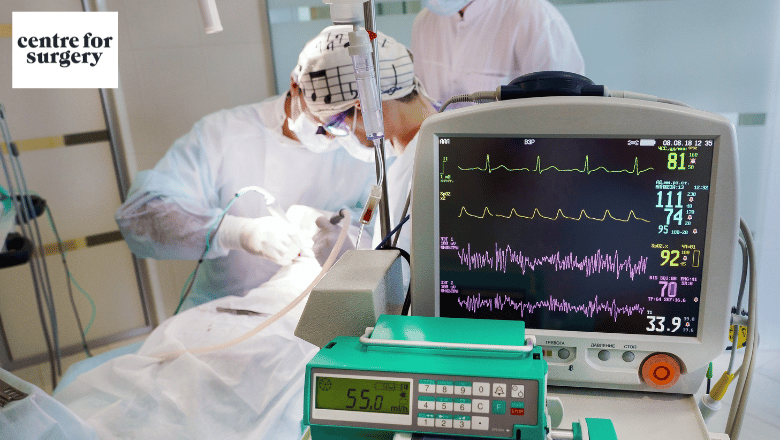
- Full intraoperative monitoring including ECG, pulse oximetry, blood pressure, capnography, and depth-of-anaesthesia monitoring.
- Secured airway with a laryngeal mask or endotracheal tube.
- Full anaesthetic pre-assessment including ASA classification, airway assessment, and review of medical history.
- CQC-regulated facility with full resuscitation capability and trained recovery staff.
- Appropriate fasting period.
These standards apply whether the anaesthetic technique is TIVA, inhalational general anaesthesia, or sedation. The difference between cosmetic clinics is rarely the choice of technique itself — it is the monitoring, staffing, and facility standards around it.
Cosmetic procedures we perform without general anaesthetic
Some procedures we perform are well suited to local anaesthetic with or without minor oral sedation:
- Labiaplasty (can be performed under local anaesthetic).
- Clitoral hood reduction.
- Some smaller blepharoplasty cases, particularly upper lid surgery on selected patients (see our guide on blepharoplasty).
- Otoplasty in adults (can be performed under local anaesthetic).
- Earlobe repair and minor reconstructive work.
- Mole, cyst, and lipoma excisions.
For these, the choice between local anaesthetic alone, local with light oral sedation, or full general anaesthesia is a discussion at consultation based on patient preference, anatomical factors, and the size of the planned procedure.
Side effects and recovery
The recovery profile from TIVA, twilight sedation, and local anaesthetic with light sedation differs in degree rather than kind. Common post-anaesthetic side effects include:
- Drowsiness for 4 to 12 hours.
- Mild confusion or disorientation in the first hour of recovery, usually fully resolved by discharge.
- Nausea (lower with modern propofol-based TIVA than with older inhalational techniques).
- Temporary memory loss for the period of the procedure itself.
- Dry mouth and mild sore throat from any airway device used.
Regardless of which anaesthetic technique is used, patients cannot drive, operate machinery, sign legal documents, or be left unsupervised for 24 hours after a general anaesthetic or significant sedation. The arrangements for this are part of our pre-operative checklist — see essential preparations before your plastic surgery.
What to ask at your consultation
Specific questions worth asking about anaesthesia at your consultation:
- What anaesthetic technique is planned for my procedure, and why this one?
- Will a consultant anaesthetist be present throughout, or will the surgeon manage sedation?
- What monitoring will be in place during the procedure?
- What is the planned airway management?
- What is the facility’s emergency response capability if a complication arises during anaesthesia?
For any cosmetic procedure beyond the most minor, the answers should include a consultant anaesthetist, full monitoring including capnography, a secured airway for any procedure over 30 to 45 minutes, and CQC-regulated facility resources. Anywhere less than this for a meaningful surgical procedure is taking on avoidable risk.
Booking a consultation
If you have specific concerns about anaesthesia, raise them at your consultation — the operating surgeon and the anaesthetist will both be involved in the final plan. To book a consultation, call 0207 993 4849 or use the contact form. We are based at 95–97 Baker Street, Marylebone.
Related reading
- How to avoid botched cosmetic surgery
- What a CQC Good rating means for cosmetic surgery patients
- From enquiry to consultation: what to expect
Centre for Surgery · CQC-regulated · GMC specialist-registered surgeons · 95–97 Baker Street, Marylebone, London W1U 6RN · 0207 993 4849 · Book a consultation · Finance from 0% APR