
Frown lines and forehead wrinkles are the two most commonly treated areas in cosmetic injectables. Both are caused by muscle activity — repeated contraction of specific facial muscles etches dynamic lines into the skin, which over time become static and visible at rest. Understanding which muscles are responsible, and at what stage your lines are at, determines which treatment is right for you.
This guide covers the anatomy, the prevention strategy, and the full ladder of treatments from skincare through to surgery.
The anatomy behind the lines
Different muscle groups produce different patterns of forehead and frown lines. Treatment targets them individually.
Frontalis
The frontalis is the broad muscle that covers the front of the forehead. It’s the only muscle that raises the eyebrows. Every time you raise your brows in surprise, in conversation, or to widen your eyes, the frontalis contracts and the skin above it folds into horizontal lines. Over years, these dynamic lines become permanent horizontal forehead wrinkles.
Corrugator supercilii
The corrugator supercilii sits between the brows. It pulls the inner eyebrows down and inward when you frown, concentrate, or squint. The vertical lines that develop between the brows — known as glabellar lines or “the elevens” — are caused by repeated contraction of this muscle.
Procerus and depressor supercilii
The procerus is a small muscle running vertically over the bridge of the nose. It creates the horizontal line at the top of the nose during frowning. The depressor supercilii pulls the inner brow down further. Together these muscles contribute to the glabellar frown complex.
Why this matters for treatment
Effective injection technique relaxes the specific muscles responsible for the lines you have without affecting nearby muscles unnecessarily. An experienced injector treats the glabellar complex (corrugator + procerus + depressor supercilii) as a group when patients have frown lines, and treats the frontalis carefully — too much relaxation of the frontalis can cause brow heaviness, while too little leaves residual forehead lines.
What causes them
Muscle activity is the main cause, but several other factors accelerate the process.
Genetics determine your baseline skin thickness, collagen density, and how rapidly your skin loses elastin with age. This is fixed.
Sun exposure is the biggest modifiable factor. UV light breaks down collagen and elastin and accelerates the formation of static lines. Daily SPF use, year-round, is the single most effective preventative step.
Smoking reduces blood flow to the skin and degrades collagen directly. The characteristic deep forehead lines of long-term smokers are caused by both the chemical effect and repeated facial expression.
Sleep position contributes to asymmetric wrinkling on the side of the face that habitually presses into the pillow.
Hydration and skincare habits influence how lines appear day-to-day, though they don’t reverse established wrinkles.
How to prevent them
Skincare
Three categories of product have meaningful evidence behind them:
Daily broad-spectrum SPF applied every morning, year-round. This is the single highest-impact step.
Topical retinoids (over-the-counter retinol or prescription tretinoin) thicken the dermis and stimulate collagen turnover. Start with a low concentration and build tolerance — initial dryness or peeling is normal.
Vitamin C serum provides antioxidant protection during the day and supports collagen synthesis.
Moisturising and hydration help skin look smoother in the moment but don’t affect underlying structure.
Lifestyle
Stop smoking. Get enough sleep. Maintain a stable weight. Wear sunglasses to reduce squinting in bright light. Limit time in direct sun, particularly at midday.
Diet matters less than people think for wrinkles specifically, but a diet rich in antioxidants and omega-3 fatty acids supports general skin health.
Treatment ladder — from least to most invasive
Skincare for the earliest stage
For patients in their twenties and early thirties with no static lines yet, SPF + retinoid + vitamin C is the right starting point. This is prevention, not correction.
Anti-wrinkle injections for dynamic and early static lines
Anti-wrinkle injections use small doses of botulinum toxin to relax the target muscle. Treating dynamic lines early, before they become static, is the most effective preventative strategy — once a line is fully etched into the skin at rest, injections soften but do not eliminate it.
How the procedure works: a fine needle is used to deliver small volumes (typically a total of 10 to 25 units across the upper face, depending on the patient) into precise points on the frontalis, corrugator, procerus, and depressor supercilii. The injections themselves take 10 to 15 minutes.
What to expect: a brief sting at each injection point. Small bumps that settle within 15 minutes. Occasional mild bruising that resolves over a few days. No numbing cream is needed for this area.
When you’ll see results: initial relaxation appears at three to five days, with the full result visible at two weeks. The effect lasts three to four months on average, slightly longer with regular treatment as the muscle softens.
Combined treatment is usually better than treating one area: the most balanced result usually comes from treating the forehead, glabella, and crow’s feet together rather than addressing one area in isolation. The muscles work as a group, and selectively treating one area can produce unintended effects elsewhere (for example, the brow may drop if the frontalis is treated without the depressors).
RELATED: Anti-Wrinkle Injections FAQs
Energy-based treatments for skin quality
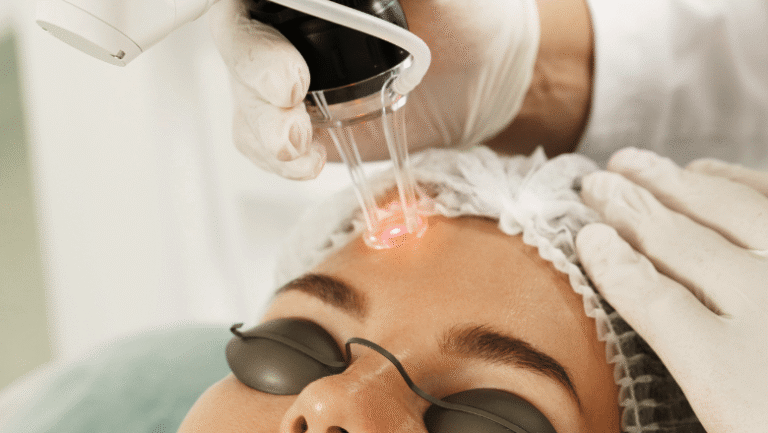
For patients whose forehead has accumulated surface damage from sun exposure as well as muscle-driven lines, energy-based skin treatment improves texture and stimulates collagen. Fotona 4D stimulates collagen with no downtime; Morpheus8 combines microneedling with radiofrequency for deeper remodelling. These are often combined with anti-wrinkle injections for a more comprehensive result.
Dermal fillers for deep static lines
Where lines have set so deeply that the muscle relaxation alone won’t smooth them, small amounts of dermal filler can be placed within the line itself to physically fill the depression. This is most commonly used for the deep glabellar frown line that remains visible even after anti-wrinkle injection. Caution: the glabella is a high-risk area for filler due to vascular anatomy — this should only be performed by an experienced injector.
Surgical brow lift for significant brow descent
Anti-wrinkle injections lift the brow by one to two millimetres. For patients with significant brow descent, heavy upper lid skin, or deeply set forehead wrinkles that haven’t responded to injectables, a surgical brow lift is the appropriate intervention. An endoscopic brow lift uses small incisions hidden in the hairline and a camera to reposition the brow and forehead tissues. The result is permanent and can take a decade off the upper face when indicated.
Facelift for combined upper, mid, and lower face ageing
A facelift addresses the lower two-thirds of the face — jawline, jowls, neck. It does not typically address forehead wrinkles. Patients with both forehead concerns and lower-face laxity are sometimes candidates for combined brow lift + facelift in a single operation.
Who is a good candidate for which treatment
- 20s–early 30s, no static lines: skincare and SPF only. Preventative anti-wrinkle injections are an option for patients with strong muscle activity and early dynamic lines.
- Mid-30s to 40s, dynamic and early static lines: regular anti-wrinkle injections every three to four months is the mainstay. Add energy-based treatments for skin texture if relevant.
- 40s–50s, deeper static lines and emerging brow descent: combination of injectables + filler for set lines, with energy-based treatment for skin quality. Surgical brow lift becomes a serious option when the brow is descending visibly.
- 50s and beyond, significant brow descent or hooding: surgical brow lift, often combined with upper blepharoplasty if there is excess upper lid skin.
A consultation is the appropriate next step. The honest assessment of which stage your skin is actually at — and which intervention matches it — is what produces a good result.
Common questions
How quickly do anti-wrinkle injections for forehead work?
You’ll start to see relaxation at days three to five. Full effect is visible at two weeks. Patients often book follow-ups worried that the treatment hasn’t worked at day two or three — almost always, it just hasn’t finished settling.
Will my forehead look frozen?
Not when treated by an experienced injector using a conservative dose. Good treatment preserves natural movement while softening the dynamic lines.
How often do I need to repeat the treatment?
Every three to four months on average. Patients on a consistent schedule often find the effect lasts slightly longer over time as the treated muscles soften.
Can I have anti-wrinkle injections and surgery at the same time?
Not on the same day, but they’re often combined in a treatment plan. Anti-wrinkle injections are commonly used as maintenance between or after surgical brow lift to keep the result smooth.
Do men get treatment for forehead wrinkles?
Increasingly, yes. Male patients typically need higher doses than female patients because the forehead muscles are stronger and the brow position should remain horizontal rather than arched.
RELATED: Eyelid Surgery vs Forehead Lift
Centre for Surgery · CQC-regulated · GMC specialist-registered surgeons · 95–97 Baker Street, Marylebone, London W1U 6RN · 0207 993 4849 · Book a consultation · Finance from 0% APR
Medically reviewed by Dr Spyridon Vlachos, GMC 7522950.