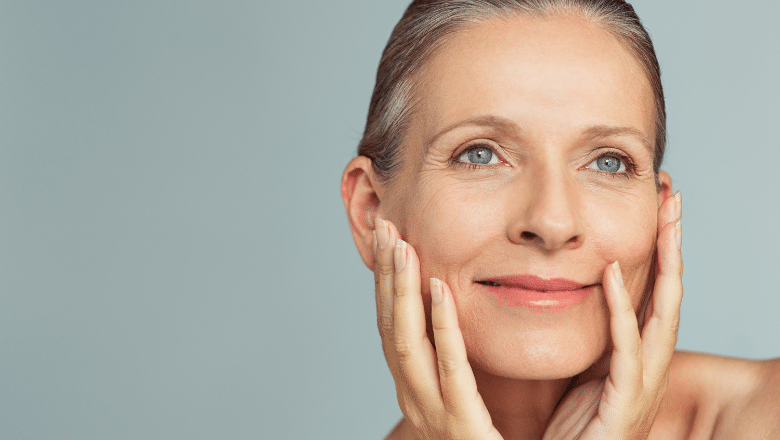

Nasolabial folds — the lines running from the sides of the nose to the corners of the mouth — are one of the most commonly treated areas in facial aesthetics. Patients usually call them “smile lines” or “laugh lines.”
What’s clinically important is this: nasolabial folds are not really a wrinkle problem. They’re a volume problem. The fold deepens as the mid-face descends and the cheek volume that used to support it diminishes. This means the right treatment isn’t usually about smoothing the line itself — it’s about restoring what’s been lost above it.
This guide covers the anatomy, what makes the folds worse, the two-technique filler approach that produces the best results, and when surgery is the right answer.
The anatomy behind the fold
The nasolabial fold sits at the natural junction between the cheek and the upper lip — the place where two structurally different tissue compartments meet. In youthful faces, the fold is barely visible at rest because the cheek volume above it is full and “tents” smoothly over the underlying support.
Several anatomical structures contribute to its appearance:
Levator labii superioris — the muscle that raises the upper lip. When it contracts during smiling, it pulls the lip upward and outward, deepening the fold.
Zygomaticus major — the main smile muscle, running from the cheekbone to the corner of the mouth. Its contraction lifts the corner of the mouth and creates the dynamic component of the fold.
Subcutaneous fat compartments — the malar (cheek), nasolabial, and superficial buccal fat pads provide the volume that determines how the fold sits at rest. Loss or descent of these compartments is the single biggest factor in how deep the fold becomes with age.
The supportive ligaments — the zygomatic-cutaneous ligament and others — anchor the cheek to the underlying bone. When these stretch with age, the cheek tissue descends, accentuating the fold above the corner of the mouth.
The implication of this anatomy: treating the fold itself, in isolation, often doesn’t produce the result patients want. The cause of the fold is sitting above it — in the cheek — and addressing it requires looking at the whole mid-face rather than just the line.
What makes nasolabial folds worse
Volume loss is the primary driver. From the mid-thirties onward, the cheek fat compartments thin and descend. By the age of 80, even patients with diligent sun protection have lost around 75% of their dermal collagen compared to their twenties. The mid-face deflates, the supportive structures relax, and the fold deepens.
Genetics set how prominent the fold is to begin with. Some patients are born with visible nasolabial folds in their twenties; others develop them only in their fifties.
Sun exposure accelerates the loss of dermal collagen and elastin. The cheek and mid-face area takes a significant share of cumulative UV damage.
Smoking compounds volume loss with vascular impairment and direct collagen damage.
Significant weight fluctuation repeatedly stretches and recoils the skin, weakening its elastic recoil and exaggerating volume loss patterns.
Sleep position contributes to asymmetric folds in patients who consistently sleep on one side.
Repetitive facial movement contributes — particularly in patients with very expressive faces — but is rarely the dominant factor.
For an overview of how this fits into broader facial ageing, see our guide on fine lines versus wrinkles.
Treatment options — from least to most invasive
Skincare and lifestyle
Skincare doesn’t reverse established nasolabial folds, but it slows their progression. Daily broad-spectrum SPF is the highest-impact single intervention. Topical retinoids build dermal collagen over time. Vitamin C provides antioxidant protection and supports collagen synthesis.
Stopping smoking and maintaining a stable weight matter substantially. Adequate sleep, hydration, and a diet with sufficient protein support skin quality from within.
Dermal fillers — the two-technique approach
For most patients, hyaluronic acid dermal fillers are the most effective non-surgical treatment. There are two complementary techniques, and the best results often combine them.
Technique 1: Mid-face restoration. Filler is placed in the cheek and zygomatic area to restore the lost volume. By rebuilding the structural support above the fold, the heavy descended skin is lifted off the lip, and the fold flattens indirectly. This is the approach that produces the most natural-looking result, because it addresses the cause of the fold rather than just the appearance.
Technique 2: Direct fold treatment. A small amount of filler placed precisely within the line itself softens what remains visible after the mid-face has been restored. This is usually done after the cheek work, not before — addressing the cheek first often reduces how much (if any) direct fold filler is needed.
Why both techniques are usually better than either alone. Filling the fold without restoring the cheek can produce an unnatural, sausage-like appearance — the line is filled but the face still looks deflated. Restoring the cheek without addressing a deep fold leaves the fold visible despite the improved overall structure. The combination addresses both elements.
Hyaluronic acid is the standard product for this area because it integrates well with surrounding tissue, holds the shape predictably for 9 to 18 months, and — importantly — can be dissolved with hyalase if the result isn’t what was wanted. HA also draws moisture into the tissue (it can hold around 1000 times its weight in water), which contributes to the smoothing effect.
What to expect on the day. The session takes 30 to 45 minutes, including a 15-minute wait for topical anaesthetic. The product itself contains lidocaine. Either a needle or a blunt cannula is used depending on the area and the practitioner’s preference. Results are visible immediately, with mild swelling settling over a week.
Anti-wrinkle injections — a limited role
Anti-wrinkle injections can sometimes be used to soften the contribution of the levator labii superioris in patients whose fold has a strong dynamic component, but the doses are very small and the technique is technical. Over-treatment can flatten the smile or affect upper-lip function. For most patients, this isn’t the right primary treatment for nasolabial folds — filler is.
For more on when injections do and don’t help, see our guide on anti-wrinkle injections versus dermal fillers.
Energy-based treatments — for skin quality
Fotona 4D and Morpheus8 stimulate collagen production in the dermis. They don’t eliminate established folds but they improve overall skin quality, texture, and modest tightening. Best used as a complement to filler rather than a replacement.
Biostimulators — for the broader picture
Profhilo and polynucleotide treatments improve dermal quality and skin hydration. They support the structural foundation that filler then sits on. Patients with poor skin quality may benefit from biostimulator preparation before filler work.
Surgery — when descent is significant
For patients with significant tissue descent — particularly when the fold has deepened in the context of jowling, mid-face flattening, and visible cheek descent — surgical treatment is more effective than non-surgical maintenance.
A facelift repositions the descended SMAS and overlying tissue, lifting the mid-face back to a more youthful position. This addresses the structural cause of the deep nasolabial fold rather than masking it.
A mini facelift focuses on the lower cheek and jawline. Useful for patients with moderate jowling and softening of the fold but not yet enough descent to warrant a full facelift.
Facial fat transfer takes the patient’s own fat from another area and re-injects it into the mid-face. Unlike filler, the result is permanent (for the fraction that survives transfer — typically 50-70%) and integrates fully with surrounding tissue. Often combined with facelift surgery for a complete result.
For more on how the surgical and non-surgical options compare for facial ageing more broadly, see our guide on non-surgical neck rejuvenation and related canonical pages for nearby areas.
Combining treatments — the typical plan
For most patients in their late 30s to 50s, the most natural-looking result for nasolabial folds comes from combination treatment rather than a single approach. A typical plan might include:
- Cheek filler to restore mid-face volume
- A small amount of filler within the fold itself if needed after cheek restoration
- Anti-wrinkle injection treatment for adjacent dynamic lines (forehead, glabella, crow’s feet) for overall balance
- Skincare with daily SPF and topical retinoid
- Energy-based treatment annually if skin quality is a concern
For patients with significant descent, the conversation shifts toward surgical assessment. A consultation with our specialist team establishes which approach matches your actual anatomy.
Cost
Filler treatment is typically priced per syringe, with most patients needing 1 to 2 syringes for cheek restoration plus a smaller amount for the fold itself. Cost varies depending on the number of syringes used. Surgical options vary substantially depending on the procedure. Finance options through Chrysalis Finance, including 0% APR, are available across all treatment types.
Common questions
If filler in the fold itself isn’t the best approach, why do I see it everywhere?
Direct fold filler is the simplest treatment to deliver and the easiest one for an inexperienced injector to perform. It often produces a visible short-term improvement, which is why patients see it advertised. The more comprehensive cheek-and-fold approach requires more anatomical understanding and typically more product, but produces a more natural-looking and longer-lasting result. We use the comprehensive approach because it’s what works.
How long will the result last?
6 to 18 months for hyaluronic acid filler, depending on the area treated, the product used, and individual metabolism. Cheek filler typically lasts longer than filler placed directly into a mobile area like the fold itself.
Can I have my filler dissolved if I don’t like it?
Yes — that’s one of the main reasons we use HA filler. Hyalase dissolves the filler within 24 to 48 hours, and the area can be re-treated about two weeks later if needed.
Are there risks I should know about?
The main concerning risk for facial filler is vascular occlusion — filler entering a blood vessel and blocking it, which can cause skin necrosis or, in extreme cases involving facial arteries that connect to the eye, vision changes. This is rare with careful technique using cannulas where appropriate, but it cannot be reduced to zero. The treatment should always be performed by a practitioner with detailed anatomical knowledge and immediate access to hyalase.
Less serious side effects include mild swelling, bruising, and tenderness at injection sites — all of which resolve within a few days.
How young can I start treating nasolabial folds?
There’s no specific age limit, but in most patients the folds aren’t really a concern until the mid-to-late 30s. Treating very early — before there’s much to address — risks the same patterns of over-treatment we caution against generally. See our guide on how young is too young for the broader case on early intervention.
Will surgery completely eliminate nasolabial folds?
A facelift dramatically improves them by repositioning the descended tissue, but doesn’t completely eliminate them — the fold is partly an anatomical feature, not just an ageing feature, and it’s natural for some line to remain. The aim is to restore the youthful balance, not to erase the line entirely.
Centre for Surgery · CQC-regulated · GMC specialist-registered surgeons · 95–97 Baker Street, Marylebone, London W1U 6RN · 0207 993 4849 · Book a consultation · Finance from 0% APR