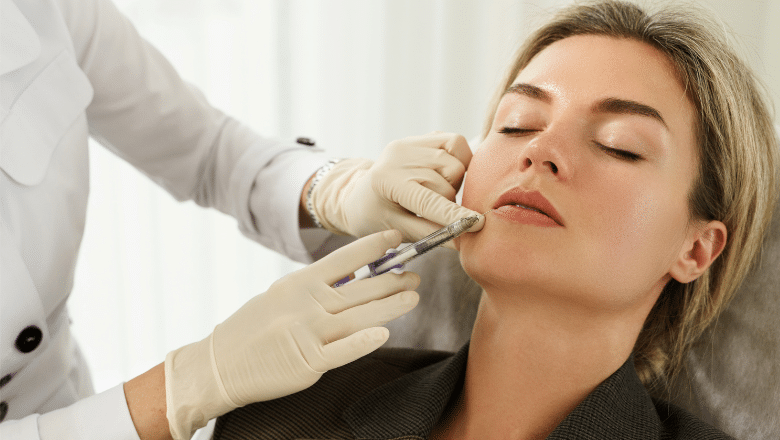
Lip filler migration is when filler placed inside the lip drifts outward beyond the vermillion border — the natural line where the lip skin meets the surrounding facial skin. The result is a ledge of product visible above the upper lip, sometimes called a “filler moustache” or “filler shelf,” producing the puffy, distorted appearance that’s now widely recognised on social media and that prompts many patients to seek correction.
This is the comprehensive guide to lip filler migration: what it actually is anatomically, why it happens, how to prevent it, and how to fix it when it occurs. For the broader treatment context, see our lip filler service page.
The anatomy of migration
The lip has clear anatomical boundaries. The vermillion border is the line where pink lip skin meets ordinary facial skin — it’s defined by a small ridge called the “white roll,” which is where the cupid’s bow is sculpted and where the lip’s natural definition lives. Inside the vermillion is the lip proper (the “vermillion” — the red zone). Outside is the perioral skin including the philtrum (between the nose and the cupid’s bow) and the upper lip cutaneous area.
Filler is intended to sit within the vermillion — adding volume to the body of the lip while preserving the crispness of the border. When migration occurs, the filler has drifted across the border and now sits in the cutaneous skin above the upper lip. Once there, it creates a visible ridge or shelf that distorts the natural transition between lip and face.
The classic signs of migration:
- A visible ridge or step above the upper lip
- Loss of the natural cupid’s bow definition
- Shortening of the philtrum (the space between nose and lip)
- A “duck pout” or “shelf” appearance when smiling or speaking
- Lips that look puffy at rest in a way that doesn’t match the patient’s natural anatomy
For the wider context of how aesthetic trends have driven this phenomenon, see our guide on current trends in lip filler treatments.
Why filler migrates
Several factors contribute, often in combination:
Overfilling
The single largest cause. The lip tissue has a finite capacity to hold filler in its natural compartments. Beyond that, additional product has to go somewhere — and it migrates along the path of least resistance, typically upward into the cutaneous lip and philtrum. Once the natural lip capacity has been exceeded, every additional milliliter of filler increases migration risk substantially.
This is why the trend toward dramatically enhanced lips, fuelled by social media imagery, has driven an epidemic of migration. Lips that look acceptable in still photos because they’re filled past their natural capacity are exactly the lips that develop visible shelves and ledges in motion.
Incorrect injection technique
Filler placed too superficially — too close to the skin surface rather than within the body of the lip — is more likely to drift. Filler placed too far above the vermillion border in an attempt to create lip flip-like definition is essentially placed in migration position from day one. For the proper comparison of filler vs flip approaches, see our guide on lip flip vs lip filler.
The choice of injection method matters too. Bolus injections (placing larger volumes in single points) and aggressive multi-pass micro-injection techniques like the Russian lip technique both increase migration risk compared with conservative linear threading techniques.
Wrong product choice
Lip filler products vary in firmness (G’ value), water-binding capacity, and integration properties. A robust filler designed for structural cheek work, placed in the lip, will sit harder and drift more readily than a softer filler specifically formulated for the lip. Inexperienced injectors using whatever filler they have on hand — rather than the right product for the area — produce more migration.
A particular caution: permanent fillers (PMMA, silicone, polyacrylamide) carry significantly higher migration risk than HA, and the migration is much more difficult to correct because the product cannot be dissolved with hyalase. This is one of the main reasons we don’t offer permanent fillers and recommend against them.
Repeated treatment without intervals
Patients who return for top-ups before the previous round has fully metabolised gradually accumulate volume. Each top-up adds to the residual filler from before. Over time, the lip compartment is overfilled even when each individual treatment was modest, and migration follows.
This is why a regular pattern of dissolving accumulated filler (every 12 to 18 months, depending on usage) is part of responsible long-term lip filler management.
Inadequate practitioner experience
Lip filler is widely advertised as a “starter” injectable and frequently performed by practitioners with limited training. The UK regulatory environment doesn’t restrict who can administer dermal fillers — they’re classified as medical devices rather than prescription medications — so non-medical injectors with brief courses can legally treat patients. The result is widely variable technique and outcomes, with migration being one of the most common consequences.
Anatomical predisposition
Some patients are more prone to migration than others — typically those with a short philtrum, thin lip skin, or naturally subtle vermillion border definition. These patients need particularly conservative volumes and careful technique.
How to prevent migration
1. Conservative volumes
The single most important preventive measure. Start with 0.5 to 1ml on a first treatment, with a small top-up at 2 weeks if needed. Avoid the pressure to “go bigger” each session — modest, well-placed filler that respects natural anatomy ages far better than maximalist filling that needs constant correction.
A useful test: if the proposed result wouldn’t look natural in motion (when you smile or speak), don’t proceed with that volume.
2. Right product for the area
At Centre for Surgery, we use lip-specific HA fillers chosen for their softness, low water-binding profile, and good integration with lip tissue. Robust structural fillers designed for cheek or jawline contouring are inappropriate for the lip and increase migration risk.
3. Proper injection technique
- Placement within the vermillion, not above it
- Conservative volumes per injection point
- Cannula technique where appropriate (less tissue trauma, lower bleeding/bruising)
- Avoiding the more aggressive “shelf-creating” techniques (Russian lip, certain Korean techniques) in patients whose anatomy doesn’t naturally support them
4. Following aftercare
The first 48 hours matter. Pressure on the lips, vigorous facial movement, heat exposure, and certain sleeping positions can all displace soft, still-integrating filler. See our full lip filler aftercare guide for the comprehensive protocol.
5. Appropriate intervals between treatments
Don’t top up before the previous round has settled and partially metabolised. Most patients should wait at least 6 to 8 months between maintenance sessions — sooner if a clinical assessment confirms residual filler is fully resolved.
6. Choosing an experienced practitioner
The combination of detailed lip anatomy knowledge, product expertise, and aesthetic judgment matters more than equipment or location. An experienced injector should be willing to:
- Tell you no when more filler isn’t appropriate
- Recommend dissolving before adding if there’s residual product
- Suggest alternatives (lip lift surgery, smaller volume than requested) when those would serve you better
- Document their work with photographs at each session
- Have hyalase on-site for immediate complications
How to fix migration that’s already happened
The good news is that HA filler is reversible. Hyaluronidase (hyalase) is an enzyme that breaks down hyaluronic acid filler within 24 to 48 hours of injection. Used appropriately, it can completely dissolve migrated filler and reset the lip area. For the full guide to the dissolving process, see dissolving filler in the face and lips.
The dissolving process:
- Initial assessment to determine extent of migration and any other concerns
- Small injections of hyalase placed at the sites of migrated filler — focusing on the cutaneous lip area above the vermillion where the migration sits
- Immediate effect begins within 24 hours; full dissolution typically complete within 48 hours
- A waiting period of 2 to 4 weeks allows the tissue to settle and any residual filler to fully resolve
- Re-treatment with appropriate technique and conservative volume can begin after the assessment period
What dissolving does and doesn’t do:
- It breaks down HA filler — both your migrated filler and, unavoidably, any underlying natural HA in the tissue around the injection site. The latter regenerates within days to weeks.
- It doesn’t damage the lip tissue itself or affect the natural lip structure.
- Multiple dissolving sessions may be needed for very heavily filled patients — sometimes scheduled 2 to 4 weeks apart.
For patients with significant accumulated filler over years, the dissolving process can produce a lip that looks “deflated” temporarily — the tissue has stretched to accommodate the filler and needs time to recover natural tone. Most patients see substantial recovery within 6 to 12 weeks. The temporary appearance is a price worth paying for the long-term return to natural anatomy.
The “reset and rebuild” approach
For patients with significant migration, the standard approach at Centre for Surgery is:
Stage 1: Full dissolution. All existing filler dissolved with hyalase. Sometimes requires more than one session.
Stage 2: Recovery period. 2 to 4 weeks (longer for heavily filled patients) to allow tissue to settle and the area to return to baseline.
Stage 3: Reassessment. Honest evaluation of the patient’s natural lip anatomy without any filler influence. What does the lip actually look like? What are the genuine aesthetic concerns versus what was perceived through the lens of accumulated filler?
Stage 4: Conservative re-treatment, if appropriate. Small volume, lip-specific filler, appropriate technique. Some patients discover at this point that they don’t actually need much filler at all once the migrated material is gone.
Stage 5: Long-term maintenance plan. Modest volumes at appropriate intervals, with periodic full dissolution (every 12 to 18 months) to prevent accumulation.
This approach restores natural lip anatomy and prevents the gradual progression of migration over years.
When migration suggests trying something different
Some patients with significant migration history are good candidates for considering whether filler is the right tool at all. Alternatives include:
Lip lift surgery — a permanent surgical procedure that shortens the philtrum, lifts the upper lip, and produces enhanced lip appearance without any filler. See our guides on lip lift longevity and bullhorn vs corner lip lift. For the broader comparison between options, see lip lift surgery vs lip flip vs lip filler.
Smaller volume filler with appropriate technique — for patients whose previous treatment was poorly executed rather than fundamentally wrong. Often the result they actually wanted is achievable with half the volume they’d been receiving.
No filler at all — for patients whose filler history has been driven by trend-chasing rather than genuine anatomical concerns. After dissolving and reset, some patients are surprised to find they prefer their natural lips.
For the broader discussion of what lip filler can and can’t address, see our guide on can lip filler lift the corners of the mouth.
What to look for if you suspect your filler has migrated
A self-check:
At rest: Look at your lips in a mirror with a neutral expression. Is there a clear ridge or step where your upper lip meets the skin above it? Has the philtrum (the space between your nose and lip) become noticeably shorter than it used to be? Is your cupid’s bow less defined than before treatment?
Smiling: Take a photo while smiling naturally. Does the upper lip protrude or “shelf” outward rather than curving naturally? Is there a noticeable ledge between lip and face?
Speaking: Take a video while talking. Does the upper lip move naturally with your speech, or does it look “stuck” or oddly puffy in motion?
If you notice any of these patterns, book a consultation for assessment. Migration can be subtle in early stages and dramatic when established — earlier intervention with hyalase is usually simpler than waiting until significant tissue distortion has developed.
Risk factors that increase migration probability
You’re at higher risk if:
- You’ve had multiple lip filler treatments without ever dissolving
- Your previous treatments have been at increasingly large volumes
- Your injector has used the same product across multiple facial areas (rather than lip-specific filler)
- You’ve been chasing a specific celebrity or social media lip look
- You have a naturally short philtrum or thin lip skin
- You’ve had treatment from non-medical or inexperienced injectors
- You’ve ignored aftercare instructions in the past
None of these are reasons to avoid lip filler permanently — they’re reasons to choose your next treatment carefully, prioritise an experienced injector, and accept conservative volumes.
Cost considerations
The cost of dissolving migrated filler at Centre for Surgery is priced per session. Most patients need one dissolving session, sometimes two for heavily filled areas. Subsequent re-treatment with appropriate technique is priced per syringe of lip filler used.
A useful financial framing: a single round of dissolving followed by appropriate conservative filler treatment typically costs less than the 2 to 3 years of accumulating top-up filler that led to the migration in the first place. Finance options through Chrysalis Finance, including 0% APR, are available.
Common questions
How quickly does migration develop?
Variable — sometimes within weeks of overfilling, sometimes gradually over multiple treatment cycles. Acute migration immediately after a single treatment usually indicates technique issues; gradual migration over months to years usually indicates accumulating volume.
Will dissolving filler make my lips worse than before treatment?
No — dissolving returns the lips to their pre-treatment state, not to a worse state. Patients sometimes feel their lips look “thin” or “deflated” immediately after dissolving because they’ve been used to the filled appearance for months or years. Within 4 to 8 weeks, the lips look like the patient’s natural lips again.
Can dissolving filler damage my lips permanently?
No. Hyalase breaks down HA — the filler and any local natural HA, which regenerates within days. There’s no permanent effect on the lip tissue itself. The treatment has an excellent safety profile when administered by experienced practitioners.
How long should I wait after dissolving before getting filler again?
Minimum 2 weeks, ideally 4 weeks. The longer wait allows for full tissue assessment and proper planning of conservative re-treatment.
Can I prevent migration if I genuinely want bigger lips?
You can have larger lips without migration — but only up to the limit of what your natural lip anatomy supports. Beyond that limit, the lips can’t physically contain the volume you want and migration becomes inevitable. For patients who want dramatic lip enhancement beyond what filler can safely deliver, lip lift surgery may be more appropriate.
Does dissolving hurt?
The injections themselves are quick and tolerable — similar discomfort to filler injection. Some patients describe a brief stinging sensation at injection sites. Topical anaesthetic can be used to minimise discomfort.
What if I had my filler somewhere else and they won’t help with the migration?
You can be assessed and treated at any reputable clinic — you don’t need to return to the original practitioner. At Centre for Surgery, we routinely assess and dissolve filler placed elsewhere. Bring details of what was used previously if available, but it’s not essential — hyalase works regardless of which HA filler brand was originally placed.
Centre for Surgery · CQC-regulated · GMC specialist-registered surgeons · 95–97 Baker Street, Marylebone, London W1U 6RN · 0207 993 4849 · Book a consultation · Finance from 0% APR