
Uneven buttocks — also known as glute imbalance or buttock asymmetry — is a common concern in which one buttock is larger, higher, or a different shape from the other. A degree of asymmetry is completely normal; no one’s body is perfectly symmetrical. But where the difference is more noticeable, it can affect the fit of clothing, cause muscular discomfort, and knock a person’s confidence. This guide explains what glute imbalance is, why buttocks become uneven, how to tell if you have it, and the full range of non-surgical and surgical treatments — from targeted exercise to a Brazilian Butt Lift (BBL) or buttock lift.
At Centre for Surgery in London, our GMC-registered consultant plastic surgeons treat buttock asymmetry with bespoke, individually-planned procedures at our CQC-regulated Baker Street clinic — always beginning with an honest assessment of whether surgery is the right answer for you, or whether a non-surgical route would serve you better.
What Is a Glute Imbalance?
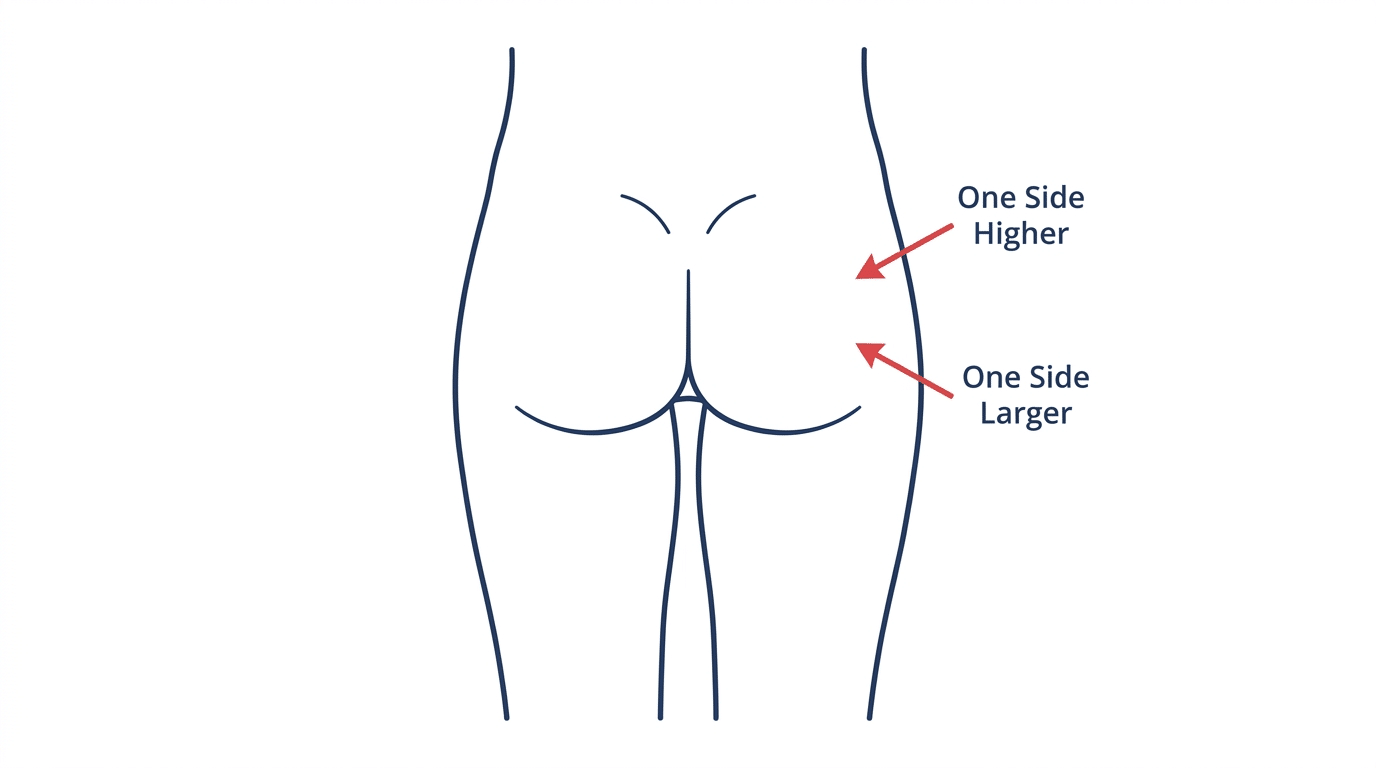
Glute imbalance, also known as uneven buttocks or buttock asymmetry, is a condition in which one buttock is larger, sits higher, or has a different shape from the other. The shape and volume of the buttocks are determined by a combination of fat, muscle (chiefly the gluteus maximus, medius, and minimus), and the underlying bone structure of the hips and pelvis — and a difference in any of these can produce visible asymmetry.
Because even a small difference in buttock size or shape can affect confidence, glute imbalance is a genuine concern for many people, even though a degree of asymmetry is entirely natural. It can affect the fit and comfort of close-fitting clothing such as sportswear and swimwear, cause muscular strain or discomfort, and lead to self-consciousness. Understanding the cause is the first step to choosing the right treatment.
What Are the Symptoms of Buttock Asymmetry?
The signs of glute imbalance vary from person to person, and some affect appearance while others affect comfort and function. Common symptoms include one buttock appearing larger or sitting higher than the other; the two buttocks being noticeably different shapes; uneven muscle soreness, or one buttock feeling weaker during movement or exercise; and a loss of confidence caused by the appearance of the buttocks. For some people the concern is purely aesthetic; for others, the primary issue is muscular — pain, weakness, or fatigue on one side. The overall impact on confidence and comfort is what matters most, and it varies with the severity and cause.
What Causes Glute Imbalance and Uneven Buttocks?
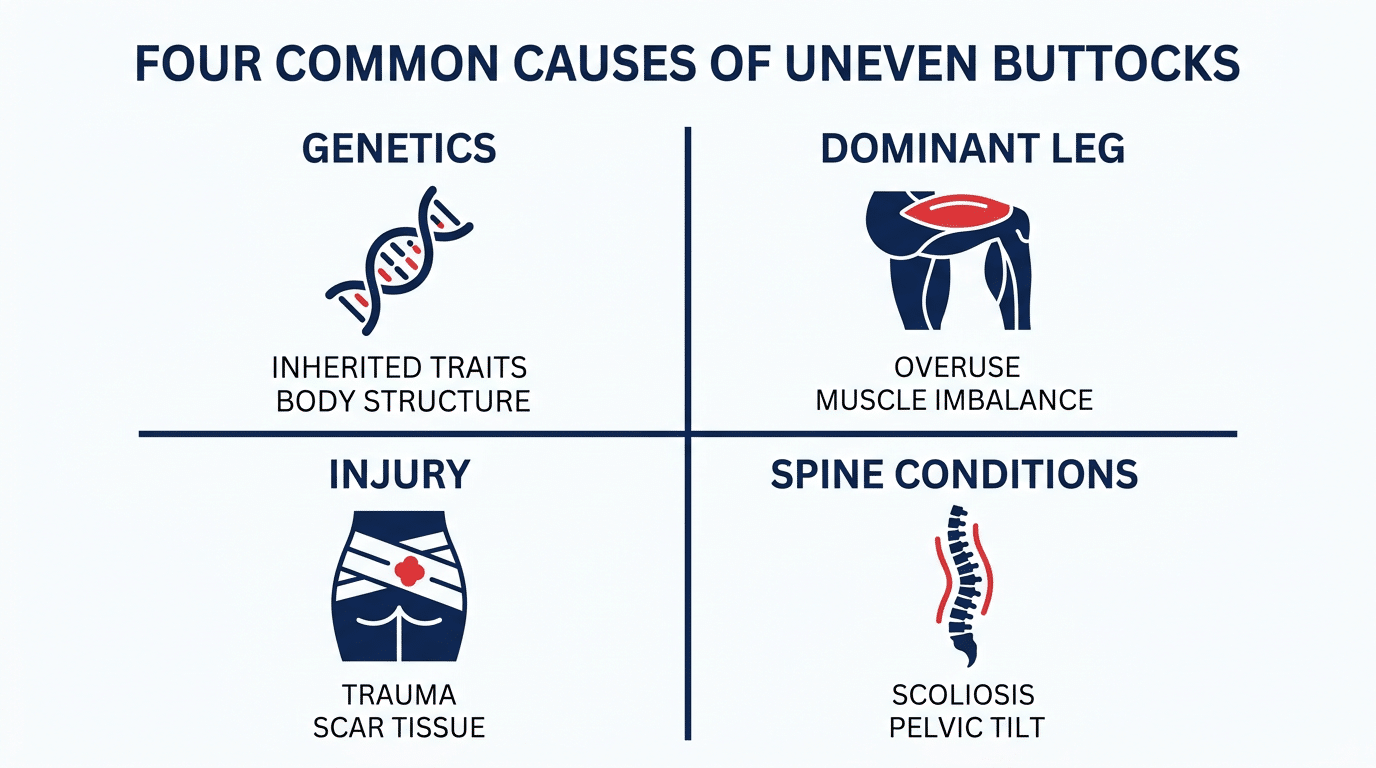
Uneven buttocks have several possible causes. Sometimes the cause is obvious; in other cases it takes assessment by a specialist to identify. The main causes are as follows.
Genetics
Buttock fat and muscle distribution naturally vary between individuals, and genetics plays a significant role. People with close family members affected by uneven buttocks are more likely to experience it themselves, though it can also occur without any family history. The severity varies too — even within a family, some people’s asymmetry is far more pronounced than others’.
Anatomy and a Dominant Leg
No one’s body is exactly the same on both sides. Just as most people have a dominant hand, we also have a dominant leg, which we naturally favour during movement and exercise. If that dominance is strong, over time the muscles in one buttock can become considerably stronger and more developed than the other — a true glute muscle imbalance producing a difference in size and shape.
Injury
Injury or trauma to the buttocks, hips, or legs can cause asymmetry. Direct injury may affect the shape and size of a buttock, and musculoskeletal injuries to the legs and hips can cause fat and muscle to break down more on one side than the other. Improper rehabilitation can also cause tissue to rebuild unevenly during recovery. This often resolves on its own over time, but in some cases the effect is longer-lasting.
Medical Conditions and Spinal Curvature
Certain medical conditions cause buttock asymmetry by affecting the shape and structure of the spine and hips. The most common is scoliosis — a sideways curve of the spine that pulls the surrounding muscles unevenly, creating tension on one side and weakness on the other, which leads to hip asymmetry and an uneven distribution of buttock fat and muscle. Other spinal conditions including kyphosis, lordosis, and arthritis can have a similar effect. Where the cause of glute imbalance is not obvious, a specialist assessment is the best way to establish it and plan the right treatment.
How to Tell If You Have a Glute Imbalance
Glute imbalance presents differently in different people. For some, it is clearly visible — one buttock looks noticeably larger or higher, especially in fitted clothing or from behind in a mirror. For others, the signs are primarily muscular: pain, weakness, or fatigue in one buttock during exercise, or a sense that one side “isn’t firing” properly during movements like squats or lunges. A simple way to check is to look in a mirror from behind in good light, and to notice during single-leg exercises whether one side feels distinctly weaker. If you are unsure of the cause, a consultation with an experienced surgeon provides a proper assessment.
How to Treat Uneven Buttocks (Non-Surgical)
Where the imbalance is caused by muscle rather than fat distribution, bone structure, or skin laxity, non-surgical approaches can be very effective — particularly physical therapy and targeted exercise. These are the first-line options for mild to moderate glute imbalance.
Physical Therapy
Especially where the imbalance stems from injury or a medical condition, physiotherapy can help. It may include physiotherapy exercises, massage, hot and cold therapy, and radiofrequency or electrical muscle stimulation. Depending on your concerns, physical therapy can rebalance the muscle between the two sides, strengthen the surrounding muscles to correct overdominance, and rehabilitate old or recent injuries to improve function and reduce discomfort.
Corrective Exercises
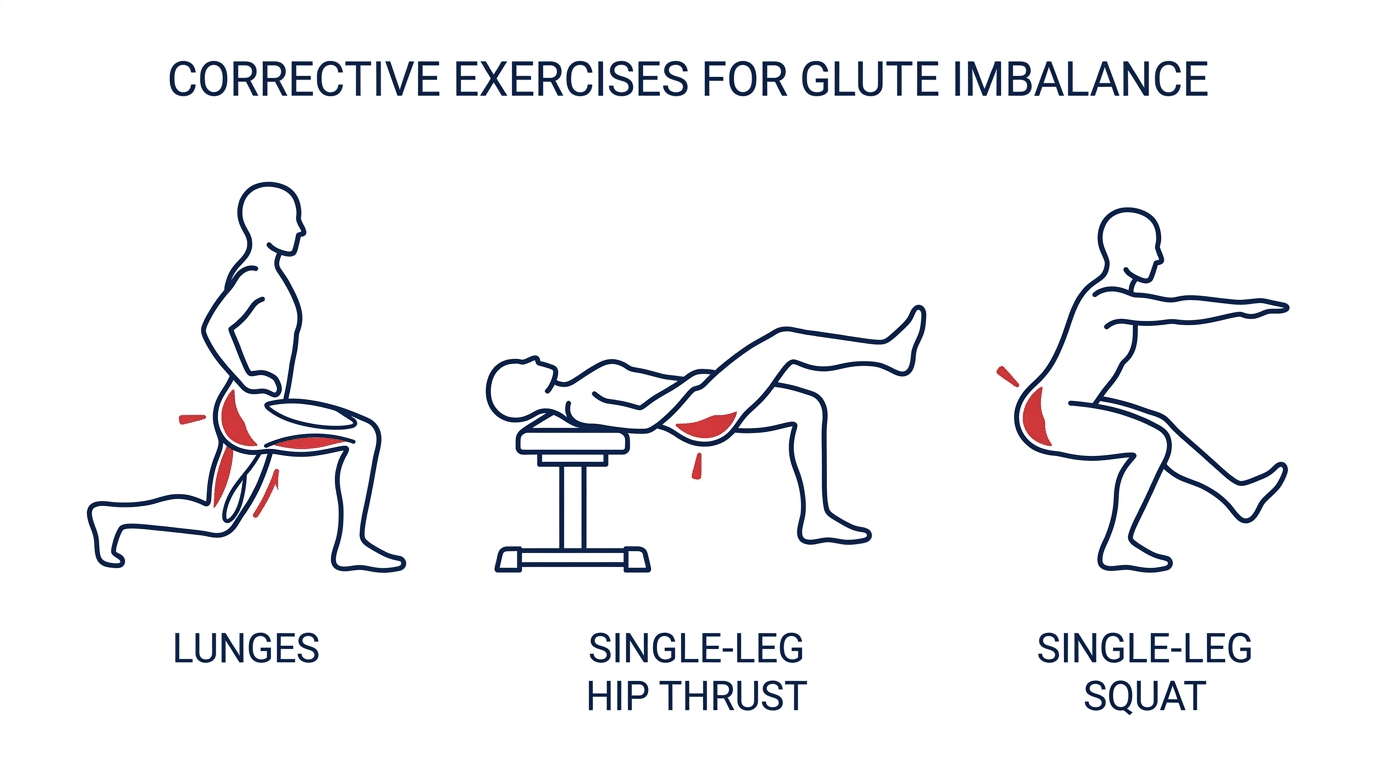
Exercise is one of the most effective ways to self-manage and improve a muscular glute imbalance. The key principle is unilateral training — working each side of the body independently so the weaker side is forced to work harder and catch up, rather than letting the dominant side take over. Effective exercises include lunges, single-leg hip thrusts, and single-leg (Bulgarian split) squats. Using ankle weights on the weaker side, or simply starting each set with the weaker side and matching the reps on the stronger side, further encourages balance. Consistency over weeks and months is what produces results — this is a gradual process, not a quick fix.
It is important to be realistic: exercise can rebalance muscle, but it cannot correct asymmetry caused by fat distribution, bone structure, significant skin laxity, or an underlying skeletal condition. Where those are the cause, surgery is the more effective route.
Surgical Treatments for Uneven Buttocks
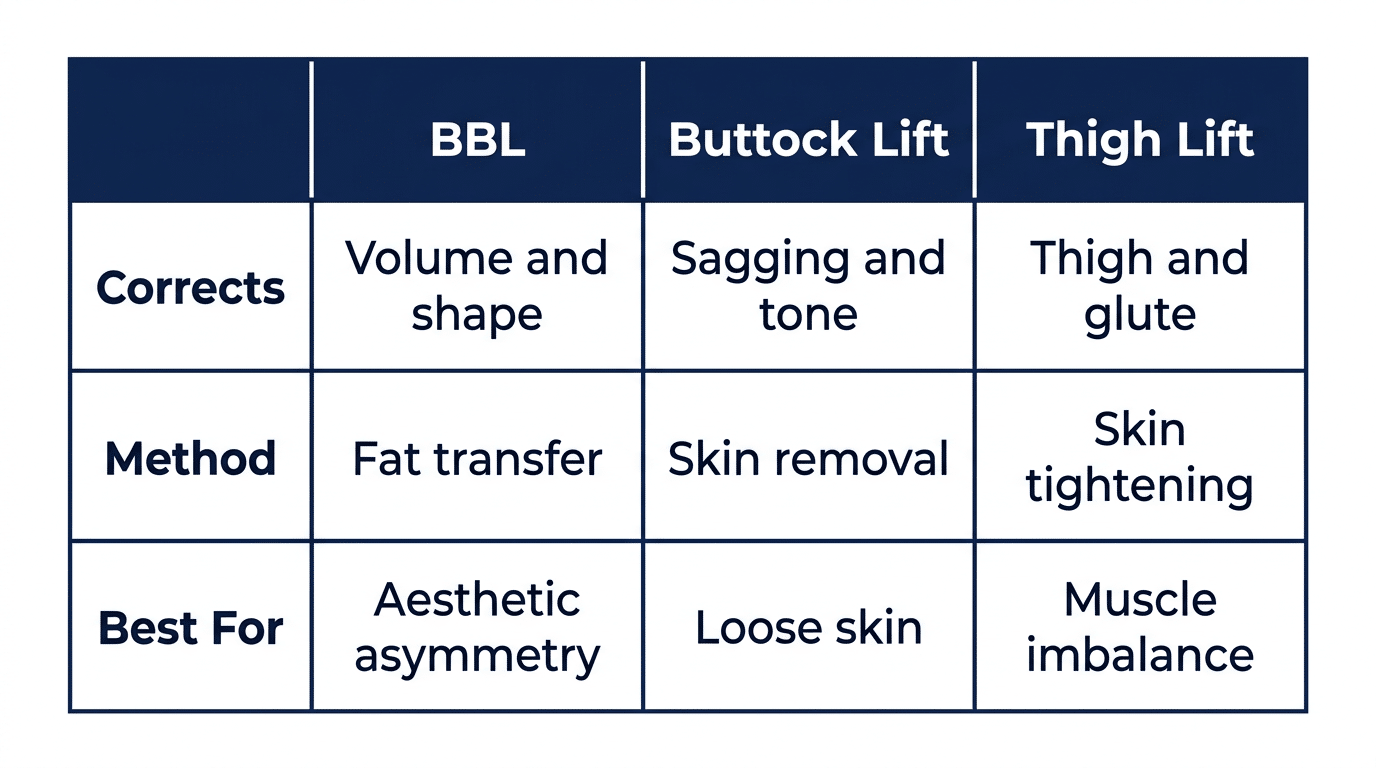
Where physical therapy and exercise are not enough — either because the imbalance is more significant or because its cause is not muscular — surgery offers the most effective, long-term correction. Because these procedures can be planned individually for each side, they are particularly well suited to correcting asymmetry. The right procedure depends on the cause and nature of your imbalance.
Brazilian Butt Lift (BBL)
A Brazilian Butt Lift is often the ideal procedure for correcting aesthetic asymmetry — where the primary concern is a difference in size or shape rather than a functional muscle problem. Liposuction harvests fat from areas such as the abdomen, flanks, and thighs, which is purified and then transferred into the buttocks. Because the surgeon controls exactly how much fat is placed on each side, a BBL can add volume specifically to the smaller buttock to even out the two — making it one of the most precise ways to correct a size difference. For slimmer patients, a skinny BBL achieves the same balancing effect with the limited fat available. A BBL at Centre for Surgery uses the ultrasound-guided technique for safety, with fat placed above the muscle.
Buttock Lift
A buttock lift addresses the shape and tone of the buttocks by removing excess skin and tightening and repairing the underlying muscle. It is the appropriate procedure where sagging, loose skin, or functional muscular concerns are part of the picture. Crucially, a buttock lift can be performed as a bespoke operation — treating each side individually — so glute muscle imbalance and asymmetry can be corrected side-by-side to create a proportionate, balanced result. It also addresses functional muscular concerns that a BBL alone does not.
Thigh Lift
Where glute imbalance is linked to overdominance of the leg and thigh muscles on one side, a thigh lift can rebalance the tone and appearance of the thighs, allowing the buttock muscles to rebalance over time. It removes excess skin, and tightens and repositions the thigh tissue. A thigh lift can be combined with a buttock lift or BBL to enhance the overall lower-body result.
For patients with asymmetry across the whole lower body — often after significant weight loss — these procedures can be combined within a lower body lift. Which procedure, or combination, is right for you is determined at consultation with a specialist body surgeon.
Am I a Candidate for Uneven Buttocks Surgery?
Suitability depends on the cause of your asymmetry and your general health. A BBL is most appropriate for patients who want to correct a difference in buttock size or shape, are in good health, are non-smokers (or willing to stop), are within a reasonable weight range, and — for a fat-transfer BBL — have enough donor fat to harvest. A buttock lift suits those with loose skin or a functional muscular imbalance, commonly after weight loss. Anyone whose imbalance may stem from an underlying condition such as scoliosis should have that assessed first. Realistic expectations matter: the goal is improved balance and proportion, not perfect symmetry, which no body naturally has. An honest consultation is the only way to determine which procedure, if any, is right for you.
Recovery After Uneven Buttocks Surgery
Recovery depends on the procedure. After a BBL, most patients take around two weeks off work and must avoid sitting or lying directly on the buttocks for about two weeks to protect the newly transferred fat, using a special cushion when seated thereafter; swelling settles over several weeks and the final shape emerges at three to six months once the transferred fat has established its blood supply. A buttock lift or thigh lift involves a similar two-week initial recovery, a compression garment for around six weeks, and avoidance of strenuous activity for six to eight weeks while the tissues heal. Your surgeon will give you a tailored recovery plan and aftercare guidance for whichever procedure you have.
How Much Does Uneven Buttocks Surgery Cost in London?
The cost depends on the procedure and its complexity — a BBL, buttock lift, or thigh lift each has a different price, and combining procedures affects the total. Because correcting asymmetry is highly individual, an accurate price is confirmed in writing after your consultation. Our BBL cost guide sets out indicative pricing. Finance options including 0% APR are available through our partner Chrysalis Finance for procedures over £1,500 — visit our Finance Options page for details.
Frequently Asked Questions
Why are my buttocks uneven?
Asymmetry in the buttocks is normal and natural — no one is perfectly symmetrical. More noticeable unevenness, known as glute imbalance, has several possible causes including genetics, natural anatomy and a dominant leg, injury, and medical conditions such as scoliosis. If you are unsure of the cause, a specialist assessment will identify it and guide treatment.
Why are my buttocks different sizes?
Many factors can make buttocks different sizes, including genetics, injury, medical conditions, and natural anatomical variation. Muscle dominance also plays a part — if one side of the body works harder, the glute muscle on that side can become larger. Some difference in size is completely normal.
How do I know if I have a glute imbalance?
Glute imbalance can be visible — one buttock appearing larger or higher — or muscular, with pain or weakness in one buttock during movement. Looking in a mirror from behind and noticing whether one side feels weaker during single-leg exercises are simple ways to check.
Can you fix uneven buttocks with exercise?
Where the cause is muscular, yes — targeted unilateral exercises such as lunges, single-leg hip thrusts, and single-leg squats can rebalance the muscles over time. Exercise cannot correct asymmetry caused by fat distribution, bone structure, loose skin, or a skeletal condition; those require surgical correction.
What is the best surgery for uneven buttocks?
It depends on the cause. A BBL is ideal for correcting differences in size or shape using fat transfer; a buttock lift addresses sagging skin and muscular imbalance; a thigh lift helps where thigh-muscle dominance is involved. A consultation determines the best option or combination for you.
Is it normal to have one buttock bigger than the other?
Yes. A degree of difference between the two sides is completely normal and very common. It only warrants treatment if it is pronounced enough to affect your confidence, comfort, or function.
Can uneven buttocks be a sign of something serious?
Usually not — most asymmetry is simply natural variation or muscle dominance. However, where it is linked to a noticeable spinal curve, back pain, or a change in posture, it is worth having assessed, as conditions such as scoliosis can be a contributing factor.
Uneven Buttocks Treatment at Centre for Surgery
Centre for Surgery corrects uneven buttocks with Brazilian Butt Lift, buttock lift, and thigh lift surgery at our CQC-regulated Baker Street clinic in central London. Every procedure is performed by GMC-registered consultant plastic surgeons and planned individually — each side assessed and treated in its own right — to correct asymmetry and create a balanced, proportionate result. Treatment always begins with a thorough consultation and an honest assessment of whether surgery or a non-surgical approach best suits your concern.
Finance options including 0% APR are available through our partner Chrysalis Finance — visit our Finance Options page for details.
Phone: 0207 993 4849 | Email: contact@centreforsurgery.com | Address: 95-97 Baker Street, London W1U 6RN
[contact-form-7 id=”256″ title=”Treatments form”]