
You are getting dressed, catch sight of yourself in the mirror, and spot a small brown mark that you are almost certain wasn’t there before. If you are past your twenties, a brand-new mole can be unsettling — most of us assume moles are something you are born with or collect in childhood, not something that appears out of nowhere in adulthood. So why do you suddenly have a new mole as an adult, and should you be worried? The reassuring headline is that most new moles are completely harmless. But because a genuinely new or changing mole in an adult carries a slightly higher chance of being significant than a mole you have had since childhood, it is one of those things worth understanding properly — and knowing when to have checked.
At Centre for Surgery, mole assessment and removal is carried out through our dedicated mole removal service, part of our wider skin lesion removal service. This guide explains what a mole actually is, why new ones appear later in life, how to tell a harmless new mole from one that needs a professional look, and what to do next.
What is a mole, exactly?
A mole — known medically as a melanocytic naevus (plural naevi) — is a small cluster of pigment-producing cells. Normally, the cells that give your skin its colour, called melanocytes, are spread evenly through the skin. A mole forms when these cells grow in a group rather than spread out, creating a concentrated spot of pigment that shows on the surface as a brown, tan or black mark.
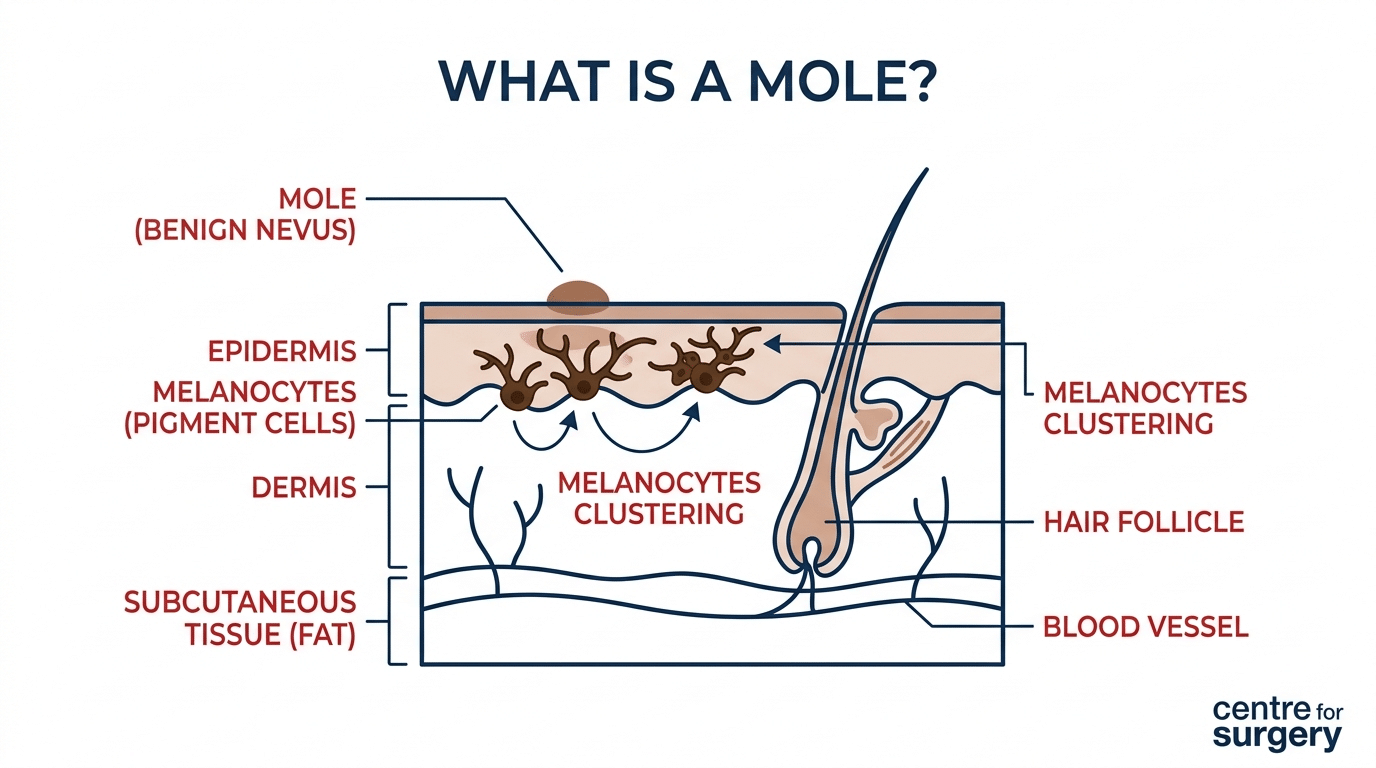
Most moles are entirely benign. They can be flat or raised, smooth or slightly rough, and range from pale pink to dark brown depending on your skin tone and how much pigment the cells produce. The average adult has somewhere between 10 and 40 of them. Most appear during childhood and the teenage years — which is exactly why a new one in adulthood stands out and prompts the question that brought you here.
It is worth saying clearly at the outset: the fact that a mole is new does not make it dangerous. New moles appear for several ordinary reasons. The point of understanding them is simply to know which new moles deserve a second look, and which you can note and move on from.
Why do new moles appear in adulthood?
The honest scientific answer is that the exact cause of benign moles is not fully understood, even by dermatologists. But several well-recognised factors drive new moles to appear in adults, and usually more than one is at play.
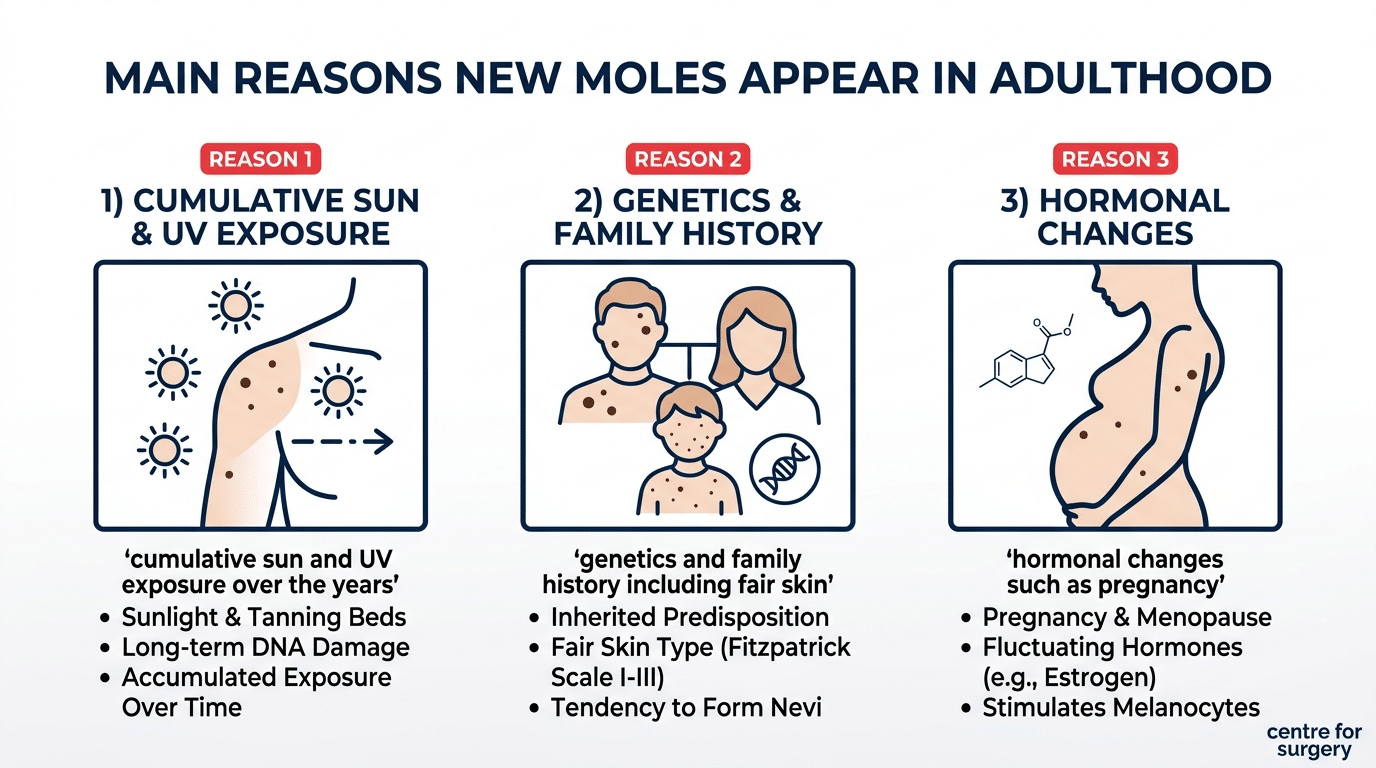
Cumulative sun exposure. This is the big one. Ultraviolet radiation — from the sun and from sunbeds — stimulates melanocytes, and the damage accumulates over a lifetime. Years of sun exposure, including the sunburns of your childhood and twenties, can prompt new pigment cells to cluster and form moles well into adulthood. This is why new moles often appear on areas that have caught a lot of sun over the years, and why sun protection matters at every age.
Genetics and skin type. Your baseline tendency to form moles is strongly inherited. If your parents had a lot of moles, or a history of atypical ones, you are more likely to keep developing them as an adult. People with fair skin, freckles, light or red hair, and those who burn easily rather than tan are generally more prone to new moles — and, importantly, also carry a higher baseline skin-cancer risk, which is part of why their new moles are worth monitoring.
Hormonal changes. Shifts in hormone levels can activate melanocytes and cause new moles to appear or existing ones to darken. This is why new moles are commonly noticed during pregnancy, and can also occur around other times of hormonal change. These moles are usually benign, but because pregnancy also changes existing moles, any that look genuinely different still deserve a check rather than being dismissed as “just hormones.”
Age itself plays a role too: the older you are, the more cumulative sun exposure and cellular change you have banked, so the likelihood of developing a new mole rises with each decade. In other words, a new mole in your thirties, forties or beyond is common — and usually nothing sinister.
The different types of mole you might notice
Not all moles look the same, and knowing the common types can take some of the worry out of noticing a new one. Ordinary acquired moles are usually grouped by how deep the pigment cells sit. Junctional moles tend to be flat and evenly brown; compound moles are slightly raised with even colour; and intradermal moles are the raised, often paler, dome-shaped moles that are extremely common and almost always harmless. A new mole in any of these ordinary forms — even marks — is usually nothing to worry about.
The type that warrants a little more attention is the atypical or dysplastic mole. These are moles that are larger than average, with slightly irregular borders or a mix of colours, and they can look somewhat like the “ugly duckling” among your other moles. Having a few atypical moles does not mean you have or will get skin cancer — many people have them and never have a problem — but people with several are advised to be more vigilant about monitoring and to have new or changing moles assessed, because atypical moles are a marker of a slightly raised baseline risk. If you suspect a new mole falls into this category, it is a good candidate for a professional look rather than watchful waiting.
When is a new mole normal, and when should it be checked?
Here is the part that actually matters. The great majority of new moles are benign. But the medical reason a new adult mole is worth a moment’s attention is this: while melanoma — the most serious form of skin cancer — is uncommon, a new or changing pigmented mark in an adult is statistically more likely to be significant than a stable mole you have carried since childhood. So the goal is not alarm; it is knowing what a reassuring new mole looks like versus one that warrants a professional look.
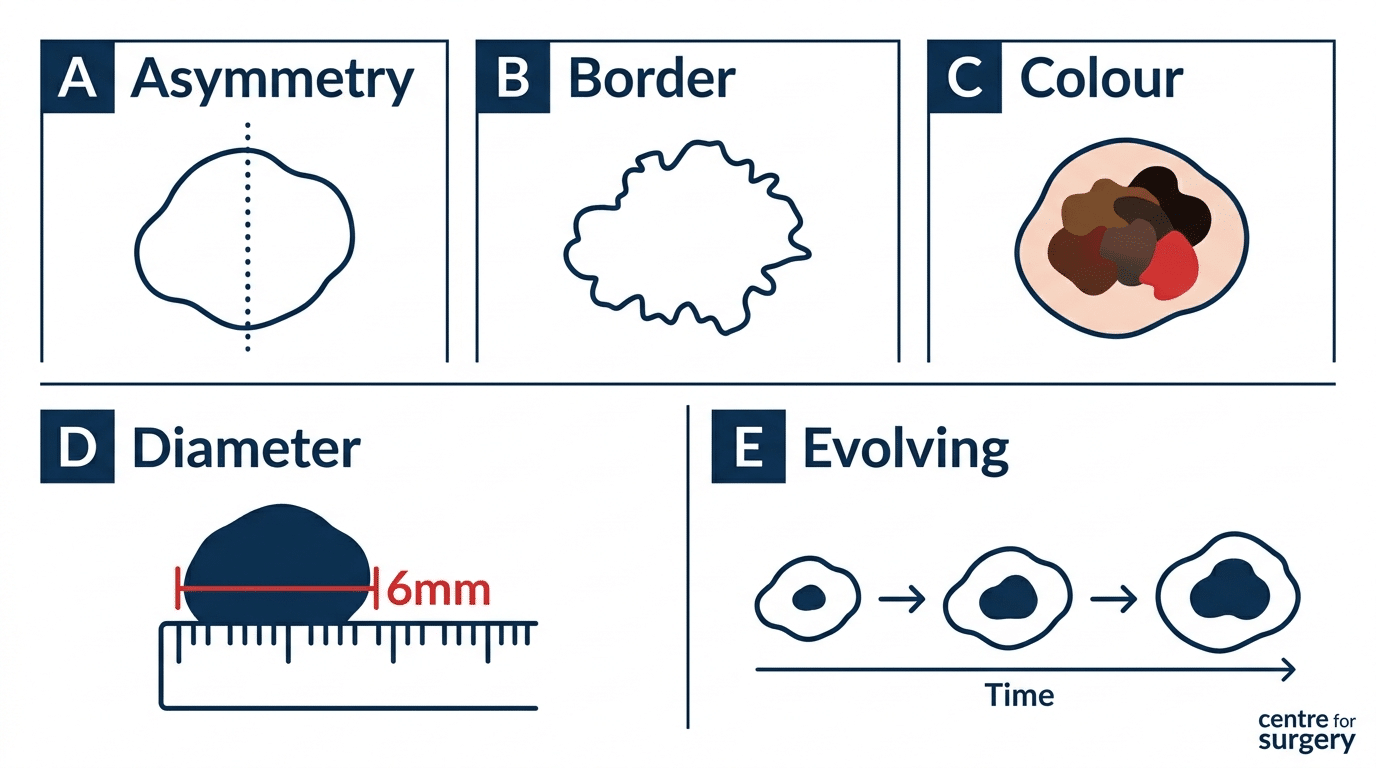
The most widely used checklist is the ABCDE rule. It is not a diagnosis — it is a simple prompt to decide whether something is worth showing to a professional.
A — Asymmetry. A reassuring mole is roughly symmetrical: if you imagine a line through the middle, the two halves match. One half looking unlike the other is worth noting.
B — Border. Benign moles usually have a smooth, well-defined edge. Irregular, ragged, notched or blurred borders are a reason to check.
C — Colour. A single, even colour is reassuring. A mix of shades — several browns, black, or patches of red, white or blue — is worth assessing.
D — Diameter. Larger moles (bigger than about 6mm, the size of a pencil-end) deserve more attention, though melanomas can be smaller too.
E — Evolving. This is the single most important sign, and the one most relevant to a new mole. Any mole that is changing — growing, darkening, changing shape, or newly itching, crusting or bleeding — should be assessed. Change over time is the key warning sign.
Alongside ABCDE, dermatologists use the “ugly duckling” principle: a mole that simply looks different from all your others — the odd one out — is worth a look, even if it doesn’t tick a specific box. If a new mole is small, evenly coloured, symmetrical, stable and looks like your other moles, it is very likely harmless. If it is doing something the others aren’t, that is your cue to have it seen.
What should I do if I notice a new mole?
There is a sensible, low-stress order of steps that applies to almost any new mole.
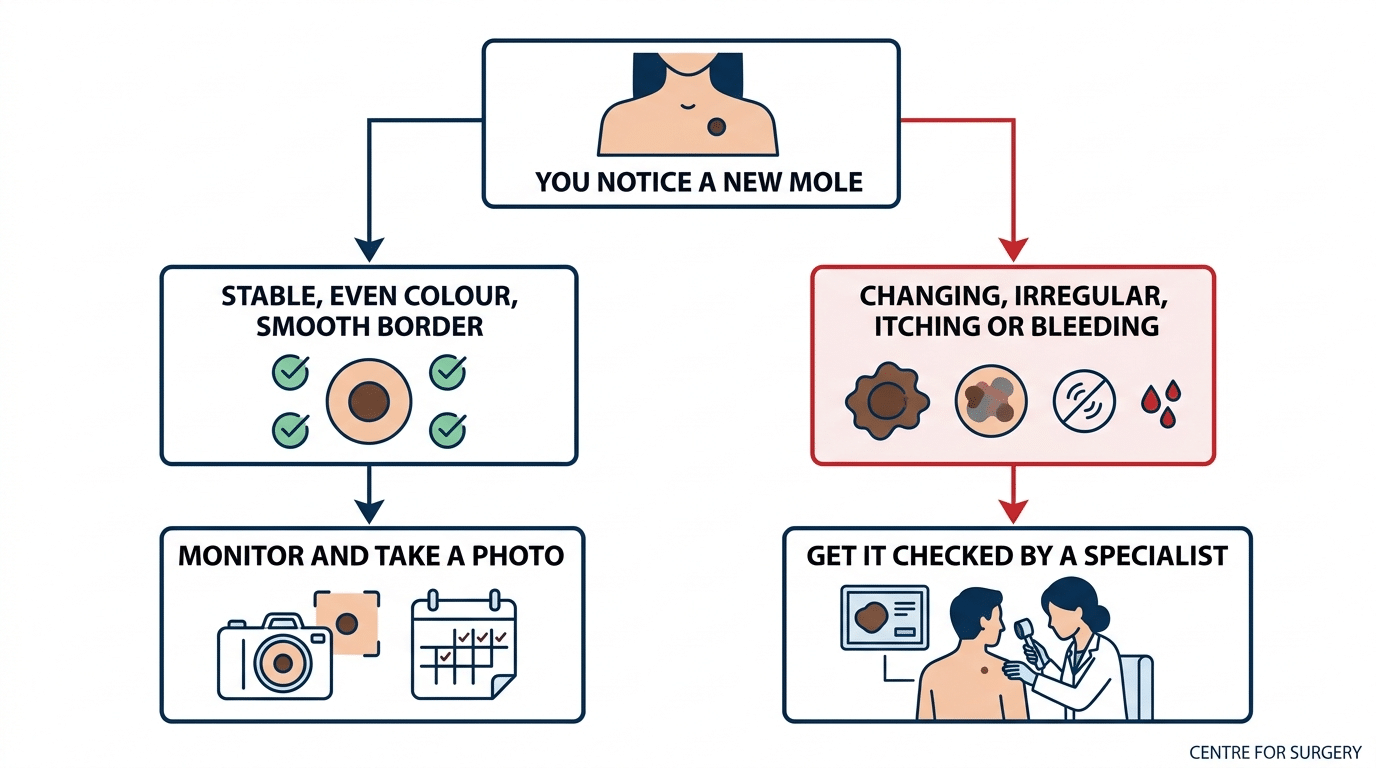
First, take a photo. A clear, dated photograph — ideally with something for scale, like a ruler or a coin nearby — gives you a baseline. Moles change slowly, and memory is unreliable, so a photo is the single best tool for spotting genuine change over the following weeks and months.
If it looks reassuring, monitor it. A new mole that is small, symmetrical, evenly coloured, smooth-bordered and stable can reasonably be kept an eye on. Re-photograph it periodically and compare.
If it has any warning features, get it checked. If a new mole is changing, has irregular borders or uneven colour, is itching, crusting or bleeding, or simply stands out from your other moles, arrange a professional assessment rather than waiting. The same applies if you are in a higher-risk group — fair skin, lots of moles, a family or personal history of skin cancer, or significant past sun or sunbed exposure — where a lower threshold for checking is sensible.
Crucially, having a mole checked is quick, straightforward and often deeply reassuring. A benign mole confirmed as benign costs you nothing but a little time; a significant one caught early is far more treatable. When in doubt, the safe choice is always to have it looked at. For the fuller picture on how a harmless mole differs from something more serious, our detailed guide on the difference between a mole and a melanoma walks through the distinctions in depth, and if your new mole is itching or has bled, our guide on whether to be concerned about an itchy or bleeding mole covers exactly what those symptoms mean.
Other new marks that get mistaken for moles
Sometimes the “new mole” you have spotted isn’t a mole at all. Several other harmless skin marks become more common with age and are frequently mistaken for new moles — which is another reason a quick professional check can be so reassuring. Age spots (also called solar lentigines or liver spots) are flat, light-brown patches caused by sun exposure, common on the hands and face. Cherry angiomas are small, bright-red raised dots made of tiny blood vessels, which multiply with age and are entirely benign. And seborrhoeic keratoses are waxy, “stuck-on” brown growths that can look alarming but are harmless — though occasionally a genuine concern can mimic one, which is why our guide on whether a seborrhoeic keratosis can turn into melanoma is worth a read if that is what you think you are looking at.
The practical takeaway is that “a new brown or dark mark” covers a range of very different things, most of them harmless. You do not need to identify which is which yourself — that is precisely what an assessment does quickly and accurately. But it does explain why not every new mark is a mole, and why a specialist look sorts out the uncertainty in one visit.
How a specialist assesses a new mole
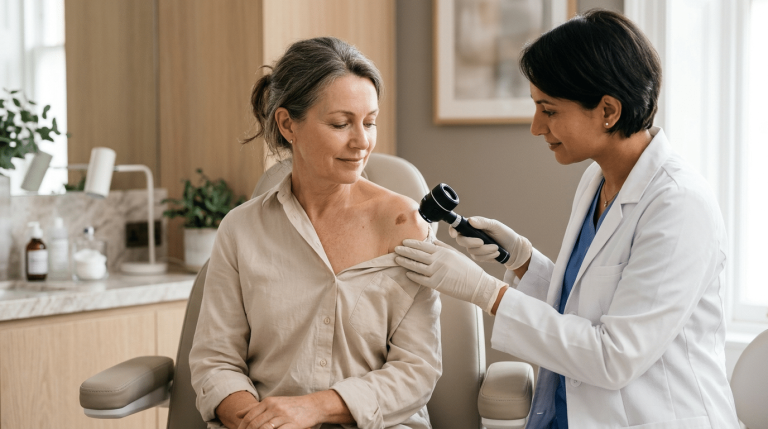
A professional mole assessment is far more thorough than a glance in the mirror. At Centre for Surgery, a new or changing mole is examined by a GMC-registered specialist using a dermatoscope — a handheld device that magnifies and illuminates the skin, revealing pigment patterns and structures invisible to the naked eye. This allows a confident distinction between an ordinary benign mole and one with features that need further action, in the great majority of cases.
If a mole has any concerning features, the definitive answer comes from removing it and sending the tissue for histopathology — laboratory examination under a microscope. This is the gold standard, because it examines the actual cells rather than relying on surface appearance. Where a mole is removed at Centre for Surgery, it is sent for histopathology so the diagnosis is confirmed rather than assumed. For people with many moles or a higher-risk profile, mole mapping and periodic surveillance can also be arranged to track changes systematically over time.
Can I have a new mole removed?
Yes. Beyond assessment for peace of mind, moles are removed for two reasons: because a mole has features that make removal-with-histology the safest course, or simply because a mole is unwanted — perhaps it catches on clothing or a razor, sits somewhere cosmetically sensitive, or you would rather it were gone.
The technique depends on the mole. Options include surgical excision (removing the mole in full and closing the skin with stitches, which allows the whole lesion to be sent for histology), shave excision for suitable raised moles, and laser removal in selected cosmetic cases where the diagnosis is not in doubt. Which method suits a given mole — and whether histology is needed — is exactly what a consultation determines. You can read the full detail of the techniques and how they are chosen on our mole removal page.
One important point: reputable clinics do not simply destroy a new or changing mole with a method that leaves nothing behind before it has been properly assessed, because doing so discards the tissue needed to confirm what it was. Diagnosis comes first; the removal method follows from it. This is also why home mole-removal kits and creams are strongly discouraged — beyond the risk of scarring and infection, they destroy the mole without any assessment of what it actually was.
Where a mole is removed cosmetically, cost depends on the number, size and location of the moles and the technique used, so an accurate figure comes only after an assessment. For any procedure over £1,500, Centre for Surgery offers 0% APR finance through Chrysalis Finance, subject to status.
Frequently asked questions
Is it normal to get a new mole in my 30s, 40s or later?
Yes. While most moles appear in childhood and the teenage years, new moles can and do appear in adulthood, driven mainly by cumulative sun exposure, genetics and hormonal changes. It becomes less common with age, which is why a genuinely new mole later in life is worth keeping an eye on — but it is usually harmless.
Does a new mole mean skin cancer?
Usually not. The large majority of new moles are benign. However, because a new or changing mole in an adult carries a higher relative chance of being significant than a long-standing one, any new mole with irregular features, or that changes over time, should be assessed by a professional.
How quickly should I get a new mole checked?
A new mole that looks reassuring — small, even, symmetrical and stable — can be photographed and monitored. One that is changing, irregular, itching, crusting or bleeding, or that stands out from your other moles, should be assessed promptly rather than left.
Can new moles appear during pregnancy?
Yes. Hormonal changes in pregnancy can cause new moles to appear and existing ones to darken. These are usually benign, but because pregnancy also alters existing moles, any that look genuinely different should still be checked to be safe.
Should I use a mole-removal cream on a new mole?
No. Home removal creams and kits risk burns, scarring and infection, and — most importantly — they destroy the mole without anyone assessing what it was. Any mole worth removing is worth removing properly, by a specialist, with histology where appropriate.
Book a mole assessment at Centre for Surgery
If you have noticed a new mole and would like the reassurance of a professional opinion — or you would simply like an unwanted mole removed — a specialist assessment can confirm what it is and talk you through your options. Centre for Surgery is an independent clinic on Baker Street, rated “Good” across all five domains by the Care Quality Commission, England’s independent healthcare regulator. Every mole is assessed by a GMC-registered specialist with dermoscopy, and removed tissue is sent for histopathology so the diagnosis is confirmed rather than assumed. Our medical content is reviewed by Consultant Plastic Surgeon Dr Spyridon Vlachos (GMC 7522950).
Call: 0207 993 4849
Email: contact@centreforsurgery.com
Address: 95–97 Baker Street, London W1U 6RN
Online: Book a consultation via our contact form below.
[contact-form-7 id=”256″]