

A cleft chin — the small dimple or vertical crease in the middle of the chin, sometimes called a “butt chin” or chin dimple — is one of those features people feel strongly about. Some love theirs and want to keep it, or even create one. Others find it bothers them every time they catch their reflection, and want to know whether it can be softened or removed. The good news is that both are possible. Whether you want to reduce a prominent cleft or add a subtle dimple, there are safe, effective options, and the right one depends entirely on what is causing the shape of your chin in the first place.
This guide explains what a cleft chin actually is, why some people have one, and every proven way to either soften or create one — from non-surgical injectable treatments through to permanent surgical correction. Throughout, we focus on the UK context and on giving you an honest, realistic picture so you can decide what, if anything, you would like to do.
What is a cleft chin?
A cleft chin is a visible indentation, dimple or Y-shaped crease in the centre of the chin. It can be barely noticeable — a soft shadow that only shows in certain light — or it can be a deep, prominent groove that is one of the first things people see. It affects men and women in roughly equal numbers, and it is a completely normal anatomical variation rather than any kind of defect or health problem.
The feature has drifted in and out of fashion over the decades. In mid-twentieth-century cinema a dimpled chin was considered the height of rugged glamour. Today, tastes are more mixed: some people regard a cleft chin as a distinctive, attractive signature, while others prefer a smoother, more uniform chin surface. Neither preference is right or wrong. What matters is how you feel about your own chin, and whether changing it would make you feel more like yourself.
It is worth saying clearly at the outset: a cleft chin never needs to be treated for medical reasons. Any decision to soften, remove or create one is entirely cosmetic and entirely personal.
What causes a cleft chin?
To understand which treatment will work, you first need to understand what is creating the cleft. There are three underlying causes, and many people have a combination of more than one. This is the single most important thing to get right, because a treatment that works beautifully for a muscle-driven cleft will do very little for one driven by the bone.
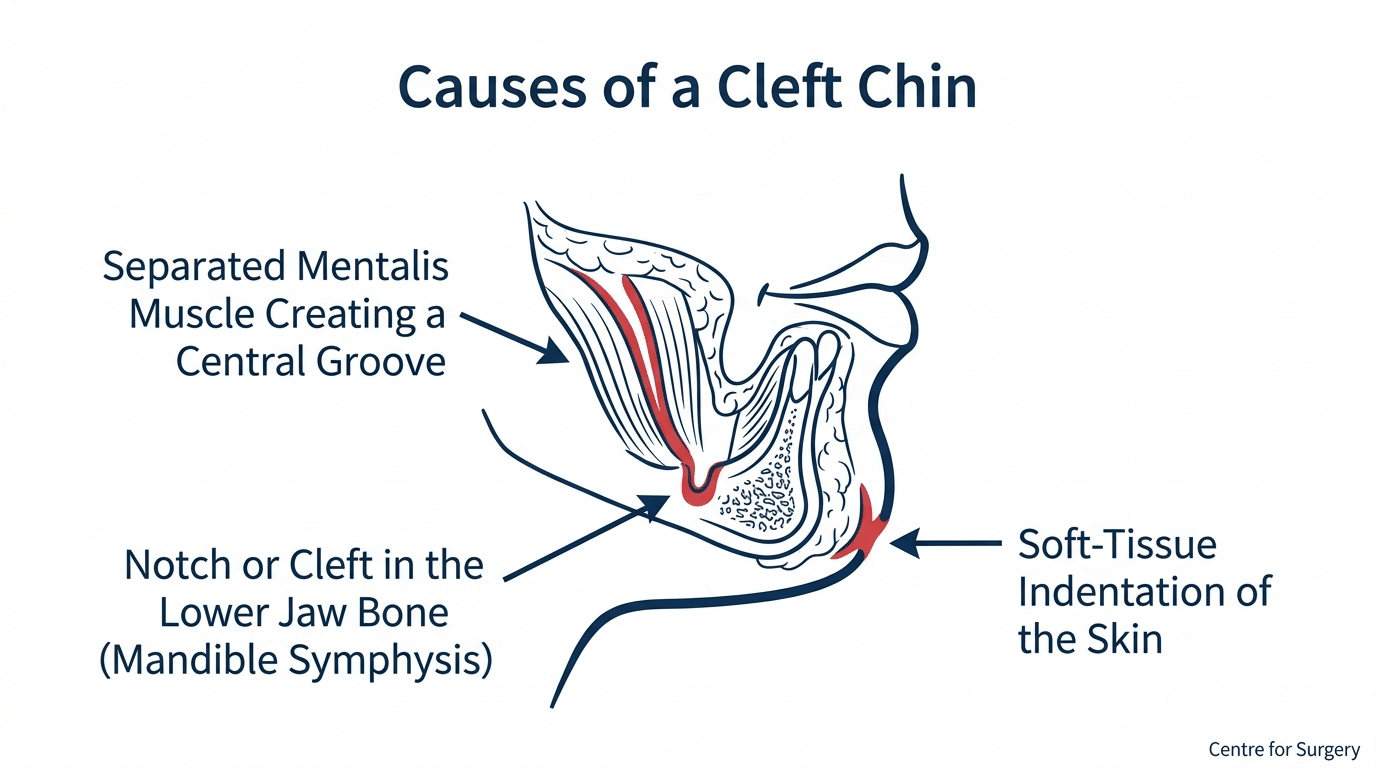
The mentalis muscle. The chin has a pair of small muscles called the mentalis muscles, which sit side by side. In many people with a cleft chin, these paired muscles have a gap between them or pull in a way that creates a central groove in the overlying skin. When the muscle is the main driver, the cleft often becomes more pronounced when you move your mouth, purse your lips or tense the chin — a sign that muscle activity is involved.
The jaw bone. The lower jaw (the mandible) forms from two halves that fuse together before birth at a join called the mandibular symphysis. In some people this join leaves a small notch or depression in the bone at the front of the chin, and that bony contour shows through as a cleft. When the bone is the cause, the cleft is present and unchanging whether the chin is relaxed or moving.
Soft-tissue indentation. Sometimes the skin and soft tissue of the chin are simply tethered inward, with slightly less padding in the centre, creating a dimple independent of muscle movement or bone shape. This is the same mechanism that produces dimples elsewhere on the face.
Genetics sit behind all three. A cleft chin tends to run in families and is generally inherited in a dominant pattern, which is why you will often see the same chin passed down through generations. That genetic origin is also why “home remedies” and facial exercises cannot remove a cleft chin — the shape is built into your muscle, bone or soft-tissue structure, and only treatments that address those structures can change it.
How to get rid of or soften a cleft chin
If you would like to reduce or remove a cleft chin, there are four main options. They vary considerably in how invasive they are, how long they last and how much they cost. We have arranged them below from least to most permanent. The best choice depends on the cause of your cleft — which is why an in-person assessment matters so much — but understanding the menu helps you have a more informed conversation at consultation.
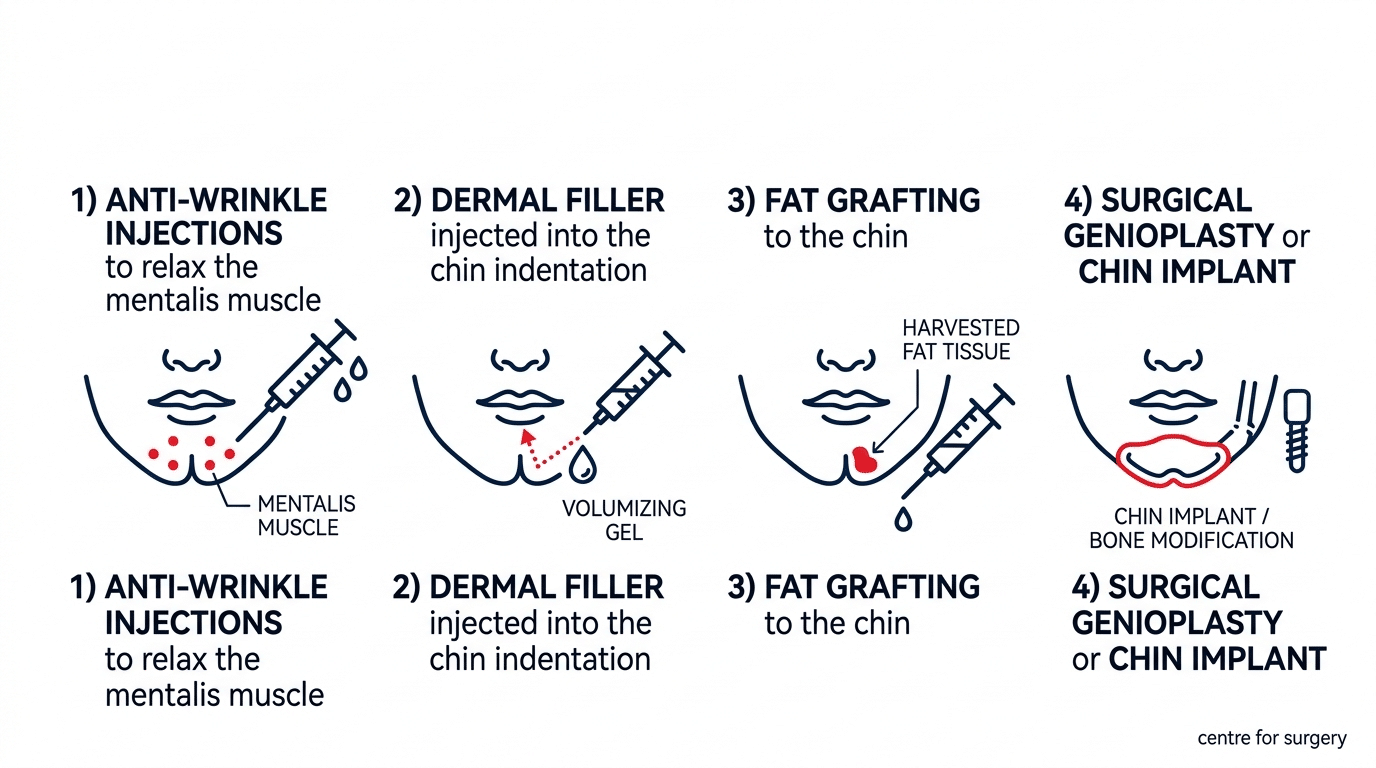
Anti-wrinkle injections (for muscle-driven clefts)
When a cleft is driven mainly by the pull of the mentalis muscle, anti-wrinkle injections can relax that muscle so it stops drawing the skin inward, softening the groove. The treatment takes only a few minutes, involves no downtime, and the effect appears over the following days. Because it works on muscle activity rather than adding volume, it is best suited to clefts that deepen when you move your chin. The effect is temporary — typically lasting a few months — so it needs to be repeated to maintain the result, and it is often combined with filler for a more complete, longer-lasting improvement.
Dermal fillers (for soft-tissue clefts)
Dermal fillers are one of the most popular non-surgical ways to soften a cleft chin. A hyaluronic-acid filler is injected precisely into the indentation to add volume beneath the skin, smoothing the groove and levelling the chin surface. Results are visible almost immediately, downtime is minimal, and because these fillers are reversible, adjustments can be made if needed. Fillers are best suited to clefts caused by soft-tissue indentation. Results generally last from several months to around a year before a top-up is needed. At Centre for Surgery this is offered through our chin fillers treatment, which can also refine chin projection and contour at the same time.
Fat grafting (a longer-lasting filler)
For people who want a more lasting result without an implant, fat grafting uses your own fat as a natural filler. A small amount of fat is harvested from another area, such as the abdomen, purified, and injected into the chin to fill the cleft. Because it uses your own tissue, there is no risk of allergic reaction. Some of the transferred fat is naturally reabsorbed over the first few months, but the fat that survives provides a long-lasting, natural-looking correction. It is a good middle path between temporary fillers and permanent surgery.
Genioplasty or chin implant (for bone or structural clefts)
When a cleft is driven by the underlying bone, or when someone wants a permanent, definitive correction, surgery is the most reliable route. A genioplasty (chin surgery) reshapes or repositions the chin bone and can adjust the position of the mentalis muscles, correcting the cleft at its source without a visible external scar. Alternatively, a chin implant can be used to build up and smooth the contour. Surgery has the longest recovery of all the options and the highest cost, but it is the only approach that permanently addresses a bone-driven cleft. It is also the natural choice for anyone whose cleft comes alongside a weak or receding chin, where a chin augmentation can improve projection and profile balance at the same time. Where the goal is to reduce an over-prominent chin rather than build it up, chin reduction surgery may be more appropriate.
How a cleft chin is created
Not everyone wants their cleft gone — some people want one they were never born with. A defined chin dimple can read as a striking, characterful feature, and creating one is an established, if more specialised, cosmetic request.
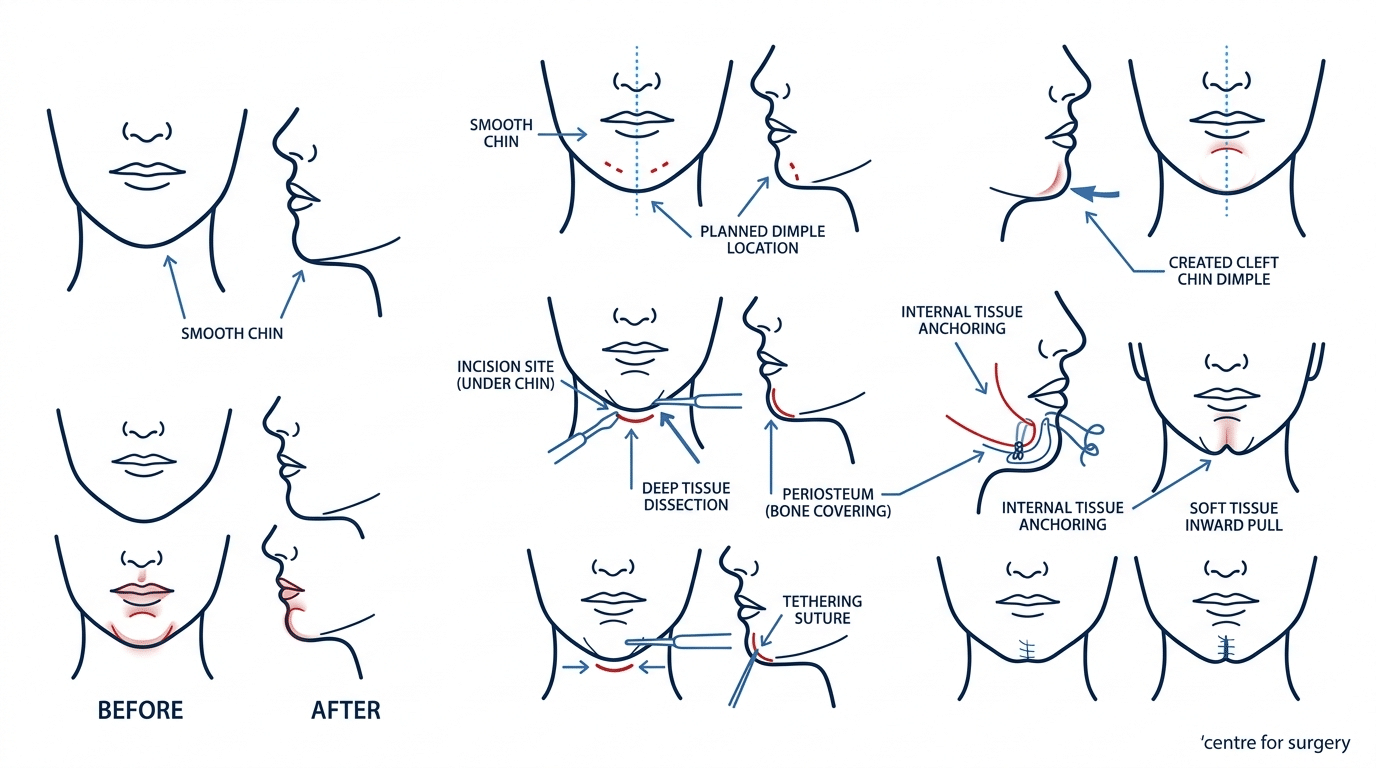
A cleft chin is created surgically using a soft-tissue technique, sometimes described as a chin dimpleplasty. Through a small, hidden incision, the surgeon tethers the soft tissue of the chin inward at the desired point, forming a controlled central dimple. The depth and position are planned carefully to suit your facial proportions, so the result looks like a natural feature rather than an obviously engineered one. Recovery is generally quicker than for major chin surgery, and the dimple settles over the following weeks. Because this is a structural change to the soft tissue, it is designed to be long-lasting. As with any facial procedure, the key to a natural outcome is conservative, precise planning — which is why it should only ever be performed by an experienced surgeon who assesses your chin in person.
Which cleft chin treatment is right for me?
Because the right treatment is dictated by the cause, the most useful thing you can do before a consultation is understand which category your chin most likely falls into. The guide below matches cause to treatment. It is not a substitute for an in-person assessment — most people have some overlap between causes, and only a surgeon examining your chin can confirm the picture — but it will help you follow the logic of what is recommended to you.
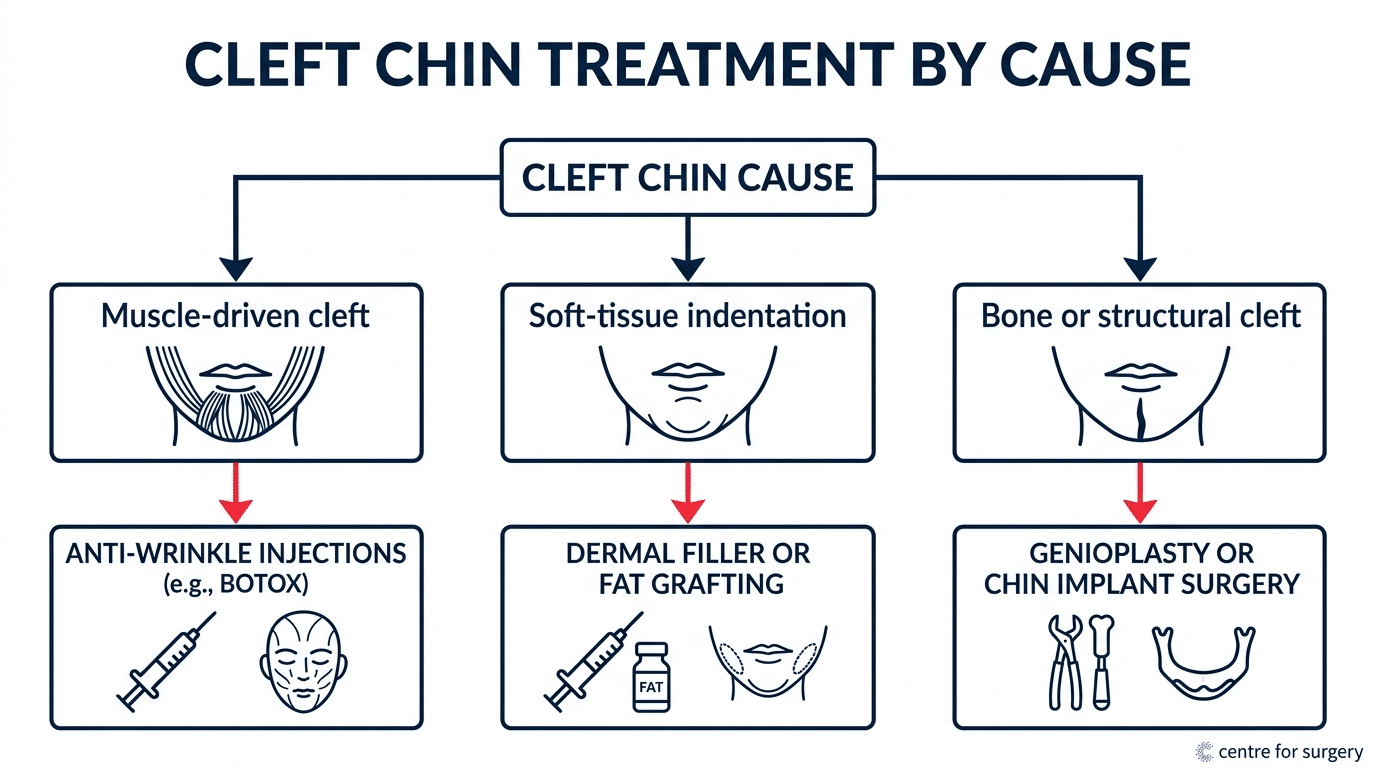
If your cleft deepens when you move your chin, muscle activity is likely a major factor, and anti-wrinkle injections — often alongside filler — are usually the starting point.
If your cleft is a fixed soft-tissue indentation that does not change much with movement, dermal filler or fat grafting will typically give the smoothest correction, with fat grafting offering more longevity.
If your cleft is driven by the bone, or you want a permanent, one-off correction, genioplasty or a chin implant is the most reliable route.
If your cleft comes with a weak or receding chin, augmentation can address both the projection and the cleft together for a more balanced profile.
A consultation exists precisely to work this out with you. At Centre for Surgery, that means a face-to-face assessment with a specialist who will examine your chin at rest and in movement, discuss what is realistic, and recommend the least invasive option that will achieve the result you are after.
What to expect from recovery
Recovery varies a great deal depending on which treatment you have, and it is worth knowing what is realistic before you commit. The non-surgical options are the quickest to bounce back from. After anti-wrinkle injections or dermal fillers, most people return to their normal day straight away. You may notice some minor redness, swelling or the odd small bruise at the injection points, and it is sensible to avoid strenuous exercise and heavy social plans for a couple of weeks while the treatment settles into its final position. With fillers, the result you see immediately will soften and refine slightly over the first week or two.
Fat grafting sits in the middle. Because fat is taken from another part of the body, there is a little more swelling and a slightly longer settling period, and it can take a few months before the final, stable result is clear as the surviving fat establishes itself.
Surgical options — genioplasty, chin implants or dimple creation — involve the most recovery. You should expect swelling and some bruising in the days after surgery, with the chin continuing to refine over several weeks to months as the tissues settle. Most people take a short period away from work and social commitments and follow specific aftercare instructions on eating, sleeping position and activity. Your surgical team will give you a clear, personalised recovery plan and see you for follow-up appointments to check your healing is on track. Whatever route you take, patience through the settling period is part of getting a natural-looking result.
How much does cleft chin treatment cost?
Cost depends entirely on which treatment is right for you. Non-surgical options such as anti-wrinkle injections and dermal fillers sit at the more affordable end and are charged per treatment, bearing in mind they need periodic top-ups to maintain the result. Fat grafting and surgical options such as genioplasty, chin implants or dimple creation are larger one-off procedures with a correspondingly higher cost, but they are also longer-lasting or permanent. Because every chin and every treatment plan is different, we do not quote a fixed price online — the only accurate figure is one given after an in-person assessment of your chin and your goals.
For surgical procedures over £1,500, Centre for Surgery partners with Chrysalis Finance, which offers 0% APR finance options subject to status, so the cost can be spread over monthly instalments. Your patient coordinator can talk through the options at your consultation.
Frequently asked questions
Can you get rid of a cleft chin without surgery?
Often, yes. If your cleft is driven by muscle activity or by a soft-tissue indentation, non-surgical treatments such as anti-wrinkle injections or dermal fillers can soften or smooth it effectively, with no downtime. Clefts driven by the underlying bone, however, generally need surgery for a reliable, lasting correction. This is why identifying the cause first is so important.
Is a cleft chin removal permanent?
It depends on the method. Anti-wrinkle injections and dermal fillers are temporary and need maintenance. Fat grafting is long-lasting, though some fat is reabsorbed. Genioplasty, chin implants and surgical correction are designed to be permanent. If a permanent result is your priority, a surgical assessment is the right starting point.
Does a cleft chin get more noticeable with age?
For some people it can. As we age, the face loses a degree of soft-tissue volume and the skin becomes less firm, which can make an existing cleft appear a little deeper over time. This is one reason volume-based treatments such as filler or fat grafting can be helpful — they restore the fullness that softens the groove.
Can you create a cleft chin if you weren’t born with one?
Yes. A chin dimple can be created surgically through a soft-tissue technique that tethers the tissue inward to form a controlled dimple. Careful, conservative planning is essential to keep the result looking natural and suited to your facial proportions.
Are chin dimple treatments suitable for everyone?
All cosmetic treatments at Centre for Surgery are for adults aged 18 and over who are in good general health and have realistic expectations. The best way to find out whether a particular treatment suits you is a face-to-face consultation, where your suitability can be properly assessed.
Book a consultation at Centre for Surgery
Whether you want to soften a prominent cleft chin, remove it altogether, or create a subtle dimple, the essential first step is the same: a face-to-face consultation with a specialist who can examine your chin, identify what is driving its shape, and recommend the most appropriate treatment for your goals. Centre for Surgery is an independent clinic on Baker Street, rated “Good” across all five domains by the Care Quality Commission, England’s independent healthcare regulator. Our medical content is reviewed by Consultant Plastic Surgeon Dr Spyridon Vlachos (GMC 7522950).
Call: 0207 993 4849
Email: contact@centreforsurgery.com
Address: 95–97 Baker Street, London W1U 6RN
Online: Book a consultation via our contact form below.
[contact-form-7 id=”256″]