

If you have found a soft, painless lump under your skin and been told it is a lipoma, one of the first questions most patients ask is whether it will simply go away on its own. It is a reasonable question — many soft tissue changes in the body do resolve without treatment, so it makes sense to wonder whether a lipoma is one of them.
The short, clear answer is no — a lipoma will not disappear on its own, and understanding exactly why is the key to making an informed decision about whether lipoma removal is right for you. At Centre for Surgery in London, our GMC-registered consultant surgeons remove lipomas at our CQC-regulated Baker Street clinic, and this guide explains the biology behind why lipomas persist, what can make them appear to change, and how to decide whether removal is the right next step.
Why Lipomas Don’t Go Away on Their Own
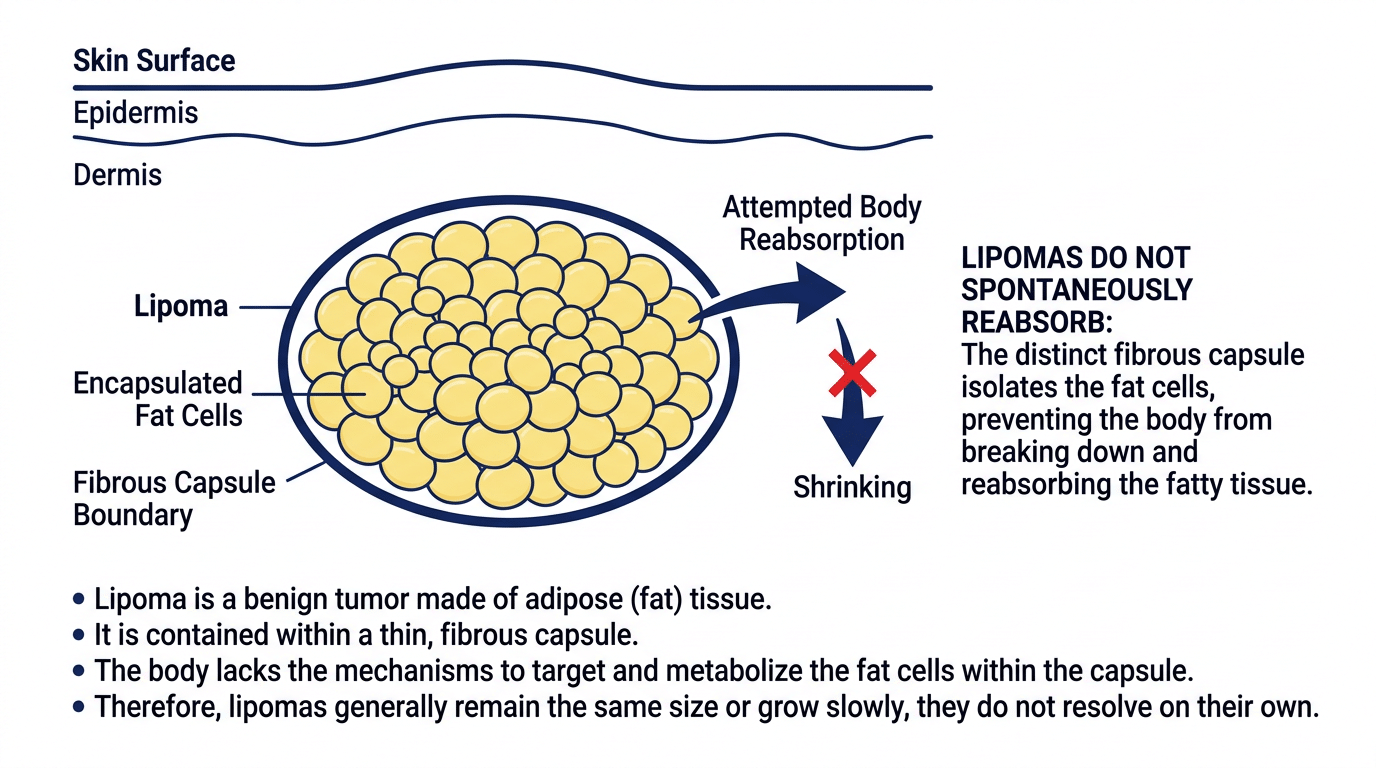
A lipoma is a benign tumour made up of mature fat cells, surrounded by a thin fibrous capsule that separates it from the surrounding tissue. This capsule is the single most important fact in understanding why lipomas behave so differently from ordinary body fat. Normal fat tissue is metabolically active — it can be broken down and used for energy through diet and exercise. A lipoma, by contrast, exists inside its own enclosed structure, disconnected from the body’s normal fat metabolism. The fat cells within it are not actively exchanged with the rest of the body’s fat stores in the way ordinary subcutaneous fat is, which is why no amount of diet, exercise, or weight loss causes a lipoma itself to shrink or disappear.
This same encapsulation is also why lipomas tend to remain remarkably stable over time. Once formed, most lipomas grow extremely slowly, if at all, and many patients report having the same lump, largely unchanged, for years or even decades. The lump you have today is, in the great majority of cases, the lump you will still have in five or ten years’ time without treatment.
This also explains why there are no creams, supplements, or non-surgical treatments that reliably resolve a lipoma. Various topical treatments and injection therapies are sometimes marketed for fatty lumps, but without mechanically removing or fully dissolving the fibrous capsule and its contents, any apparent reduction tends to be temporary, partial, or attributable to the natural variation in how a lipoma feels at different times rather than genuine clinical improvement.
Do Different Types of Lipoma Behave Differently?
While the term “lipoma” covers a range of benign fatty tumours, most of the common types share the same fundamental biology — an enclosed capsule of mature fat cells that the body cannot reabsorb. Standard subcutaneous lipomas (the most common type, lying just beneath the skin surface) behave as described above. Deep lipomas, which lie beneath the muscle fascia rather than in the subcutaneous layer, are less common, often larger, and more difficult to detect by feel — but they similarly do not resolve on their own and may in fact be harder to monitor reliably, making clinical assessment more important if a deep lump is suspected.
A smaller proportion of lipomas have unusual histological features — such as angiolipomas (which contain blood vessels and are often painful), fibrolipomas (with a higher proportion of fibrous tissue), or pleomorphic lipomas (with varied cell types). These variants are all still benign and do not resolve spontaneously either, but they can have slightly different clinical presentations, which is one reason assessment by an experienced surgeon is valuable before proceeding with any treatment. Our post on whether a lipoma can become painful covers angiolipomas and other pain-associated variants in more detail.
What Can Make a Lipoma Appear to Change?
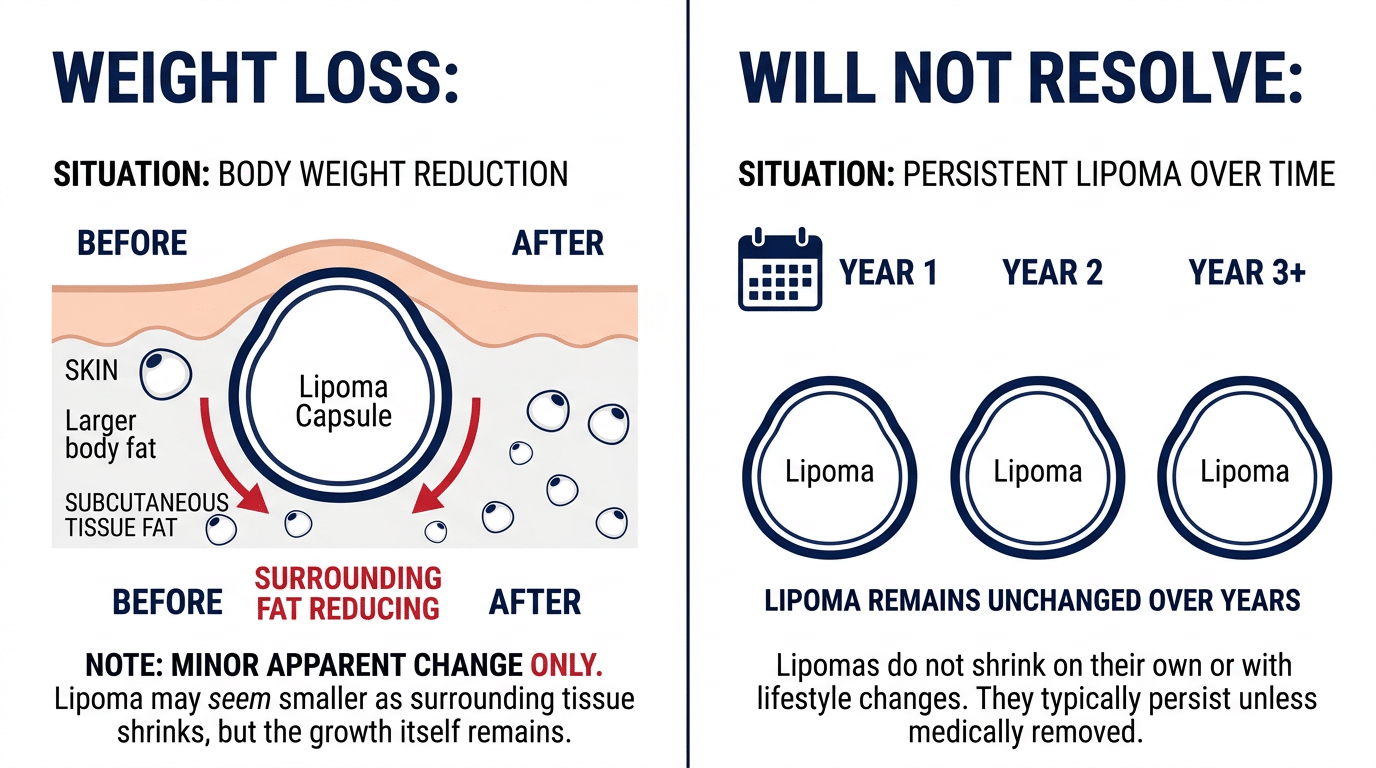
Patients sometimes report that a lipoma seems to have changed size, and there are a few genuine explanations for this that are worth understanding, since they are different from the lipoma itself actually shrinking.
Weight Loss
Significant weight loss reduces the volume of ordinary subcutaneous fat surrounding a lipoma. Because the lipoma itself does not reduce in the same way, this can have the paradoxical effect of making the lipoma feel or look more prominent rather than smaller, simply because there is less surrounding tissue to camouflage it. Patients sometimes misinterpret this increased prominence as the lipoma growing, when in fact it is the same size and the surrounding tissue has changed instead.
Fluid and Inflammation
A lipoma that becomes inflamed, knocked, or irritated can temporarily swell due to fluid accumulation or localised inflammation around the capsule. Once this settles, the lump typically returns to its usual baseline size — this is a temporary fluctuation, not the lipoma shrinking permanently.
Variation in How It Feels
Because lipomas are soft and mobile, they can feel different depending on the position you are in when you examine them, ambient temperature (which affects surrounding tissue tension), and how much time has passed since you last checked. Patients who examine the lump frequently often report changes that are, in reality, within the normal range of variation for a stable lipoma rather than genuine size changes.
Genuine Growth
While most lipomas remain stable, slow growth over years is not unusual, and some lipomas do gradually increase in size over time. This is a normal feature of how lipomas behave and is not, on its own, a cause for concern — though any growth should still be assessed if it is rapid, or if the lump becomes painful or hard, since these features can occasionally indicate a different and rarer type of fatty tumour requiring further investigation.
So Will My Lipoma Ever Go Away?
Without treatment, no — a true lipoma will persist indefinitely. This is an important distinction from many other common skin lumps and bumps, some of which can resolve on their own; lipomas, due to their encapsulated structure, simply do not. The only way to permanently remove a lipoma is through surgical excision, which removes the fat cells along with their fibrous capsule.
As covered in our post on lipoma vs cyst, correctly identifying that a lump is in fact a lipoma — rather than a cyst or another type of lesion, several of which behave quite differently — is an important first step before considering any treatment options. Our post on whether a lipoma can become painful also covers one of the more common reasons patients decide to pursue removal even after a period of watchful waiting.
Do I Need to Have My Lipoma Removed?
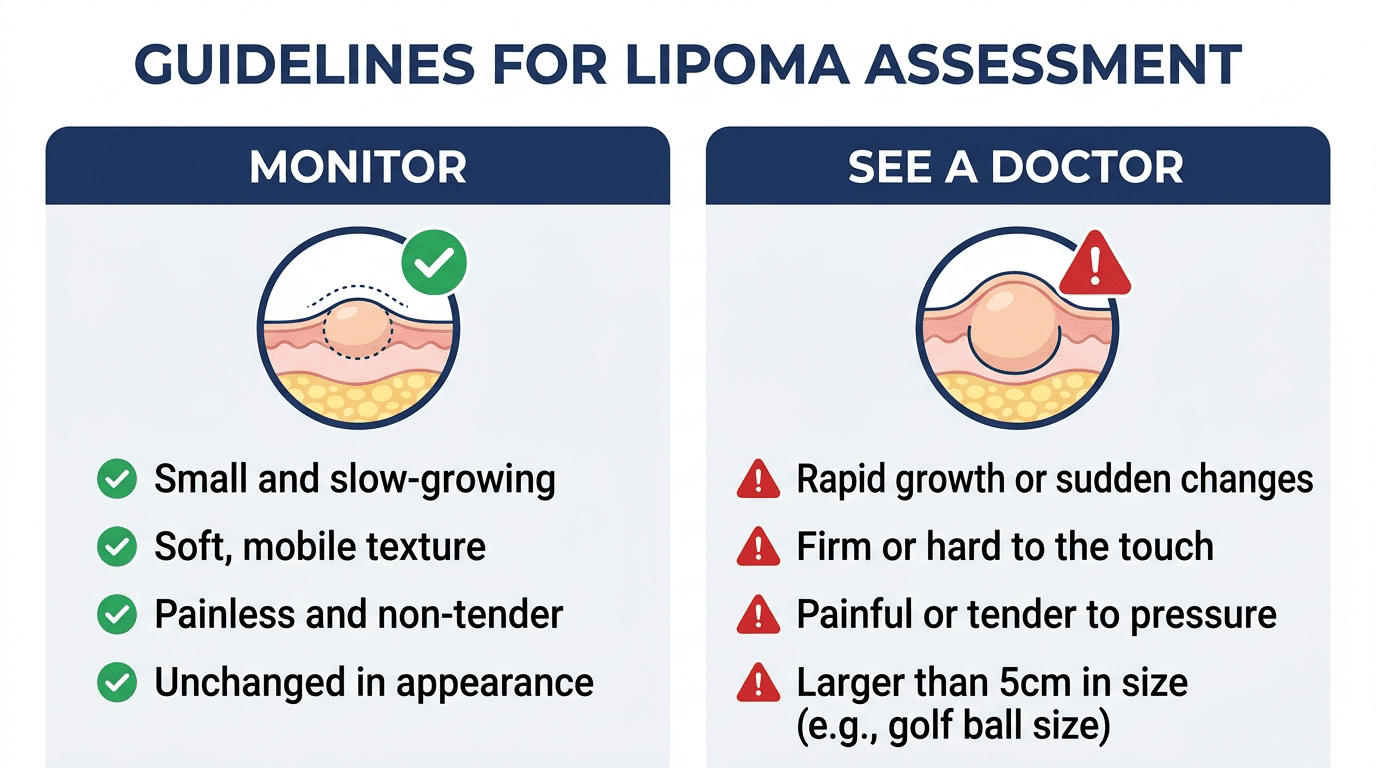
Not every lipoma needs to be removed. A small, soft, painless lipoma that has remained stable for a long period and does not bother the patient cosmetically can often simply be monitored, with no medical urgency to intervene. Many patients live with small lipomas indefinitely and never feel the need to have them removed.
Removal becomes a more clearly appropriate option when a lipoma is growing noticeably, has become painful or tender, is in a location where it causes discomfort from clothing or pressure, is cosmetically bothersome, or when there is any uncertainty about the diagnosis that would benefit from histological examination after removal. Lipomas in functionally important locations — over joints, near nerves, or on the neck — may also warrant earlier removal than those in lower-impact areas, since growth in these locations can have practical consequences beyond cosmetic ones.
A lipoma that grows rapidly, feels unusually hard rather than soft and mobile, or becomes painful should always be assessed promptly by a clinician. These features warrant a closer look to rule out the rarer possibility of a liposarcoma — a malignant fatty tumour that can closely resemble a lipoma in its early stages but behaves very differently and requires a different treatment pathway. The vast majority of fatty lumps are benign, but any lump with these features should not simply be observed and assumed to be harmless.
What Does Lipoma Removal Involve?
Lipoma removal is typically a straightforward day-case procedure performed under local anaesthetic, during which the lipoma and its surrounding capsule are excised through a small incision. The procedure is usually quick — most uncomplicated lipomas can be removed in under an hour — and patients can generally return home the same day. Removing the capsule completely, rather than simply draining or reducing the lipoma, is essential for preventing recurrence at the same site — our post on whether lipomas come back after removal explains this in more detail. Most patients recover quickly, and our post on how long lipoma removal takes to heal sets out a realistic recovery timeline. Straightforward cases can often be assessed and removed at the same visit, making the overall process considerably more convenient than many patients expect.
Frequently Asked Questions
Can a lipoma shrink with diet and exercise?
No — a lipoma is encapsulated and disconnected from the body’s normal fat metabolism, so diet and exercise have no effect on its size, even though they reduce ordinary body fat elsewhere. In fact, significant weight loss can make a lipoma feel more prominent by reducing the surrounding tissue that previously concealed it.
Why does my lipoma look bigger after I lost weight?
This is usually because the surrounding subcutaneous fat has reduced while the lipoma itself has stayed the same size, making it more prominent and noticeable. The lipoma has not grown — the contrast between it and the surrounding tissue has simply increased.
Is it dangerous to leave a lipoma untreated?
In the vast majority of cases, no — lipomas are benign and leaving one untreated carries no significant health risk. Removal is usually an elective decision based on symptoms, growth, or cosmetic preference rather than medical necessity. However, any lump that grows rapidly, becomes painful, or feels hard should be assessed rather than assumed to be a straightforward lipoma.
How do I know if my lump is a lipoma and not something else?
Lipomas are typically soft, mobile beneath the skin, painless, and slow-growing. However, other benign lumps including epidermoid cysts and ganglion cysts can feel similar. Any lump that is hard, fixed in place, rapidly growing, or painful should be assessed by a clinician rather than self-diagnosed.
Will a lipoma keep growing indefinitely?
Most lipomas grow very slowly or not at all over many years. Some remain completely stable indefinitely; others grow gradually. Very rarely, a lipoma may grow more noticeably — this warrants clinical assessment to confirm the diagnosis remains correct.
Is lipoma removal permanent?
Yes — when the capsule is fully removed during surgery, recurrence at the same site is uncommon. However, patients with a tendency to develop lipomas can form new ones in different locations over time, since removal treats the individual lipoma rather than the underlying predisposition to form them.
Can I have multiple lipomas removed at once?
Yes — patients with multiple lipomas can often have several removed in a single session, depending on their size and location. Your surgeon will assess the most practical and safe approach at consultation.
Lipoma Removal at Centre for Surgery
Centre for Surgery performs lipoma removal at our CQC-regulated Baker Street clinic in central London. All procedures are performed by GMC-registered consultant surgeons following thorough clinical assessment to confirm diagnosis before any treatment is planned.
Finance options including 0% APR are available through our partner Chrysalis Finance — visit our Finance Options page for details.
Phone: 0207 993 4849 | Email: contact@centreforsurgery.com | Address: 95-97 Baker Street, London W1U 6RN

Related Articles
- Nose Piercing Bumps: Causes and Treatments
- Same-Day Mole Removal — What to Expect
- What Is the Difference Between a Soft Lump and a Hard Lump Under the Skin?
[contact-form-7 id=”256″ title=”Treatments form”]