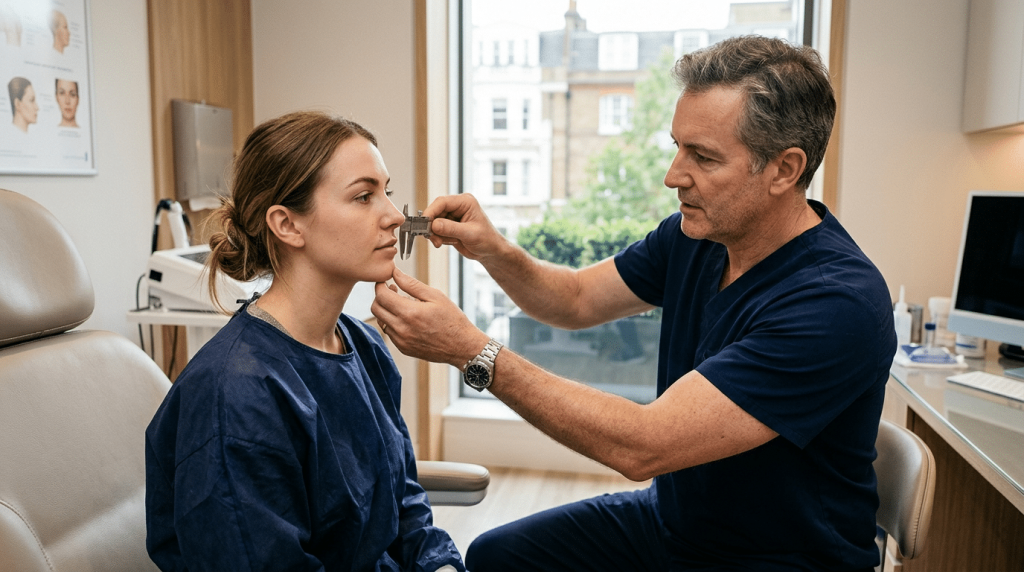
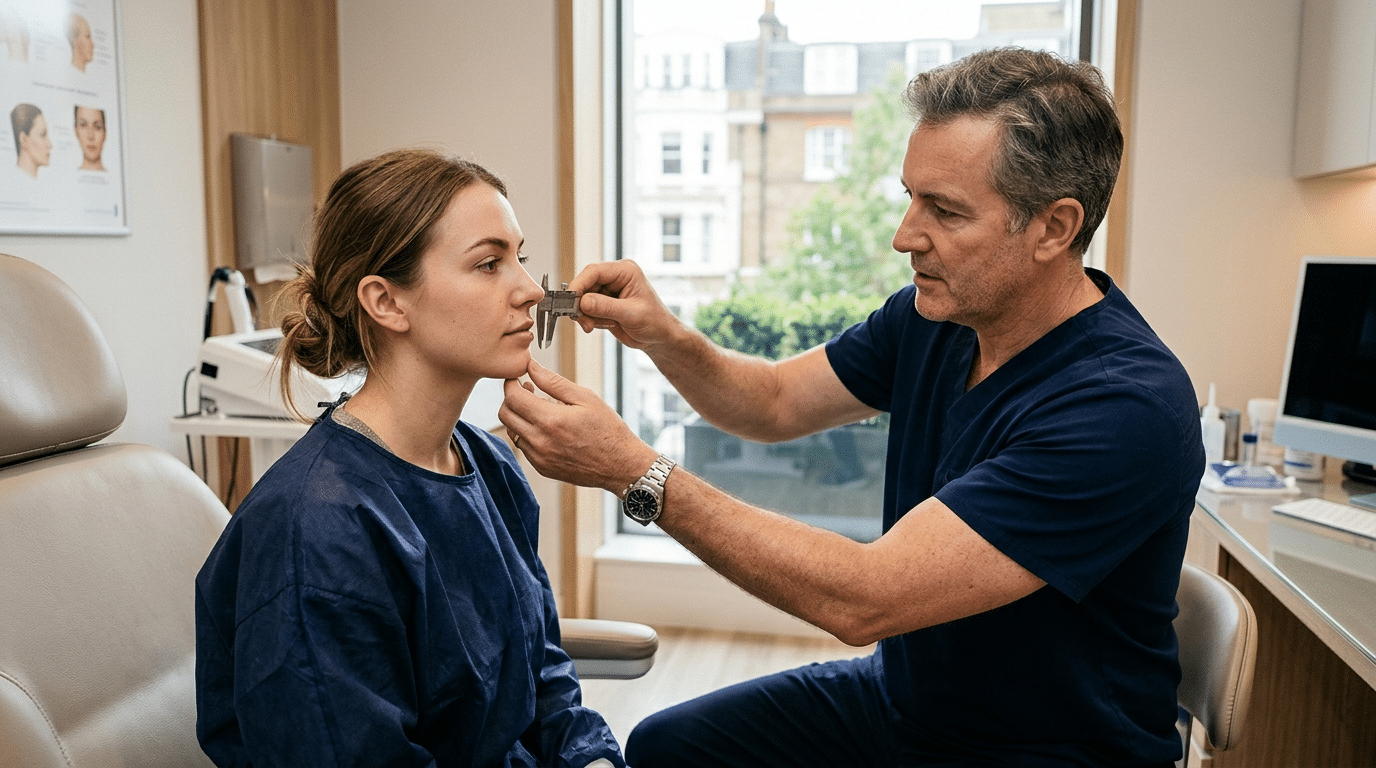
The philtrum — the vertical area between the base of the nose and the upper lip — plays a far bigger role in facial balance than its size suggests. When the philtrum is long, the upper lip can appear thin, the teeth disappear from view when the mouth is relaxed, and the whole lower face can read as older than it is. It is one of the most common concerns raised at lip and perioral consultations, yet also one of the most frequently mistreated, because the most popular lip treatment — filler — does not actually address it.
At Centre for Surgery in London, our surgeons treat philtrum-related concerns with lip lift surgery and, where genuinely appropriate, dermal lip fillers at our CQC-regulated Baker Street clinic. This guide explains what the philtrum is, what counts as “long”, what causes it, why filler alone often fails to correct it — and sometimes makes it look worse — and how to choose the treatment that actually addresses your anatomy.
What Is the Philtrum?
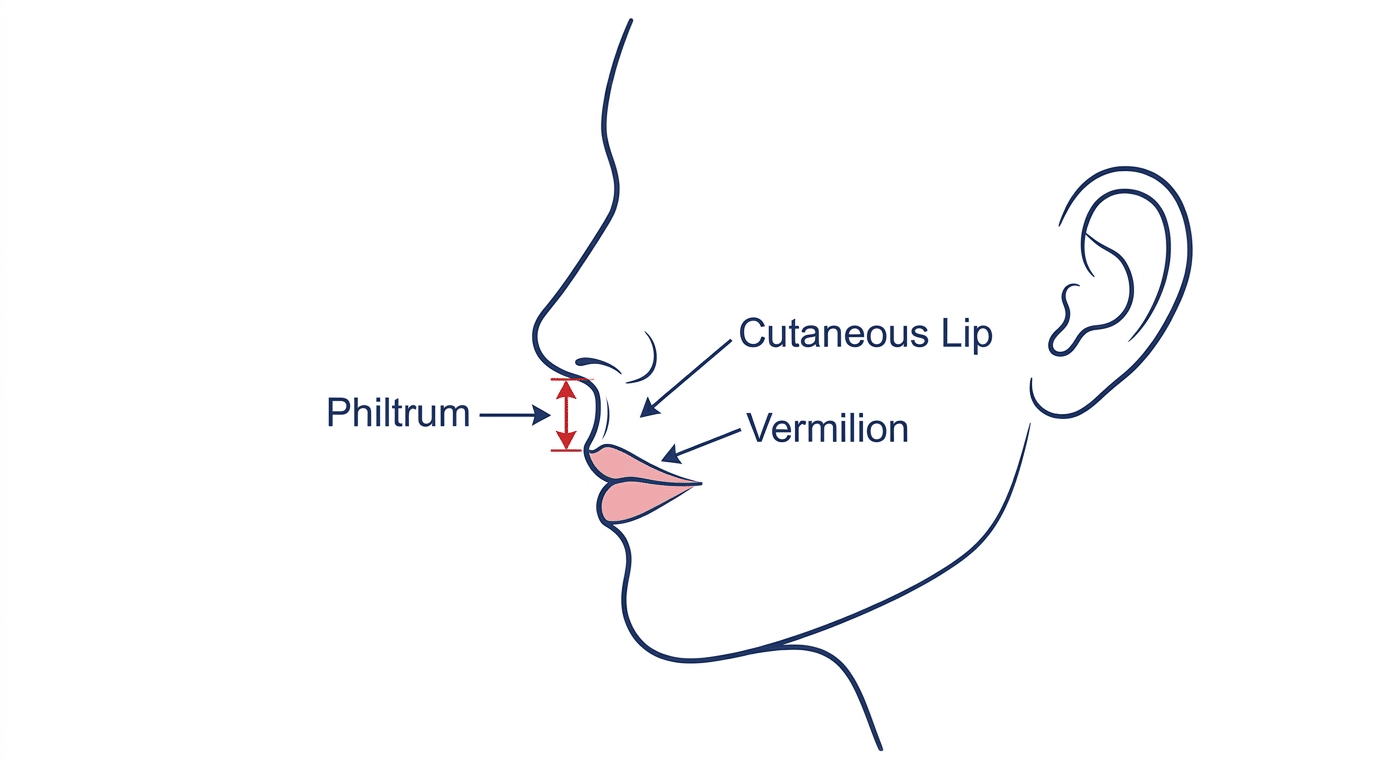
The philtrum is the vertical groove running from the base of the nose (the columella) down to the Cupid’s bow of the upper lip, bordered on each side by two raised ridges called the philtral columns. When surgeons assess this area, they think in terms of two distinct components of the upper lip: the cutaneous lip — the skin-covered portion between the nose and the pink lip — and the vermilion — the pink portion of the lip itself. This distinction matters enormously for treatment, because a “long philtrum” is fundamentally a problem of too much cutaneous lip relative to vermilion. Understanding which component is out of proportion is the key to choosing a treatment that works — and it is exactly the distinction that generic lip treatment advice tends to miss.
What Counts as a Long Philtrum?
In aesthetic practice, the generally accepted ideal philtrum length is around 11 to 13 millimetres in women and 13 to 15 millimetres in men, measured from the base of the columella to the peak of the Cupid’s bow. A commonly used guide for overall lower-face harmony is that the distance from the lower lip to the chin should be roughly twice the length of the philtrum.
Beyond raw measurements, surgeons assess two functional markers that matter more to how the face actually reads. The first is incisor show at rest — in a youthful face, around two to four millimetres of the upper front teeth are visible when the lips are gently parted and relaxed. A long philtrum drapes the upper lip over the teeth and reduces this to zero, which is one of the strongest visual cues of perioral ageing. The second is the upper lip’s proportion in profile — a long cutaneous lip flattens and lengthens the area under the nose, making the upper lip appear recessed and thin from the side, regardless of how much volume the vermilion actually has. These functional markers, rather than millimetre measurements alone, are what a skilled surgeon assesses at consultation.
How a Long Philtrum Affects Facial Appearance
A disproportionately long philtrum tends to produce a recognisable set of effects: the upper lip appears thin even when it has reasonable volume, because much of it is rotated inward and downward; the upper teeth vanish when speaking and smiling gently, which reads as aged; the lower third of the face appears elongated, unbalancing facial proportions; and the Cupid’s bow flattens, reducing lip definition. Because these changes mirror the changes of natural ageing, a congenitally long philtrum can make even a young face read as older — and conversely, philtrum lengthening with age is one of the main reasons the perioral area is often the first part of the face to look aged. Our post on the different lip shapes covers how philtrum length interacts with overall lip morphology.
What Causes a Long Philtrum?
Genetics
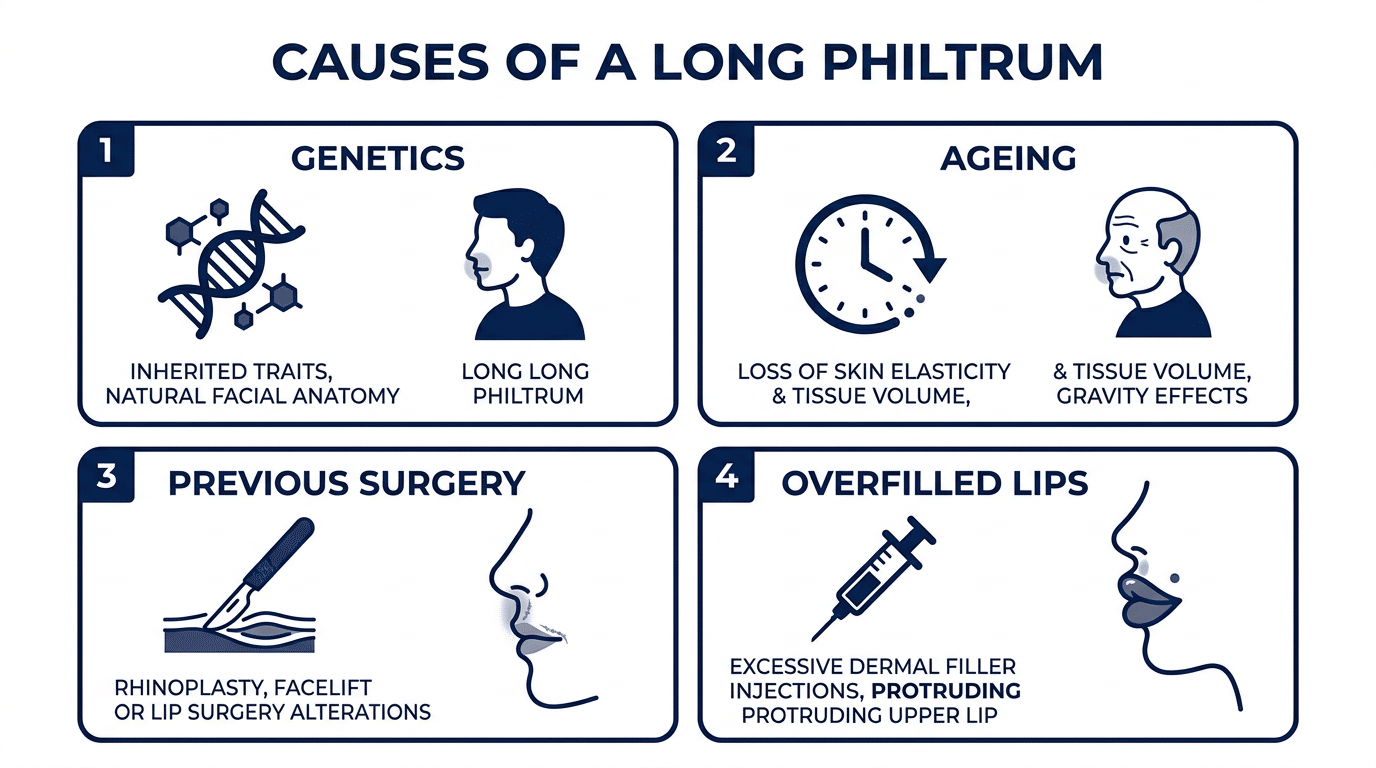
Most long philtrums are simply inherited facial anatomy — present from a young age and often shared with other family members. As with all facial proportions, there is wide natural variation, and a longer philtrum is not an abnormality; it becomes a treatment consideration only when the person is bothered by its effect on their appearance.
Ageing
The philtrum lengthens progressively with age through two combined mechanisms. The soft tissues of the upper lip lose collagen and elastin, causing the cutaneous lip to stretch and descend. At the same time, the underlying maxilla — the bone of the upper jaw — gradually loses volume, reducing the structural support beneath the lip and allowing the whole perioral area to lengthen and flatten. This is why the philtrum can lengthen by several millimetres between young adulthood and later life, and why upper lip lengthening is one of the most reliable markers of facial ageing.
Previous Surgery
Certain surgical procedures can lengthen the philtrum as a side effect — most notably rhinoplasty techniques that lower or de-project the columella, which increases the apparent distance between nose and lip. Patients who feel their upper lip changed after nose surgery are frequently describing exactly this effect.
Overfilled Lips and Filler Migration
Repeated lip filler treatment — particularly when overfilled or when product migrates above the lip border — can stretch the tissues of the upper lip and blur the border between vermilion and cutaneous lip. Over time this both lengthens the philtrum area and creates the heavy, shelf-like upper lip appearance associated with overfilled lips. Uneven migration can also produce visible unevenness between the two sides of the mouth, as covered in our post on asymmetrical lips causes and treatments. In these patients, dissolving the existing filler is the essential first step before any further treatment is planned.
A long philtrum can also occasionally be a feature of certain congenital conditions, though in these cases it is identified in childhood alongside other features and is a matter for specialist paediatric care rather than aesthetic treatment.
Why Lip Filler Alone Often Doesn’t Fix a Long Philtrum
This is the single most important thing to understand before treating this concern — and the point most generic advice gets wrong. Dermal filler adds volume to the vermilion, projecting the pink lip forward. It does nothing to shorten the cutaneous lip, because the problem there is vertical skin excess, not missing volume. In a patient whose underlying issue is a long philtrum, adding filler volume can actually make the imbalance more visible: the lip projects forward beneath an unchanged expanse of cutaneous lip, producing the heavy, protrusive look — without any improvement in tooth show or upper lip height. Worse, as described above, repeated filling can stretch the tissue and lengthen the philtrum further over time.
This does not mean filler has no role — for patients whose primary issue is genuinely low vermilion volume with normal philtrum length, lip fillers remain an excellent option, as covered in our post on thin lips causes and treatments. The point is that the right treatment depends on the right diagnosis: volume problems respond to volume; vertical length problems require vertical shortening.
Treatment Options for a Long Philtrum
Lip Lift Surgery — the Definitive Correction
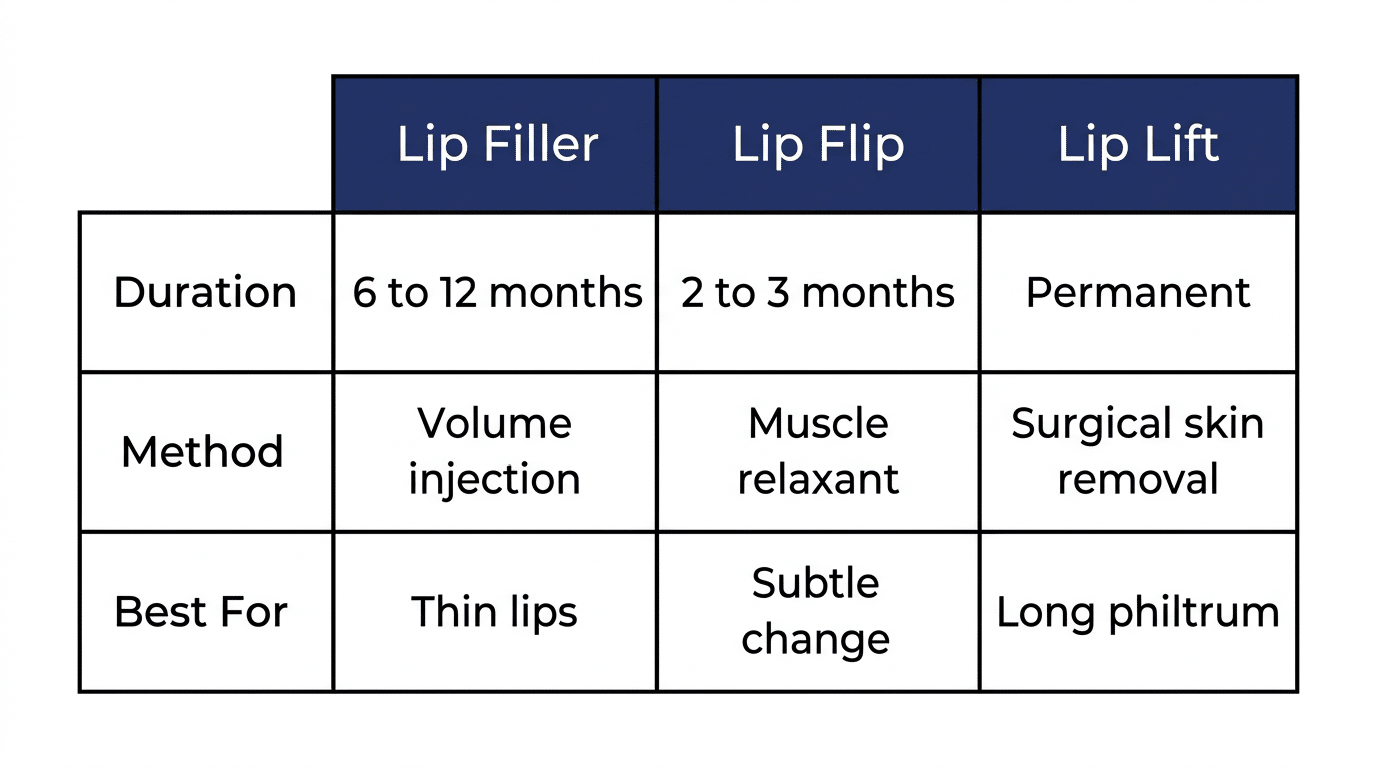
A lip lift is the only treatment that directly and permanently shortens the philtrum. The most commonly performed technique — the bullhorn lip lift — removes a precisely measured strip of skin from directly beneath the base of the nose, lifting the upper lip upward, increasing the visible vermilion, restoring tooth show at rest, and rolling the lip border gently outward. The incision follows the natural crease at the nasal sill, where the resulting fine scar sits within the shadow of the nose and typically matures to be barely perceptible. Our posts on the bullhorn lip lift and bullhorn vs corner lip lift explain the technique variations in detail.
The amount of skin removed is the critical planning decision — typically a proportion of the excess rather than a fixed amount, calculated from your existing philtrum length, tooth show, and gum line. Conservative, precisely measured excision is what protects against over-shortening, which can produce excessive gum show when smiling. This is a key reason to choose a surgeon experienced specifically in lip lift surgery, and it is assessed carefully at consultation — particularly in patients who already show significant gum when smiling, as covered in our post on gummy smile treatment.
The procedure is performed under local anaesthetic in around 60 to 90 minutes as a day case, with sutures removed at around one week and most visible healing complete within two weeks. Our post on how a lip lift can transform your face without fillers covers the procedure journey in full, and our lip lift cost guide sets out current London pricing.
Lip Flip — a Subtle, Temporary Alternative
A lip flip uses precisely placed muscle relaxant injections along the upper lip border to relax the muscle that curls the lip inward, allowing the vermilion to roll slightly outward. This increases visible pink lip without adding volume and can modestly improve the appearance of a long philtrum — but it does not shorten the cutaneous lip, the effect is subtle, and it lasts only around two to three months. It is best suited to patients wanting to preview the general direction of a lip lift result, or those with a mild concern who prefer a non-surgical option.
Lip Filler — for Volume Problems, Not Length Problems
As explained above, filler addresses vermilion volume rather than philtrum length. It is the right choice when thin lips are the genuine primary concern, can play a supporting role alongside a lip lift for patients who want both lift and volume, and is the wrong first choice when the philtrum itself is the problem.
Which Treatment Is Right for Me?
The honest answer depends on a proper assessment of your anatomy, but the general principles are straightforward. If your philtrum measures long, your upper teeth are hidden at rest, and your upper lip looks thin despite reasonable volume — the problem is vertical length, and a lip lift is the treatment that actually addresses it. If your philtrum length is normal but your lips lack volume — filler is the appropriate choice. If your concern is mild and you want a reversible, non-surgical option first — a lip flip offers a subtle preview. And if you have previously had significant filler treatment, assessment of possible migration and stretching comes first, since dissolving may be required before the true baseline anatomy can even be evaluated.
Frequently Asked Questions
What is the ideal philtrum length?
Around 11 to 13 millimetres in women and 13 to 15 millimetres in men is the generally accepted aesthetic range, though facial harmony matters more than any single measurement — the philtrum’s proportion relative to the chin height and the degree of tooth show at rest are equally important markers.
Can exercises shorten a long philtrum?
No. The philtrum’s length is determined by skin and underlying structure, not muscle tone, and no facial exercise can shorten it. Claims otherwise have no anatomical basis.
Does lip filler shorten the philtrum?
No — filler adds forward projection to the pink lip but does not reduce the vertical skin distance between nose and lip. In patients whose underlying issue is a long philtrum, filler alone frequently fails to improve the appearance and can make the imbalance more noticeable.
Is a lip lift scar visible?
The incision is placed in the natural crease at the base of the nose, where the mature scar sits within the nasal shadow. In the early weeks it appears as a fine pink line, typically fading substantially over three to six months to become barely perceptible in most patients.
Can a lip lift be overdone?
Yes — removing too much skin can produce excessive tooth and gum show. This is prevented through careful pre-operative measurement and conservative excision planning, which is why surgeon experience in this specific procedure matters. Patients with a pre-existing gummy smile require particularly careful assessment.
How long does a lip lift last?
A lip lift is permanent — the removed skin does not return. The natural ageing process continues gradually over the decades that follow, but the philtrum will always remain shorter than it would have been without the procedure.
Should I have a lip lift or rhinoplasty first?
If you are considering both, they should be planned together, since nasal base changes directly affect philtrum appearance. Your surgeon will advise on sequencing — in many cases they can be discussed within a single treatment plan at consultation.
Long Philtrum Treatment at Centre for Surgery
Centre for Surgery performs lip lift surgery and lip filler treatment at our CQC-regulated Baker Street clinic in central London. All assessments are performed by experienced surgeons who will measure your philtrum, assess your tooth show and lip proportions, and recommend the treatment that genuinely addresses your anatomy rather than defaulting to the most requested option.
Finance options including 0% APR are available through our partner Chrysalis Finance — visit our Finance Options page for details.
Phone: 0207 993 4849 | Email: contact@centreforsurgery.com | Address: 95-97 Baker Street, London W1U 6RN
[contact-form-7 id=”256″ title=”Treatments form”]