

Almost everybody has some degree of natural facial asymmetry, and the lips are no exception — but for some patients, lip asymmetry is noticeable enough to affect confidence, photographs, and how the mouth moves when speaking or smiling. The good news is that lip asymmetry is one of the most treatable concerns in facial aesthetics, provided the underlying cause is correctly identified first.
At Centre for Surgery in London, our GMC-registered consultant surgeons assess and treat lip asymmetry using the full range of options available, including lip lift surgery and dermal filler, at our CQC-regulated Baker Street clinic. This guide explains the different types of lip asymmetry, what genuinely causes each one, and — critically — why matching the right treatment to the right cause is the single most important factor in achieving a natural, lasting improvement.
What Counts as Lip Asymmetry?
Lip asymmetry refers to a meaningful, visible difference in the shape, volume, position, or movement of the lips between the left and right sides of the mouth, or between the upper and lower lip. A small degree of asymmetry is universal and entirely normal — very few faces are perfectly symmetrical, and most asymmetry of this kind is simply part of normal facial individuality rather than something requiring treatment. What brings patients to consultation is asymmetry significant enough to be noticed in photographs, in the mirror, or by others, or asymmetry that affects how the lips function during speech and expression.
The Three Types of Lip Asymmetry
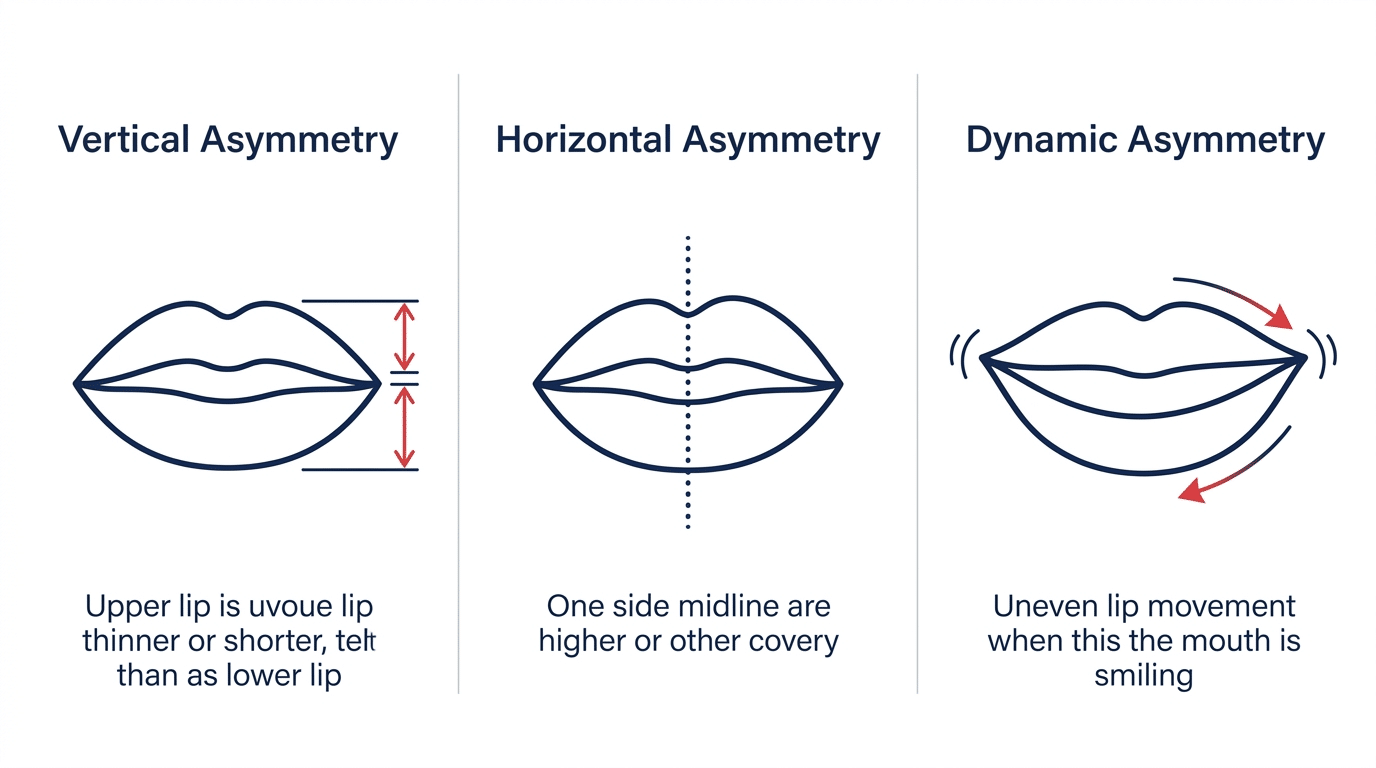
Correctly categorising the type of asymmetry present is the first step in working out what is causing it, because each type tends to point towards a different category of underlying cause.
Vertical Asymmetry
This refers to an imbalance in the relationship between the upper and lower lip — for example, an upper lip that is disproportionately thin or short relative to the lower lip, or a lower lip that appears to dominate the profile. Vertical asymmetry is frequently related to the underlying skeletal relationship between the upper and lower jaw, as well as to natural ageing changes, which tend to affect the upper lip more visibly than the lower lip.
Horizontal Asymmetry
This refers to a difference between the left and right sides of the mouth — one corner of the mouth sitting higher than the other, one side of the lip appearing fuller, or the midline of the lips not aligning with the midline of the face. Horizontal asymmetry is the type most commonly rooted in underlying facial skeletal asymmetry, which is present in almost everyone to some degree, or in localised volume differences from injury, filler migration, or uneven natural lip development.
Dynamic Asymmetry
This refers to asymmetry that only becomes apparent during movement — when smiling, speaking, or making other expressions — rather than at rest. Dynamic asymmetry is the type most likely to involve the underlying facial muscles or, in rarer cases, the nerves that control lip movement, and it requires a different diagnostic approach to static (at-rest) asymmetry.
What Causes Lip Asymmetry?
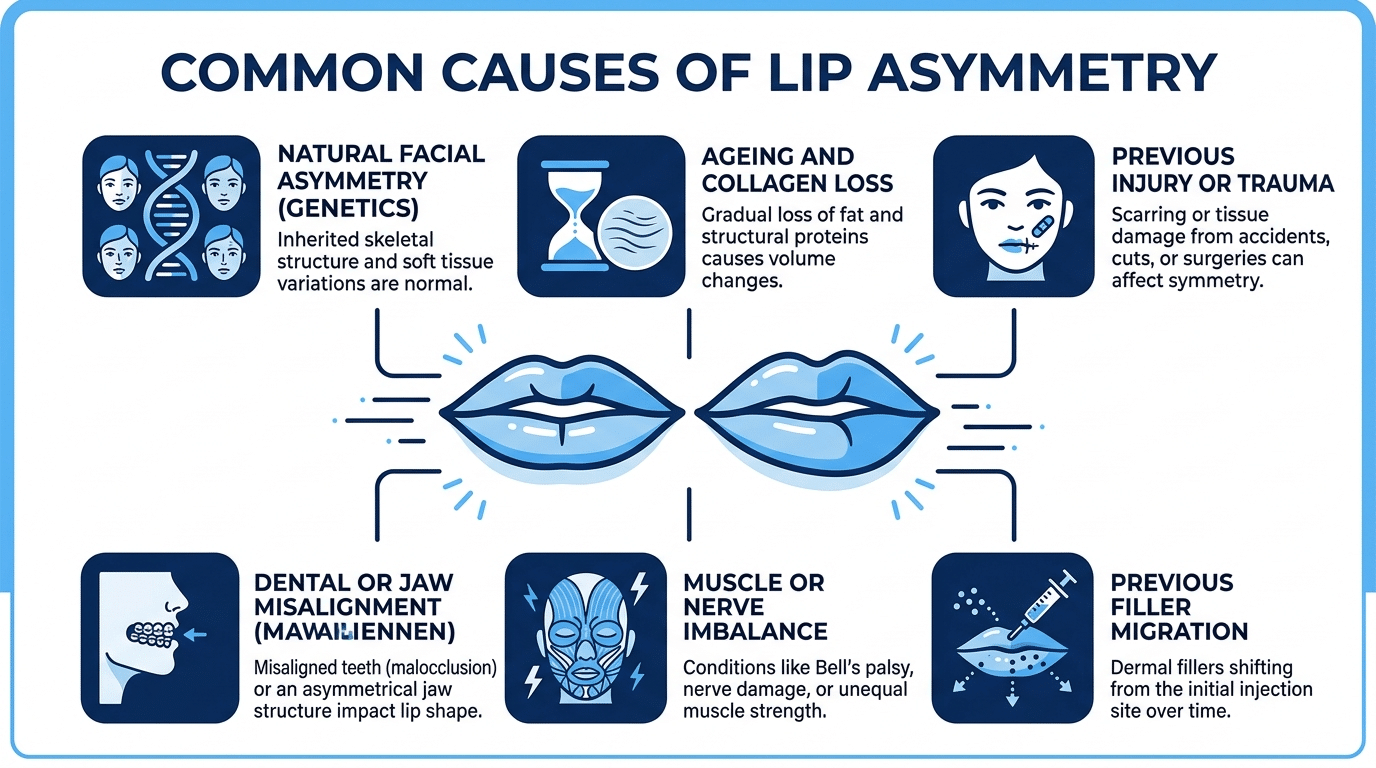
Natural Facial Asymmetry
True facial symmetry is rare. Most people have some inherent asymmetry in their underlying bone structure, soft tissue distribution, and muscle development, and the lips — sitting directly over this structure — reflect it. This is the most common underlying cause of mild lip asymmetry and is present from a young age, often becoming more noticeable with the volume loss associated with ageing rather than appearing for the first time later in life.
Ageing and Collagen Loss
The lips are among the first areas of the face to show visible signs of ageing, due to their constant movement and the thinner, more delicate skin texture compared to the rest of the face. As collagen and elastin production slows with age, lip volume is lost — but this loss is rarely perfectly even between the upper and lower lip, or between the two sides of the mouth, which is why pre-existing mild asymmetry frequently becomes more pronounced and noticeable in the 40s and beyond.
Previous Injury or Trauma
Lip lacerations, fractures involving the jaw or surrounding facial bones, and scar tissue from previous surgery or significant dental work can all alter lip shape, volume, or movement on one side, producing asymmetry that was not present before the injury occurred.
Dental and Jaw Misalignment
Because the lips sit directly over the teeth and jaw, significant dental misalignment or asymmetry in the underlying jaw structure frequently produces visible lip asymmetry. This is particularly relevant for vertical asymmetry between the upper and lower lip, and in more significant cases may require input from a dental or orthognathic specialist alongside any aesthetic lip treatment.
Muscle or Nerve Imbalance
The lips are controlled by a complex group of small muscles, primarily the orbicularis oris, working in coordination with branches of the facial nerve. Subtle differences in muscle strength or tone between the two sides — present from birth or developing over time — can produce dynamic asymmetry that is only visible during movement. In rarer cases, a history of Bell’s palsy or other facial nerve conditions can cause more pronounced and persistent dynamic asymmetry, and this should always be assessed by a clinician familiar with facial nerve anatomy before any aesthetic treatment is considered.
Previous Filler Migration or Uneven Treatment
Dermal filler that has been placed unevenly, or that has migrated from its original injection site over time, is an increasingly common cause of lip asymmetry in patients who have previously had filler treatment elsewhere. This is a particularly important cause to identify clinically, because the correct treatment is very different from addressing naturally occurring asymmetry — it typically involves dissolving the migrated filler before any further treatment is planned.
Matching Treatment to Cause
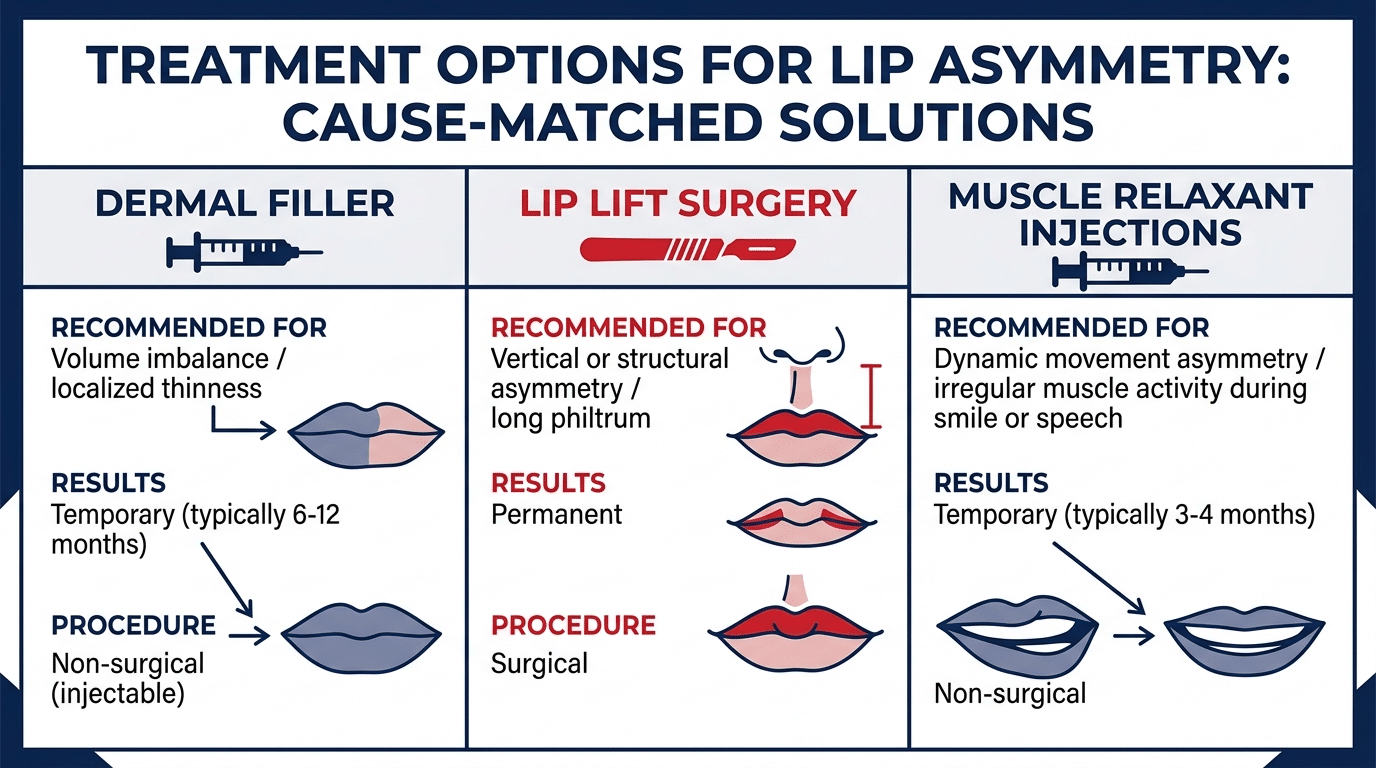
This is the single most important principle in treating lip asymmetry effectively: the right treatment depends entirely on what is actually causing the asymmetry, not simply on which treatment happens to be most commonly requested. Treating the wrong cause with the wrong technique is the most frequent reason patients are left dissatisfied after attempting to correct lip asymmetry elsewhere.
Dermal Filler
For asymmetry caused by genuine volume imbalance — one side or one lip being naturally smaller than the other, or volume loss from ageing affecting one area more than another — carefully placed dermal filler can correct the imbalance non-surgically, with results lasting around six to twelve months before requiring repeat treatment. This approach is not appropriate for structural or vertical asymmetry that is not primarily a volume problem, and it is never appropriate as a first step in a patient whose asymmetry stems from previous filler migration, where dissolving treatment must come first.
Lip Lift Surgery
For vertical asymmetry — particularly an excessively long or asymmetric distance between the base of the nose and the upper lip border — surgical correction through a lip lift directly addresses the structural cause in a way that filler cannot. A lip lift permanently shortens the philtrum and can be precisely tailored to correct asymmetry between the two sides, producing a durable, structural improvement rather than a temporary volumetric one. As covered in our post on the different lip shapes, understanding your specific anatomical starting point is essential to planning the right surgical correction.
Muscle Relaxant Injections
For dynamic asymmetry caused by muscle imbalance — visible specifically during movement rather than at rest — carefully placed muscle relaxant injections in the stronger or more active side can rebalance lip movement during expression and speech. This requires considerable precision and experience, since over-treatment can affect normal lip function, and is not an appropriate first-line treatment for asymmetry that is primarily structural or volumetric rather than muscular in origin.
Why Accurate Diagnosis Matters So Much
Because the three categories of cause — structural, volumetric, and muscular — require fundamentally different treatments, an accurate clinical assessment before any treatment is started is essential. A thorough consultation will examine your lips both at rest and during movement, assess the relationship between your lips, teeth, and jaw, take a history of any previous injury, dental work, or aesthetic treatment, and — where filler migration is suspected — may recommend dissolving treatment before any further steps are planned. Attempting to correct lip asymmetry without this assessment, or defaulting to filler regardless of the underlying cause simply because it is the most commonly requested treatment, is one of the most common reasons patients are left with results that do not fully resolve their concern.
When Should I Seek Assessment for Lip Asymmetry?
Mild, longstanding asymmetry that has not changed and causes no functional concern does not require treatment unless you wish to address it for cosmetic reasons — this is an entirely elective decision. However, asymmetry that has appeared or worsened suddenly, asymmetry accompanied by other facial changes such as drooping or weakness, or asymmetry that affects your ability to fully close your mouth or speak clearly should be assessed promptly, as these features can occasionally indicate an underlying medical cause unrelated to ageing or cosmetic factors and warrant broader clinical evaluation before any aesthetic treatment is considered.
Frequently Asked Questions
Is some degree of lip asymmetry normal?
Yes — almost everyone has some natural facial and lip asymmetry, and most of it falls within the normal range of facial individuality rather than requiring treatment. Treatment is a personal, elective decision for patients whose asymmetry is noticeable enough to bother them.
Can filler alone fix all types of lip asymmetry?
No — filler is effective for volume-related asymmetry but does not address structural causes such as an asymmetric philtrum length, which requires surgical correction, or dynamic asymmetry caused by muscle imbalance, which is better addressed with muscle relaxant injections. Using filler as a default for every type of asymmetry is a common reason for incomplete or unsatisfying results.
Can lip filler make asymmetry worse?
If placed without an accurate diagnosis of the underlying cause, yes — filler added to the wrong side, or in the wrong amount, can accentuate rather than correct an imbalance. This is one of the reasons a thorough assessment before treatment is essential.
How long does lip lift surgery take to heal?
Initial swelling typically settles over one to two weeks, with the final result and scar maturation visible by around three to six months. Your surgeon will provide a full recovery timeline specific to the extent of correction required at your consultation.
Could my lip asymmetry be a sign of a medical condition?
In the majority of cases, no — it reflects normal facial individuality, ageing, or previous injury. However, asymmetry that appears suddenly or is accompanied by other signs of facial weakness should be assessed by a clinician to rule out a neurological cause before any cosmetic treatment is pursued.
Lip Asymmetry Treatment at Centre for Surgery
Centre for Surgery performs lip lift surgery and dermal lip filler at our CQC-regulated Baker Street clinic in central London. All assessments and procedures are performed by GMC-registered consultant surgeons following thorough clinical evaluation to identify the genuine underlying cause of your lip asymmetry before any treatment is recommended.
Finance options including 0% APR are available through our partner Chrysalis Finance — visit our Finance Options page for details.
Phone: 0207 993 4849 | Email: contact@centreforsurgery.com | Address: 95-97 Baker Street, London W1U 6RN

Related Articles
- Can Botched Chin Liposuction be Corrected?
- Facelift for Acne Scars
- Four Insights I Wish I Had Before My Facelift
[contact-form-7 id=”256″ title=”Treatments form”]