

If you have searched “tummy tuck regrets” before booking your consultation, you are doing exactly what a careful, well-informed patient should do. Understanding why some patients end up disappointed with their results — and, crucially, how to avoid being one of them — is one of the most useful things you can do before committing to surgery.
At Centre for Surgery in London, our GMC-registered consultant surgeons perform tummy tuck surgery at our CQC-regulated Baker Street clinic, and our consultation process is specifically built around preventing the avoidable causes of regret covered in this guide. The reassuring reality is that the overwhelming majority of tummy tuck patients are satisfied with their results. But genuine regret does happen, and it is almost always traceable to a small number of identifiable, avoidable causes. This guide explains exactly what they are and how to protect yourself against each one.
How Common Is Tummy Tuck Regret?
Patient satisfaction rates following abdominoplasty are consistently high in published outcome studies, and the procedure remains one of the most reliably satisfying in body contouring surgery when patients are properly selected and prepared. Genuine regret — as opposed to normal frustration during the early weeks of recovery, which is a different and far more common experience — is relatively uncommon. Where it does occur, it is rarely about the surgery itself going wrong in a technical sense. It is far more often about a mismatch between what the patient expected and what they understood the procedure, the recovery, or the result would actually involve.
The Most Common Causes of Tummy Tuck Regret
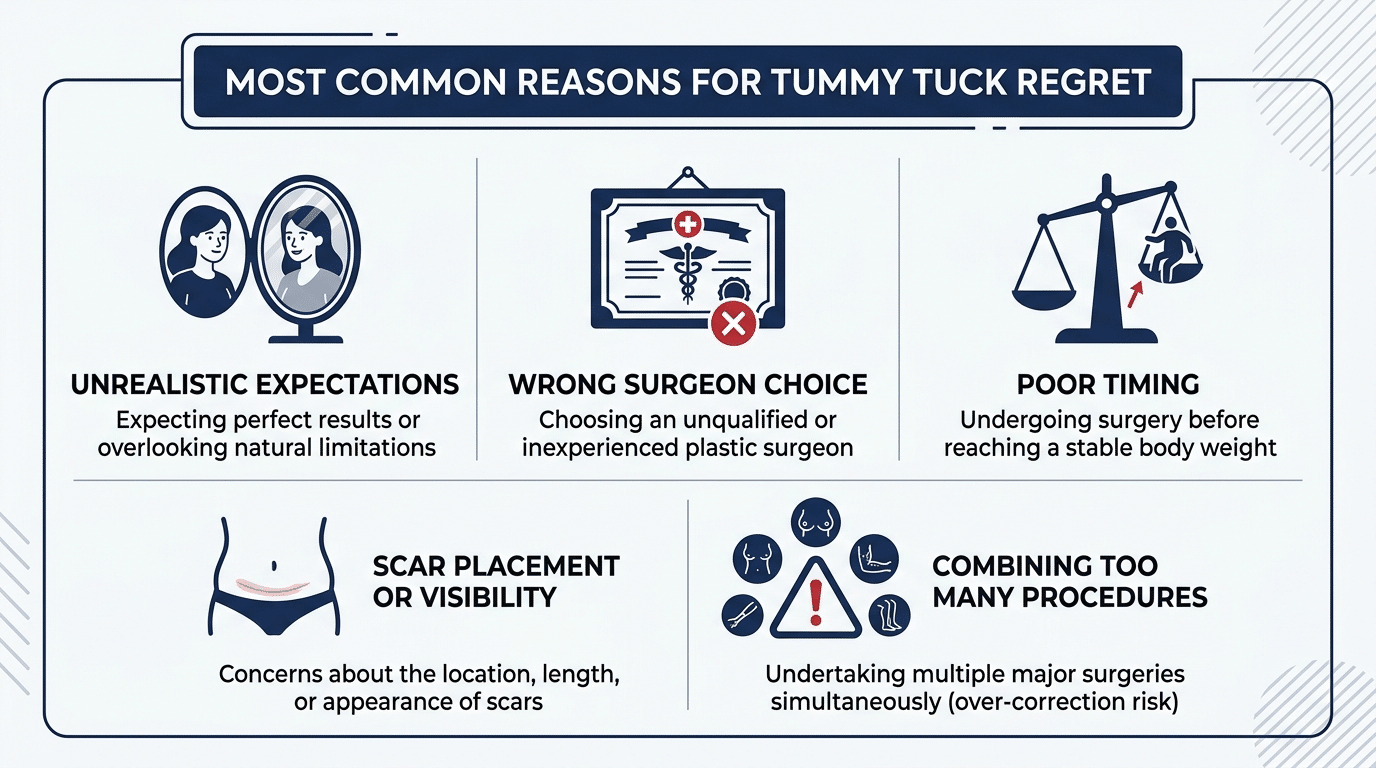
Unrealistic Expectations About the Result
This is, by a significant margin, the most common driver of dissatisfaction after any cosmetic procedure, and tummy tuck is no exception. A tummy tuck removes excess skin and fat from the lower abdomen and repairs separated abdominal muscles, producing a flatter, firmer, more contoured abdominal profile. What it does not do is create a body that looks like it has never had children, never gained weight, or never aged. Patients who go into surgery expecting a flawless, surgically “perfect” result — rather than a significant, genuine improvement on their starting point — are the patients most likely to feel disappointed regardless of how technically well the surgery is performed.
As covered in our post on the factors that influence cosmetic surgery results, your own anatomy, skin quality, and healing response all shape the final outcome alongside the surgeon’s technique — no surgeon can override these biological factors entirely. Our post on how to get rid of a mum tum also covers the realistic range of outcomes for the specific abdominal changes that occur after pregnancy, which is a particularly common source of mismatched expectations.
Choosing the Wrong Surgeon
The single most controllable factor in avoiding regret is who performs your surgery. Tummy tuck results vary enormously based on surgical skill — scar placement, muscle repair technique, and the symmetry and contour of the final result all depend directly on the experience of the surgeon. Patients who choose a provider based primarily on price, availability, or aggressive marketing — rather than verified GMC specialist register status and a strong, consistent track record specifically in abdominoplasty — are taking on meaningfully higher risk of an outcome they are not happy with. As covered in our post on how to choose the right cosmetic surgery clinic, this single decision has more influence over your eventual satisfaction than almost any other factor in the entire process.
Poor Timing — Operating Before Weight Is Stable
A tummy tuck is not a weight-loss procedure, and having one before your weight has stabilised is one of the most common and most avoidable causes of regret. If you lose or gain a significant amount of weight after surgery, the abdominal contour achieved by the procedure can be altered or lost entirely, sometimes requiring revision surgery to correct. Surgeons generally recommend being at or close to your stable, target weight — and, for women, having completed your family — before proceeding, precisely to protect the longevity of the result. As covered in our post on BMI and cosmetic surgery eligibility, weight stability thresholds applied before abdominoplasty are a clinical safeguard for your result, not an arbitrary restriction.
Choosing the Wrong Type of Procedure
Not every patient who wants a flatter stomach needs a full tummy tuck, and choosing the wrong procedure for your specific anatomy is a recognised cause of post-operative disappointment. Patients with good skin elasticity and only localised fat, but no muscle separation or excess skin, are often better served by liposuction alone — our post on liposuction vs tummy tuck for a flatter stomach explains how to tell these candidate profiles apart. Similarly, patients with limited lower abdominal laxity and no significant muscle separation may be excellent candidates for a mini tummy tuck rather than the full procedure, as detailed in our post on whether a mini tummy tuck is enough for your needs. Undergoing more extensive surgery than your anatomy actually requires increases recovery burden and scarring without a corresponding improvement in outcome.
Underestimating the Recovery
Tummy tuck recovery is genuinely demanding — more so than many patients anticipate going in. The first one to two weeks involve significant restriction in movement, an inability to stand fully upright, and a level of discomfort that surprises many patients who expected something closer to a more minor procedure. Patients who go into surgery without a realistic understanding of this recovery curve — and without adequate practical support arranged at home — are more likely to experience the early weeks as overwhelming, which can colour their overall perception of the decision even once the physical result has settled. Our post on how long you will be hunched over after a tummy tuck sets realistic expectations for this specific and often underestimated part of recovery, and our post on why bloating occurs after cosmetic surgery addresses another common and unexpected early discomfort that catches many patients off guard.
Combining Too Many Procedures in One Session
Combining a tummy tuck with other procedures — most commonly as part of a mummy makeover — can be entirely appropriate and is often more efficient than staging procedures separately. As covered in our post on whether you can combine a breast lift and tummy tuck, well-planned combination surgery performed by an experienced surgeon under appropriate anaesthetic conditions is a safe and well-established approach for the right candidate. But combining an excessive number of procedures in a single, very long surgery increases both the physical recovery burden and the risk of complications, which can in turn affect the final result and the patient’s experience of the whole process. As detailed in our post on whether a mummy makeover is safe, the right combination, and the right limit, is something an experienced surgeon will assess carefully rather than simply agreeing to whatever the patient requests. Our post on types of anaesthesia used in plastic surgery covers the additional anaesthetic considerations relevant to longer, combined procedures.
Scar Visibility and Placement
Every tummy tuck leaves a scar — this is an unavoidable consequence of the procedure, and any expectation otherwise sets a patient up for disappointment regardless of how well the surgery is performed. Where the scar is placed, how it is closed, and how it is positioned relative to underwear and swimwear lines all affect how visible and how acceptable it feels to the patient long term. As detailed in our post on what to expect from tummy tuck scars, understanding scar placement and the realistic maturation timeline in advance prevents a common and entirely avoidable source of post-operative disappointment.
How to Avoid Becoming a Regret Statistic
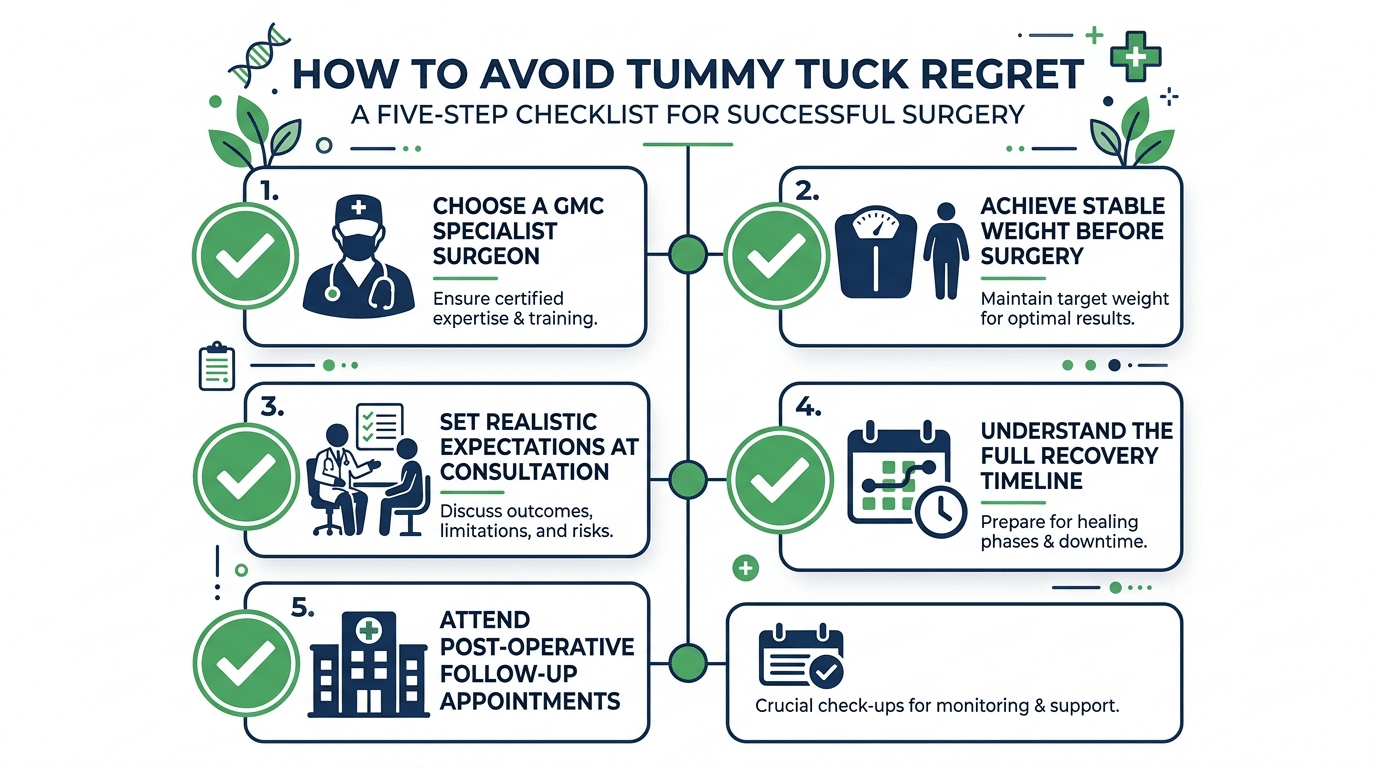
Choose a surgeon on the GMC Specialist Register for plastic surgery, operating at a CQC-regulated facility, with a substantial and consistent track record specifically in abdominoplasty. Achieve a stable weight before proceeding, and be confident you have completed any planned future pregnancies — our post on how soon you can have a mummy makeover after pregnancy covers the appropriate timing in detail. Set realistic expectations at consultation — ask to see results in patients with a starting point similar to your own, not just the most dramatic transformations in the gallery. Understand the full recovery timeline in detail, including the practical support you will need in the first two weeks, before committing to a date. Attend every scheduled post-operative follow-up appointment, since early identification and management of any concerns significantly improves the trajectory of recovery and the final outcome.
Our post on how to get the best tummy tuck result covers these preparation steps in further practical detail.
How Long Until You Can Properly Judge Your Result?
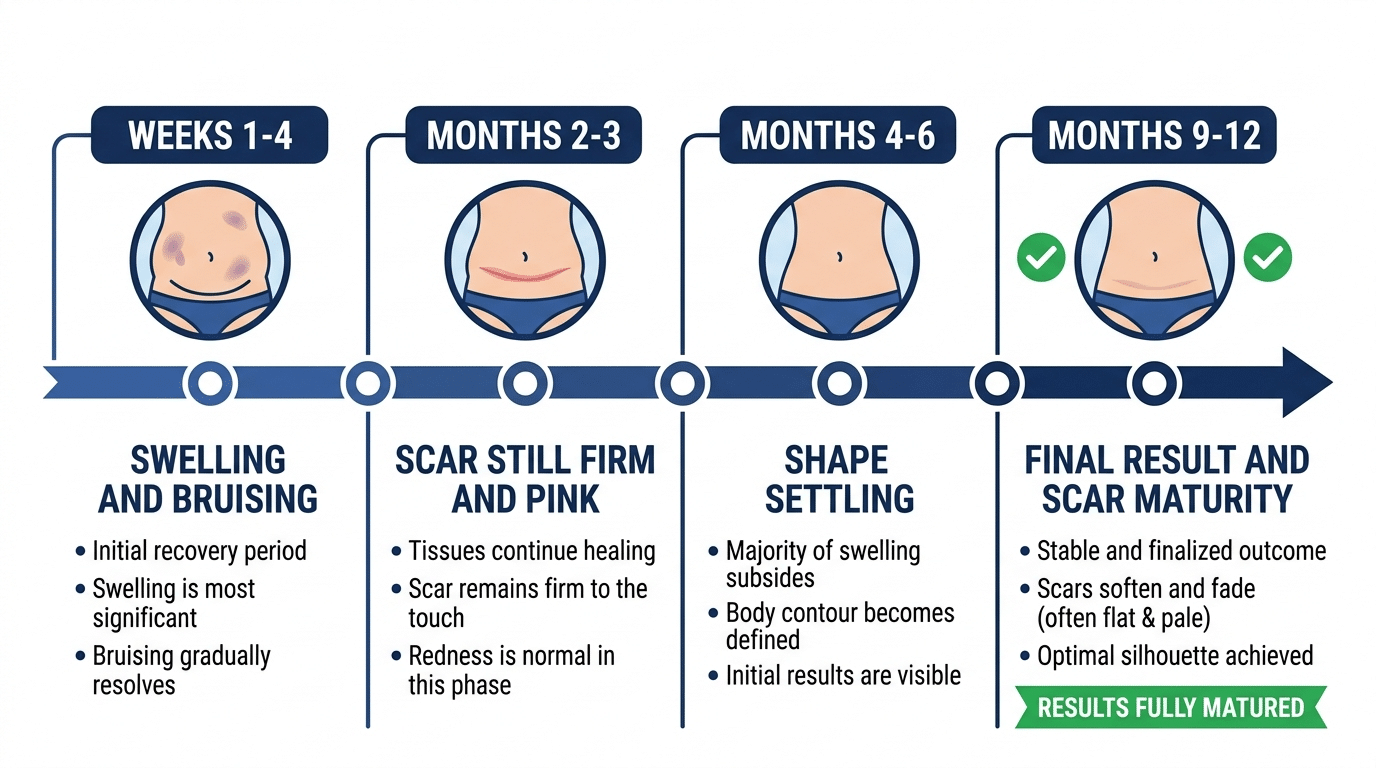
A significant proportion of what feels like early regret is, in reality, simply premature judgement of a result that has not yet fully matured. Swelling can persist in a meaningful way for three to six months after a tummy tuck, and the final abdominal contour and scar appearance are not fully settled until around nine to twelve months post-surgery. Patients who assess their result at six weeks — when swelling is still present and the scar is still pink and firm — are not seeing the final outcome, and judging the surgery a failure at this stage is one of the most common and most avoidable sources of unnecessary distress.
It is also worth understanding what is genuinely normal during this period rather than a sign of a poor result. Some asymmetry is normal in early healing. A sensation of tightness or numbness across the lower abdomen is expected and typically improves gradually over months as nerve sensation recovers. The abdomen often looks and feels different lying down compared to standing, and contour can appear to fluctuate with daily bloating, fluid retention, or hormonal changes during this period — none of which reflect the final result. As covered in our post on what happens if you are not happy with your cosmetic surgery results, giving your body adequate time to heal is always the right first step before drawing any conclusions, regardless of which procedure you have had.
What to Do If You Are Genuinely Unhappy
If, after giving your result adequate time to mature, you remain genuinely unhappy, the right first step is always to go back to your original surgeon and raise your concerns directly. A reputable surgeon will assess your concerns objectively and explain whether your result is within the normal range or whether revision surgery is appropriate. As covered in our post on the risks of abdominoplasty and whether a tummy tuck is safe, understanding the genuine risk and complication profile of the procedure also helps distinguish between a normal healing variation and something that genuinely warrants further clinical assessment.
If you remain unsatisfied after this conversation, or have lost confidence in your original surgeon’s judgement, seeking an independent second opinion from another GMC-registered consultant plastic surgeon is a reasonable and appropriate next step. This is a well-established part of the patient journey for any cosmetic procedure, not just abdominoplasty, and it should never feel like an unusual or disloyal thing to do.
Frequently Asked Questions
Is tummy tuck regret common?
No — published patient satisfaction data for abdominoplasty is consistently high. Genuine regret is uncommon and, where it occurs, is usually traceable to unrealistic expectations, poor surgeon selection, or premature judgement of an unhealed result rather than a failure of the surgery itself.
What is the biggest cause of tummy tuck regret?
Unrealistic expectations about the result — expecting a flawless, surgically “perfect” abdomen rather than a significant, genuine improvement on the patient’s own starting anatomy — is the single most common driver of post-operative dissatisfaction.
How long should I wait before judging my tummy tuck result?
A minimum of six months, and ideally a full year. Swelling can persist for three to six months, and the scar and final abdominal contour are not fully settled until around nine to twelve months after surgery.
Can a tummy tuck be reversed if I regret it?
The procedure itself is not reversible in the sense of restoring pre-surgical anatomy, but revision surgery can address many specific concerns about scar appearance, contour irregularities, or residual skin laxity, depending on the issue.
Will losing or gaining weight after my tummy tuck ruin the result?
Significant weight fluctuation after surgery can meaningfully alter the abdominal contour achieved by the procedure. This is why achieving a stable weight before surgery — and maintaining it afterwards — is one of the most important factors in long-term satisfaction.
Should I have a tummy tuck alone or as part of a mummy makeover?
This depends entirely on your individual concerns and anatomy. Patients addressing multiple areas affected by pregnancy or weight change — typically the abdomen and breasts together — often benefit from a combined mummy makeover approach, while patients with abdominal concerns alone are usually better served by a standalone tummy tuck. A thorough consultation is the only reliable way to determine which approach is right for you.
Tummy Tuck Surgery at Centre for Surgery
Centre for Surgery performs tummy tuck surgery at our CQC-regulated Baker Street clinic in central London. All procedures are performed by GMC-registered consultant plastic surgeons following a thorough consultation process designed to ensure realistic expectations and appropriate patient selection from the outset.
Finance options including 0% APR are available through our partner Chrysalis Finance — visit our Finance Options page for details.
Phone: 0207 993 4849 | Email: contact@centreforsurgery.com | Address: 95-97 Baker Street, London W1U 6RN
Related Articles
- Tummy Tuck vs Liposuction
- Understanding Tummy Anatomy For The Best Tummy Tuck Results
- What Are the Different Types of Body Contouring Implants?
[contact-form-7 id=”256″ title=”Treatments form”]