The rise of GLP-1 weight-loss medications — semaglutide (Ozempic, Wegovy) and tirzepatide (Mounjaro) — has helped enormous numbers of people lose significant weight, often quickly. But one question comes up again and again, both from people already taking these medications and from those considering them: does GLP-1 weight loss cause loose skin, and if so, is there anything you can do about it? This guide answers that directly — explaining why loose skin happens, whether you can prevent or minimise it while you’re losing weight, what “Ozempic face” and “Ozempic body” really mean, and when surgery becomes the answer.
The short version: it isn’t the medication itself that causes loose skin — it’s the amount and speed of the weight loss. Any rapid, substantial weight loss can leave skin that struggles to retract. The good news is there are sensible steps that reduce the risk, and for skin that doesn’t bounce back, excess skin removal surgery at our CQC-regulated London clinic offers a definitive solution.
Does Ozempic or Mounjaro Actually Cause Loose Skin?
Not directly. There is nothing about semaglutide or tirzepatide that affects the skin itself. What these medications do extremely well is reduce appetite and produce significant weight loss — and it is that weight loss, particularly when it is large and rapid, that leaves loose skin behind.
Here’s why. When you carry excess weight, your skin stretches to accommodate the fat beneath it. Skin has a degree of natural elasticity, but that elasticity has limits, and it takes time to adapt. When the fat is lost quickly — as it often is on GLP-1 medications — the skin simply cannot retract fast enough to keep pace. The result is redundant, loose skin, most noticeably on the abdomen, arms, thighs, breasts, and neck. So while people talk about “Ozempic loose skin” or “Mounjaro loose skin,” the medication is really just the vehicle for the fast weight loss that is the true cause.
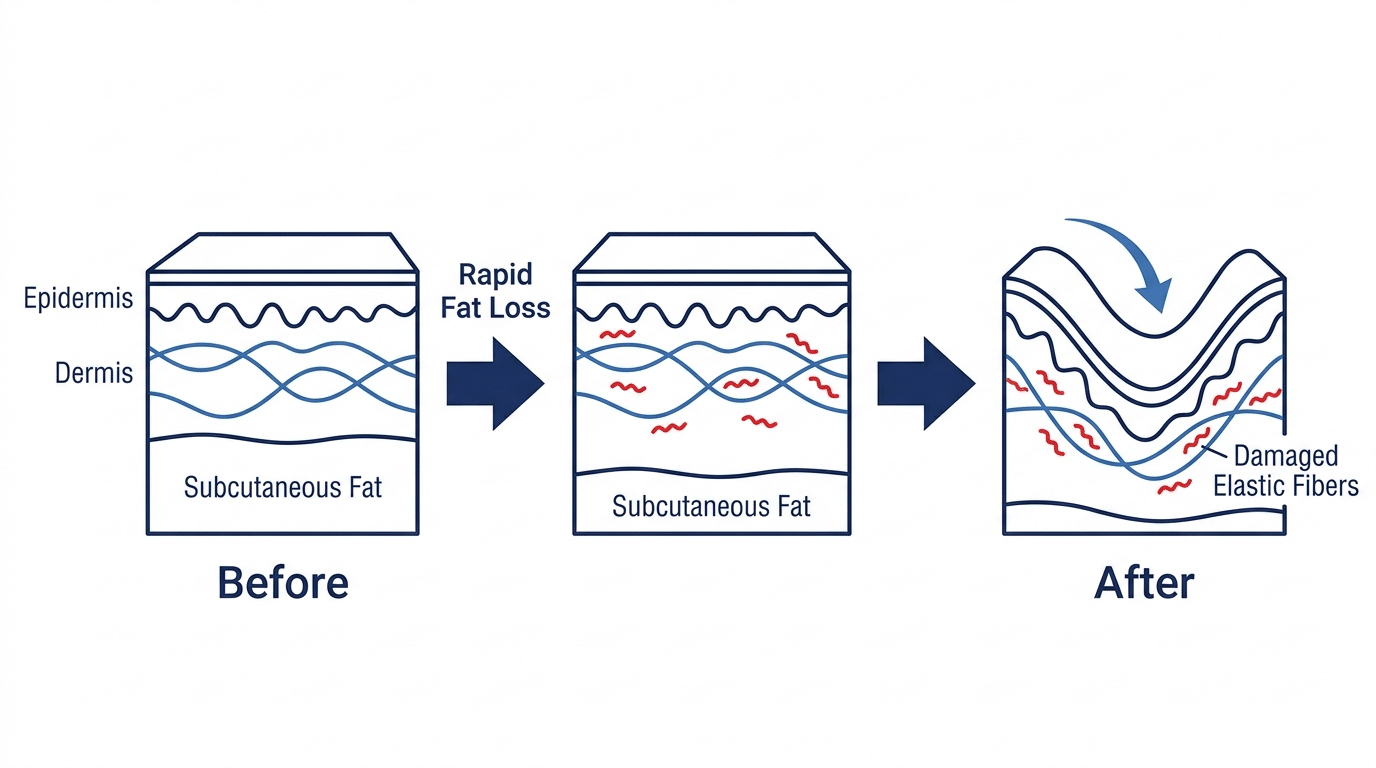
Why GLP-1 Weight Loss Tends to Leave More Loose Skin
Several factors specific to how GLP-1 medications work make loose skin more likely than with slower, gradual weight loss:
- Speed of loss. Rapid weight loss gives the skin less time to gradually retract. The faster the fat goes, the more the skin lags behind.
- Amount of loss. GLP-1 medications often produce large total weight loss. The more weight lost, the more the skin was stretched, and the more redundant skin is likely to remain.
- Muscle loss alongside fat. Significant weight loss — especially rapid loss without adequate protein and resistance exercise — can include a loss of muscle as well as fat. Losing the underlying muscle “scaffolding” can make skin appear even looser and less supported.
Individual factors matter too. Older skin has less elastic recoil, so people over 40 or 50 tend to see more loose skin. Genetics, sun damage, smoking history, and how many times someone’s weight has fluctuated over the years all affect how well skin retracts. This is why two people who lose the same amount of weight can end up with very different amounts of loose skin.
Is Loose Skin from GLP-1 Medication Different to Other Weight Loss?
The loose skin itself is no different — redundant skin is redundant skin, whether the weight came off through Ozempic, Mounjaro, bariatric surgery, or diet and exercise. What differs is the pattern and likelihood. Traditional diet and exercise usually produces slower, more gradual weight loss, giving skin the best chance to retract along the way, so loose skin from dieting alone is often less pronounced. Bariatric (weight-loss) surgery, by contrast, typically produces very large and relatively rapid weight loss, and is well known for leaving significant loose skin that frequently needs surgical removal.
GLP-1 medications sit somewhere in between, but closer to the bariatric end: the weight loss can be both substantial and fast, which is exactly the combination most likely to leave loose skin. There is also a specific point worth understanding about muscle. Because GLP-1 medications work largely by reducing appetite and overall food intake, people can end up eating too little protein and losing more muscle than they would with a carefully managed diet-and-exercise programme. That muscle loss is part of why “Ozempic body” can look particularly deflated, and it’s the main reason protein and resistance training matter so much during treatment.
What Are “Ozempic Face” and “Ozempic Body”?
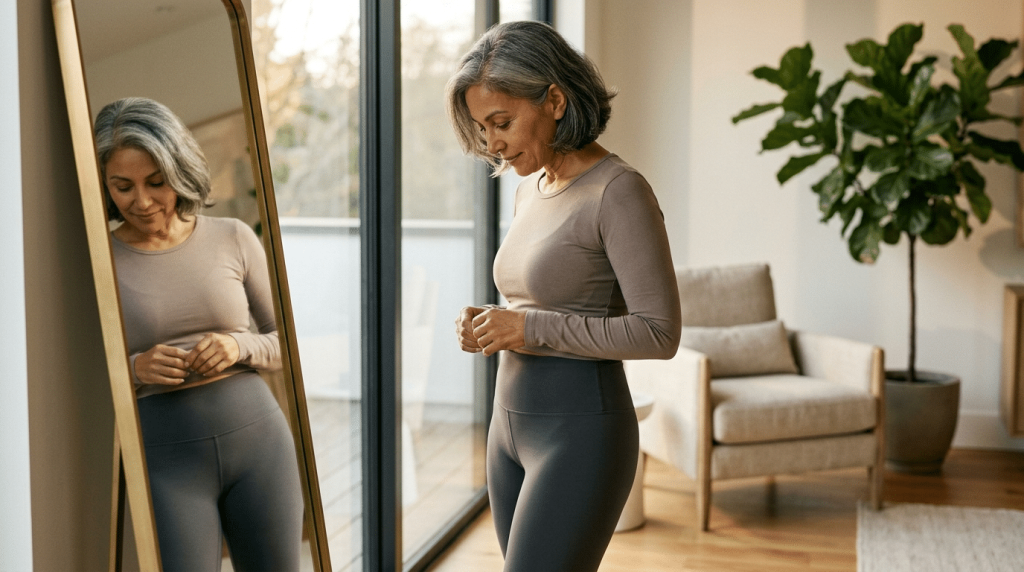
“Ozempic face” is the widely-used nickname for the facial changes that can accompany rapid GLP-1 weight loss. As fat is lost from the face along with the rest of the body, the face can look gaunt, hollowed, or older, with more prominent lines and looser skin around the jaw and neck. “Ozempic body” refers to the same phenomenon across the body — loose or crepey skin on the abdomen, arms, and thighs once the fat that filled it out has gone.
Again, neither is a side effect of the drug on the skin. Both are simply the visible result of losing facial and body fat quickly. The face and neck are often the first areas people notice, because facial fat loss shows early and is hard to conceal.
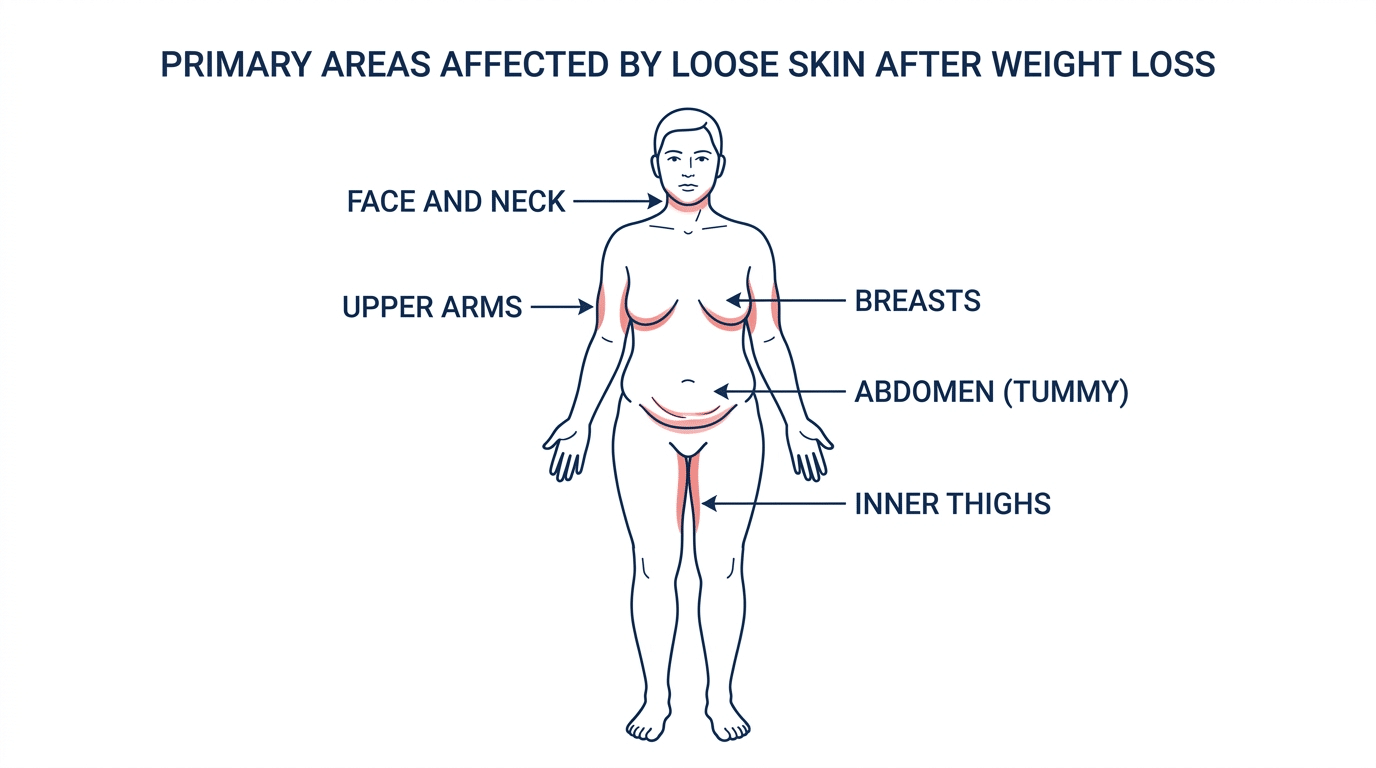
How Much Loose Skin Will I Be Left With?
This is impossible to predict precisely in advance, because it depends on the interaction of several things: how much weight you lose in total, how quickly, your age, your genetics, and the natural quality and elasticity of your skin. As a general guide, the larger and faster the weight loss and the older the skin, the more loose skin is likely to remain. Someone in their twenties or thirties losing a moderate amount with good skin elasticity may see very little; someone in their fifties losing a large amount rapidly is far more likely to be left with folds that need addressing.
It’s also worth knowing that loose skin continues to settle for months after the weight has stabilised. Skin retracts gradually, and what looks loose immediately after reaching your goal weight may tighten somewhat over the following six to twelve months. This is one of the reasons surgeons advise waiting before deciding on surgery — it allows you to see what your skin will do on its own before committing to a procedure.
Can You Prevent or Minimise Loose Skin While on GLP-1 Medication?
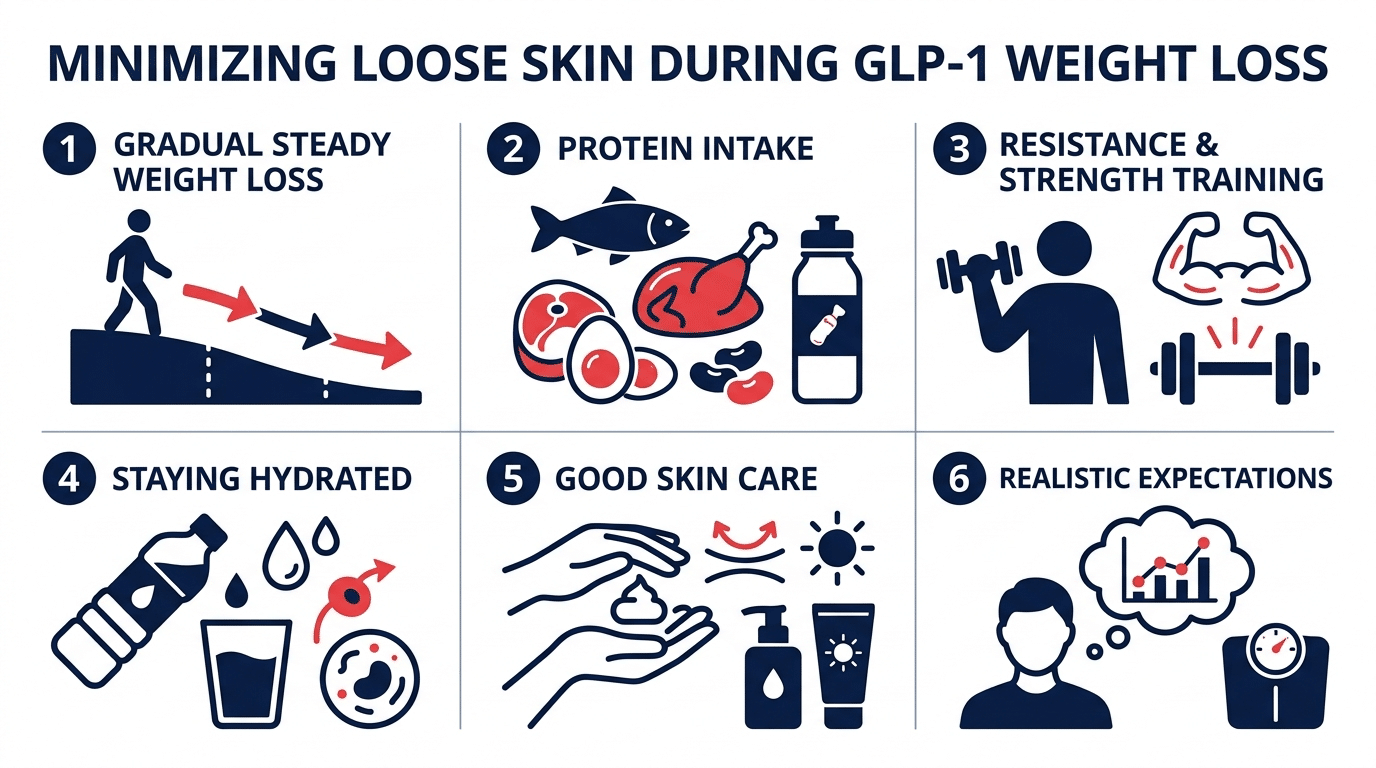
You can’t guarantee you’ll avoid loose skin, but there are genuinely useful steps that reduce the risk — and they’re most effective when started early, while you’re still losing weight, rather than after the fact. Being honest about what works matters here, because the internet is full of products that promise more than they deliver.
Lose weight gradually where you can
The single biggest factor is the pace of loss. Where your clinician’s plan allows, a steadier rate of weight loss gives your skin more time to retract along the way. This isn’t always within your control on a fixed medication protocol, but it’s worth discussing dose and pace with the prescriber managing your treatment.
Prioritise protein and resistance training
This is the most important thing most people overlook. Rapid weight loss can strip muscle as well as fat, and lost muscle makes skin look looser and less supported. Eating enough protein and doing regular resistance or strength training helps preserve muscle mass throughout your weight loss, maintaining the underlying support beneath the skin and improving your overall body composition. It won’t tighten skin that has already lost its elasticity, but it meaningfully helps the end result.
Stay hydrated and look after your skin
Well-hydrated skin is more supple. Drinking enough water, keeping the skin moisturised, not smoking, and protecting skin from sun damage all support its resilience and its capacity to retract. These are supportive measures rather than fixes, but they cost nothing and help.
Have realistic expectations
For modest weight loss in younger people with good skin elasticity, the skin often retracts well on its own over the months following weight loss. For large weight loss, older skin, or skin that has been repeatedly stretched, some degree of loose skin is likely no matter what you do — and no cream, supplement, or exercise can rejoin or shrink significantly redundant skin. Knowing this in advance helps you plan.
Do Skin-Tightening Creams and Supplements Work?
This is one of the most common questions, and the honest answer is: not for significant loose skin. Firming creams, collagen supplements, and “skin-tightening” lotions are heavily marketed to people who’ve lost weight, but there is no topical product that can tighten skin which has genuinely lost its elasticity. At best, a good moisturiser improves the skin’s surface appearance and hydration temporarily.
Similarly, while building muscle through exercise improves the contour beneath the skin and is well worth doing, it cannot shrink an overhanging fold of loose skin. For mild laxity, time, hydration, muscle-building, and good skin care may be enough. For moderate to severe loose skin, the only thing that removes it is surgery. Being clear-eyed about this saves a lot of money spent on products that can’t deliver what they promise.
When Is Surgery the Answer for Loose Skin After GLP-1 Weight Loss?
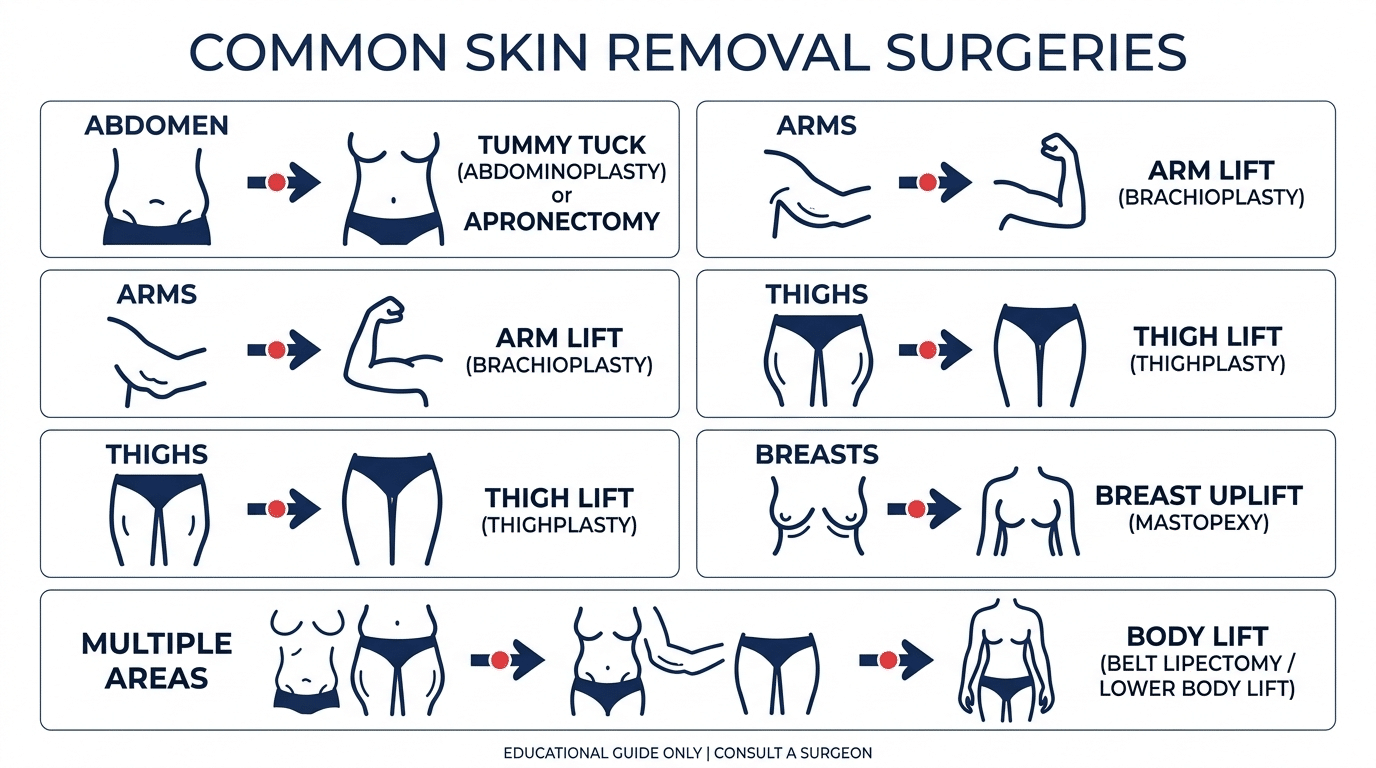
Where loose skin is significant — hanging folds on the abdomen, “bat-wing” upper arms, loose inner thighs, sagging breasts, or a loose neck — and it doesn’t retract with time, surgical removal is the definitive solution. It’s worth considering surgery when the loose skin is causing physical problems (such as recurrent irritation or chafing in the folds), when it limits clothing or activity, or when it significantly affects confidence after all the hard work of losing the weight.
The right procedure depends on the area affected:
- Abdomen: an apronectomy removes the overhanging apron of lower tummy skin, while a tummy tuck (abdominoplasty) also tightens the muscles and refines the contour.
- Arms: an arm lift (brachioplasty) removes loose inner-arm skin.
- Thighs: a thigh lift removes excess inner-thigh skin.
- Breasts: a breast uplift (mastopexy) lifts and reshapes sagging breasts.
- Multiple areas: a lower body lift (belt lipectomy) addresses the abdomen, flanks, back, and buttocks together.
For many post-weight-loss patients, more than one area is involved, and treatment is planned in stages. Our overview of skin removal procedures after weight loss sets out the full range, and our guide on which body areas are most affected by excess skin goes into more detail on each.
What Happens During Skin Removal Surgery and Recovery?
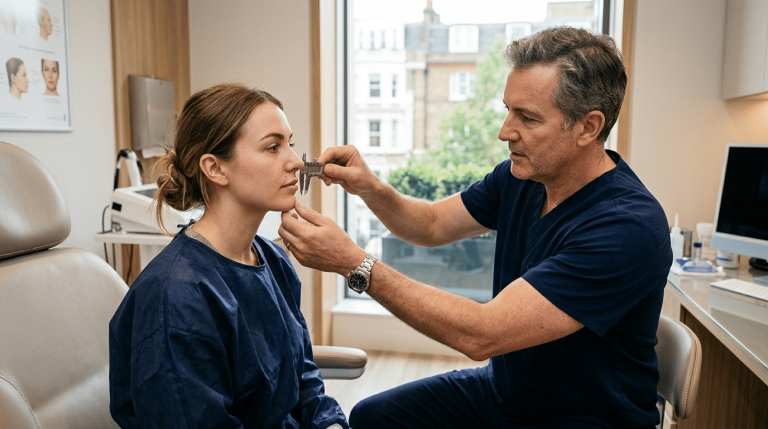
Excess skin removal is carried out under general anaesthetic. The surgeon removes the redundant skin, tightens the underlying tissues where appropriate, and closes the incisions so that scars fall in the most discreet positions possible — for example, low across the abdomen where underwear sits, or on the inner arm. Where muscle separation or stubborn fat is also present, muscle repair or liposuction may be combined in the same operation. The length of surgery depends on how many areas are treated.
Recovery varies with the extent of the procedure, but some principles are common to all skin removal surgery. You’ll wear a compression garment for around six weeks to support the tissues and reduce swelling. Most people take around two weeks off work for a desk-based job, longer for physical work, and must avoid heavy lifting and strenuous exercise for at least six weeks. Swelling and bruising settle over the first few weeks, while the final contour continues to refine over several months. Scars are a necessary trade-off of removing skin — they are permanent, but placed discreetly and fade significantly over 12 to 18 months. Where several areas are treated in stages, your surgeon will set out a realistic overall timeline at consultation.
When Should You Have Skin Removal Surgery?
Timing matters. Surgeons generally advise waiting until your weight has been stable for around six months before having skin removal surgery. There are two reasons: first, it allows time to see how much your skin retracts on its own; and second, further weight loss or gain after surgery can affect the result. Because GLP-1 weight loss can continue over a long period, and because some people stop or change their medication, reaching a settled, stable weight first is important. Our post on skin removal surgery after losing weight quickly covers timing in more depth.
If your main issue is recurrent rashes or soreness where loose skin folds trap moisture, our guide to skin irritation after weight loss explains how to manage it and when surgery resolves it for good.
Is Loose Skin Removal Available on the NHS?
NHS funding for skin removal is limited and usually requires evidence of significant functional problems — such as recurrent infections or ulceration in the skin folds that haven’t responded to treatment — along with strict eligibility criteria. Purely cosmetic loose skin is not routinely funded. Many patients choose private surgery for quicker access and broader eligibility. Our detailed guide on skin removal surgery on the NHS after weight loss explains the criteria in full.
How Much Does Skin Removal Surgery Cost?
The cost of skin removal surgery depends on which area or areas are treated and how extensive the procedure is — a single-area arm lift sits at the lower end, while a full lower body lift or several staged procedures cost more. Because most post-weight-loss patients need more than one area addressed, the total is best established at a personal consultation, where your surgeon can assess exactly what’s involved and give you a clear, itemised quote. Finance options including 0% APR are available through our partner Chrysalis Finance for procedures over £1,500, which allows the cost to be spread over manageable monthly payments — see our Finance Options page for details.
Frequently Asked Questions
Does everyone who takes Ozempic or Mounjaro get loose skin?
No. It depends on how much weight you lose, how quickly, your age, and your skin’s natural elasticity. Modest weight loss in younger people with good skin elasticity often leaves little or no loose skin, while large or rapid loss — particularly in older skin — is more likely to.
Will the loose skin tighten up on its own over time?
Mild laxity often improves over the months after weight loss as the skin gradually retracts. Significant loose skin, however, generally does not resolve on its own, because the skin has lost the elasticity needed to shrink back.
Can I prevent loose skin by losing weight more slowly on GLP-1?
A steadier pace of weight loss gives skin more time to adapt and can reduce loose skin, though it can’t always prevent it entirely — especially with large total weight loss or older skin. Preserving muscle with protein and resistance training is just as important.
Does building muscle get rid of loose skin?
Building muscle improves the contour beneath the skin and helps your overall shape, and preserving muscle during weight loss reduces how loose the skin looks. But exercise cannot remove or shrink an established fold of redundant skin — only surgery can do that.
Is loose skin from Ozempic worse than from dieting?
The skin itself is the same, but because GLP-1 medications can produce faster and larger weight loss than dieting alone — and can involve more muscle loss — they tend to leave more loose skin than gradual diet-and-exercise weight loss would. Preserving muscle and losing weight steadily narrows that gap.
Will I be left with scars after skin removal surgery?
Yes — removing skin always leaves a scar, as the skin has to be cut and re-closed. Scars are placed as discreetly as possible (for example, low on the abdomen or on the inner arm), are permanent, and fade significantly over 12 to 18 months. For most patients who were troubled by significant loose skin, this is a worthwhile trade-off.
What is the best treatment for significant loose skin after Ozempic or Mounjaro?
For significant loose skin, surgical removal is the only definitive treatment. The specific procedure depends on the area — tummy tuck or apronectomy for the abdomen, arm lift for the arms, thigh lift for the thighs, breast uplift for the breasts, or a body lift for multiple areas.
How long should I wait after finishing GLP-1 weight loss before surgery?
Most surgeons advise waiting until your weight has been stable for around six months, to allow the skin to retract as much as it will and to ensure the surgical result isn’t affected by further weight change.
Loose Skin Treatment After Weight Loss at Centre for Surgery
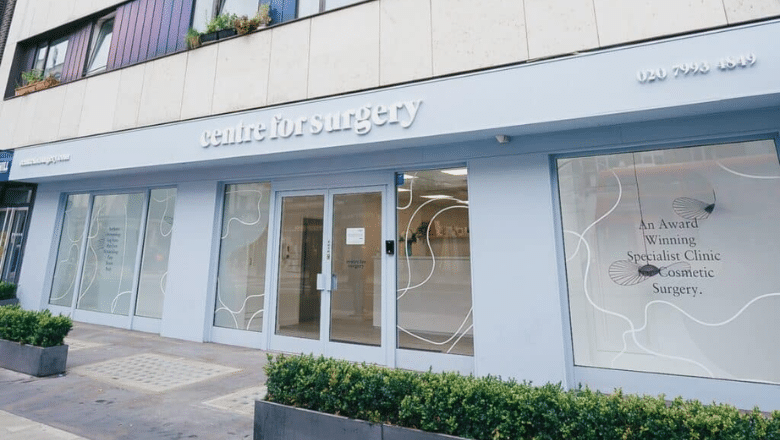
Centre for Surgery is one of the UK’s most experienced providers of body-contouring and excess skin removal surgery, treating loose skin after all forms of major weight loss — including GLP-1 medications such as Ozempic, Wegovy, and Mounjaro. Treatment is carried out by GMC-registered consultant plastic surgeons at our CQC-regulated clinic at 95–97 Baker Street, London, which holds a “Good” rating from the Care Quality Commission (CQC). Your consultation includes an honest assessment of your skin and general health and a tailored plan — including whether treatment is best staged across more than one procedure.
Finance options including 0% APR are available through our partner Chrysalis Finance for procedures over £1,500 — visit our Finance Options page for details.
Phone: 0207 993 4849 | Email: contact@centreforsurgery.com | Address: 95-97 Baker Street, London W1U 6RN
[contact-form-7 id=”256″ title=”Treatments form”]