

If you have developed the soft yellow patches of xanthelasma on your eyelids and then had a blood test come back showing normal cholesterol, you are probably confused — and maybe a little frustrated. Xanthelasma is so strongly associated with cholesterol that being told your levels are fine can feel like it doesn’t add up. So can you actually have xanthelasma with normal cholesterol? The answer is yes, and it is far more common than most people expect: roughly half of everyone with xanthelasma has entirely normal blood lipids. This guide explains why that happens, what it means for your health, and what — if anything — you should do about it.
At Centre for Surgery, xanthelasma assessment and removal is part of our skin lesion removal service, and treatment is carried out through our dedicated xanthelasma removal service. But before treatment, it is worth understanding what your normal cholesterol result actually tells you — and what it doesn’t.
What is xanthelasma?
Xanthelasma — more fully, xanthelasma palpebrarum — are soft, flat or slightly raised yellowish plaques that develop on the eyelid skin, most often at the inner corner of the upper or lower eyelid. They are frequently symmetrical, and in some people all four eyelids are involved. They are painless, do not affect vision, and are entirely benign, with no potential to become cancerous.
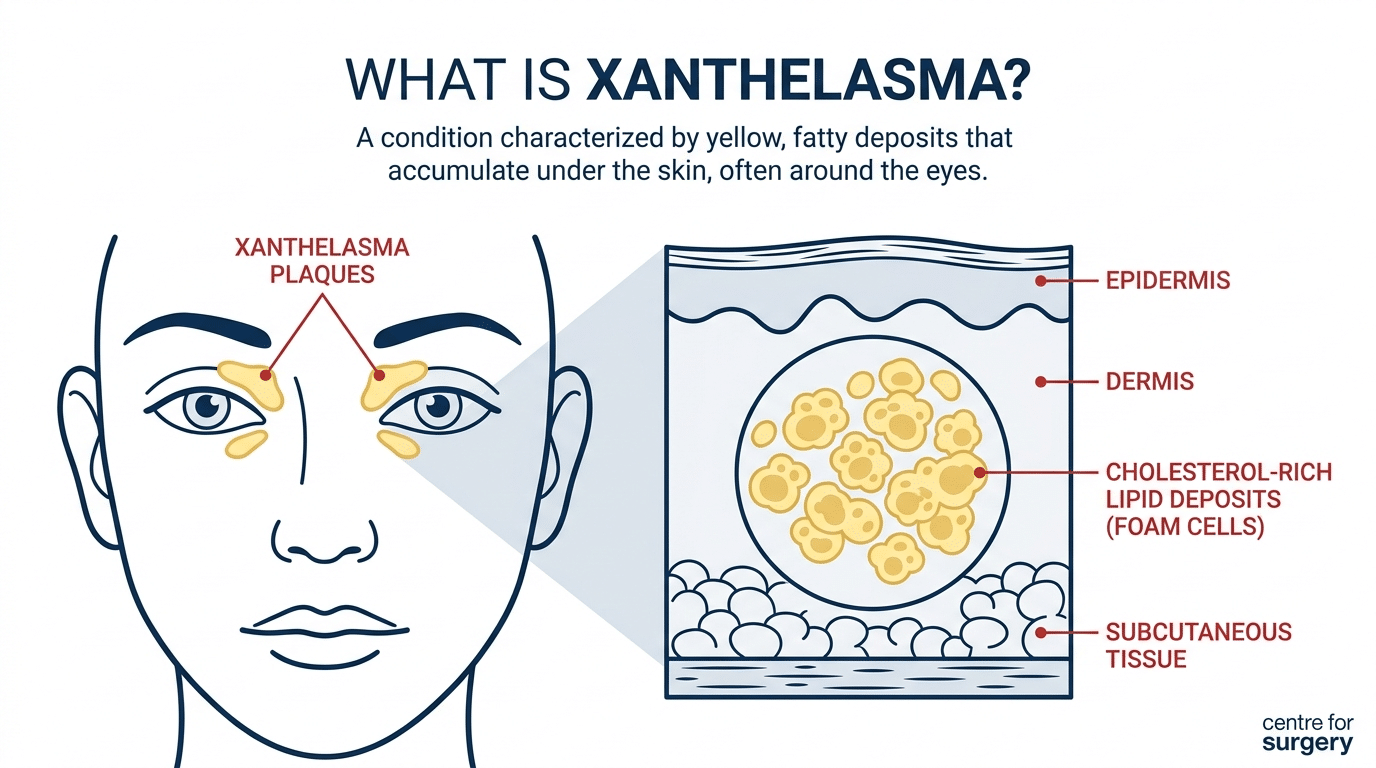
The yellow colour comes from their content: xanthelasma are deposits of cholesterol-rich material in the dermis, the deeper layer of the skin. More specifically, they are made up of lipid-laden immune cells called foam cells — macrophages that have taken up cholesterol and become swollen with it. The name itself describes the appearance, coming from the Greek for “yellow” and “plate”. They tend to start small, just a few millimetres across, and enlarge slowly over months or years. Left alone, they do not resolve on their own; they stay the same size or gradually grow.
Because the deposit is made of cholesterol, the natural assumption — by patients and often by the people around them — is that xanthelasma must mean high cholesterol. For about half of people, that assumption is correct. For the other half, it isn’t. Understanding which group you are in is the whole point of a lipid test, and it is why a normal result is genuinely useful information rather than a contradiction.
Can you have xanthelasma with normal cholesterol?
Yes. This is the key fact that surprises most people: a substantial proportion of people with xanthelasma — commonly cited as around 40 to 50 percent — have completely normal blood lipid levels. Xanthelasma is strongly associated with raised cholesterol, but association is not the same as requirement. Having the plaques does not prove your cholesterol is high, and a normal cholesterol result does not mean your xanthelasma has been misdiagnosed.
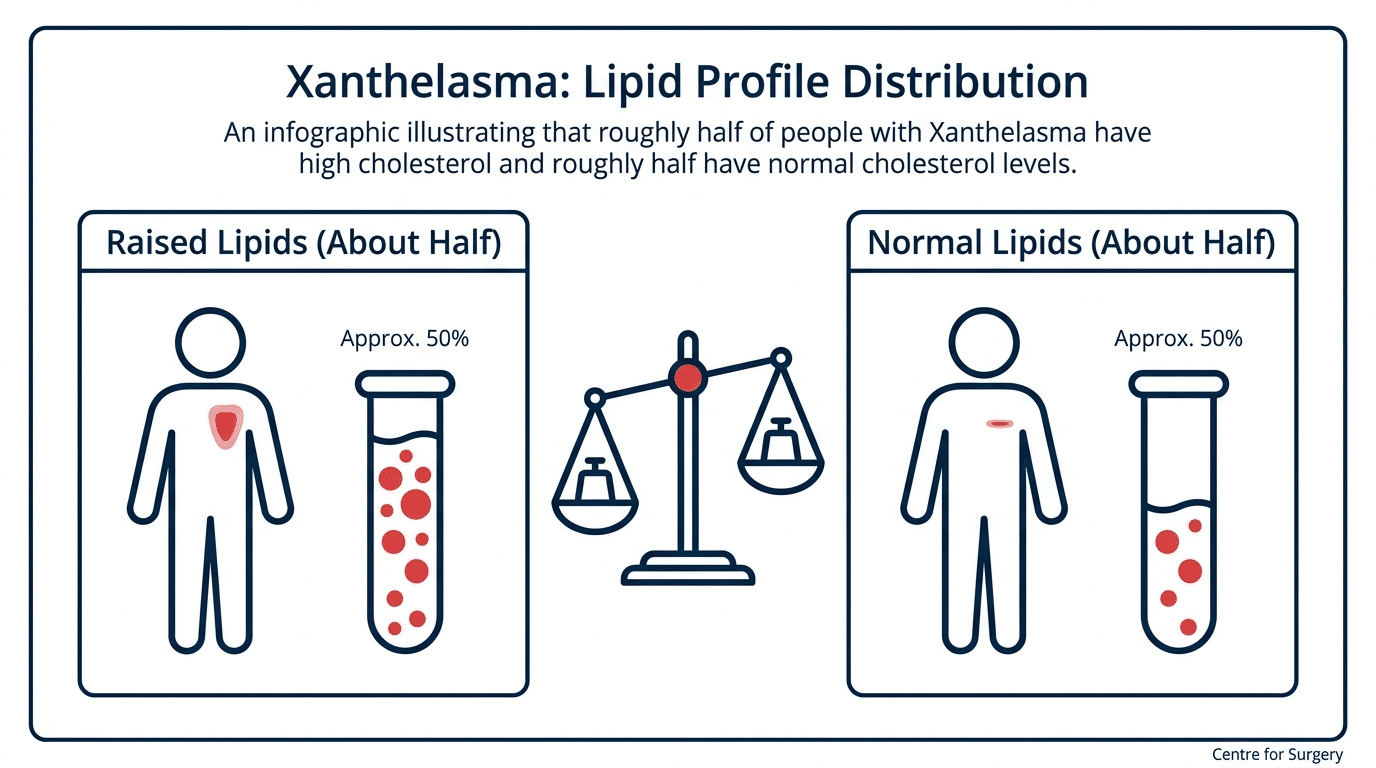
It helps to think of xanthelasma as a sign that can point to a lipid problem rather than one that always does. In roughly half of cases it is a visible clue that blood cholesterol is elevated — sometimes the first outward sign a person ever gets, which is exactly why it is worth taking seriously and testing for. In the other half, the plaques form despite normal circulating cholesterol, driven by local and genetic factors in the eyelid skin itself. Both groups have real xanthelasma. The difference lies in the mechanism, not the diagnosis.
So if your blood test came back normal, nothing about that result casts doubt on what the plaques are. It simply places you in the roughly-half of patients whose xanthelasma is not being driven by high circulating cholesterol — and that has its own explanation.
Why does xanthelasma form when cholesterol is normal?
If the cholesterol in your blood is normal, where is the cholesterol in the plaque coming from? The answer lies in what is happening locally in the eyelid skin, and in your individual genetic make-up, rather than in the overall level of fat circulating in your bloodstream.
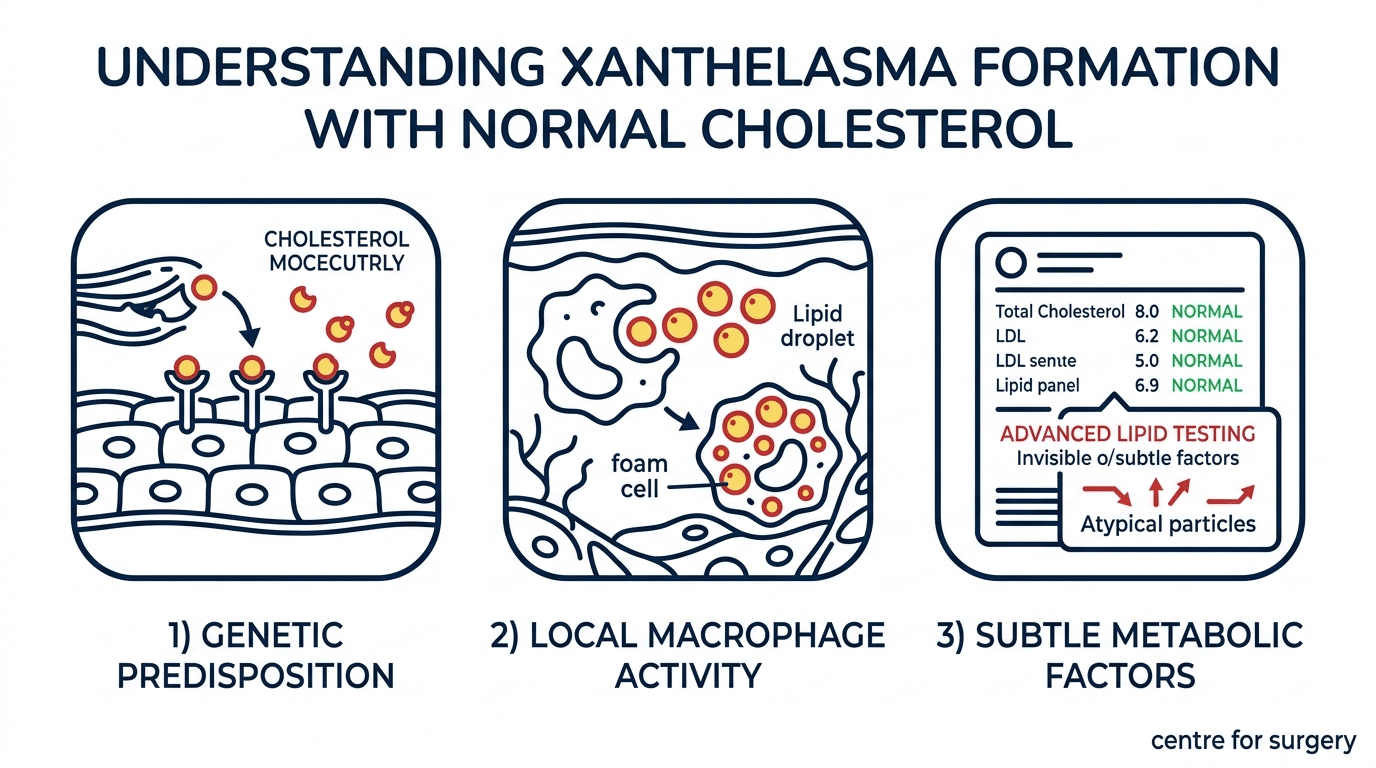
Genetic predisposition. The most important factor in normal-cholesterol xanthelasma is an inherited tendency. In these patients, the cells in the eyelid skin appear to take up and deposit cholesterol more readily than usual, even when the amount of cholesterol in the blood is perfectly normal. The eyelid is a favoured site because the skin there is thin, mobile and rich in the immune cells that scavenge lipids. This is why xanthelasma often runs in families and can appear in people who are otherwise healthy with textbook blood results.
Local macrophage activity. The plaques form when macrophages in the dermis take up lipid and turn into foam cells. This is a local process. Even with a normal overall lipid level, the local behaviour of these cells — how readily they accumulate and hold onto cholesterol at that specific site — can be enough to produce a visible deposit over time.
Subtle factors a standard test may not capture. A routine cholesterol panel measures the common markers — total cholesterol, LDL, HDL and triglycerides. But lipid biology is more complex than those four numbers. In some people with normal standard results, there are subtler differences in how lipids are transported and handled — in the function of HDL particles, or in specific apolipoproteins — that a basic panel does not show. These are not something to become anxious about, but they are one reason the “normal cholesterol” picture is not always as complete as a single result suggests.
Local skin factors can also play a part: areas of minor inflammation or previous irritation on the eyelid can make deposits more likely to form in predisposed individuals. The overall message is that normal-cholesterol xanthelasma is real, well-recognised, and explained by local and genetic biology rather than by any diagnostic error.
Who tends to get xanthelasma?
Xanthelasma is not rare, and certain patterns are well recognised. It most often appears from the forties onwards, though it can develop earlier — and when it does appear young, that is one situation where a lipid check becomes especially worthwhile, as early-onset cases are more likely to be linked to an inherited cholesterol condition. It is somewhat more common in women than in men, and more common in people of Asian and Mediterranean descent. A family history of xanthelasma is a strong pointer, reflecting the inherited tendency that underlies so many normal-cholesterol cases.
None of these risk factors change the fundamental picture: xanthelasma is benign wherever it appears and in whomever it appears. But they help explain why two people with identical, perfectly normal cholesterol results can differ in whether they develop the plaques — genetics and background load the dice long before blood lipids come into it.
Other conditions linked to xanthelasma
While high LDL cholesterol is the classic association, xanthelasma is occasionally linked to other conditions that affect how the body handles fats — and some of these can be present even when a basic cholesterol panel looks reasonable. Certain liver conditions, in particular a form of liver disease that raises cholesterol, are recognised associations. Diabetes and an underactive thyroid can both affect lipid handling and are sometimes found alongside xanthelasma. Rare inherited lipid disorders can also produce the plaques.
This is not a reason for alarm if you feel well and your cholesterol is normal — the large majority of normal-cholesterol xanthelasma has no sinister underlying cause. It is simply another reason that a proper assessment, rather than self-diagnosis, is the sensible route: a clinician can decide whether your particular picture warrants anything beyond a standard lipid test, and your GP can arrange broader checks if there is any reason to.
Does normal cholesterol mean I don’t need to worry?
Mostly, yes — but with one sensible caveat. A normal lipid result is genuinely reassuring: it means your xanthelasma is very unlikely to be a warning sign of dangerously high cholesterol, and the plaques themselves remain completely benign regardless of your lipid levels. You are not dealing with a health threat, and any decision to treat is purely cosmetic.
The caveat is that a single normal cholesterol reading is a snapshot, not a lifelong guarantee. Cholesterol levels change over the years with age, weight, diet and other factors, so it remains worthwhile to keep up with routine health checks as you would anyway. Some clinicians also note that xanthelasma has been studied as a possible marker of cardiovascular risk that is partly independent of measured cholesterol — meaning it can be worth a broader conversation with your GP about your overall heart-health picture, even when your lipids look fine. This is not cause for alarm; it is simply good, thorough care.
In short: normal cholesterol plus xanthelasma is a common, benign, well-understood combination. It does not need urgent action, but it is a reasonable prompt to make sure your general cardiovascular health has been reviewed at some point.
What should I do if I have xanthelasma?
Whether your cholesterol is raised or normal, there is a sensible order of steps. The guide below sets it out.
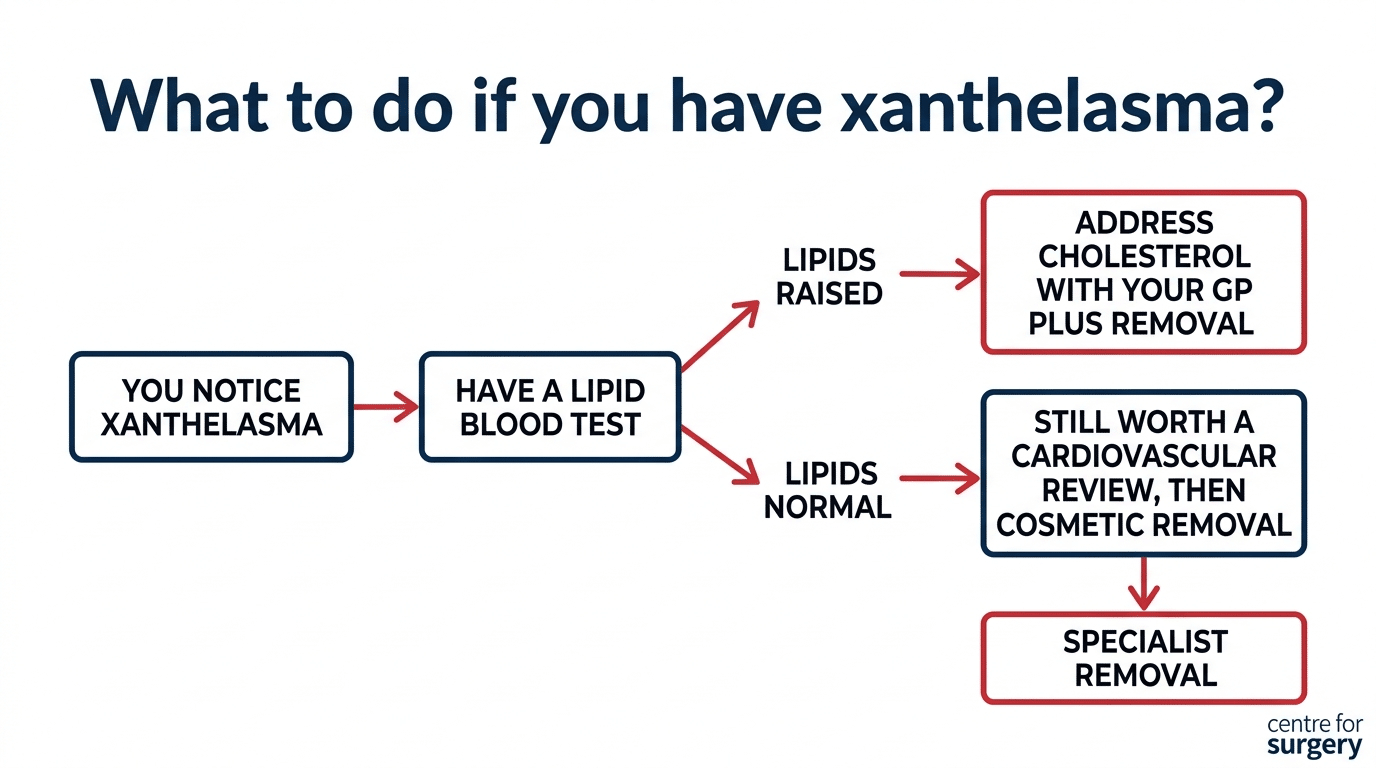
First, have a lipid blood test. Because xanthelasma is associated with raised cholesterol in about half of cases, checking your lipids is the single most useful first step — it identifies the half of patients for whom the plaques are a genuine warning sign. This is usually arranged through your GP.
If your lipids are raised, addressing them with your GP matters for two reasons: reducing cardiovascular risk, and reducing the likelihood of new xanthelasma forming after any removal. Managing the underlying cholesterol is an important part of the overall picture, not just the plaques themselves.
If your lipids are normal, as they are for roughly half of patients, there is no cholesterol problem to treat — but it is still reasonable to have your general cardiovascular health reviewed with your GP at some stage. After that, removal becomes a straightforward cosmetic decision.
Then consider removal. Xanthelasma do not go away on their own, and many people choose to have them removed because they are visible, can look like tired or ageing eyes, and can gradually enlarge. Removal is a cosmetic choice, and it is the same procedure whether your cholesterol is high or normal.
How is xanthelasma removed?
Xanthelasma sit on delicate eyelid skin, close to the eye, which is why removal is best carried out by an experienced specialist rather than in a general beauty setting. At Centre for Surgery, the plaques are treated at our dedicated xanthelasma removal service, most commonly using erbium YAG laser ablation, which precisely removes the deposit while protecting the surrounding skin. For larger or thicker plaques, surgical excision is an alternative, and treatment can sometimes be combined with eyelid surgery where appropriate. Most treatments are carried out under local anaesthetic as a day-case procedure.
One honest point worth knowing before treatment: xanthelasma can recur after removal, particularly in people with an ongoing genetic tendency or uncontrolled high cholesterol. This is exactly why identifying your lipid status first matters — for the raised-cholesterol group, managing the underlying levels reduces the chance of the plaques coming back. For the normal-cholesterol group, recurrence is driven by the genetic predisposition rather than anything you can change, and it is simply managed with further treatment if needed.
Recovery is usually straightforward. After erbium laser treatment, the treated area typically forms a small area of healing skin that settles over one to two weeks, with any pinkness fading over the weeks that follow; sun protection during healing is important to reduce the risk of pigment change, particularly in darker skin tones. Larger or thicker plaques are sometimes treated in two planned stages for a cleaner cosmetic result and to protect the delicate eyelid skin, rather than being removed too aggressively in one session. Because the treatment area is close to the eye, having it done by a specialist who works in this region routinely is the single biggest factor in a safe, tidy outcome.
Because xanthelasma can be confused with other small facial lesions, an accurate diagnosis is part of the consultation. Small white keratin-filled bumps around the eyes, for instance, are usually milia rather than xanthelasma, and are treated differently — one of several reasons a specialist assessment is worthwhile before assuming what a bump is. If you want a broader sense of how we distinguish benign eyelid and facial lesions from anything more concerning, our guide on whether a seborrhoeic keratosis can turn into melanoma explains the general principle of assessment before treatment.
Frequently asked questions
Is it normal to have xanthelasma with normal cholesterol?
Yes. Around 40 to 50 percent of people with xanthelasma have completely normal blood lipids. The plaques in these cases are driven mainly by a genetic tendency and local skin factors rather than by high circulating cholesterol.
If my cholesterol is normal, is my xanthelasma harmless?
The plaques themselves are always benign, whatever your cholesterol level. A normal lipid result is reassuring, though it is still worth keeping up with routine health checks and discussing your overall cardiovascular health with your GP, since a single reading is only a snapshot.
Will removing xanthelasma stop it coming back?
Removal treats the visible plaque, but xanthelasma can recur — especially where there is a genetic tendency or ongoing high cholesterol. Managing raised lipids, where present, reduces recurrence. In people with normal cholesterol, any recurrence is genetic and is simply treated again if needed.
Can I remove xanthelasma at home?
No. Xanthelasma sit on thin skin very close to the eye, and home remedies or acid-based products risk burns, scarring and eye injury. Removal should always be carried out by an experienced specialist in a clinical setting.
Should I still have a cholesterol test if my xanthelasma is small?
Yes. Even small xanthelasma can be the first outward sign of raised cholesterol in the half of patients who have it, so a lipid test is worthwhile regardless of the size of the plaques.
Will my xanthelasma keep getting bigger?
Xanthelasma tend to stay the same size or enlarge slowly over months and years — they do not shrink or disappear on their own, even if raised cholesterol is later brought under control. Because they are progressive rather than self-resolving, many people choose to have them removed sooner rather than waiting, while the area to be treated is smaller. There is no medical urgency to remove them, though; the timing is entirely a personal, cosmetic decision.
Can xanthelasma appear somewhere other than the eyelids?
The plaques specific to the eyelids are called xanthelasma. Similar cholesterol-rich deposits can appear elsewhere on the body — on tendons, elbows or knees, for example — where they are known as xanthomas. If you have deposits beyond the eyelids, it is worth mentioning to your GP, as more widespread deposits are more likely to be linked to an underlying lipid disorder and warrant fuller assessment.
Book a xanthelasma assessment at Centre for Surgery
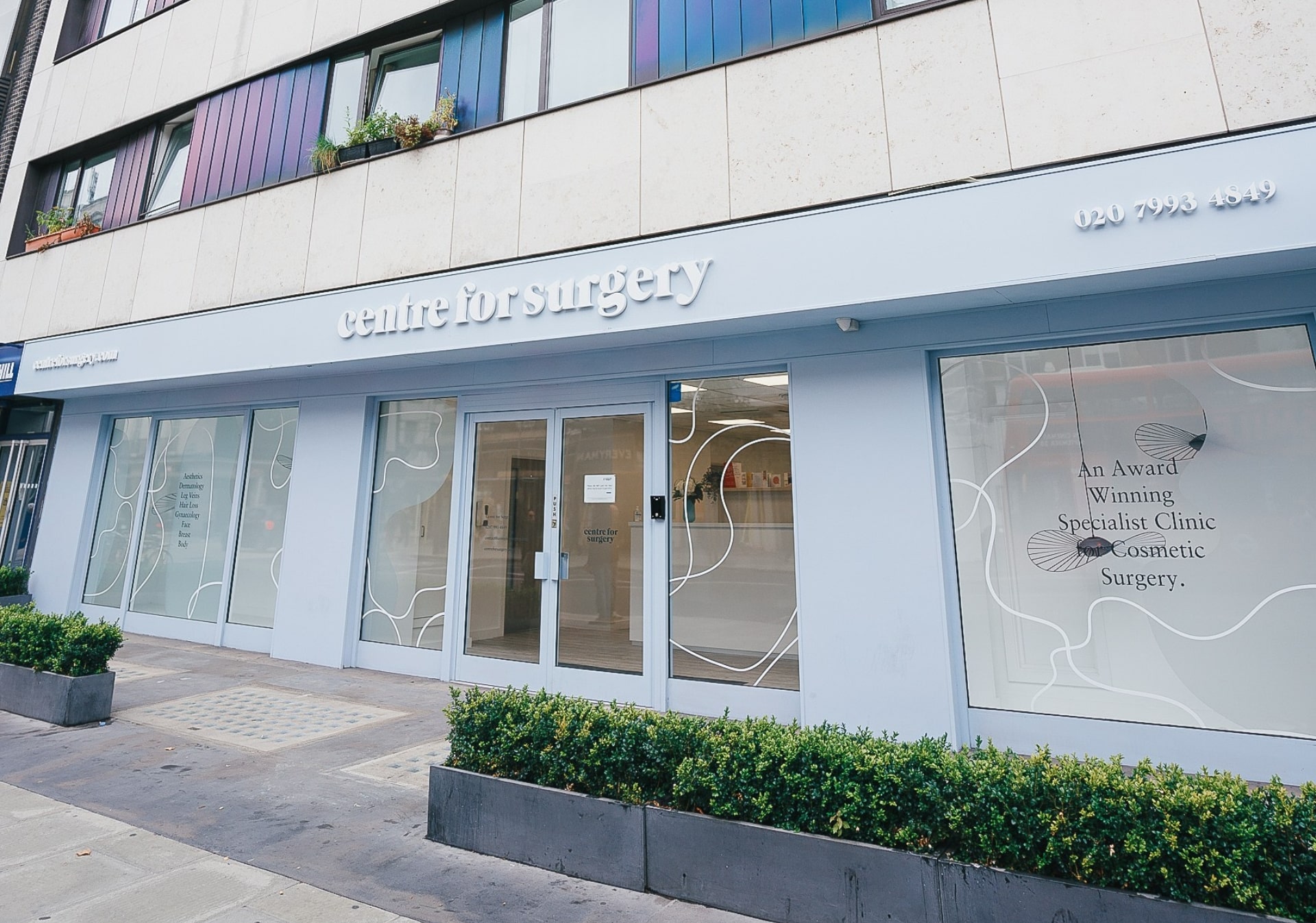
If you have noticed yellow plaques on your eyelids — whether or not your cholesterol has come back normal — a specialist assessment can confirm the diagnosis, advise on lipid testing, and talk you through your removal options. Centre for Surgery is an independent clinic on Baker Street, rated “Good” across all five domains by the Care Quality Commission, England’s independent healthcare regulator. Our medical content is reviewed by Consultant Plastic Surgeon Dr Spyridon Vlachos (GMC 7522950).
Call: 0207 993 4849
Email: contact@centreforsurgery.com
Address: 95–97 Baker Street, London W1U 6RN
Online: Book a consultation via our contact form below.
[contact-form-7 id=”256″]