Should I Be Concerned About an Itchy or Bleeding Mole?

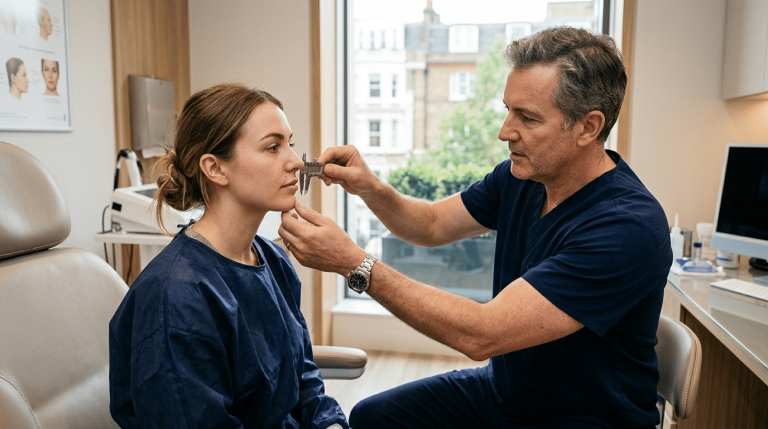
Itchy or bleeding mole assessment at Centre for Surgery London

An itchy or bleeding mole is one of the most common reasons patients seek a plastic surgical assessment. The good news is that in most cases there is a simple, mechanical explanation — the mole has been caught on clothing, irritated by shaving, or rubbed by jewellery. The reason it nevertheless warrants careful attention is that persistent itching or unexplained bleeding can also, occasionally, be the first sign of a melanoma. Distinguishing between the two is not something to attempt at home.

This guide covers when an itchy or bleeding mole is likely to be harmless and when it warrants prompt assessment, the warning signs that should not be ignored, and what happens at a mole assessment at Centre for Surgery’s CQC-regulated Baker Street private hospital.


The common, mechanical reasons moles become itchy or bleed

Most itchy or bleeding moles have a simple external cause:

  • Friction from clothing — moles on the bra line, waistband, collar, neckline or under tight straps are repeatedly rubbed throughout the day. Persistent friction can produce itching and, if it breaks the skin surface, mild bleeding.
  • Shaving — moles on the face, neck, legs, underarms or pubic area can be nicked during shaving, particularly raised moles that sit above the surrounding skin.
  • Jewellery — necklace chains, watch straps, earrings and rings can catch on moles in the corresponding area.
  • Scratching — scratching for any reason (eczema, dry skin, insect bites in the vicinity) can secondarily traumatise a nearby mole.
  • Sport or activity — repeated contact in contact sports, abrasion against gym equipment, or chafing during running.
  • Hair removal methods — waxing, threading, and other techniques can traumatise moles.
  • Dry skin or inflammation — moles in inflamed skin (eczema, dermatitis) can itch alongside the surrounding skin.
  • Direct injury — a knock, scratch or cut to the mole.

A single isolated episode of bleeding or itching with an obvious cause — you nicked the mole while shaving, or knocked it against a doorframe — is rarely concerning. The mole will typically heal over a few days and return to its previous appearance.


When itching or bleeding warrants assessment

Several patterns of symptoms should prompt prompt professional review:

  • Spontaneous bleeding — the mole bleeds without any obvious external cause. This is one of the more significant warning features and warrants assessment within days rather than weeks.
  • Persistent or recurrent itching — particularly itching localised to one specific mole that persists for more than a few weeks.
  • Itching or bleeding in combination with visible change in the mole — change in size, shape, colour, border, or texture.
  • A mole that develops a crust or scab that doesn’t heal in the normal 1–2 week timeframe.
  • Bleeding after only minimal contact — a mole that bleeds when lightly touched, when previously it required substantial trauma to bleed.
  • Discharge from the mole — any wet, weepy, or pus-like material.
  • Itching deep beneath the mole — a tingling, prickling, or burning sensation that feels deeper than surface skin irritation.
  • Pain — moles are not normally painful. Persistent pain or tenderness in a specific mole warrants attention.

None of these symptoms means melanoma is certain — most isolated symptoms have benign explanations — but each is a reason for the lesion to be examined by an experienced plastic surgeon rather than monitored further at home.


The ABCDE rule — putting symptoms in context

Itching and bleeding should always be considered alongside the visual features of the mole. The ABCDE rule, widely used in clinical practice for assessing pigmented lesions, gives a structured framework:

  • A — Asymmetry: a benign mole is roughly symmetrical. A melanoma is typically asymmetrical — one half looks different from the other.
  • B — Border: a benign mole has a smooth, well-defined border. A melanoma typically has an irregular, notched, scalloped, or blurred border.
  • C — Colour: a benign mole is usually a single uniform colour. A melanoma often shows multiple colours within the lesion — different shades of brown or black, sometimes with red, white or blue areas.
  • D — Diameter: most benign moles are smaller than 6mm. Larger lesions warrant attention, particularly if they are growing.
  • E — Evolution: any change in an established mole — in size, shape, colour, surface, or symptoms — is the most important single warning sign of all.

Some clinicians add F — Funny-looking. A mole that simply looks different from your other moles (“the ugly duckling”) warrants assessment even if no other criterion is met. For the full guide on distinguishing benign moles from melanoma, see what is the difference between a mole and a melanoma?

Itching and bleeding take on greater significance when one or more of the ABCDE features is also present. An itchy mole that is also asymmetric, has irregular borders, and contains multiple colours warrants urgent review. An itchy mole that is otherwise textbook-benign and has a clear mechanical cause for the itching is much less concerning.


What causes moles to itch — the biology

Itching in a mole can arise from several distinct mechanisms:

Nerve ending irritation

Moles contain nerve endings just like the surrounding skin. Anything that stimulates these endings — friction, dry skin, mild inflammation, allergens — can produce itching. This is by far the most common cause and reflects the same nerve sensitivity that produces itching in the surrounding skin.

Inflammatory change within the mole

Mild inflammation within the mole itself — from local irritation, immune response, or minor trauma — can stimulate the nerve endings within. This is also typically benign and resolves once the precipitating factor (whatever it is) is removed.

Malignant change

Less commonly, malignant transformation within the mole — early melanoma — can produce itching through cellular changes affecting the local nerve endings. This is one of the recognised symptoms of melanoma, though by itself it is non-specific. Importantly, itching in isolation is rarely the only sign of melanoma; it is usually accompanied by some of the ABCDE visual changes.

Surrounding skin conditions

If you have eczema, contact dermatitis, or another inflammatory skin condition in the area, moles within the affected region will itch alongside the surrounding skin. This typically resolves when the underlying skin condition is treated.


What causes moles to bleed

Most bleeding from moles has a mechanical cause — the mole has been physically damaged in some way. Several specific patterns:

  • Pedunculated moles — raised moles on a narrow stalk are more likely to be nicked or pulled, producing bleeding
  • Moles in high-friction areas — neckline, belt line, bra line, underwear line
  • Moles on shaved areas — face, neck, legs, axilla, pubic area
  • Moles being picked or scratched — sometimes unconsciously, particularly during sleep

Bleeding from a recently traumatised mole typically clears within minutes with gentle pressure and is followed by a small scab, which heals within 1–2 weeks. Recurrent bleeding from the same mole, or bleeding that occurs without obvious trauma, is the pattern that warrants assessment. Spontaneous bleeding — that is, bleeding the patient cannot account for — is one of the more significant warning symptoms in the assessment of pigmented lesions.


What to do if your mole is bleeding right now

If you have just noticed a mole bleeding:

  1. Apply gentle, direct pressure with a clean gauze, cloth or tissue for 5–10 minutes
  2. Avoid wiping or rubbing — this can prolong bleeding
  3. Once bleeding stops, leave the mole alone — don’t apply creams, alcohol, or antiseptic unless the wound is dirty
  4. Cover with a light dressing if needed
  5. Allow normal healing over the following 1–2 weeks

If the bleeding does not stop after 10 minutes of pressure, if there is heavy bleeding, or if the wound is large, seek prompt medical attention. Most mole bleeding is easily controlled with simple pressure.

If the mole has been bleeding without obvious cause — once it has stopped — book an assessment promptly. The fact that bleeding has occurred is information your surgeon needs.


What a mole assessment involves at Centre for Surgery

Assessment at our Baker Street clinic typically takes 20–30 minutes:

  1. History — your surgeon takes a focused history covering when you first noticed the mole, what has changed, what symptoms you have experienced, your personal and family history of skin cancer, and your skin type and sun exposure history.
  2. Clinical examination — visual inspection of the mole and any related moles elsewhere on the body, with attention to the ABCDE features.
  3. Dermoscopic examination — a handheld illuminated magnifier (dermatoscope) allows the surgeon to examine the internal structure of the mole at high magnification. Dermoscopy identifies features that are not visible to the naked eye and is the single most important diagnostic tool in pigmented lesion assessment.
  4. Discussion — your surgeon explains what the assessment has shown, whether removal is recommended, and what your options are.
  5. Same-day removal where appropriate — for clinically suspicious lesions or for patients who wish to proceed for cosmetic or peace-of-mind reasons, removal can often be performed in the same appointment.

Every surgically excised mole at Centre for Surgery is sent for histological analysis as standard, providing definitive cellular-level diagnosis. For full detail on this practice, see should every removed mole be sent for biopsy?


Should the mole always be removed?

Not always. For an itchy mole with a clear mechanical cause (friction from a bra strap, recurrent shaving cuts) and no other concerning features, the appropriate management is often:

  • Clinical examination and dermoscopy to confirm the mole is benign
  • Removal of the mechanical trigger if possible (changing underwear, adjusting clothing, leaving the mole when shaving)
  • Active monitoring with photographs at consistent angles
  • Review at 3–6 months if symptoms persist

For a mole with concerning features — itching plus visible change, or spontaneous bleeding, or ABCDE features — the appropriate management is surgical excision with histological analysis. The principle: when in doubt, the safer course is to remove and analyse rather than to monitor.

The honest framing: a benign mole that has been excised and confirmed on histology is gone, and the patient has certainty. A mole that turns out to be benign on examination but is left in place still needs ongoing monitoring and may need future review. Many patients with otherwise harmless symptomatic moles choose excision for the peace of mind alone.


What we don’t recommend

  • Watching a spontaneously bleeding mole — bleeding without an obvious cause warrants prompt assessment rather than continued observation.
  • Topical treatment for symptomatic moles — creams and ointments can mask symptoms without addressing the underlying lesion. Any mole that is symptomatic should be examined first, then any topical treatment considered.
  • DIY removal of a symptomatic mole — the risks include scarring, infection, incomplete removal, and — most importantly — destruction of evidence that would have identified a melanoma. See can you remove a cyst at home? for the broader case against DIY skin lesion removal.
  • Waiting for the GP NHS pathway in suspicious cases — current waiting times for two-week-wait suspicious skin lesion referral are variable. Patients with concerning symptoms who want prompt assessment may need to attend privately. See can I get mole removal on the NHS?
  • Dismissing changes because the mole has always been there — a long-established mole that has recently changed is exactly the situation that warrants assessment. Moles can transform at any point in life.

Frequently asked questions

Can a mole become cancerous from being scratched?

No — scratching does not cause cancer. However, a cancerous mole may be itchy and prone to bleeding when scratched, which is the indirect association.

Should I be worried if my mole bled once?

A single episode of bleeding with a clear cause — a shaving cut, a knock, a clothing snag — is rarely concerning. Recurrent bleeding from the same mole, or spontaneous bleeding without obvious cause, warrants assessment.

How quickly can I be seen at Centre for Surgery?

Most patients are offered an assessment within one to two weeks. For clinically concerning lesions, we can usually arrange more urgent assessment.

Is mole assessment painful?

No. The clinical examination and dermoscopy are entirely non-contact and painless. If removal is performed in the same appointment, the local anaesthetic injection is a brief sting and the removal itself is painless.

Do you do urgent skin cancer assessment?

Yes. Patients with concerning lesions are seen promptly, examined with dermoscopy, and excision with histology arranged where appropriate. If a melanoma is confirmed on histology, we manage onward care including referral to a specialist skin cancer multidisciplinary team.

Can children have itchy moles assessed?

Yes. Paediatric pigmented lesions are assessed individually. Most childhood moles are benign and will not change, but any symptomatic or concerning lesion deserves the same careful assessment as in adults.

What does melanoma feel like?

In its earliest stages, melanoma is usually asymptomatic and feels no different from a benign mole. More advanced lesions can itch, bleed, develop a crust, or feel firm and raised. The absence of symptoms does not mean a lesion is benign — visual assessment and dermoscopy are the primary diagnostic tools.

How are itchy moles treated?

If the assessment confirms a benign mole, treatment is usually addressing the mechanical cause (changing clothing, modifying shaving technique) or — if the patient prefers — excising the mole electively. If the assessment raises concern, excision with histological analysis is the appropriate next step.


Mole assessment at Centre for Surgery

Centre for Surgery is a CQC-regulated plastic surgery clinic at 95–97 Baker Street, Marylebone. Mole assessment and removal is performed by GMC-registered consultant plastic surgeons. Dermoscopic examination is standard. Every surgically excised mole is sent for histological analysis. Same-day removal is available for many patients. No GP referral is required.

For more on mole-related topics, see our guides to mole vs melanoma, can all moles be safely removed?, why every removed mole is sent for biopsy, and why choose a plastic surgeon for mole removal.


Centre for Surgery · CQC-regulated · GMC specialist-registered surgeons · 95–97 Baker Street, Marylebone, London W1U 6RN · 0207 993 4849 · Book a consultation · Finance from 0% APR