

If you have noticed one or more small, firm bumps on your lower legs and you shave regularly, it is natural to wonder whether the two are connected. So, does shaving cause dermatofibromas? The honest answer is that shaving does not directly cause them, but it can act as one of the minor skin triggers that some dermatofibromas are thought to develop from — which is part of why these harmless bumps so often turn up on the legs, especially in women who shave. This guide explains what that link really means, why the lower legs are the classic site, and what you can — and can’t — do about it.
At Centre for Surgery, dermatofibromas are assessed and treated as part of our skin lesion removal service, with removal carried out through our dedicated dermatofibroma removal service. Before thinking about removal, though, it helps to understand what these bumps are and where they come from.
What is a dermatofibroma?
A dermatofibroma is a common, benign (non-cancerous) skin nodule made up of fibrous tissue, small blood vessels and various cells of the dermis — the middle layer of the skin. They are also known as benign fibrous histiocytomas. They are very common: it is estimated that up to one in twenty adults will develop at least one during their lifetime.
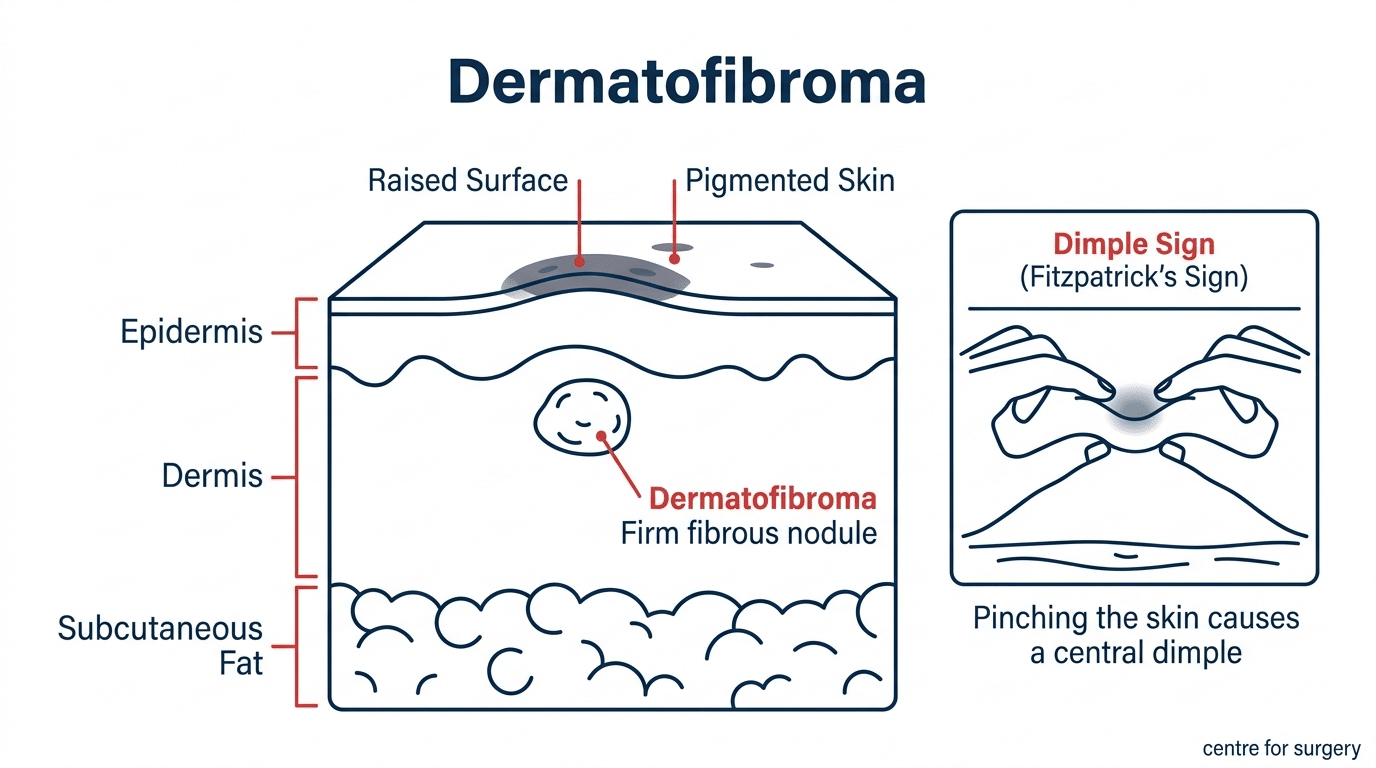
A typical dermatofibroma is small — usually under a centimetre — firm to the touch, and feels tethered in place rather than moving freely under the skin. The colour ranges from pink to a reddish-brown or darker brown, and the surface is often slightly raised. One characteristic feature helps identify them: the “dimple sign”. If you gently pinch the skin on either side of a dermatofibroma, the centre dimples inwards rather than bulging out, because of the firm fibrous core anchoring it. This is a useful clinical clue that distinguishes a dermatofibroma from some other lesions, though only a specialist assessment can confirm the diagnosis.
Crucially, dermatofibromas are harmless. They do not need to be removed for any medical reason, and any decision to have one removed is a personal, cosmetic one — usually because it is repeatedly caught during shaving, or because a person dislikes how it looks or feels.
Does shaving cause dermatofibromas?
Here is the nuanced but important answer. The exact cause of dermatofibromas is not fully understood, but the leading idea is that many of them form as an over-exuberant healing response to minor skin trauma. Recognised triggers include insect bites, thorn pricks, scratches, ingrown hairs — and shaving nicks. So shaving is not a direct “cause” in the sense of a razor creating a dermatofibroma every time; rather, in people who are predisposed, the tiny skin injuries that shaving can produce are one of the minor traumas that a dermatofibroma may develop from.
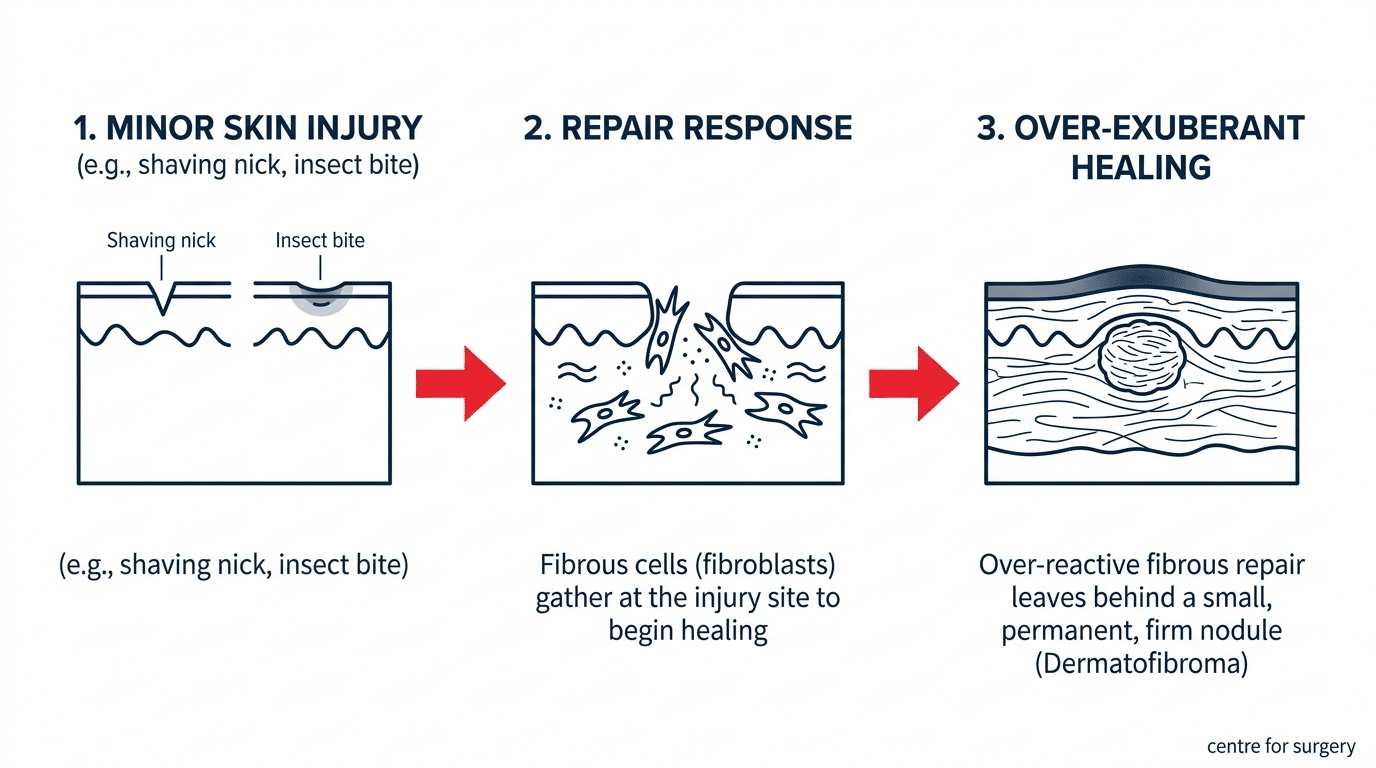
It helps to picture the sequence. A minor injury occurs — a small nick from a razor, an ingrown hair, a bite. The skin sets about healing it, and the fibrous, collagen-producing cells of the dermis gather at the site. In most people, healing finishes tidily and nothing is left behind. But in some people, that fibrous healing response is a little over-enthusiastic and doesn’t fully switch off, leaving a small, permanent knot of fibrous tissue in the dermis: a dermatofibroma. That is why they feel firm — they are essentially a tiny, contained area of scar-like fibrous tissue.
This explains the association with shaving without overstating it. Shaving is an extremely common source of repeated minor skin trauma on the legs, so in predisposed individuals it is one plausible route by which a dermatofibroma can be triggered. But most people who shave never develop one, and plenty of people who develop dermatofibromas cannot recall any injury at all. The tendency to form them at all is the bigger factor; the minor trauma is simply a possible starting point.
Why do dermatofibromas appear on the legs?
Dermatofibromas can appear anywhere, but the lower legs are the single most common site, and they occur noticeably more often in women than in men. Once you understand the trauma link, the reason for both patterns becomes clear.
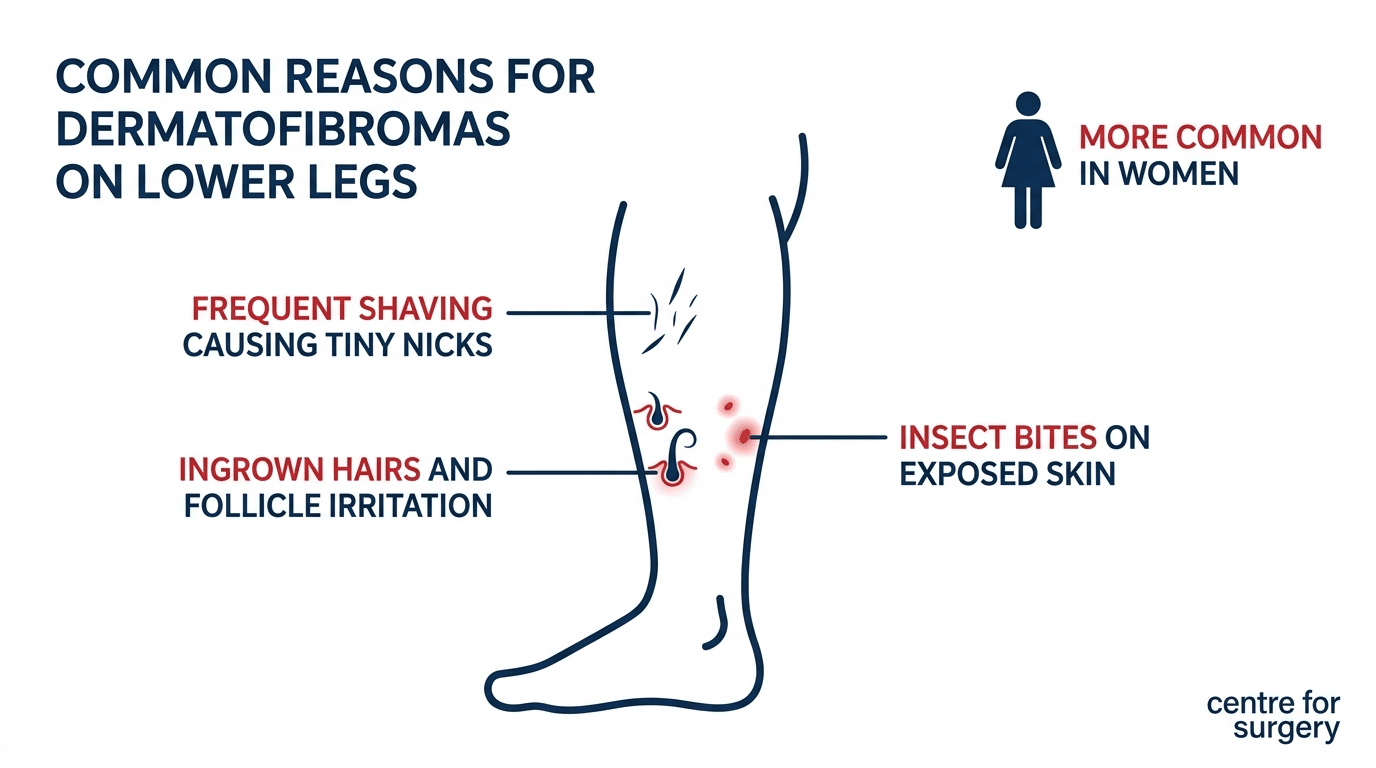
The lower legs are one of the most frequently shaved areas of the body, which means they experience regular, repeated minor skin trauma in the form of nicks, razor irritation and ingrown hairs. They are also often exposed, making them a common target for insect bites. Combine a favoured site for minor injury with an individual predisposition to over-heal, and the lower leg becomes the classic location for dermatofibromas to appear. The higher frequency in women is widely thought to relate in part to leg shaving being more common, alongside other individual factors.
None of this means you have done anything wrong. Dermatofibromas are not a sign of poor hygiene, they are not contagious, and shaving your legs is a completely normal thing to do. The link simply reflects the fact that the legs see a lot of minor skin trauma, and a minority of people are prone to responding to that trauma by forming these small, harmless nodules.
Who is most likely to get dermatofibromas?
If shaving and minor trauma were the whole story, everyone who shaves would have dozens of these bumps — and they don’t. The deciding factor is individual susceptibility: some people’s skin simply responds to minor injury by laying down a little too much fibrous tissue, and those are the people who develop dermatofibromas. This tendency is why one person can shave for decades without a single bump while another develops several.
Certain patterns are well recognised. Dermatofibromas are most common in adults, often appearing between the twenties and fifties, and they are more frequent in women than in men. People who develop one are more likely to develop others over time, reflecting that underlying predisposition. Occasionally, having a larger number of dermatofibromas appear together is associated with changes in the immune system — for example in people with certain autoimmune conditions or those taking medication that affects immunity — which is one of several reasons a specialist is worth seeing if you are developing multiple bumps rather than a single one. For most people, though, a dermatofibroma is simply an isolated, harmless quirk of how their skin healed one small injury.
Can I stop shaving to get rid of a dermatofibroma?
This is the practical question most people really want answered, and it has two parts.
First, stopping shaving will not remove a dermatofibroma you already have. Once the fibrous nodule has formed in the dermis, it is a settled structure. It will not dissolve or fade because you stop shaving over it, and dermatofibromas very rarely disappear on their own. So if your goal is to get rid of an existing bump, changing your shaving habits is not the route — removal is a separate decision, discussed below.
Second, and more usefully: gentler shaving may reduce ongoing irritation of an existing dermatofibroma and could, in theory, reduce the minor trauma that contributes to new ones in someone who is prone to them. Repeatedly nicking or dragging a razor over a raised dermatofibroma can cause it to bleed or become sore, which is one of the main reasons people find them a nuisance and seek removal. Being gentler on the area is sensible for comfort, even though it won’t reverse what is already there.
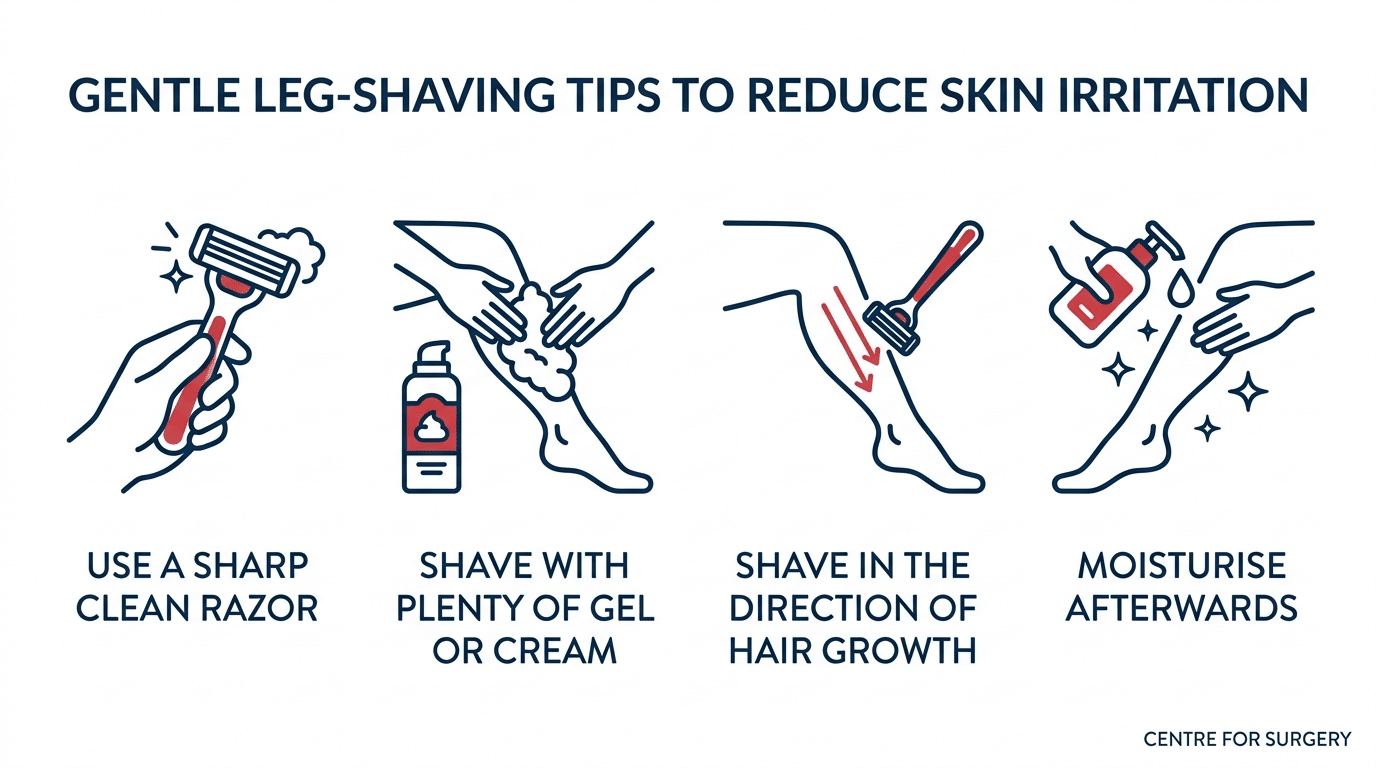
If you want to be kinder to your leg skin, a few simple habits help reduce nicks and irritation: use a sharp, clean razor rather than a dull one that drags; shave with plenty of gel or cream rather than on dry skin; shave in the direction of hair growth to reduce ingrown hairs; and moisturise afterwards. If a particular bump keeps catching, shaving carefully around it rather than directly over it can spare you the repeated irritation until you decide what to do about it.
Other leg bumps that can be mistaken for a dermatofibroma
“A firm bump on the leg” is not always a dermatofibroma, and part of the value of an assessment is telling them apart. Several other common bumps can appear on shaved legs and are sometimes confused with one. Ingrown hairs and folliculitis — inflammation around a hair follicle — can produce small, sometimes tender red bumps, but these are related to the hair follicle and usually settle, unlike the permanent firm nodule of a dermatofibroma. A skin cyst can also form a lump, but a cyst tends to feel softer and more mobile and often has a central punctum, whereas a dermatofibroma feels firm, tethered and shows the dimple sign. Ordinary moles and other pigmented spots are a different category again.
The practical point is not that you need to diagnose yourself, but the opposite: because these look-alikes are genuinely similar to the untrained eye, a proper assessment is the reliable way to know what a bump actually is. That is especially worthwhile for any lump that is new, changing, or behaving differently from the others on your skin.
When should a leg bump be checked?
Most dermatofibromas are completely harmless and never need medical attention. However, because “a firm bump on the leg” can occasionally be something other than a dermatofibroma, it is worth having a lesion assessed by a professional if it is behaving in any way that is out of the ordinary. You should arrange a check if a bump is growing noticeably, changing colour, bleeding without being caught or knocked, becoming painful, or if you are simply not sure what it is. A specialist can confirm the diagnosis — often using the dimple-sign test and a closer examination — and rule out anything that needs different management. When there is any doubt, the safe step is always to have it looked at rather than assume.
How is a dermatofibroma removed?
If a dermatofibroma is bothering you — catching when you shave, causing discomfort, or simply unwelcome cosmetically — it can be removed. Because a dermatofibroma extends down into the dermis, surface treatments and so-called removal creams cannot reach it; the reliable method is surgical excision, where the whole nodule is removed and the skin closed with stitches. At Centre for Surgery, dermatofibroma removal is carried out by a GMC-registered plastic surgeon, and the removed tissue is sent for histopathology to confirm the diagnosis. You can read the full detail on our dermatofibroma removal page.
The one honest trade-off to weigh is scarring. Surgical excision leaves a small scar in place of the bump, so it is worth a proper conversation with your surgeon about whether removal is the right choice for you, particularly on the lower legs, where healing can be a little slower and scars can take longer to mature. This is exactly the kind of risk-and-benefit discussion that a consultation is for. Because dermatofibromas can be confused with other skin lesions, an accurate diagnosis is part of that process — if you would like a broader sense of how benign lumps are told apart from anything more concerning, our guide on whether a seborrhoeic keratosis can turn into melanoma explains the general principle of assessing before treating.
The procedure itself is usually quick and carried out under local anaesthetic as a day case. After the area is numbed, the nodule is excised in full and the skin closed with sutures, which are typically removed after one to two weeks depending on the site — lower-leg wounds are often left a little longer because that area heals more slowly. You will be able to walk straight afterwards, but it is sensible to avoid running and high-impact exercise for a few weeks while a lower-leg wound settles, and to keep the area protected from the sun during healing, as fresh scars can darken with UV exposure. Your surgeon will give you specific aftercare guidance and, where helpful, silicone-based scar management to support a tidy final result.
Cost depends on the size, number and location of the lesions being removed, so the only accurate figure comes after an assessment. For any procedure over £1,500, Centre for Surgery offers 0% APR finance through Chrysalis Finance, subject to status, so treatment can be spread over monthly instalments.
Frequently asked questions
Can shaving over a dermatofibroma make it worse?
Shaving over a dermatofibroma won’t make it grow, but it can repeatedly nick or irritate it, causing bleeding or soreness. This ongoing irritation is one of the most common reasons people choose to have a dermatofibroma removed.
If I stop shaving, will my dermatofibroma go away?
No. Once a dermatofibroma has formed, it is a settled fibrous nodule in the skin and will not disappear if you stop shaving. Dermatofibromas rarely resolve on their own, so removal is the only reliable way to get rid of one.
Does everyone who shaves get dermatofibromas?
No. Most people who shave never develop a dermatofibroma. They form only in people who are predisposed to respond to minor skin trauma by producing this fibrous overgrowth, which is why some people get them and most don’t.
Are dermatofibromas on the legs dangerous?
Dermatofibromas are benign and not dangerous. That said, any leg bump that grows, changes, bleeds unprompted or becomes painful should be assessed by a professional, since occasionally other lesions can resemble a dermatofibroma.
Can I have a dermatofibroma removed if it keeps catching when I shave?
Yes. A dermatofibroma that is repeatedly caught or irritated during shaving is a common reason for removal. It is done by surgical excision under local anaesthetic, leaving a small scar in place of the bump.
Do dermatofibromas grow back after removal?
When a dermatofibroma is fully excised — the whole nodule removed rather than just shaved off at the surface — recurrence at that site is uncommon. Surface techniques that leave part of the lesion behind are more likely to allow regrowth, which is one reason complete surgical excision is the preferred method. Being prone to dermatofibromas does mean you could develop new ones elsewhere over time, but that is a new lesion rather than the old one returning.
Should I worry about a bump that has been on my leg for years?
A dermatofibroma that has been stable and unchanged for years, feels firm, and shows the dimple sign is very reassuring and typically needs no action. As always, if it starts to change in size, colour or texture, or begins to bleed or hurt without being knocked, have it assessed to be sure.
Book a dermatofibroma assessment at Centre for Surgery
If you have a firm bump on your leg that keeps catching when you shave, or you would simply like to know what it is, a specialist assessment can confirm the diagnosis and talk you through whether removal is right for you. Centre for Surgery is an independent clinic on Baker Street, rated “Good” across all five domains by the Care Quality Commission, England’s independent healthcare regulator. Every lesion is assessed by a GMC-registered plastic surgeon, and removed tissue is sent for histopathology so the diagnosis is confirmed rather than assumed. Our medical content is reviewed by Consultant Plastic Surgeon Dr Spyridon Vlachos (GMC 7522950).
Call: 0207 993 4849
Email: contact@centreforsurgery.com
Address: 95–97 Baker Street, London W1U 6RN
Online: Book a consultation via our contact form below.
[contact-form-7 id=”256″]