

Monolid eyes — also called single eyelids — are an eye shape in which the upper eyelid has no visible crease, giving a smooth, single fold of skin from the brow to the lashes. They are a completely normal and common feature, most prevalent in people of East Asian descent but found across every ethnicity. For many people a monolid is simply part of who they are; for others, creating or defining an upper eyelid crease is a long-considered choice. This guide covers both perspectives honestly — what monolids are, why some people choose double eyelid surgery, exactly how the procedure works, and the temporary alternatives — with the depth and nuance the topic deserves.
At Centre for Surgery in London, our GMC-registered consultant surgeons perform Asian blepharoplasty (double eyelid surgery) at our CQC-regulated Baker Street clinic, with a specific focus on results that enhance the natural eye rather than change a person’s fundamental appearance.
What Are Monolid Eyes?
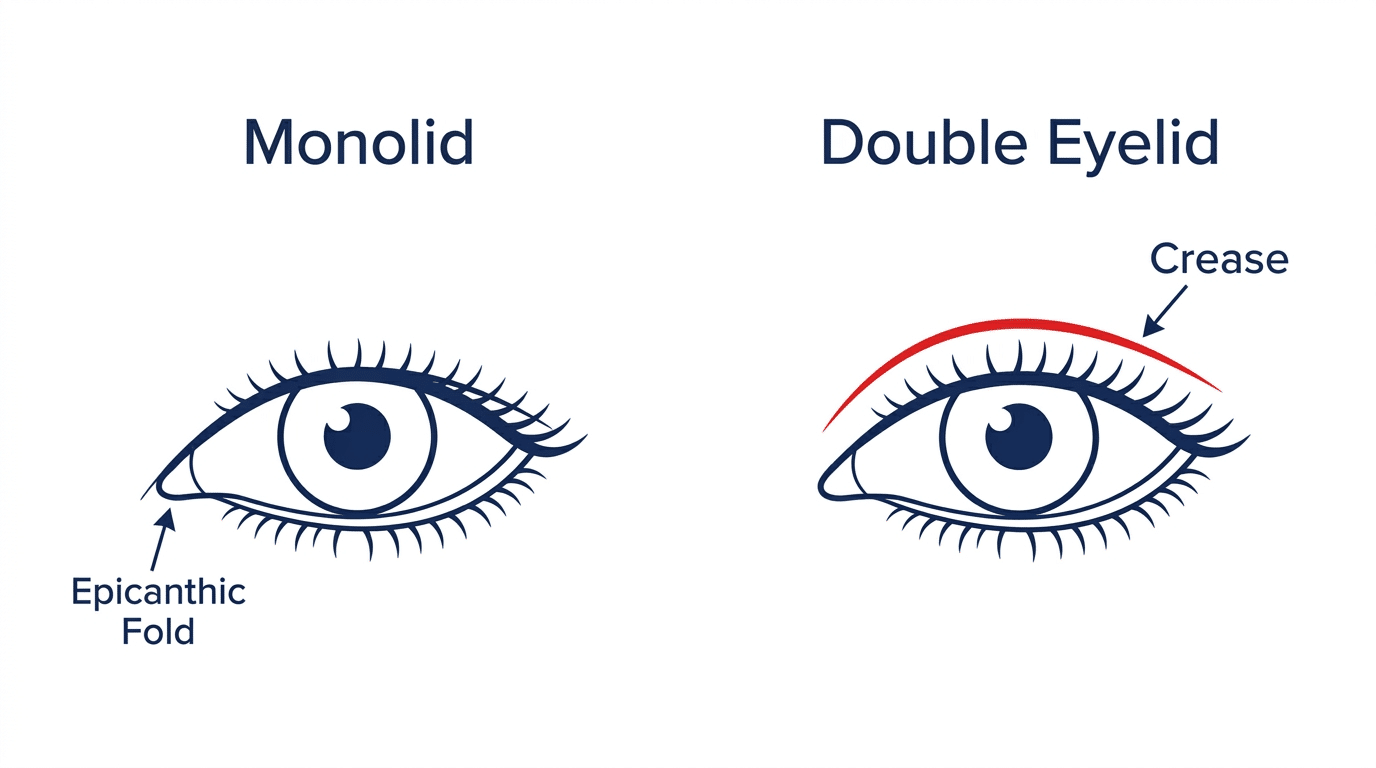
A monolid is an upper eyelid without a visible crease. In a double eyelid, when the eye is open there is a visible fold between the lashes and the eyebrow — medically called the superior palpebral sulcus. This crease is created by fibres of the levator muscle (the muscle that lifts the eyelid) attaching to the skin, so that when the eye opens, the skin above folds inward and a crease appears. In a monolid, those attachments sit differently, so no crease forms and the eyelid remains smooth.
Monolid eyes often also feature an epicanthic fold (sometimes called an epicanthal fold) — a fold of skin from the upper eyelid that covers the inner corner of the eye, known medically as the medial canthus. The presence of an epicanthic fold is part of what gives monolid eyes their characteristic appearance, and it is relevant to treatment, because addressing the fold is a separate consideration from creating a crease.
It is worth stating plainly: having monolid eyes is entirely normal and carries no health implications whatsoever. There is nothing to “correct” medically. Any decision to change the eyelid is purely personal and aesthetic.
Monolid vs Double Eyelid — What’s the Difference?
The single difference between a monolid and a double eyelid is the crease. Double eyelids have a visible fold above the lashes when the eyes are open; monolids do not. Both are natural, both are common, and neither is “better” — the perception of one over the other is entirely cultural and personal. Some people find monolids elegant and distinctive and would never change them; others prefer the added definition a crease brings. Beauty standards around eye shape vary enormously between cultures and shift over time, and there is no objectively correct answer. Our post on whether eyelid surgery changes your eye shape explores this in more depth.
Why Do Some People Choose Double Eyelid Surgery?
People consider monolid surgery for a range of reasons, and understanding your own motivation is an important part of the process. Common reasons include wanting a defined crease for a more open-eyed appearance; finding that eye makeup applies and shows more easily with a crease; addressing asymmetry where one eye has a natural crease and the other does not; or, in some cases, a functional element where heavy upper eyelid skin sits low over the lashes. Whatever the reason, a good surgeon will explore it with you rather than simply proceeding — because the goal of well-done surgery is to enhance your natural eye, not to impose a different one.
Enhancing, Not Changing — the Most Important Principle
This is the point that matters most, and it is one many general guides skip. Well-performed double eyelid surgery does not “Westernise” the eye or erase ethnic identity — and any surgeon who frames it that way is the wrong surgeon. The aim of a skilled, culturally aware procedure is to create a crease that suits your individual anatomy and facial features, in harmony with the rest of your face, while fully preserving the natural character of your eye. A crease that is set too high or too deep produces an obviously operated, unnatural result that sits at odds with the rest of the face. A crease planned at an appropriate height, respecting your existing eyelid structure, looks like a crease you could have been born with. This is why experience specifically in East Asian eyelid anatomy matters so much — it is a genuinely specialist area of blepharoplasty, and it is the expertise our surgeons bring to it.
Is a Monolid the Same as a Droopy Eyelid (Ptosis)?
No — and confusing the two leads to the wrong treatment. A monolid is simply an eyelid without a crease; the eyelid opens normally and the eye is fully visible. Ptosis is a drooping of the upper eyelid caused by weakness of the levator muscle, where the lid itself sits low over the eye, sometimes affecting vision and often making the eyes look tired or uneven. Some people have both a monolid and a degree of ptosis, in which case creating a crease alone would not address the drooping — the ptosis needs separate assessment and, if present, its own repair. Establishing whether ptosis is part of the picture is a key part of the consultation, because it changes the surgical plan entirely.
Non-Surgical Options — Eyelid Tape, Glue and Makeup
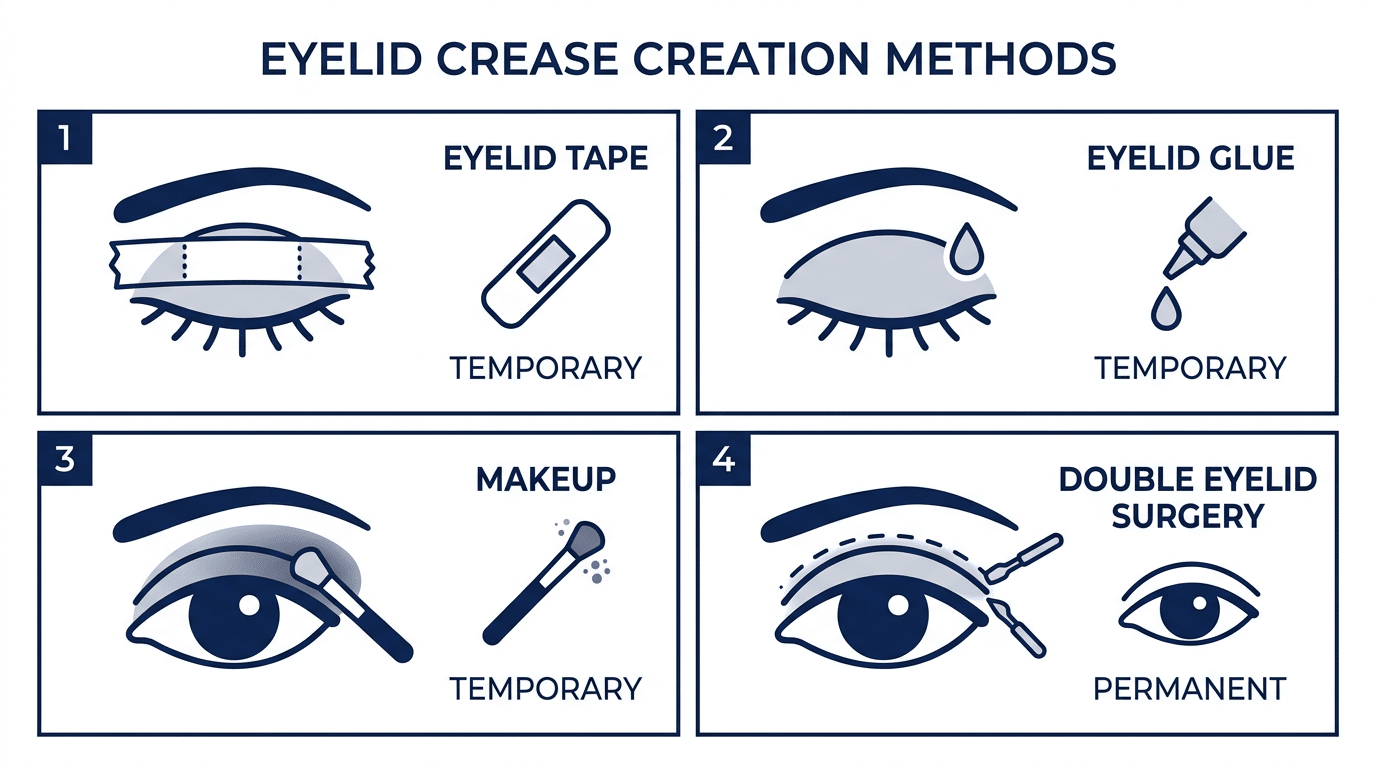
Before considering surgery, it is well worth understanding the temporary options — both because they suit many people perfectly and because they let you preview the look of a crease before committing to anything permanent.
Eyelid tape (also called eye lift strips) — thin adhesive strips placed where the crease should sit, pushing the skin up to hold a fold in place. Eyelid glue works on the same principle with adhesive. Makeup techniques — using graduated eyeshadow and eyeliner — can create the illusion of a crease and more defined, elongated eyes without any adhesive at all. All three are non-permanent, inexpensive, and reversible, and they are an excellent way to experiment with the appearance of a crease.
There is one honest caveat worth knowing: repeated, long-term use of tape or glue involves pulling on the delicate eyelid skin, and over years this can stretch the skin, potentially making any future surgery more complex. Used occasionally, they are fine; relied on daily for years, they are not an ideal long-term strategy. For anyone wanting a lasting result, surgery is the definitive option.
Double Eyelid Surgery (Asian Blepharoplasty) — How It Works
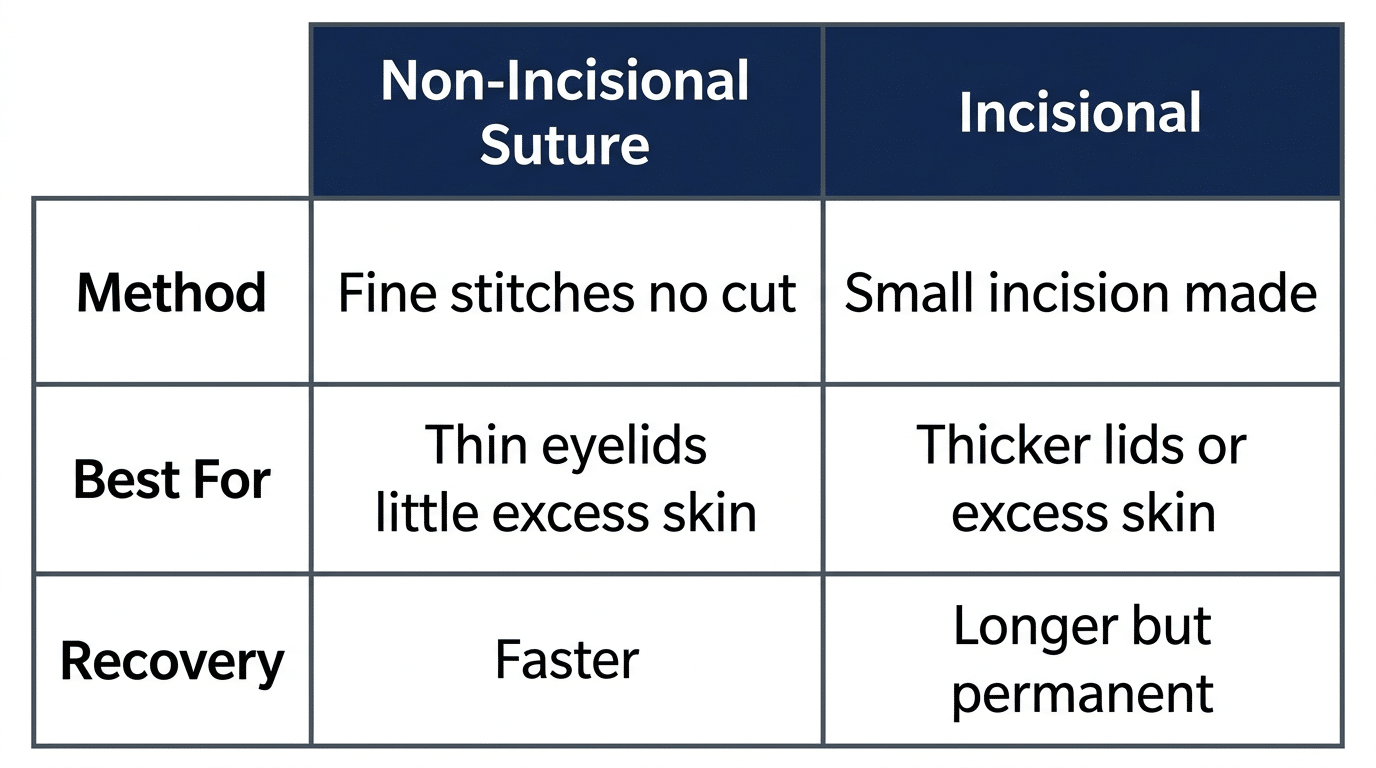
Double eyelid surgery — a specialised form of blepharoplasty — creates a defined upper eyelid crease. There are two main techniques, and the right one depends on your individual eyelid anatomy.
Non-Incisional (Suture) Technique
The non-incisional method creates a crease using fine sutures placed through the eyelid to form the fold, without making a cutting incision. It suits patients with thinner eyelids and little excess skin, offers a faster recovery, and has the advantage of being potentially reversible if the sutures are released. Its limitation is that it may be less durable in some patients, and it is not suitable where there is significant excess skin or thicker eyelid tissue.
Incisional Technique
The incisional method creates the crease through a fine incision along the planned crease line, through which excess skin and a small amount of tissue can be removed, and the crease is anchored precisely. It suits patients with thicker eyelids or more excess skin, gives the most defined and durable, long-lasting result, and allows the surgeon the greatest control over crease height and shape. The trade-off is a slightly longer recovery and, because tissue is removed, it is generally considered permanent.
Both techniques are typically performed under local anaesthetic with or without sedation, and usually take around 60 to 90 minutes. Our post on blepharoplasty under local vs general anaesthetic explains the anaesthetic options in detail.
Combining with Epicanthoplasty
Because monolid eyes frequently have a prominent epicanthic fold at the inner corner, double eyelid surgery is sometimes combined with epicanthoplasty — a procedure that refines the epicanthic fold to lengthen the appearance of the eye at the inner corner and complement the new crease. Whether this is appropriate depends entirely on your individual anatomy and goals, and it is something to discuss carefully at consultation, since not everyone needs or wants it.
What About Asymmetry — One Monolid and One Double Eyelid?
Having one eye with a natural crease and one without is more common than people expect, and it is one of the most frequent reasons patients seek treatment. It can be present from birth or develop over time with age and changes in skin elasticity. Double eyelid surgery on the monolid side — carefully matched to the existing natural crease on the other side — can create symmetry between the two eyes. Matching a surgically created crease to an existing natural one is a precise task and a good example of why surgeon experience matters. Our post on whether eyelid surgery can fix asymmetrical eyes covers this scenario in more detail.
Recovery After Double Eyelid Surgery
Recovery is generally straightforward. Some swelling and bruising around the eyes is normal in the first one to two weeks and settles progressively — the non-incisional technique typically settles faster than the incisional. Most patients take around a week off work and social activities while the initial swelling subsides. Fine sutures, where used, are usually removed at around a week. The crease often looks a little high and tight initially and softens into its natural final position over the following weeks to months as the swelling fully resolves. You will be advised to keep the head elevated, avoid strenuous activity for a few weeks, and protect the eyes from the sun. Our post on how soon you can wear makeup after eyelid surgery answers one of the most common recovery questions.
How Much Does Double Eyelid Surgery Cost in London?
The cost of double eyelid surgery depends on the technique used, whether one or both eyes are treated, and whether it is combined with epicanthoplasty or ptosis repair. Because the plan is tailored to your individual anatomy, an accurate price is confirmed at consultation. Finance options including 0% APR are available through our partner Chrysalis Finance for procedures over £1,500 — visit our Finance Options page for details.
Frequently Asked Questions
Is having monolid eyes a problem?
Not at all. Monolid eyes are a normal, common, healthy eye shape with no medical implications. Any decision to create a crease is entirely personal and cosmetic, never medically necessary.
Does double eyelid surgery change my ethnic appearance?
Well-performed surgery does not, and should not. The aim is to create a natural crease that suits your individual anatomy and preserves the character of your eye — enhancing your natural appearance rather than changing your ethnic identity. This requires a surgeon experienced specifically in East Asian eyelid anatomy.
Is double eyelid surgery permanent?
The incisional technique is generally permanent, as tissue is removed. The non-incisional suture technique is potentially reversible if the sutures are released, though it may be less durable over time. Your surgeon will help you weigh this at consultation.
What is the difference between eyelid tape and surgery?
Eyelid tape creates a crease only while it is worn and must be reapplied daily; it is temporary and non-invasive. Surgery creates a lasting crease. Long-term daily use of tape can stretch the eyelid skin over time, so it is not an ideal permanent strategy.
Can I have surgery on just one eye?
Yes — this is common for patients who have one monolid and one natural double eyelid and want the two to match. The surgically created crease is carefully matched to the existing natural one for symmetry.
Is monolid surgery painful?
The procedure is performed under local anaesthetic with or without sedation, so you remain comfortable throughout. Afterwards, discomfort is generally mild and well controlled, with some swelling and bruising in the first week or two.
What is an epicanthic fold and will surgery remove it?
An epicanthic fold is a fold of skin covering the inner corner of the eye, common in monolid eyes. Double eyelid surgery creates a crease but does not by itself remove the epicanthic fold — refining the fold is a separate procedure (epicanthoplasty) that can be combined with double eyelid surgery if appropriate for your goals.
Will I look natural after surgery?
With appropriate crease-height planning and a surgeon experienced in this specific area, the result should look like a natural crease in harmony with your face. An over-high or over-deep crease is the hallmark of poorly planned surgery, which is why surgeon selection is so important.
Monolid and Double Eyelid Surgery at Centre for Surgery
Centre for Surgery performs Asian blepharoplasty (double eyelid surgery) at our CQC-regulated Baker Street clinic in central London. All procedures are performed by GMC-registered consultant surgeons with specific expertise in East Asian eyelid anatomy, following a thorough consultation to plan a crease that enhances your natural eye, assess whether ptosis or an epicanthic fold should be addressed, and give you an honest view of what will suit you.
Finance options including 0% APR are available through our partner Chrysalis Finance — visit our Finance Options page for details.
Phone: 0207 993 4849 | Email: contact@centreforsurgery.com | Address: 95-97 Baker Street, London W1U 6RN
[contact-form-7 id=”256″ title=”Treatments form”]