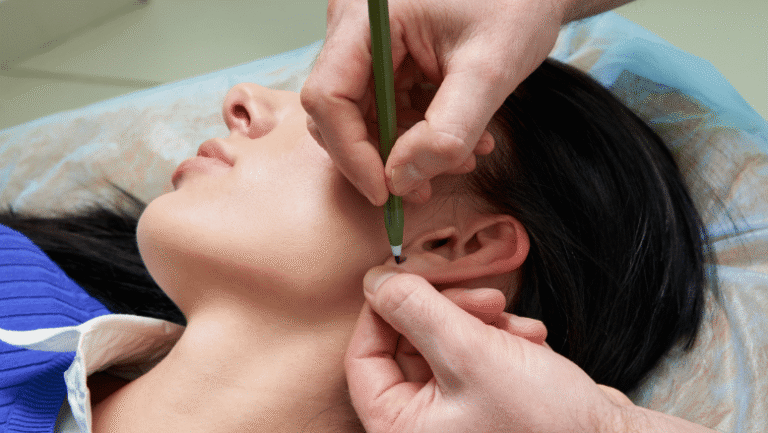

Jowls — the soft tissue that sags below the jawline, blurring the sharp transition between face and neck — are one of the most visible markers of facial ageing. They develop as the supporting ligaments of the lower face weaken, the skin loses its retractive properties, and facial fat descends from where it should sit (high on the cheek) to where gravity pulls it (along and below the jawline).
For mild to moderate jowling, several non-surgical treatments can produce meaningful improvement. For significant jowling with substantial skin laxity, the honest answer is that no non-surgical treatment matches what a surgical lower facelift delivers — but understanding what each approach can and can’t achieve helps make the right decision. This guide covers the non-surgical options that genuinely work, who suits each, and when surgery is the more appropriate intervention.
Why jowls develop
Several anatomical changes contribute to jowl formation:
Ligament weakening. The mandibular ligament and other supporting structures that hold facial soft tissue in its youthful position progressively weaken with age. This allows tissue to slide downward over time.
Volume loss. The fat compartments of the mid-face thin with age. The cheek mound flattens, removing the upward support that previously held the lower face in position. The remaining fat — no longer anchored above — accumulates along the jawline.
Skin laxity. Collagen and elastin decline produces skin that can no longer retract to fit the underlying tissue. Loose skin contributes both visually (looking sagging) and mechanically (allowing further descent).
Bone changes. Subtle resorption of the mandible (jawbone) reduces the bony framework supporting the lower face. The jawline becomes less defined as a result.
Lifestyle factors. Sun exposure, smoking, poor sleep, and chronic stress all accelerate the underlying processes that produce jowls.
The right treatment depends on which of these factors is dominant in your particular case.
Fotona4D laser facelift
Fotona4D uses dual laser wavelengths in four sequential treatment modes — including an intra-oral pass that delivers heat to the deep tissues of the lower face from inside the mouth. The combination stimulates collagen production, contracts existing collagen for immediate tightening, and improves overall skin quality.
For early to moderate jowling driven by skin laxity rather than significant descent, Fotona4D can produce meaningful improvement. The treatment works by:
- Immediate collagen contraction during treatment
- Stimulated collagen production over 8-12 weeks following each session
- Cumulative effect across a treatment course
What to expect:
- Sessions take 45-60 minutes
- Warm sensation during treatment, no significant pain
- Mild redness for a few hours, sometimes into the next day
- No downtime — patients return to normal activities immediately
- Course of 3-4 sessions spaced 4 weeks apart
How long it lasts: 12-24 months from a completed course, with annual maintenance recommended.
Cost: from £600 per session.
For more on how this works for neck-specific concerns, see our guide on how to tighten neck skin without surgery.
Morpheus8 radiofrequency microneedling
Morpheus8 combines microneedling with deep radiofrequency energy. The microneedles penetrate the skin to deliver RF energy at depths of up to 4mm — substantially deeper than traditional microneedling and into the layer where ageing changes occur.
For jowl treatment, Morpheus8 offers:
- Significant skin tightening through collagen contraction and remodelling
- Some fat reduction at deeper settings (useful for early jowl fat accumulation)
- Improvement in overall skin texture and quality
- Stronger result than non-ablative laser, with more recovery
What to expect:
- Topical anaesthetic for about 45 minutes before treatment
- Procedure takes 30-45 minutes
- Heat-and-pressure sensation during the passes
- 4-7 days of pinkness with tiny scabs that flake away
- Course of 2-3 sessions spaced 4-6 weeks apart
How long it lasts: 12-24 months from a completed course, with annual maintenance recommended.
Cost: from £650 per session.
For more on the comparison between energy-based devices, see our broader non-surgical facelift hub.
FaceTite radiofrequency-assisted lipolysis
FaceTite delivers radiofrequency energy below the skin via a small probe inserted through tiny incisions. The combination of internal heat (from the probe) and external monitoring (a surface electrode) provides controlled tightening of the deeper tissues with significant skin contraction.
FaceTite is particularly effective for jowls because:
- It can reduce small fat deposits contributing to jowl fullness
- It tightens skin from below through deep collagen remodelling
- A single session produces meaningful improvement (vs. multiple sessions for non-invasive treatments)
- The effect is more pronounced than non-ablative laser or radiofrequency
What to expect:
- Performed under local anaesthesia (sometimes with sedation)
- Takes 60-90 minutes
- Recovery: about 1 week of swelling and tightness
- Single session typically sufficient
- Final result develops over 3-6 months
How long it lasts: permanent skin tightening from the collagen remodelling, with ongoing facial ageing continuing as normal afterward.
Cost: from £2,500 for the face.
Dermal filler for volume support
Counterintuitively, adding volume can improve jowl appearance — particularly for patients whose jowling is driven primarily by mid-face volume loss rather than skin laxity.
Cheek filler placed at the lateral cheekbone restores the structural support that ageing has thinned. When the cheekbone has its proper prominence, the lower face has the upward anchor it needs to look more lifted. The visual effect: cheekbones look more defined, jawline looks crisper, and the jowls appear less prominent — without directly treating the jowls themselves.
For patients with deeper marionette lines accompanying jowls, targeted filler in those creases reduces their visibility and softens the descending appearance of the lower face. See our guide on marionette lines.
For comprehensive lower-face refreshment with filler, the liquid facelift (8-point lift) places HA at eight strategic anchor points to lift descended tissue back toward its youthful position.
What to expect:
- Treatment takes 30-60 minutes
- Immediate visible result, with continued improvement over 2 weeks
- Mild bruising or swelling for 3-5 days
- Filler reversible with hyalase if needed
How long it lasts: 12-18 months for most areas.
Cost: from £450 per syringe.
Profhilo and polynucleotides for skin quality
For patients whose jowls are accompanied by crepiness, dullness, and overall skin texture deterioration, bioremodelling treatments improve dermal quality alongside any other interventions.
Profhilo uses high-concentration HA injections at specific points across the face and lower face. It improves overall skin hydration, elasticity, and quality through a unique bioremodelling mechanism that’s distinct from filler. See our comprehensive Profhilo guide.
Polynucleotide treatment uses purified DNA fractions to stimulate fibroblast activity and improve skin quality through different biological mechanisms. Often combined with Profhilo or used independently.
Both treatments produce subtle but meaningful improvement in skin quality. Neither lifts descended tissue — they’re best understood as complementary to other treatments rather than primary jowl interventions.
Cost: Profhilo from £350-£700 per session; polynucleotides from £400 per session.
The combination approach
For most patients with jowls, the best result comes from combining several treatments:
Cheek filler + Fotona4D or Morpheus8. Restore mid-face volume while tightening the lower face. Effective for early to moderate jowling.
FaceTite + filler. Substantial skin tightening combined with strategic volume restoration. For more advanced jowling without full skin redundancy.
Energy-based treatment + Profhilo. Tightening combined with overall skin quality improvement.
Multi-modal full plan. Combining filler, energy-based treatment, biostimulators, and ongoing anti-wrinkle injections produces comprehensive lower-face rejuvenation that no single treatment matches.
The combination approach is typical of our non-surgical facelift philosophy.
When surgery is the right answer
The honest answer: for significant jowling with substantial skin laxity, no non-surgical treatment delivers what surgical lower facelift achieves. Indicators that surgery is the more appropriate intervention:
Significant skin laxity that tents when pinched and doesn’t spring back. Filler can pad volume; lasers can tighten modestly; neither can excise excess skin.
Pronounced jowls visible even from the front (not just in profile). When the lower face has descended substantially, repositioning requires surgical access.
Diminishing returns from previous non-surgical treatment. Each round producing less benefit suggests the underlying problem isn’t something non-surgical treatment can fully address.
Multiple lower-face concerns including jowls plus neck banding plus deep folds plus volume loss. Comprehensive correction is more efficiently achieved with surgery than with extensive non-surgical work.
Surgical options for jowls include:
- Mini facelift — for patients with mild to moderate jowling and reasonable skin elasticity
- SMAS facelift — for more substantial lower-face descent
- Deep plane facelift — for the most comprehensive correction
- Neck lift or mini neck lift — often combined with facelift to address related neck banding
For the broader filler vs. surgery comparison, see our guide on dermal fillers vs facelift surgery.
Who is a good candidate for non-surgical treatment?
The ideal candidate for non-surgical jowl treatment has:
- Mild to moderate jowling
- Reasonable skin elasticity (skin springs back when pinched)
- Volume loss as a significant contributing factor
- No substantial neck banding requiring surgical correction
- Realistic expectations about subtle improvement rather than transformation
- Willingness to maintain results with periodic treatment
Less suitable candidates:
- Patients with significant skin laxity that needs excision
- Patients with pronounced lower-face descent
- Patients wanting dramatic, definitive change
- Patients who’ve accumulated significant filler over years and are at the point of diminishing returns
Cost summary
- Fotona4D: from £600 per session (course of 3-4)
- Morpheus8: from £650 per session (course of 2-3)
- FaceTite: from £2,500 (single session)
- Cheek filler: from £450 per syringe
- Liquid facelift (8-point lift): from £1,200
- Profhilo: from £350-£700 per session
- Polynucleotides: from £400 per session
A typical combined non-surgical jowl treatment plan costs £2,000-£5,000 over an initial 3-6 month course, with maintenance approximately annually. Finance options through Chrysalis Finance, including 0% APR, are available across all treatments.
Common questions
Can non-surgical treatment really improve jowls?
For mild to moderate jowling, yes — meaningfully. For significant jowling with substantial skin laxity, the honest answer is that improvement is limited compared to what surgery delivers.
How long until I see results?
Filler — immediate. Fotona4D — gradual over 8-12 weeks. Morpheus8 — gradual over 3-4 months. FaceTite — gradual over 3-6 months. Profhilo — gradual over 4-8 weeks.
Will I need maintenance?
Yes for all non-surgical treatments. Filler annually, energy-based treatments annually, Profhilo every 6-9 months.
Can I have multiple treatments at the same time?
Some combine well (filler + Profhilo). Others need sequencing (energy-based + injectables typically 2 weeks apart). Your treatment plan will sequence the components appropriately.
How do I know if I need surgery?
A simple test: pinch the loose skin near your jawline. If it springs back immediately, non-surgical treatment can probably help. If it tents momentarily before settling, surgical excision is likely needed for comprehensive correction.
What about thread lifts for jowls?
PDO thread lifts are sometimes marketed as a non-surgical alternative for jowl lifting. The evidence is mixed — results are typically modest and short-lived, and complications (thread migration, lumping, asymmetry) can be challenging to correct. We don’t offer PDO threads at Centre for Surgery; for patients who need lifting beyond what filler and energy-based treatments can provide, surgical options are the appropriate intervention.
If I have non-surgical treatment now, can I still have surgery later?
Yes — non-surgical treatment doesn’t preclude subsequent surgery. Many patients use non-surgical treatment for 5-10 years before transitioning to surgical intervention when the underlying changes have progressed further.
Will my insurance cover this?
Cosmetic treatments are not covered by NHS or UK private health insurance.
Centre for Surgery · CQC-regulated · GMC specialist-registered surgeons · 95–97 Baker Street, Marylebone, London W1U 6RN · 0207 993 4849 · Book a consultation · Finance from 0% APR