

They appear quietly. A small white bump beneath the skin at the outer corner of the eye, or a cluster of them along the upper lid. They do not hurt, they do not become inflamed, and they do not seem to respond to anything. You try to squeeze one and nothing happens. Weeks later, another appears nearby.
These are milia, and the eye area is where most people meet them. If you keep getting them there, you are not doing anything wrong — but there are specific reasons the skin around the eye is unusually prone to them, and there are specific things that help. This guide explains what milia actually are, why they favour the eye area, how to tell them apart from other small white bumps, what genuinely reduces recurrence, and why picking at them is the one thing that reliably makes matters worse. Where they bother you, milia removal is quick and leaves no mark when performed properly.
What milia actually are
A milium is a tiny cyst filled with keratin — the structural protein that makes up the outer layer of your skin. When keratin becomes trapped beneath the surface rather than shedding away as it should, it forms a small, firm, pearly-white bump sitting just under the skin.
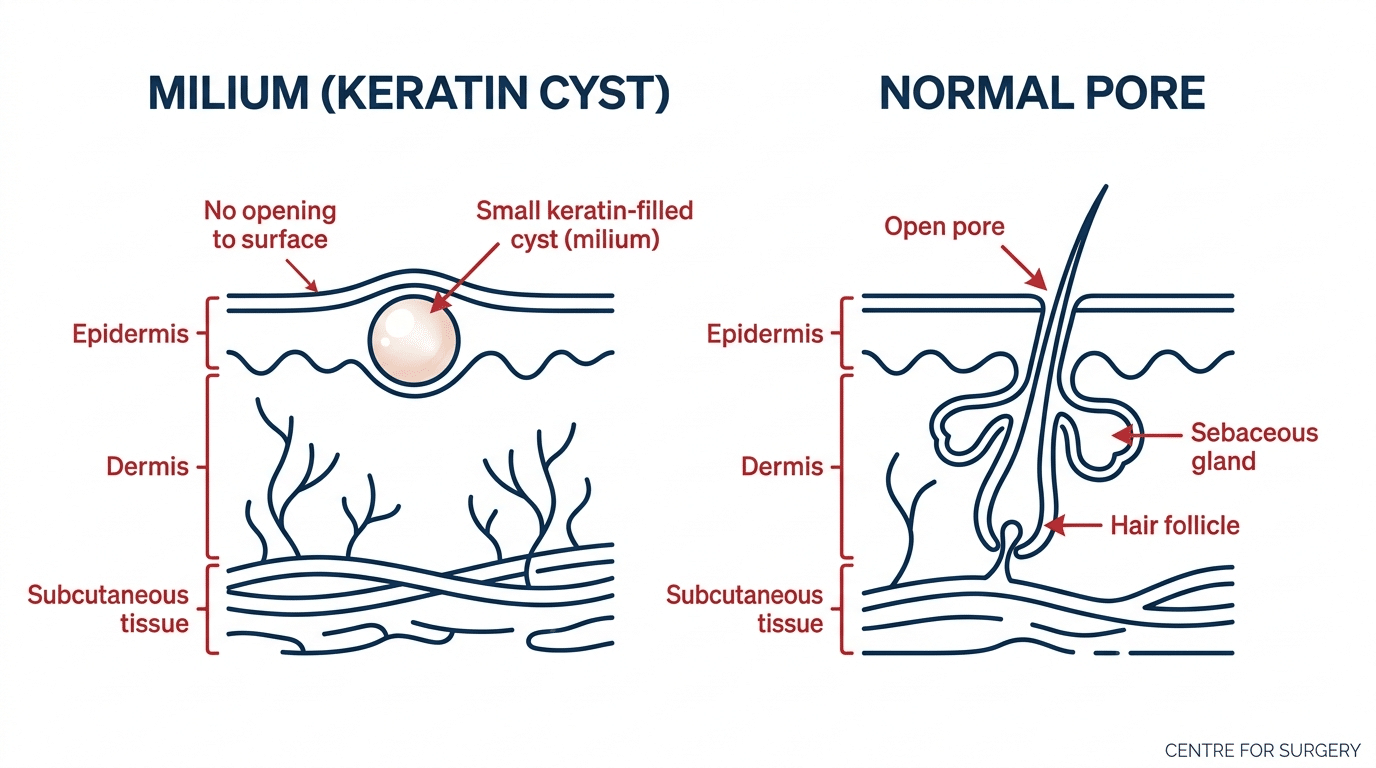
The critical detail — and the one that explains almost everything else about them — is that a milium has no opening to the surface. It is a fully enclosed cyst. A whitehead sits in a pore and has a route out. A milium does not. This is why pressing on one achieves nothing except bruising the delicate skin above it, and it is why milia can sit unchanged for months or years while a spot resolves in days.
Milia are entirely benign. They are not infected, they are not contagious, they are not a sign of poor hygiene, and they are not related to diet. They are among the most common benign lesions we assess at our skin lesion removal service, and in almost every case the only reason for treating them is that the person would rather not have them.
Primary and secondary milia
Primary milia arise spontaneously, with no preceding injury to the skin. This is the common type, and the type that appears around the eyes. Secondary milia develop after something has damaged the skin — a burn, a blistering rash, prolonged sun damage, aggressive resurfacing, or long-term potent topical steroid use. The damage disrupts the normal shedding pathway and keratin becomes trapped behind it.
Most people with recurring milia around the eyes have primary milia. That distinction matters because it means there is usually no underlying injury to treat — only the conditions that favour their formation.
Why the eye area, specifically
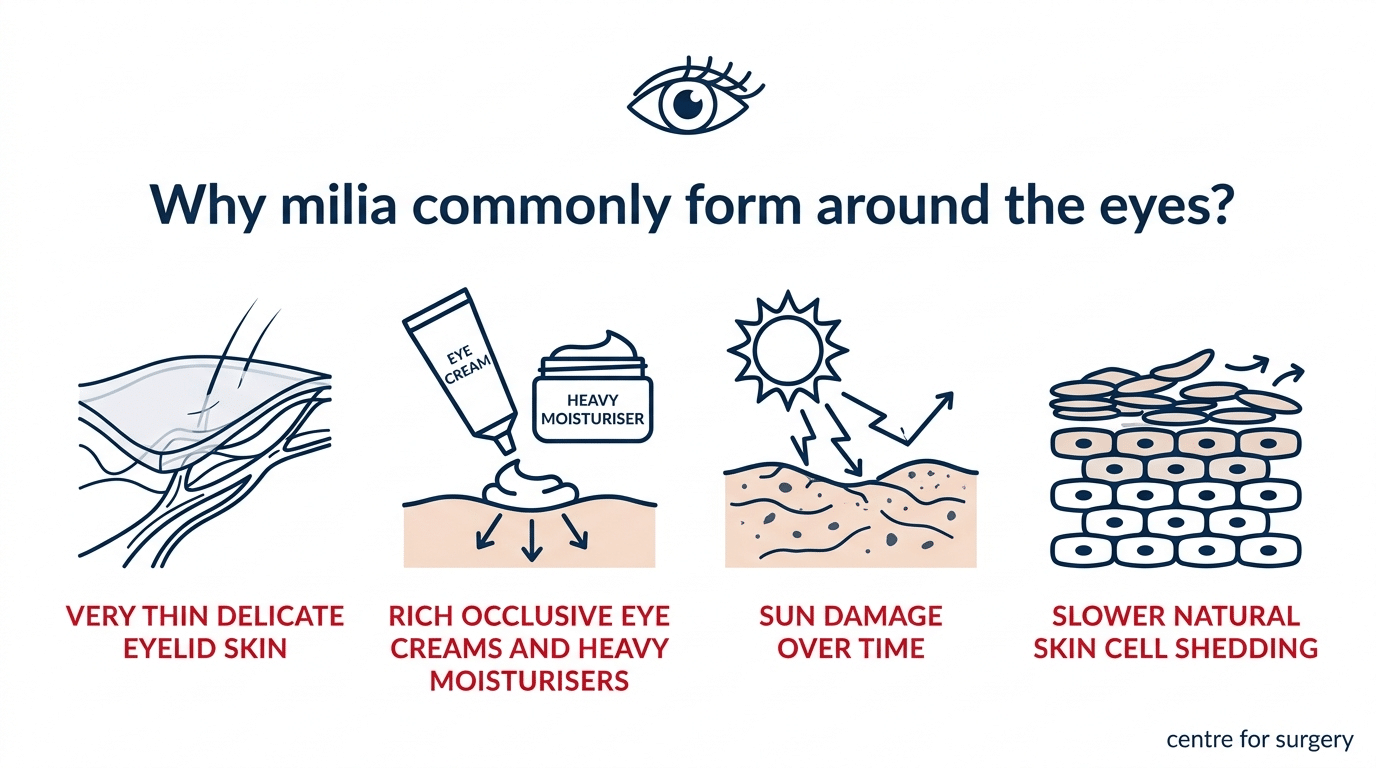
People rarely ask why they have milia. They ask why they keep getting them there. Four factors converge around the eye, and they compound.
The skin there is the thinnest on the body
Eyelid skin is a fraction of the thickness of skin on the cheek. It has fewer oil glands and a more delicate structure. Keratin that becomes trapped in thin skin sits closer to the surface, which makes a milium far more visible there than the same cyst would be elsewhere. Some milia you notice around the eye would pass unremarked on the jaw.
It is where the richest products are applied
This is the factor most within your control, and the one most people are surprised by. Eye creams are formulated to be occlusive — they are designed to sit on the skin and hold moisture in. That is precisely what they should do for dryness and fine lines. But heavy, occlusive formulations can also impede the natural shedding of surface skin cells in an area that is already poorly equipped to shed them.
Rich eye creams, heavy night balms, thick sunscreens applied close to the lash line, and long-wear makeup that resists removal all contribute. So does inadequate cleansing at the end of the day. None of these causes milia in a simple way — plenty of people use rich eye creams and never develop one — but in someone already predisposed, they tilt the balance.
Cumulative sun damage
Sun exposure over years thickens and coarsens the outer layer of the skin and disrupts the orderly process by which surface cells are shed. Sun-damaged skin sheds less efficiently. Because the eye area is difficult to protect properly — sunscreen stings, sunglasses do not cover everything, and few people apply SPF up to the lash line — this region accumulates disproportionate damage relative to how thin and vulnerable it is.
Shedding slows with age
The rate at which skin renews itself declines steadily from your twenties onward. Cells that would once have been shed in a few weeks take longer. In thin skin, with occlusive products applied over it, that slowing is enough to allow keratin to become trapped. This is why milia around the eyes become more common in the thirties and forties, and why someone who never had them at twenty-five may find they now appear regularly.
Put together: the thinnest skin on the body, sheds most slowly, receives the heaviest products, and is hardest to protect from the sun. The eye area is not unlucky. It is structurally predisposed.
Is it definitely a milium?
Most small white bumps around the eye are milia. But not all of them are, and a few of the alternatives matter.
Milia versus whiteheads
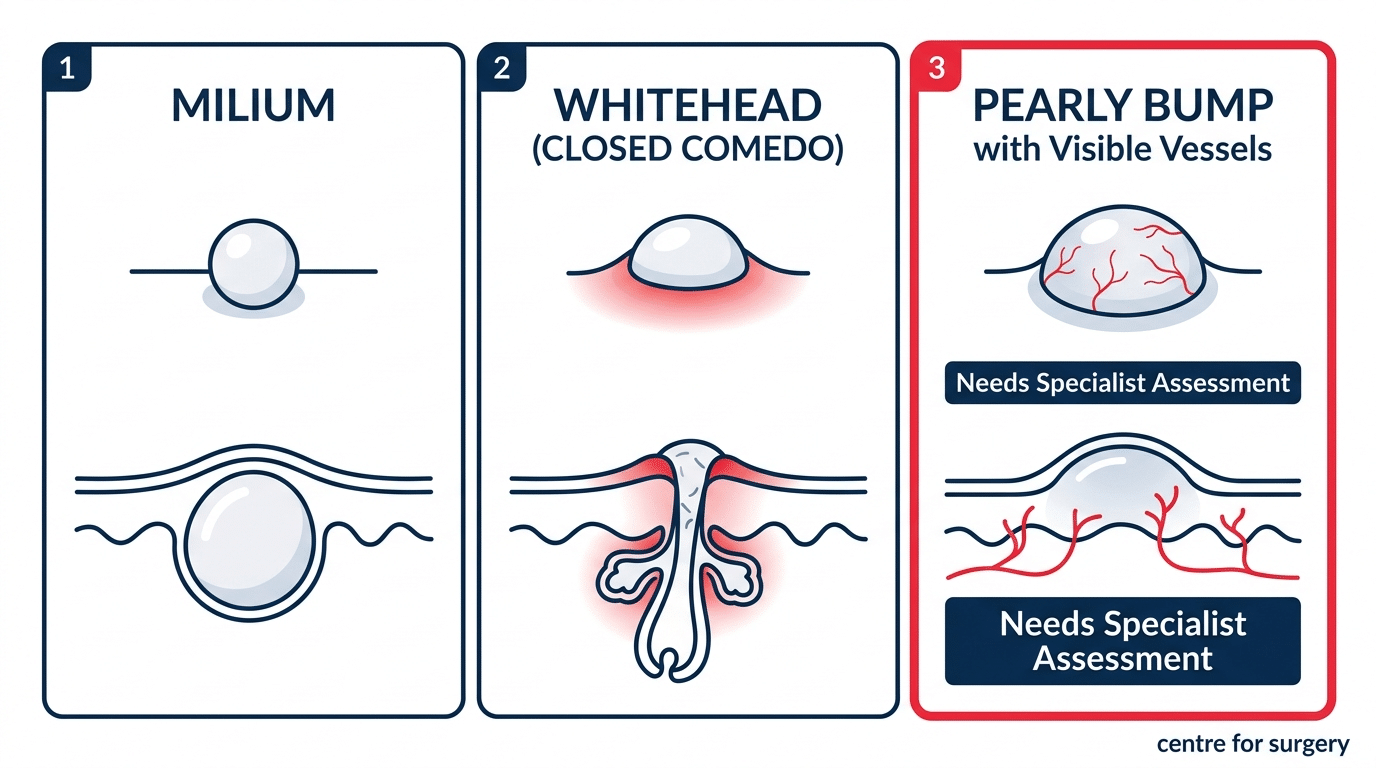
A milium is firm, does not change, has no visible pore, and is not inflamed. A whitehead is softer, sits within a pore you can usually see, is often surrounded by redness, and resolves within days to weeks. If you have pressed the bump and nothing came out, and it is still there a month later, it is far more likely a milium.
Milia versus syringomas
Syringomas are small benign growths of sweat gland tissue that also favour the lower eyelid. They are typically skin-coloured or slightly yellow rather than pearly white, often appear in symmetrical clusters on both lower lids, and feel flatter and firmer. They are harmless, but they respond to different treatment from milia, so the distinction matters practically.
Milia versus xanthelasma
Xanthelasma are soft, yellowish, flat plaques rather than discrete round bumps, and they characteristically appear at the inner corner of the eyelid. They are not white and they are not firm. They can be associated with cholesterol levels, although frequently they are not — we cover this in detail in our guide on whether you can have xanthelasma with normal cholesterol.
The one to take seriously
Basal cell carcinoma, the most common form of skin cancer, can present as a small pearly bump — and the eyelid and inner eye corner are among its typical sites. In its early stages it can look strikingly like a milium.
The features that distinguish it: it grows, slowly but persistently, over months. It may develop fine visible blood vessels across its surface. It may bleed with minor trauma, crust over, appear to heal, and then bleed again. It may develop a small central depression or ulcer. A milium does none of these things — it sits, unchanged, indefinitely.
The practical rule is straightforward. A small white bump that has not changed in six months is almost certainly a milium. A pearly bump that is growing, has visible surface vessels, bleeds, or repeatedly crusts and heals should be assessed by a specialist, and promptly. Basal cell carcinoma is highly treatable when caught early, and the eye area is precisely where early treatment preserves the most tissue. The same reasoning applies to other lesions that can be mistaken for benign ones — see our guide on telling seborrhoeic keratosis from melanoma.
If you are uncertain, have it looked at. Reassurance is quick, and the alternative to reassurance is worth catching.
Why you must not pick them
This is the most important practical point in this article, and the one most frequently ignored.
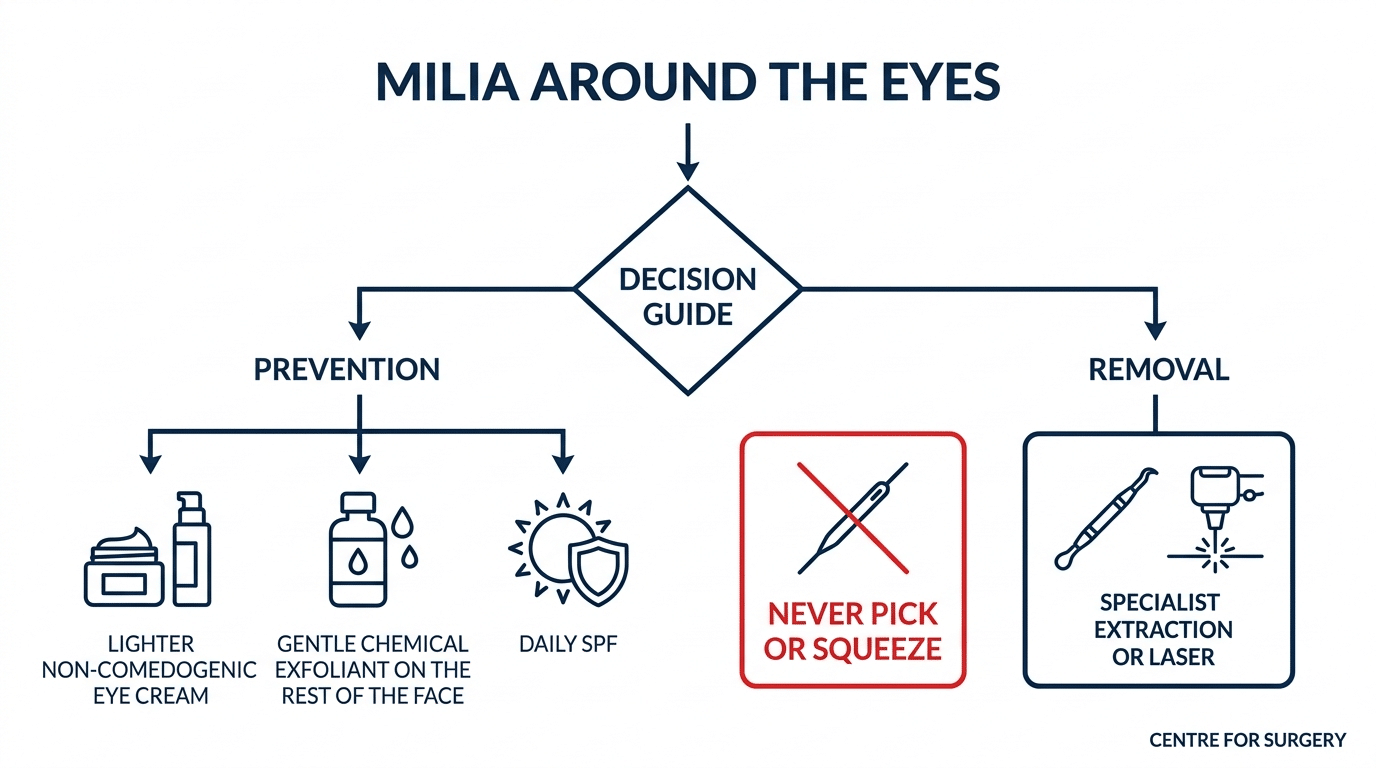
A milium has no opening. Squeezing cannot express it, because there is nowhere for the contents to go. What squeezing does accomplish is to bruise the thinnest skin on your body, rupture the cyst wall beneath the surface, and spill keratin into the surrounding tissue — which provokes inflammation. Inflammation in the eyelid resolves slowly.
Attempting to open a milium with a needle at home carries the further risks of introducing infection into the periocular tissue, and of scarring. Eyelid skin scars visibly and permanently. A milium is a cosmetic non-issue; a scar or a pigmented mark on the lower lid is not.
There is also a self-defeating logic to it. Trauma to the skin is itself a cause of secondary milia. People who persistently pick at milia around the eyes frequently find they develop more of them, in the same area, as a direct consequence.
Leave them alone. If they bother you, they are straightforward for a specialist to remove.
Reducing how often they come back
No routine prevents milia entirely. But several adjustments meaningfully reduce recurrence, and they are worth making if you find yourself dealing with new ones every few months.
Reconsider your eye cream
If you use a rich, heavy eye cream and you keep getting milia, this is the first thing to change. Switch to a lighter, non-comedogenic formulation. A gel or fluid texture rather than a balm. You do not need to abandon eye care — you need a formulation that hydrates without sitting occlusively over skin that struggles to shed.
Apply less than you think you need, and keep it away from the immediate lash line where product accumulates.
Exfoliate gently, and not directly on the eyelid
A gentle chemical exfoliant used on the face — a mild alpha-hydroxy acid, or a retinoid if your skin tolerates one — supports the natural shedding process. Used consistently, this is more effective at reducing milia formation than anything else you can do at home.
Two cautions. Do not apply exfoliating acids or retinoids directly onto the eyelid unless a clinician has specifically advised it; the skin there is too thin and the eye too close. And do not use physical scrubs anywhere near the eye. Abrasion is trauma, and trauma causes secondary milia.
Remove makeup properly
Long-wear and waterproof eye makeup requires a dedicated remover, not a hurried wipe. Product left in place overnight sits on skin that is already shedding poorly. Cleanse thoroughly, gently, and completely, without dragging at the skin.
Protect from the sun
Daily SPF and good sunglasses reduce the cumulative damage that impairs skin shedding over decades. This is slow-acting prevention rather than a quick fix, but it is the intervention with the broadest benefit to the eye area — for milia, for fine lines, and for skin cancer risk.
What prevention cannot do
Be clear-eyed about this: none of the above will clear milia you already have. A milium is an enclosed cyst; no cream reaches inside it, and no exfoliant dissolves it. Prevention changes the odds of new ones forming. Existing ones need physical removal.
How milia are removed
Removal is quick, performed under local anaesthetic or topical numbing, and produces immediate results. Milia removal at our Baker Street clinic is carried out by specialists, using the technique appropriate to the lesion.
Manual extraction
The standard approach for most milia. A fine sterile needle or blade is used to make a minute opening in the skin over the cyst, and the keratin core is then lifted out with gentle pressure. Because the cyst is enclosed, creating that opening is the entire point — it is what makes extraction possible and squeezing futile.
The procedure takes minutes. Several milia can be treated in a single session. There is typically mild redness for a day, and no lasting mark when performed correctly.
Erbium laser ablation
For milia that are very superficial, numerous, or awkwardly positioned close to the lash line, erbium laser ablation offers precise removal with minimal disturbance of the surrounding skin. The laser removes the tissue over the cyst in a highly controlled fashion. This is particularly useful around the eye, where precision matters and the margin for collateral damage is small.
Why the setting matters
The periocular region is anatomically unforgiving. The skin is thin, the eye is immediately adjacent, and scarring here is conspicuous. Extraction performed by someone experienced with this specific area, in a sterile clinical environment, is a materially different proposition from extraction attempted in a beauty salon — or at your bathroom mirror.
Centre for Surgery is regulated by the Care Quality Commission, England’s independent healthcare regulator, and rated “Good” across all five domains. Our medical content is reviewed by Consultant Plastic Surgeon Dr Spyridon Vlachos (GMC 7522950).
Frequently asked questions
Will milia go away on their own?
Sometimes, eventually. Milia in newborns typically resolve within weeks without any intervention. In adults, a milium may occasionally work its way to the surface and clear over months, but many persist indefinitely. If one has been present for six months without changing, it is unlikely to disappear on its own.
Why do I keep getting them in the same spot?
Because the conditions that produced the first one have not changed. The same thin skin, the same product applied to the same place, the same shedding rate. If you have repeatedly picked at that area, you may also be generating secondary milia through the trauma itself.
Can my eye cream really be causing them?
It can contribute. Occlusive formulations impede shedding in an area poorly suited to shedding in the first place. If you keep getting milia and use a rich eye cream, switching to a lighter one is the single most useful change you can make — though it will not clear the ones you already have.
Are milia a sign of high cholesterol?
No. You may be thinking of xanthelasma, which are soft yellowish plaques at the inner corner of the eyelid and can be associated with lipid levels. Milia are keratin cysts and have no relationship to cholesterol, diet, or any internal condition.
Can I remove a milium with a sterilised needle at home?
Please do not. The eyelid region is millimetres from the eye, the skin scars readily and visibly, and home extraction risks infection in tissue where infection is serious. Professional extraction takes minutes and leaves no mark.
Will they come back after removal?
The milium that is removed does not return — the cyst is gone. New milia may form elsewhere if the underlying conditions persist, which is why the prevention measures above are worth adopting alongside removal.
Are milia around the eyes ever serious?
Milia themselves, no. But a pearly bump near the eye that grows, develops fine surface blood vessels, bleeds, or crusts and reheals repeatedly may not be a milium, and warrants specialist assessment. Change is the signal.
Milia removal at Centre for Surgery
Centre for Surgery is an independent clinic at 95–97 Baker Street in London, rated “Good” across all five domains by the Care Quality Commission. Milia removal is performed by specialists experienced in the periocular region, using manual extraction or erbium laser as appropriate to the lesion.
At consultation the lesion is examined and confirmed. Where a bump has features that warrant further assessment, we will say so and arrange it rather than simply removing it. Where it is a straightforward milium, treatment can often be performed in the same appointment.
For procedures over £1,500, 0% APR finance is available through Chrysalis Finance, subject to status. See our finance options for details.
Call: 0207 993 4849
Email: contact@centreforsurgery.com
Address: 95–97 Baker Street, London W1U 6RN
Online: Book a consultation via our contact form below.

[contact-form-7 id=”256″]