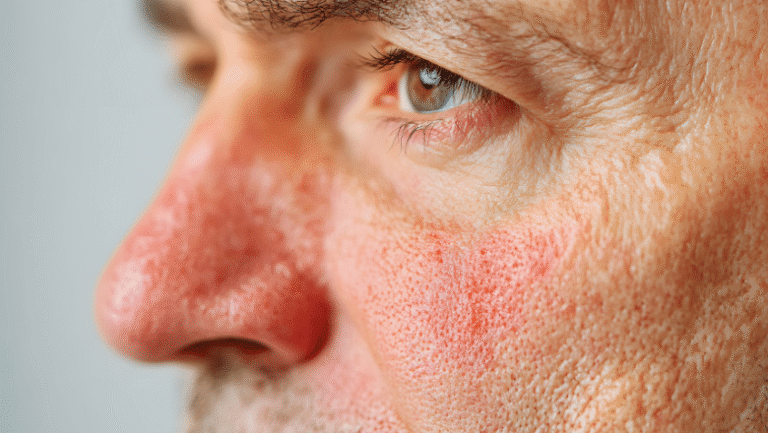
Scarring is the body’s natural response to any wound that breaches the deeper layers of the skin. Whether the injury comes from surgery, an accident, acne, a burn, or a piercing, the body produces collagen to repair the damage — and the resulting tissue is what we see and feel as a scar. What’s less widely understood is that not all scars are the same. There are several distinct types, each with its own appearance, underlying biology, and best treatment approach. Choosing the right intervention starts with identifying which type of scar you actually have.
This guide covers the main scar categories, what causes each one, what realistic treatment options exist, and where each fits within the wider scar revision service at Centre for Surgery’s CQC-regulated Baker Street private hospital.
The biology of a scar
Skin is made up of three layers: the surface epidermis, the dermis beneath it (containing collagen, elastin and blood vessels), and the subcutaneous fat layer below. Minor injuries that only affect the epidermis heal without producing a scar — the cells regenerate identically to what was there before. Any injury that reaches the dermis triggers a different repair process, one in which the body lays down replacement collagen. This collagen is structurally different from the original skin: more disorganised, less elastic, and often a different colour and texture. That is what we recognise as a scar.
Scar formation moves through three phases:
- Inflammatory phase (days 0–7) — the body clots the wound, fights infection, and recruits the cells needed for repair
- Proliferative phase (weeks 1–6) — fibroblasts produce new collagen and the wound contracts; the scar appears red, raised and firm
- Remodelling phase (months 2–18) — the collagen is gradually reorganised, the scar softens, fades and flattens
A scar continues to mature for 12 to 18 months after the injury. This is why scar revision is usually deferred for at least a year — the appearance during the first few months is not the final appearance.
Fine-line scars
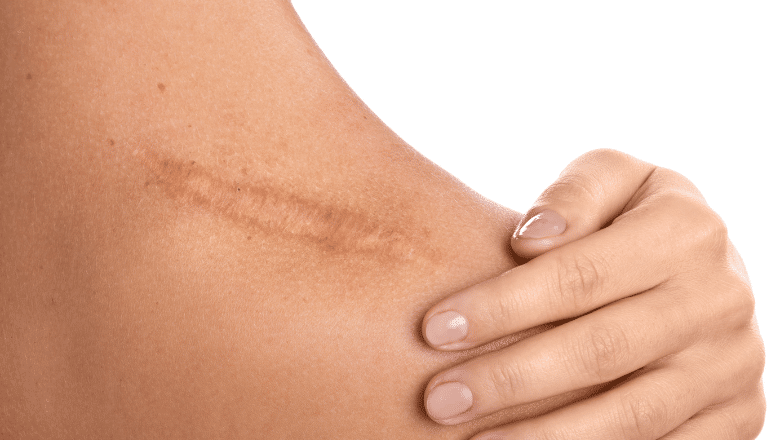
The most common scar type, and the one most surgical scars become. A fine-line scar is initially pink or red and slightly raised, then gradually fades over 12 to 18 months to a pale, flat line. The final appearance depends on the anatomical location, the patient’s skin type, the technique used to close the wound, and how the scar is cared for during healing.
Most surgical incisions placed by an experienced plastic surgeon along natural skin tension lines mature into fine-line scars that are difficult to see without close inspection. Most won’t disappear entirely, but they typically become a minor cosmetic feature rather than a prominent one. For full discussion of how surgical scars mature, see scar management after cosmetic surgery.
Hypertrophic scars
A hypertrophic scar is a raised, firm, often red scar that stays within the boundaries of the original wound. It forms when the body produces more collagen than was needed for repair, leaving the scar thicker and more prominent than a typical fine-line scar. Hypertrophic scars are most common on the chest, shoulders, upper back, and over joints — anywhere there is high skin tension. They are also more common in patients with darker skin types and in those with a personal or family history of poor scarring.
The good news: hypertrophic scars typically improve spontaneously over 12 to 24 months, gradually softening, flattening, and fading. The improvement can be accelerated with:
- Silicone gel or sheeting applied daily for several months — see do silicone strips help scars heal better?
- Intralesional steroid injection given every 4–6 weeks
- Pulsed-dye or fractional laser treatment
- Pressure therapy where appropriate
- Surgical revision in selected mature cases
For full discussion of natural history and treatment, see do hypertrophic scars go away?
Keloid scars
A keloid looks similar to a hypertrophic scar but behaves differently. The distinguishing feature: a keloid extends beyond the boundary of the original wound, growing into previously healthy skin. Where a hypertrophic scar stays within the lines of the incision, a keloid spreads sideways into normal tissue.
Keloids are also typically firmer, darker, often itchy or tender, and — unlike hypertrophic scars — they rarely improve spontaneously. Without treatment, many keloids persist or continue growing for years. They are most common in patients with darker skin types (Fitzpatrick IV–VI), in patients with a family history of keloid formation, and at certain anatomical sites including the earlobes, deltoid, chest, and jawline.
Keloids need active treatment rather than watchful waiting:
- Intralesional steroid injection — first-line, given as a course every 4–6 weeks
- Silicone gel or sheeting — alongside steroid treatment
- Surgical excision combined with post-operative steroid injection for resistant cases
- Radiotherapy after surgery in severe cases, particularly on the chest or deltoid
- Pressure earrings for earlobe keloids
- Cryotherapy or laser as adjuncts
Keloids on piercings are a particularly common presentation. For the specific approach, see how do I get rid of a keloid on my nose piercing?
Atrophic scars
The opposite of hypertrophic scarring. Atrophic scars sit below the level of the surrounding skin — they appear as depressions or indentations rather than raised marks. They form when the body produces less collagen than was needed during healing, or when underlying fat or tissue is lost during the injury.
Acne scarring is the most common cause of atrophic scarring. Other causes include chickenpox, surgical complications, and injuries that destroyed deeper tissue. Three sub-types of atrophic acne scars are recognised:
- Ice-pick scars — narrow, deep, V-shaped scars that look like the skin has been punctured. Usually under 2mm in diameter at the surface.
- Boxcar scars — broader, U-shaped depressions with sharp vertical edges, typically 1.5–4mm wide.
- Rolling scars — wider, shallow depressions with sloping edges, giving the skin a wavy or undulating appearance.
Different sub-types respond to different treatments. For full detail on acne scarring specifically, see how to get rid of acne scars, and for treatment-specific guides see TCA CROSS for acne scars, dermal fillers for acne scars, and laser acne scar removal.
Contracture scars
Contracture scars develop most commonly after burns. As the burn heals, the contracting wound pulls surrounding skin and tissue inward, producing a tight, often shiny, sometimes thickened scar that can restrict movement. Contractures crossing joints — the elbow, knee, neck, fingers — can produce genuine functional limitation as well as cosmetic concern.
Severe contractures need specialist surgical management. Techniques include Z-plasty (a rearrangement of the scar to lengthen it), W-plasty, tissue expansion, full-thickness skin grafting, or local flap reconstruction. Non-surgical treatments — laser resurfacing, pressure garments, intensive scar massage and stretching — can help with milder contractures or as adjuncts to surgery.
Pitted and sunken scars
A category that overlaps with atrophic scarring but is sometimes considered separately. Pitted scars develop where the deeper structure of the skin has been lost — most often from severe acne, chickenpox, or some types of surgical excision. They can also develop secondary to fat loss in the area, leaving a visible depression even where the skin surface looks otherwise normal.
Treatment options for pitted scars include:
- Subcision — using a fine needle to release the fibrous bands tethering the scar to deeper tissue
- Punch excision for individual deep scars — surgical removal and clean closure
- Morpheus8 radiofrequency microneedling for broader textural improvement
- Laser skin resurfacing with erbium or CO2 laser
- Dermal filler for individual depressed scars
- Fat transfer for larger volume defects
Most patients with substantial pitted scarring benefit from combining several modalities — for example Morpheus8 across the affected area, TCA CROSS for individual ice-pick scars, and targeted filler for selected deeper depressions. See does Morpheus8 help treat acne scars? for a detailed treatment guide.
White (hypopigmented) scars
Sometimes a healed scar ends up paler than the surrounding skin. The pigment-producing cells (melanocytes) in the area have been damaged or lost, leaving the scar without the melanin that gives surrounding skin its colour. White scars are most common after burns, deep surgical excisions, and some inflammatory skin conditions.
These are among the harder scars to treat because complete pigment restoration is difficult to achieve. Realistic options include fractional laser resurfacing, Morpheus8 microneedling, controlled chemical peels, and — in selected cases — medical micropigmentation (tattooing pigment into the scar to match surrounding skin). For full discussion, see can white scars be removed completely?
Stretch marks (striae)
Strictly speaking, stretch marks are a form of dermal scarring — they form when the skin is stretched faster than the dermis can adapt, producing tearing in the deeper collagen network. Initially red or purple (striae rubrae), they fade to pale silvery-white (striae albae) over months to years. They are most common after pregnancy, significant weight change, growth spurts in adolescence, and steroid use.
Treatment is challenging because the underlying damage is deep and structural rather than surface-level. The best evidence-based options include fractional laser resurfacing, Morpheus8 radiofrequency microneedling, and targeted topical retinoid use on early red striae. Complete elimination is uncommon — realistic expectations are improvement in colour and texture rather than full erasure.
Surgical scars by location
Surgical scars heal differently depending on where on the body they sit. The cluster of guides covering specific scar scenarios includes:
- Reducing scars after breast surgery — augmentation, lift and reduction incisions, each with distinct healing patterns
- How to prevent and minimise C-section scars — what genuinely works and what doesn’t
- Reducing appendix scars — open and laparoscopic scarring
- Reducing scars after body lift surgery — long incisions on high-tension areas
- Mole removal scars — what to expect
Treatment overview — surgical and non-surgical options
Non-surgical treatments
- Silicone gel and silicone sheeting — the strongest evidence base for topical scar treatment. Applied daily for 3+ months, reduces redness, thickness and itchiness. See do silicone strips help scars heal better?
- Scar massage — gentle daily massage with unperfumed moisturiser once the wound has closed; helps soften scar tissue and improve circulation. See how to massage yourself after cosmetic surgery.
- Sun protection — SPF 50 over fresh scars for at least 6–12 months prevents permanent hyperpigmentation. See the effects of tanning on cosmetic surgery scars.
- Intralesional steroid injection — for hypertrophic and keloid scars; reduces collagen overproduction
- Pressure therapy — garments or pressure earrings for selected scar types
- Laser skin resurfacing — erbium and CO2 laser for textural and pigmentation improvement
- Morpheus8 radiofrequency microneedling — for atrophic scars, stretch marks, and broader textural concerns
- Chemical peels — including TCA CROSS for individual ice-pick acne scars
- Dermal fillers — for selected depressed scars
Surgical treatments
- Scar revision surgery — excising an existing scar and re-closing the area with optimised technique to produce a less visible scar. See scar revision surgery FAQs.
- Z-plasty and W-plasty — geometric rearrangement of scar tissue to break up a straight line or release a contracture
- Punch excision — for individual deep atrophic scars
- Skin grafting — for large or contracture scars where simple closure isn’t possible
- Tissue expansion — for very large scars where surrounding skin is gradually stretched to allow excision and primary closure
- Fat transfer — for atrophic scars with significant volume loss
For cost information, see how much does laser scar removal cost in the UK?
Why timing matters in scar treatment
Scar treatment falls into two distinct phases:
Active scar management — starts as soon as the wound has closed (usually 2 weeks after the injury or operation) and continues for 6–12 months while the scar is maturing. The interventions are non-surgical: silicone, sun protection, massage, and selective steroid injection for problem scars. This phase is the most cost-effective window for influencing the final scar appearance.
Mature scar revision — performed at 12+ months once the scar has fully matured. The interventions can be surgical (excision and re-closure) or non-surgical (laser, Morpheus8). The mature scar is less likely to respond dramatically to treatment than the maturing scar — which is why earlier intervention is preferred where possible.
The single most important thing patients can do for their final scar appearance is to start active scar management early, not wait for the scar to mature and then try to fix it.
Factors that affect how your scar heals
- Genetics and skin type — patients with darker skin types and those with a family history of keloid scarring have a higher risk of problematic scarring
- Age — younger skin tends to produce more vigorous healing responses, sometimes including hypertrophic scarring; older skin heals more slowly but often more cleanly
- Anatomical location — face and neck heal beautifully; chest, shoulders, upper back and over joints are higher-tension areas where scars tend to be more visible
- Wound tension — incisions placed along natural skin tension lines heal with less tension and finer scars
- Infection — any post-operative infection markedly worsens the eventual scar
- Smoking — measurably worsens wound healing and final scar appearance; stopping for the perioperative period improves outcomes
- Nutrition and general health — adequate protein, vitamins and overall wellbeing support tissue repair
- Sun exposure — UV exposure during the first 12 months can permanently darken a healing scar
- Surgical technique — incision planning, gentle tissue handling, and layered closure all influence the final result
- Post-operative care — diligent silicone use, sun protection, and scar massage materially improve the final appearance
When to seek scar assessment
Most scars settle without intervention if the wound was managed appropriately. Some warrant earlier professional review:
- A scar that is becoming progressively raised, firm, red or itchy beyond 6–8 weeks
- A scar that is extending beyond the original wound boundary (suggesting keloid formation)
- A scar that is restricting movement at a joint
- A scar with persistent open areas, drainage, or signs of infection
- A scar that is causing significant cosmetic or psychological distress
- An older scar that has never settled and is still bothering you
Earlier intervention — particularly for hypertrophic and keloid scars — produces better outcomes than waiting for the scar to mature.
What we don’t recommend
- Vitamin E oil applied to scars — popular but with weak evidence and a meaningful rate of contact dermatitis. Silicone gel is the better evidence-based topical option.
- Sun exposure on a healing scar — UV damage during the first year can permanently darken the scar. SPF 50 daily is essential.
- “Drying out” wounds with hydrogen peroxide or alcohol — outdated advice. Modern wound care emphasises moist healing, which produces better scars.
- Topical “scar removal” creams and oils sold online — most have no good evidence base. Silicone, retinoids (for early striae), and SPF are the topical treatments with the strongest support.
- DIY surgical scar revision — needs no further explanation. Scars are easier to make worse than to make better.
- Demanding immediate scar revision within the first 6 months — most scars will improve substantially during natural maturation; intervening too early can produce a worse result than waiting.
- Smoking around the time of any procedure — measurably worsens scarring. Stopping for at least 2 weeks before and 4 weeks after is one of the highest-yield interventions available.
- Ignoring a keloid in the hope it will go away — keloids rarely resolve spontaneously. Earlier active treatment produces better outcomes.
- Steroid injections from non-medical providers — these injections need medical training to administer safely and avoid skin atrophy.
Frequently asked questions
Can a scar be removed completely?
No. Scars are permanent changes in the skin’s structure and cannot be erased entirely. What treatment can achieve is a significant reduction in visibility, making the scar much harder to see. For some patients with carefully planned and treated scars, the final result is barely detectable without close inspection.
How long does it take for a scar to heal?
The skin closes within 1–2 weeks, but scar maturation continues for 12–18 months. The appearance during the first few months — red, raised, firm — is not the final appearance. Most scars become significantly less noticeable between 6 and 18 months.
What’s the difference between a hypertrophic scar and a keloid?
A hypertrophic scar stays within the boundary of the original wound. A keloid extends beyond it into previously healthy skin. Hypertrophic scars often improve over time; keloids rarely do without active treatment.
Can I treat my scar at home?
For most scars, yes — silicone gel or sheeting, diligent sun protection, gentle massage once the wound has closed, and good general healing all help. More problematic scars (keloids, severe hypertrophic scars, mature scars not responding to basic care) need professional input.
How much does scar treatment cost?
It depends on the scar type, location, size, and treatment chosen. Non-surgical treatments start from around £350 per session; surgical scar revision is typically £1,500–4,000+ depending on complexity. Finance from 0% APR is available. For full pricing detail, see how much does laser scar removal cost in the UK?
Will the NHS treat my scar?
NHS funding for scar treatment is restricted. Functional problems (restricted movement, recurrent ulceration) may qualify; cosmetic improvement usually doesn’t. Most patients seeking scar treatment do so privately.
When should I start scar treatment?
For active scar management (silicone, sun protection, massage), as soon as the wound has fully closed — typically 2 weeks after the operation. For surgical scar revision, usually 12+ months after the original injury, once the scar has fully matured.
Do older scars respond to treatment?
Often yes, though typically less dramatically than treatment started during the maturation window. Laser resurfacing, Morpheus8 microneedling, and surgical revision can all improve mature scars; the realistic outcome is improvement rather than complete clearance.
Are some skin types more prone to bad scarring?
Yes — patients with darker skin types (Fitzpatrick IV–VI) have a higher rate of hypertrophic and keloid scarring, and a higher rate of post-inflammatory hyperpigmentation. Specialist technique and post-operative scar management matter more for these patients.
Scar revision at Centre for Surgery
Centre for Surgery is a CQC-regulated plastic surgery clinic at 95–97 Baker Street, Marylebone. All scar revision procedures are performed by GMC-registered consultant plastic surgeons. We offer the full range of surgical and non-surgical scar treatments — laser resurfacing, Morpheus8 radiofrequency microneedling, intralesional steroid injection, surgical scar revision, and combined approaches calibrated to your specific scar type and skin. No GP referral is required.
For related guides, see scar revision surgery FAQs, scar management after cosmetic surgery, do hypertrophic scars go away?, how to get rid of acne scars, laser scar removal cost, and can white scars be removed completely?
Centre for Surgery · CQC-regulated · GMC specialist-registered surgeons · 95–97 Baker Street, Marylebone, London W1U 6RN · 0207 993 4849 · Book a consultation · Finance from 0% APR